




Abstract
Rodents pose a significant threat to human health, particularly in rural subsistence farming communities in Africa, where rodents threaten food security and serve as reservoirs of human pathogens, including the agents of plague, leptospirosis, murine typhus, rat-bite fever, Lassa fever, salmonellosis, and campylobacteriosis. Our study focused on the plague-endemic West Nile region of Uganda, where a majority of residents live in Uganda government-defined poverty, rely on subsistence farming for a living, and frequently experience incursions of rodents into their homes. In this study, we show that rodent removal was achieved in a median of 6 days of intensive lethal trapping with multiple trap types (range: 0–16 days). However, rodent abundance in 68.9% of homesteads returned to pretreatment levels within a median of 8 weeks (range 1–24 weeks), and at least a single rodent was captured in all homesteads by a median of 2 weeks (range 1–16 weeks) after removal efforts were terminated. Results were similar between homesteads that practiced rodent control whether or not their neighbors implemented similar strategies. Overall, intensive lethal trapping inside homes appears to be effective at reducing rodent abundance, but control was short lived after trapping ceased.
Introduction
R
In the West Nile region of Uganda, an area that is emblematic of other rural, impoverished subsistence farming regions in East Africa, rodents continue to pose a significant threat to human health and economic stability. Recent surveys from this region revealed that rodents cause significant damage to food crops both pre- and postharvest (Eisen et al. 2013, 2014). Moreover, reports of rodents contaminating stored foods and water within homes, and rats biting residents within homes underscore the significant threat in this setting of transmission of rodent-associated pathogens to humans.
Recommendations focused on reducing food and harborage for rodents in and around homes to reduce the risk of exposure to rodent-associated pathogens (Makundi et al. 1991, Gage 1999, Orach 2003) are difficult to achieve in an area where fear of food theft is real and uninhabited structures for food storage are scarce (Eisen et al. 2013). Nonetheless, residents of the West Nile region appear to be invested in reducing rodent abundance in homes. A majority of residents practice some form of rodent control inside their homes, primarily poisoning or trapping. However, based on rodent abundance being similar between households that practiced or did not practice some form of rodent control, these attempts appear to be ineffective or inadequate (Eisen et al. 2013, 2014).
A previous study showed that intensive lethal trapping of rodents inside rural households in Mozambique significantly reduced rodents within domestic settings where food was stored (Belmain et al. 2002). Citing a perception of effectiveness, a study conducted in impoverished urban communities in South Africa demonstrated a willingness of residents to use snap traps to control rodents (Roomaney et al. 2012). In this study, focused on rural, subsistence farming villages in the West Nile region of Uganda, we sought to determine (1) how long it takes to remove rodents using live traps and lethal snap traps placed inside of homes, (2) how long it takes for rodent populations to recover to pretrapping abundance after trapping efforts are terminated, and (3) whether time to removal and recovery were affected by whether or not neighboring homesteads practiced similar rodent control strategies.
Materials and Methods
Study area and enrolled villages
We enrolled in the study a total of 102 homesteads (32 target and 70 buffer homesteads) from 5 villages situated in Okoro County in northwestern Zombo District within the West Nile region of northwestern Uganda (Fig. 1). All villages were located in areas classified, based on ecological characteristics, to pose an elevated risk for plague (Eisen et al. 2010). However, to minimize the risk to field teams of exposure to plague bacteria, we selected villages that, based on review of clinic logs, did not report human plague cases from 1999 through 2013 when village recruitment began. In this region, the majority of residents lives in impoverished rural areas and relies on subsistence farming to make a living (Lakwo et al. 2008). Villagers typically live among extended families in homesteads comprised of multiple earthen structures with thatched roofs (huts) that are surrounded by small agricultural plots or other vegetation (Eisen et al. 2014).
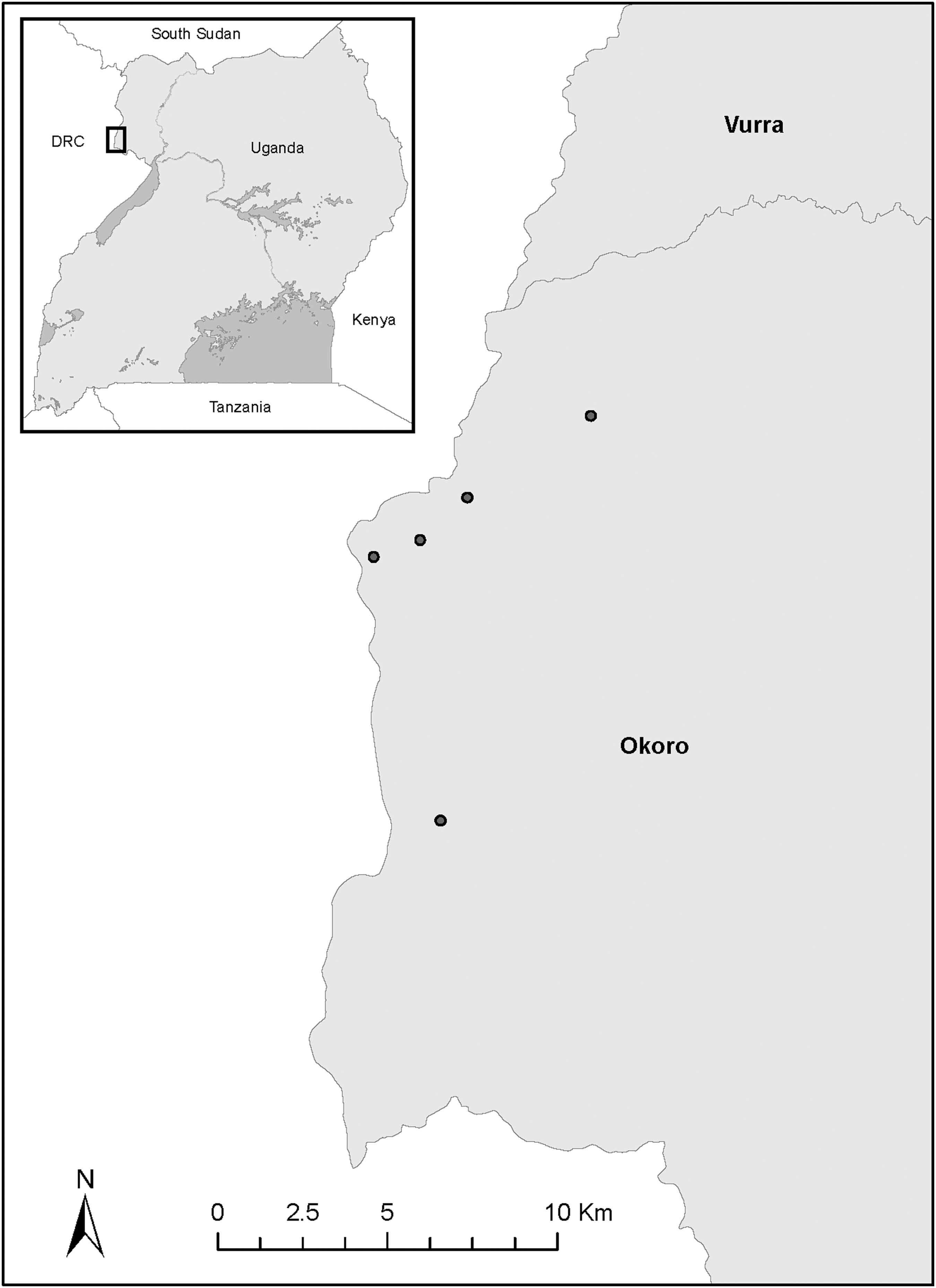
Locations of the five villages where trapping was undertaken within Okoro County in the West Nile region of Uganda.
Target and buffer homesteads
We selected a total of 32 target homesteads to participate in the study; for 18 of these homesteads (56%) buffer homesteads were also enrolled in the study. Target homesteads were selected based on the following criteria: (1) they were comprised of 3–7 huts, (2) consent was granted from the head of household to participate in the study, (3) they were situated at least 100 m from other participating target homesteads, and for target homesteads with buffers, and (4) all heads of households from neighboring households contained within the buffer zone agreed to participate.
Buffer homesteads were those situated within 50 m of target homesteads. If any hut within a homestead was within 50 m of a target homestead, all huts within that homestead were included in the buffer. Buffer homesteads were enrolled regardless of the number of huts within the household.
The purpose of sampling with and without buffers was to determine if rodent removal was as effective when a single household practiced rodent control compared with a focal homestead surrounded by neighbors who also employed the same rodent control strategies (i.e., intensive lethal trapping). That is, we wanted to evaluate whether or not it took longer to control rodents, or if rodents returned to preintervention abundance sooner, if neighboring homesteads were not contributing to rodent control efforts. All huts within the target homesteads were included in the pretreatment abundance sampling, removal, and recovery phases (described in the next subsections). By contrast, huts in buffer homesteads were included only in the pretreatment abundance sampling and removal phases.
Pretreatment abundance sampling
To assess rodent abundance before removal trapping, live trapping was conducted in groups of 2–9 target homesteads (and buffer homesteads, when applicable) during five sessions between February 2014 and May 2015. Each trapping session focused on homesteads within a single village; five villages were sampled across five trapping sessions with each trapping session focusing on a single village. Inside each hut of the target or buffer homesteads, two Tomahawk (model TLT102, Tomahawk Live Trap Company, Tomahawk, WI) and two Sherman (model 3310A, H.B. Sherman Trap Company, Tallahassee, FL) traps were placed along the top edge of exterior walls (henceforth referred to as the wall plate). In this region, huts are typically constructed of mud and wattle with grass thatched roofs, and are either round or square with an average area of 13–14 m2. Rodents frequently traverse the wall plate, as evidenced by grease markings, droppings, and previous trapping efforts (Boegler et al. 2014). These were also ideal trapping locations because they were out of reach of children and thereby reduced the likelihood of injury.
In an effort to increase capture success, traps were baited with peanut butter, dried fish and sweet potato, and locked in an open position for two nights before the commencement of trapping. Immediately following two nights of prebaiting, traps were made operational and set for two consecutive nights and checked each morning for captures. Upon capture, rodents were anesthetized, weighed, measured, identified to species and ear-tagged with a unique identification number, then released at the site of capture. These and all other animal procedures followed approved protocols (Centers for Disease Control and Prevention Division of Vector-Borne Diseases Animal Care and Use Protocol # 12–025 and # 15–010, Uganda Virus Research Institute Science and Ethics Committee).
The total number of rodents collected within the target homestead was considered the pretreatment abundance. To account for differences in trapping effort among homesteads with variable numbers of huts and accounting for traps that were closed but failed to capture animals, abundance (number of captures) was scaled per 100 trap nights.
Removal trapping
In an effort to remove rodents from target homesteads, rodents were live trapped and humanely euthanized upon capture. After two nights of pretreatment abundance trapping (described above), Sherman and Tomahawk traps (two each per hut) were rebaited as needed, and reset each evening in target and buffer huts until two consecutive nights of trapping yielded zero captures within the target homestead. Live traps were then removed and replaced with lethal snap traps (Victor snap traps; Woodstream Corporation, Lititz, PA). The purpose of the snap trap was to determine if rodents were still present, but not attracted to the live traps. In total, four snap traps, each baited as before, were placed upon the wall plate in each hut within the target and buffer homesteads. Each morning, rodent carcasses were collected and identified to species.
Recovery sampling
Live trapping with replacement was conducted following the methods used for the pretreatment abundance sampling to determine how long it took for rodent abundance to return to pretreatment levels. As a separate measure, we assessed how long it took until a single rodent was captured. Recovery live trapping commenced 7 days after removal was achieved, then repeated 2 weeks postremoval, and every 4 weeks up to 28 weeks postremoval. If pretreatment abundance was matched or exceeded in any two-night trapping session, further trapping efforts were suspended and the homestead was considered recovered to pretreatment abundance. If pretreatment abundance was not achieved or exceeded by 28 weeks postremoval, we considered recovery to have been unsuccessful.
Statistical analyses
Kruskal–Wallis tests were used to compare rodent abundances among trapping sessions. Wilcoxon signed-rank tests were used to compare rodent abundances between target and buffer homesteads. Contingency table analysis was used to determine if recovery to pretreatment abundance differed between target homesteads with or without a buffer. All statistical analyses were performed in JMP Pro 13 (SAS Institute, Cary, NC).
Results
Summary of captures from all trapping sessions
From all 102 homesteads, a combined total of 1217 small mammals were captured during the pretreatment abundance, removal, and recovery trapping phases. Of these, 97% (n = 1177) were identified as Rattus rattus. Each of the other eight species captured comprised less than 1% of the sample. These included Aethomys kaiseri, Arvicanthis niloticus, Crocidura spp., Mastomys spp., Praomys jacksoni, Taterillus emini, Thamnomys spp. and Zelotomys hildegardeae. All species were combined during analysis, but largely represent captures of R. rattus.
Pretreatment abundance sampling
Within all 32 target homesteads, the median number of huts per homestead was 3 (range: 3–7 huts). During the pretreatment trapping session, trapping yielded 9.38 rodents per 100 trap nights (range: 4.17–25.00 rodents/100 trap nights). Rodent abundance (per 100 trap nights) within target homesteads was similar among the five trapping sessions and among villages (χ2 = 5.90, d.f. = 4, p = 0.21). Per homestead, over the 2-day trapping period we observed an average trap success of 10.7% (range: 4.2–25.0%).
Among the 18 target homesteads in which buffer homesteads were trapped, the median number of homesteads within the 50 m buffer was four (range 1–9 homesteads). Buffer homesteads had a median of two huts per homestead (range 1–7 huts per homestead). Trapping yielded a median of 10.5 rodents per 100 trap nights (range 0.00–17.86 rodents/100 trap nights) per buffer homestead. Excluding target homesteads, where buffers were not trapped, the median number of rodents trapped per 100 trap nights was similar between target and buffer homesteads (Wilcoxon signed-rank test, two-tailed, p = 0.09).
Removal trapping
Of 32 target homesteads, 31 (97.0%) required two trap types (live and snap traps) to achieve removal status. During the removal trapping session, live traps and lethal snap traps combined yielded a median of 7.57 rodents per 100 trap nights in all target homesteads (range 3.13–21.53 rodents per 100 trap nights). The median number of rodents collected from target homesteads with buffers by both trap types combined (7.41 rodents per 100 trap nights; range 3.13–21.53 rodents per 100 trap nights) was similar to target homesteads trapped without buffers (median: 8.10 rodents per 100 trap nights; range: 4.17–18.75 per 100 trap nights; Wilcoxon test χ2 = 0.46, d.f. = 1, p = 0.50). Of the 18 homesteads, where buffers were trapped, the median number of rodents trapped was similar between target and buffer homesteads (Wilcoxon signed-rank test, p = 0.82).
The total number of days to achieve removal status with both trap types was similar between target homesteads with or without buffers (Wilcoxon test χ2 = 1.27, d.f. = 1, p = 0.26). Combining all target homesteads, removal was achieved in a median of 6 days of trapping with two trap types (range: 0–16 days).
Recovery sampling
Of the 32 target homesteads, recovery to pretreatment abundance was achieved by 28 weeks for 22 (68.9%) homesteads; in all homesteads (100% of 34 homesteads), at least a single rodent was captured during the 28 weeks of recovery observation. The median number of weeks to capture at least one rodent during the recovery phase was 2 weeks (range 1–16 weeks). Looking at only the 22 homesteads that achieved recovery to pretreatment abundance, recovery was achieved at a median of 8 weeks (range 1–24 weeks). There were no significant differences between homesteads with or without buffers in whether or not pretrap recovery was achieved (χ2 = 1.12, d.f. = 1, p = 0.29) or in the number of weeks to achieve recovery (χ2 = 0.32, d.f. = 1, p = 0.517).
Discussion
Although labor intensive, rodent trapping may be an effective strategy for controlling rodents inside homes in subsistence farming communities in the West Nile region and in other similar settings. Employing an aggressive rodent removal strategy, which included placement of four traps per hut, we demonstrated removal of rodents from target homesteads in an average (median) of six nights of trapping. However, multiple trap types were required to achieve success and at least a single rodent was recovered from all homesteads, on average, 2 weeks after removal efforts were terminated. Recovery to pretrapping abundance levels was achieved in a majority of homesteads, typically within 8 weeks after removal efforts were terminated. We emphasize that this strategy is not recommended during active plague epizootics unless rodents and huts are first treated with insecticides to kill fleas. Lethal rodent control during plague epizootics in the absence of prior flea control increases the risk of human exposure to infectious fleas, which leave their dead or dying hosts to seek blood meals from new hosts, including humans (Gratz 1999).
Consistent with previous studies from the West Nile region, R. rattus was the most abundant hut-dwelling rodent, was broadly distributed among households, and its abundance inside homes did not change seasonally (Amatre et al. 2009, Eisen et al. 2013, 2014, Boegler et al. 2014, Moore et al. 2015). Notably, in our study, traps were placed on wall plates, whereas previous trapping efforts in this region generally placed traps at ground level; nonetheless, R. rattus was the predominant species captured and was observed at similar abundance per trap night regardless of trap placement. These ubiquitous rodents are recognized as pests within homes, where most households reported practicing some form of rodent control; the most favored control practices include use of poisons and trapping (Eisen et al. 2013, 2014).
Indomethacin, an inexpensive anti-inflammatory drug that is readily available from druggists in the West Nile region, was the most commonly used rodenticide. Although indomethacin has been shown to be lethal to R. rattus, effects are dose dependent (Forson et al. 2008). Likewise, lethal trapping, when practiced intensively and consistently, can effectively control rodents in human dwellings (Lien-Teh et al. 1936, Belmain et al. 2002, Taylor et al. 2012). Although residents of the West Nile region are engaging in practices that have been shown to control rodents, the observation that rodent abundance inside homes that reported practicing or not practicing rodent control was similar (Eisen et al. 2013), suggests that current implementation of those practices is inadequate to effectively control rodents. We did not assess the availability of rodent traps or types of traps used in the West Nile region. However, casual observation suggests that our trapping effort was much more labor intensive than is commonly practiced.
Because immigration of rodents from surrounding areas may be significant, widespread control is often recommended in agricultural and village settings (Stenseth and Hansson 1981, Gratz 1999). Encouragingly, we showed similar efficacy of trapping a single homestead compared with trapping multiple neighboring homesteads. This success is likely attributable to the narrow home range of R. rattus in this setting. A previous study from this region showed that two-thirds of recaptured rats were collected repeatedly from the same huts and those captured in a different hut were captured a median of only 17 m away from the initial site of capture (Boegler et al. 2014).
However, we showed that after seemingly eliminating rodents using live traps (i.e., traps yielding no rodents for two consecutive nights), at least one additional rodent was trapped in subsequent snap trapping in all but one homestead. These findings show that not all small mammals were captured with live traps. We did not address whether or not snap traps, if used alone, would have been more effective than using live traps followed by snap traps. Belmain et al. (2002) concluded that trap shyness was likely to have been rare when using break-back traps in rural farming communities in Mozambique.
Although rodent abundance inside of homes was similar among trapping sessions and between homesteads with or without trapped buffers, variation in rodent abundance among homesteads was considerable. We did not collect data that would have allowed us to determine if rodent abundance was related to the type or abundance of food stored in homes, condition or age of the housing structure, or prior rodent control practices which may have reduced rodent abundance or promoted trap shyness. A previous study from the West Nile region found no association between in-home rodent abundance and the frequency of changing thatched roof where R. rattus commonly nest, storing food or garbage in huts, cooking in huts where people also sleep, or dog ownership (Eisen et al. 2014). However, that study did not directly manipulate these potential control measures to determine if such practices could be effective if the frequency of practices was modified. Moreover, effects of an integrated pest management strategy have not been evaluated in this setting.
We showed that intensive rodent trapping, in the absence of other rodent control strategies (e.g., rodent-proofing structures, reducing or securing food stored in homes) was effective at reducing rodent abundance when trapping was conducted daily and multiple trap types were used. However, we did not evaluate the efficacy of intensive trapping over long durations of time. Clearly, when rodent trapping was suspended, homes were reinfested either through reproduction of remaining rodents that were not trapped, or through immigration. Use of an integrated rodent control approach may be required in this setting to significantly impact rodent abundance over a long duration of time (Mahdi et al. 1968, Barnes 1975, Gratz 1999, Makundi et al. 1999). While providing rodent-proof housing in this region may not be economically feasible, steps to reduce food stored in huts or use of rodent-proof food storage containers, is likely to complement rodent trapping efforts. Although our trapping scheme was likely much more intensive than is commonly practiced in this region, rodent traps are reasonably priced and can be reused and, therefore, may prove to be an economically feasible approach to controlling rodents inside dwellings, provided trapping is conducted regularly.
Conclusions
Persistent, intensive lethal trapping of rodents from huts within the West Nile region appears to be effective at reducing rodent abundance, but control is short lived after control practices are terminated. Rodent removal was achieved in a median of 6 days of trapping with two trap types (range: 0–16 days). However, rodent abundance in 68.9% of homesteads returned to pretreatment levels within a median of 8 weeks (range 1–24 weeks) after removal efforts were terminated. At least a single rodent was captured in all homesteads by a median of 2 weeks (range 1–24 weeks) after removal efforts were terminated. Rodent control by neighboring homesteads was not required for effective control in a target homestead. Additional studies are needed to address whether fewer traps and trap types could achieve similar results, or if pulsed, intensive trapping could be used in place of consistent daily trapping.
Footnotes
Acknowledgments
The authors thank the participating residents of the West Nile region for allowing us to trap rodents in their homes, and the Uganda Virus Research Institute field crew for their trapping efforts.
Author Disclosure Statement
The authors declare no conflicts of interest.