




Abstract
Japanese encephalitis virus (JEV) is a zoonotic mosquito-borne flavivirus endemic in the Asia–Pacific region. Maintenance of JEV in nature involves enzootic transmission by competent Culex mosquitoes among susceptible avian and swine species. Historically, JEV has been regarded as one of the most important arthropod-borne viruses in Southeast Asia. Oronasal shedding of JEV from infected amplification hosts was not recognized until the recent discovery of vector-free transmission of JEV among domestic pigs. In this study, oral shedding of JEV was characterized in domestic pigs and miniature swine representing the feral phenotype. A rope-based sampling method followed by the detection of viral RNA using RT-qPCR allowed the collection and detection of JEV in oral fluid samples collected from intradermally challenged animals. The results suggest that the shedding of JEV in oral fluid can be readily detected by molecular diagnostic assays at the acute phase of infection. It also demonstrates the feasibility of this technique for the diagnosis and surveillance of JEV in swine species.
Introduction
J
As expected of amplification hosts, experimental challenge of JEV in swine species normally leads to systemic infection, including viremia and a detectable viral load in the lymphatic system (Williams et al. 2001, Yamada et al. 2004, Ricklin et al. 2016a, Garcia-Nicolas et al. 2017). Although clinical symptoms are often mild, high viral load caused by the systemic infection allows the invasion of JEV into the central nervous system and multiple organs. In addition to transmission by competent mosquitoes, oronasal shedding of infectious viruses in pigs has the potential to become the source of infectious viruses, which could facilitate the spread of JEV to other immunologically naive pigs in the same herd. Although oronasal infection of JEV was originally demonstrated in laboratory animal models developed based on the incidental host species, the recent discovery of vector-free JEV transmission indicated that domestic pigs are also highly susceptible to JEV through oronasal exposure (Harrington et al. 1977, Raengsakulrach et al. 1999, Ricklin et al. 2016b, Garcia-Nicolas et al. 2017). The high susceptibility and low infectious dose required for the establishment of infection after exposure through the oronasal route suggest that vector-free transmission of JEV may be epidemiologically important and warrant further investigation of the shedding profile of JEV in infected swine species. In addition, this observation could enable the development of a noninvasive veterinary diagnostic method that targets the oronasal secretions.
Although the detection of viral RNA in oronasal swabs has demonstrated the presence of JEV in the nasal cavity of infected pigs, the use of oronasal swabs as a sampling method for the diagnosis and surveillance of JEV remains limited (Ricklin et al. 2016b). Collection of swabs is a laborious process and requires the restraining of individual animals (Zimmerman 2012). Such a low-throughput method precludes the sampling of oronasal shedding from large number of animals, especially in the event of abrupt dispersal of exotic swine diseases to immunologically naive populations. A well-accepted alternative method for the collection of samples for pathogen detection in pigs is the pen-based collection of oral fluid. As a noninvasive procedure with a higher efficiency in sampling large number of animals, the pen-based collection of oral fluid allows the simultaneous sampling of oronasal shedding from multiple animals and has been successfully applied for use in diagnosis and surveillance of several swine and zoonotic pathogens, including porcine reproductive and respiratory syndrome virus, classical swine fever virus, and influenza virus (Prickett et al. 2008, Detmer et al. 2011, Dietze et al. 2017).
In this study, the feasibility of using pen-based collection of oral fluid as a surveillance method for the presence of JEV is demonstrated using experimentally challenged white-line crossbreed domestic pigs and Sinclair™ miniature swine. Detection of JEV in oral fluid collected by this rope-based sampling method was achieved using three RT-qPCR assays targeting the highly conserved genomic region of the nonstructural protein 5 (NS5) gene and the 3′ untranslated region (UTR) (Pyke et al. 2004, Yang et al. 2004, Chao et al. 2007). Our results demonstrated the feasibility of using oral fluid samples for JEV surveillance and identified the appropriate primer sets for molecular diagnosis.
Materials and Methods
Cells and viruses
Aedes albopictus C6/36 cells and African green monkey kidney Vero 76 cells were maintained in Leibovitz's L-15 medium supplemented with 10% fetal bovine serum, 10% tryptose phosphate, penicillin, streptomycin, and
Animal experiment and collection of samples
All experimental procedures in this study were approved by the Institutional Animal Care and Use Committee and Institutional Biosafety Committee of Kansas State University, and conducted in biosafety level 3 agriculture and biosafety level 3 laboratories. Experimental challenges were performed with 3-week-old piglets of domestic pigs and miniature swine containing a feral genetic background. The white-line crossbreed domestic pigs represented the domestic swine population used in commercial production. The Sinclair miniature swine (Sinclair BioResources, Auxvasse, MO), originally developed by crossing feral breeds, was chosen for experimental challenge to represent feral swine, which have previously been shown to be susceptible to JEV in the endemic region (Nidaira et al. 2008).
Fourteen animals were used in each challenge experiment. To avoid the vector-free transmission of JEV through oronasal shedding, animals belonging to the challenge and control groups were housed in separate pens (Ricklin et al. 2016b). Ten animals were randomly assigned to the challenge group and intradermally challenged with 100 μL of inoculum containing ∼107 TCID50 of JEV JE-91 strain. Four animals received an equal volume of mock solution as a negative control. Five challenged animals and two control animals were euthanized at 3 days postinfection (dpi) for analyses of viral load, tropism, and histopathology at the acute phase of infection. The remaining animals were euthanized at 28 dpi to monitor the shedding and persistent infection of JEV. Oral fluid was collected at 0–14, 21, and 28 dpi by suspending a 1.25 cm in diameter twisted cotton rope in each pen as previously described (Jaing et al. 2015). Oral fluid was immediately aliquoted and stored at −80°C until tested. Samples were briefly centrifuged to remove debris followed by the extraction of viral RNA using QIAmp Viral RNA Mini Kit (Qiagen, Inc., Germantown, MD).
RT-qPCR
Three RT-qPCR assays were evaluated for the detection of JEV viral RNA in oral fluid (Pyke et al. 2001, Yang et al. 2004, Chao et al. 2007). Detection of viral genomes by RT-qPCR assays was chosen as a diagnostic method because of the proven difficulty in obtaining virus isolates from oral fluid samples and its capability for sensitive, specific, and rapid diagnosis (Romagosa et al. 2012). As summarized in Table 1, primers and probes in all three assays were designed to target the conserved sequences in the NS5 gene and 3′ UTR of the JEV genome. The amplification strategy of the first assay is based on the highly conserved region encoding the RNA-dependent RNA polymerase (RdRp) domain of the NS5 gene, which is flanked by the pan-flavivirus primer set FU1 and CFD2 (Kuno et al. 1998). The primer set in the second assay was designed to recognize the sequence of the thumb element in the carboxy terminus of the NS5 RdRp domain (Pyke et al. 2001, Lu and Gong 2013). The third primer set targets the sequences of the 5′ dumbbell region and the 3′ conserved sequence 1 in the 3′ UTR of the JEV genome (Proutski et al. 1997). All three assays were performed using Bio-Rad iTaq™ Universal Probes One-Step Kit and analyzed with the Bio-Rad CFX96 Real-time PCR Detection System (Bio-Rad Laboratories, Hercules, CA). Four microliters of RNA extract was used as a template in each 20 μL reaction. Reactions that led to quantification cycle (Cq) value less than 34 were considered positive for JEV detection.
Nucleotide positions are based on the genome of JEV SA14 strain.
JEV, Japanese encephalitis virus; NS5, nonstructural protein 5; UTR, untranslated region.
To determine the sensitivity of the three assays, RNA extracts derived from a stock with an infectious titer at 3.3 × 10⁷ TCID50/mL were serially diluted to construct the standard curves corresponding to the infectious titers. The lack of cross-reactivity among all three assays with other flaviviruses in the JEV serocomplex was demonstrated using synthetic RNA genomes of West Nile virus and St. Louis encephalitis virus (American Type Culture Collection, Manassas, VA).
Statistics
To determine the sensitivity of the RT-qPCR assays used in this study, the limit of detection of each RT-qPCR assay was determined by the simple linear regression model on the standard curves constructed by serially diluted RNA extract. Repeated measures t test was performed to compare the quantities of RNA genomes detected by the two qRT-PCR assays.
Results
Sensitivity and specificity of RT-qPCR assays
By serially diluting RNA extract from JEV cell culture medium containing an infectious titer of 3.3 × 10⁷ TCID50/mL, standard curves of the three assays were constructed as summarized in Figure 1. The limit of detection was calculated using the simple linear regression model and used to compare the sensitivity of individual assays based on the estimated infectious titers corresponding to the cutoff Cq value at 34. The RT-qPCR assay based on the FU1 and CDF2 primer set has the highest limit of detection at 43.3 TCID50/mL, indicating its lowest sensitivity among the three assays, whereas the second assay targeting the genomic region that encodes the thumb motif of the NS5 protein showed the highest sensitivity with the lowest limit of detection at 15.7 TCID50/mL. The lowest infectious titer detected by the third assay was 36.4 TCID50/mL. All three assays also showed no cross-reactivity with the synthetic RNA genomes of West Nile virus and St. Louis encephalitis virus: two related flaviviruses in the JEV serocomplex.
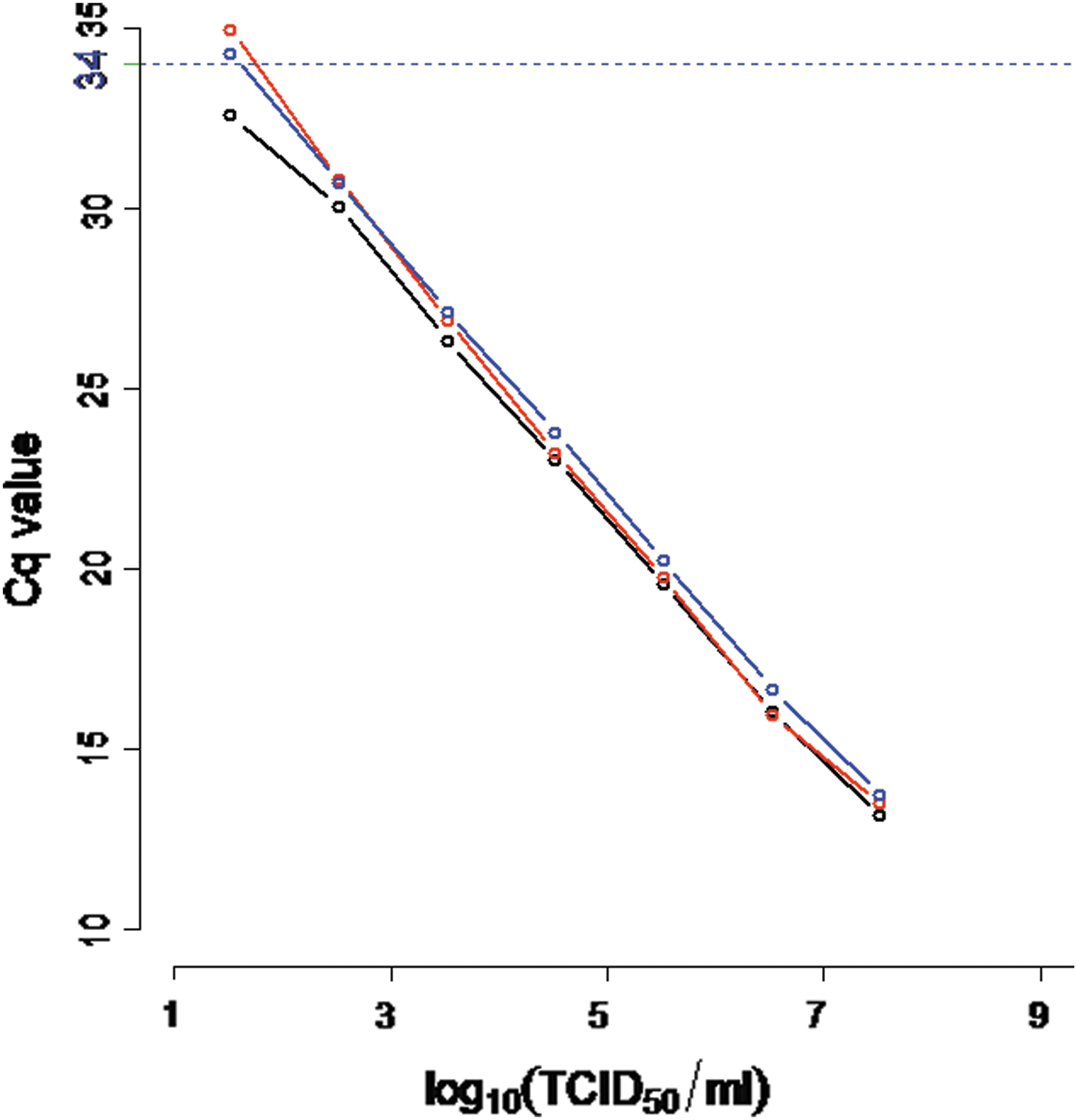
Standard curves and limit of detection of three qRT-PCR assays. Standard curves of the three qRT-PCR assays are shown in red (assay 1), black (assay 2), and blue (assay 3). Limit of detection was determined by the simple linear regression model at Cq value of 34. Cq, quantification cycle.
Detection of JEV viral RNA in oral fluid
To develop optimized protocols for the detection of JEV viral RNA in oral fluid, samples of oral fluid collected from intradermally challenged domestic pigs and Sinclair miniature swine at 0–14, 21, and 28 dpi were analyzed with the three RT-qPCR assays.
Among experimentally challenged domestic pigs, viral RNA of JEV in oral fluid was detected by two RT-qPCR assays targeting the sequences encoding the thumb motif of NS5 RdRp domain and the conserved sequences of the 3′ UTR. Although the second assay based on the primer set targeting the thumb motif of the NS5 RdRp domain consistently showed a higher level of viral load (p < 0.05) than the primer set recognizing the 3′ UTR, results from the two assays led to a similar profile of JEV viral load detected in oral fluid. As shown in Figure 2, the earliest detection of JEV genome by both assays occurred at 3 dpi followed by the peak of viral load exceeding 103 genome equivalent to TCID50/mL at 5 dpi. The presence of JEV in oral fluid was continuously observed for up to 2 weeks after infection. Despite the highly conserved sequences among JEV strains and other related members in the Flaviviridae family, JEV genomes were not detected using the RT-qPCR assay based on the pan-flavivirus FU1-CDF2 primer set, indicating its limited application to the detection of JEV in swine oral fluid samples.
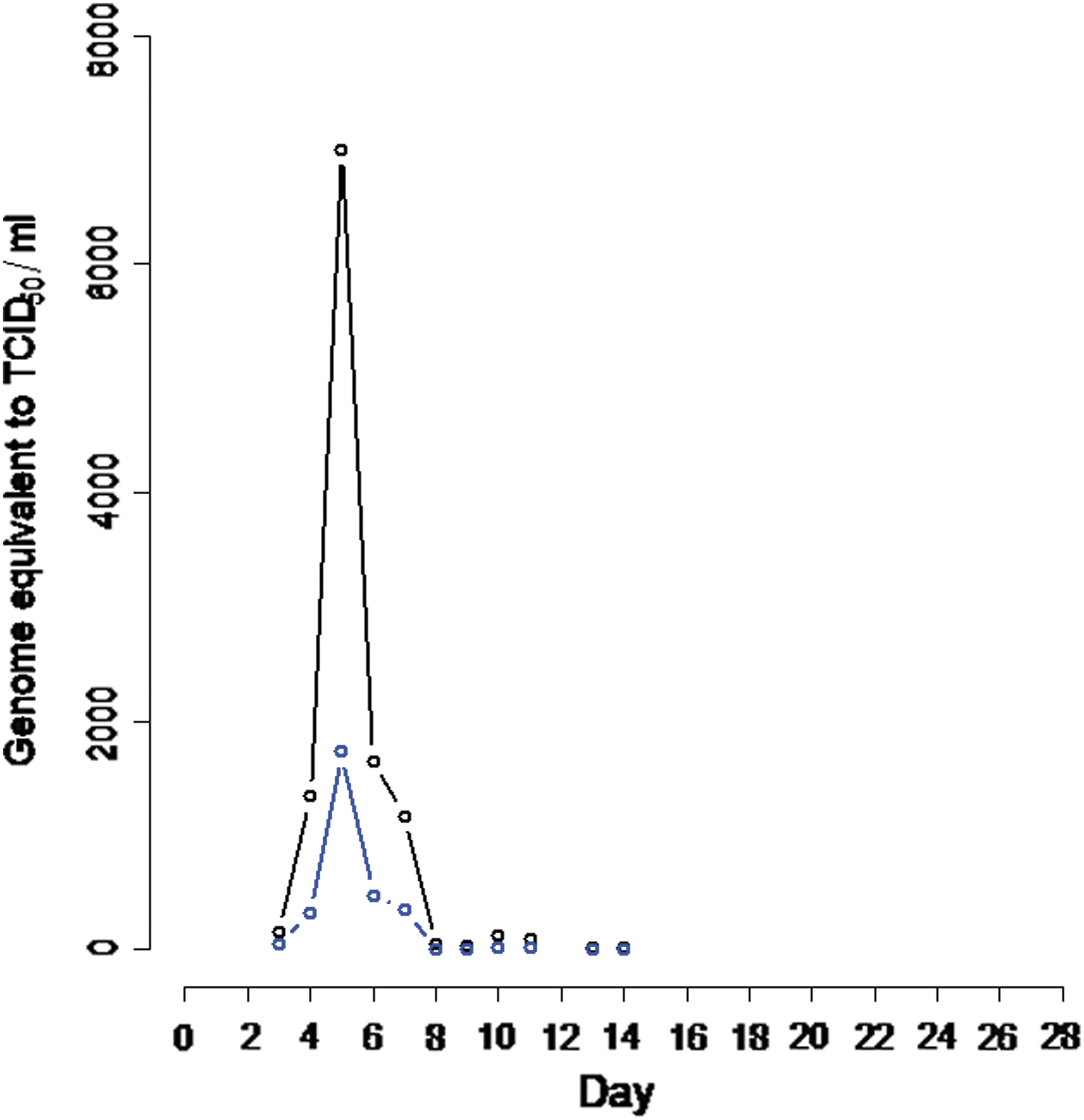
Detection of JEV genome in oral fluid collected from intradermally challenged domestic pigs between 0 and 28 dpi. Quantities of JEV genome detected by assay 2 and assay 3 are shown in black and blue, respectively. Only data collected from the samples containing detectable level of JEV genome (Cq value <34) are shown. dpi, days postinfection; JEV, Japanese encephalitis virus.
Similar to the observations of JEV shedding in oral fluid collected from domestic pigs, the establishment of JEV infection through intradermal challenge of Sinclair miniature swine led to the shedding of JEV in oral fluid detected by the two RT-qPCR assays that target the thumb motif of NS5 RdRp domain and the conserved sequences of the 3′ UTR (Fig. 3). Although the results from both of the assays suggested the peak of viral load in oral fluid that occurred at 5 dpi, the prolonged shedding of JEV was only detected by the primer set targeting the thumb motif of NS5 RdRP domain between 2 and 7 dpi. Presence of JEV genome was only detected between 4 and 6 dpi using the primer set based on the sequences of the 3′ UTR. Consistent with the results derived from the experimentally challenged domestic pigs, there was no detectable level of JEV genome in oral fluid based on the results of the RT-qPCR assay using the pan-flavivirus FU1-CDF2 primer set.
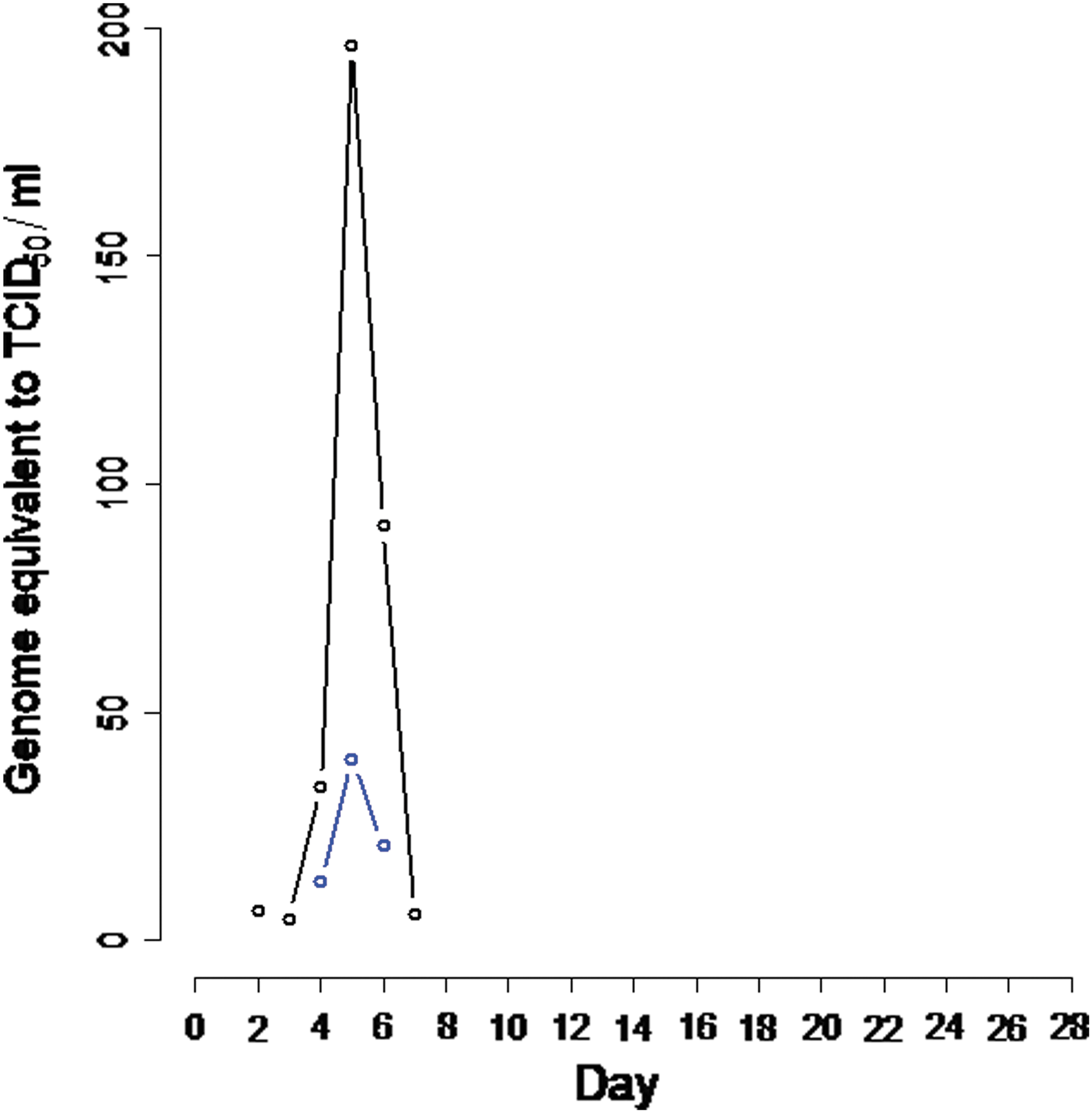
Detection of JEV genome in oral fluid collected from intradermally challenged Sinclair™ miniature swine between 0 and 28 dpi. Quantities of JEV genome detected by assay 2 and assay 3 are shown in black and blue, respectively. Only data collected from the samples containing detectable level of JEV genome (Cq value <34) are shown.
Discussion
In this study, we successfully demonstrated the feasibility of using oral fluid as a diagnostic sample for JEV infection in swine species. The rope-based collection of oral fluid provides a simple alternative to monitor the infection status of JEV in swine species without the collection of serum samples. The technique of oral fluid sampling is readily applicable to the existing surveillance systems of JEV as multiple countries in the endemic region have developed surveillance programs based on the detection of JEV in the serum of sentinel pigs (van-den-Hurk et al. 2008, Nitatpattana et al. 2011, Cappelle et al. 2016). The prolonged period of viral shedding in oral fluid provides the advantage of using oral fluid for surveillance of JEV in comparison with the shorter period that allows the detection of JEV in serum samples or oronasal swabs collected from domestic pigs challenged with the same quantity of JEV (Ricklin et al. 2016b). In addition to the increase in the throughput of sampling techniques used for JEV surveillance, the detection of JEV in oral fluid also indicates the potential of its application in veterinary diagnosis. To demonstrate the feasibility of JEV diagnosis using oral fluid samples, further studies on the profile of JEV shedding in individual infected animals will be needed.
This relatively simple procedure may also be applicable to future studies designed to delineate the role of feral swine in the transmission and maintenance of JEV in nature. Although neutralizing antibodies have been reported from a relatively small number of animals in the field (Nidaira et al. 2008, 2014), the evidence supporting that development of systemic infection and viremia during the acute phase of infection remains limited. Our results clearly indicated that miniature swine with genetic elements from feral swine can orally shed JEV following experimental infection. As an alternative to the collection of serum samples, detection of JEV in oral fluids from feral swine may be helpful in determining the incidence of acute infections among feral swine in nature.
The presence of JEV in oral fluid also has significant implications in the epidemiology of JEV. Although birds and pigs both develop systemic infection and viremia to sustain the transmission of JEV in nature, distinct profiles of oral shedding were observed. The prolonged period of oral shedding was observed among experimentally challenged swine species, whereas the presence of JEV in oral swabs collected from infected avian species was demonstrated to be transient and to vary among different species (Nemeth et al. 2012). Although it remains unclear whether similar routes of transmission can also contribute to the maintenance of JEV among susceptible avian species in the endemic region, the transmission of flaviviruses among avian species through oral shedding has previously been reported in several avian species challenged with West Nile virus and Bagaza virus (Komar et al. 2003, Llorente et al. 2015). Characterization of vector-free transmission of JEV and other zoonotic flaviviruses will substantially improve our understanding of mechanisms for viral maintenance in locations where the abundance of competent vectors may be insufficient to maintain transmission.
The observation of oral shedding in JEV-infected animals is also consistent with the recent findings of flavivirus pathogenesis in mammalian hosts. With very few exceptions such as the sexual transmission of Zika virus among primate species, transmissions of flaviviruses among mammalian hosts have been often described to be vector borne. The detection of flavivirus genomes in saliva and other body fluids highlights the need to better understand the dissemination of viruses in vertebrate hosts and its role in the development of severe or chronic forms of the clinical diseases (Murray et al. 2010, Barzon et al. 2016).
Footnotes
Acknowledgments
The authors would like to thank the technical assistance from the staff of the Biosecurity Research Institute and the Comparative Medicine Group personnel at Kansas State University College of Veterinary Medicine. The project was supported by the Swine Health Information Center project 16–258, the United States Department of Agriculture, Agricultural Research Service Cooperative Agreement 58-5430-4-021, and State of Kansas National Bio- and Agro-Defense Facility Transition Fund. This project is the result of funding provided to A.C.L. and V.B.A. by the Homeland Security Advanced Research Projects Agency of the United States Department of Homeland Security Science and Technology Directorate under contract number D15PC00276.
Author Disclosure Statement
S.H. is the Editor-in-Chief of Vector-Borne and Zoonotic Diseases. All other authors declare no conflicts of interest.