




Abstract
Lyme Borreliosis and granulocytic anaplasmosis are less extensively studied in horses than in dogs and humans. Equine ehrlichiosis is not known in Europe and is in the initial stage of investigation in South, Central, and North America. The aim of this study was to determine the seroprevalence of these infections in Bulgaria. A total of 155 horses were investigated from five regions in Southeastern Bulgaria. Horses were tested for Borrelia burgdorferi, Anaplasma phagocytophilum, and Ehrlichia spp. antibodies by a commercial rapid ELISA test. B. burgdorferi and A. phagocytophilum antibodies were found in all five regions (Burgas, Sliven, Stara Zagora, Haskovo, and Kardzhali) at frequencies of 36/155 (23.2%; 95% CI: 16.8–30.7%; ranging by region from 6.4% to 50%) and 31/155 (20%; 95% CI: 14–27.2%; ranging by region from 10% to 30.8%), respectively. Antibodies against Ehrlichia spp. were found in horses from three regions (Burgas, Stara Zagora, and Haskovo) at a rate of 6/155 (3.9%; 95% CI: 1.4–8.2%; ranging by region from 5.7% to 6.4%). The combination of B. burgdorferi/A. phagocytophilum (11/155; 7.1%; 95% CI: 3.6–12.3%) was the most common coexposure observed, followed by B. burgdorferi/Ehrlichia spp. (2/155; 1.3%; 95% CI: 0.2–4.6%) and A. phagocytophilum/Ehrlichia spp. (1/155; 0.6%; 95% CI: 0–3.5%). The study shows that horses in Bulgaria are exposed or coexposed to three tick-transmitted zoonotic bacterial species. Furthermore, it reports Ehrlichia spp. seroreactivity in equines in Europe.
Introduction
T
Equine exposure to Borrelia burgdorferi is widely documented in several European countries—The Slovak Republic (47.8%), The Netherlands (45%), Poland (25.6%), France (31/48%), and Denmark (29.0%) (Stefancikova et al. 2000, 2008, Hansen et al. 2010, Maurizi et al. 2010, Butler et al. 2016b). Moderate frequencies are established in Germany (16.1%), Sweden (16.8%), Italy (24.3%, 7.0%, 15.3%), and Romania (11.92%) (Kasbohrer and Schonberg 1990, Egenvall et al. 2001, Kiss et al. 2011, Ebani et al. 2012, Veronesi et al. 2012, Laus et al. 2013). In comparison, the seroprevalence in Turkey is lower (6%), whereas frequencies reported in the United States have varied widely among three studies (0.2%, 58.7%, 84.0%) (Cohen et al. 1992, Fritz and Kjemtrup 2003, Magnarelli and Fikrig 2005, Bhide et al. 2008, Durrani et al. 2011). Differences in serological data could be due to different frequency of vector tick exposures and potential differences in serological assays used for screening purposes.
Numerous studies in horses worldwide have shown that the seroprevalence of Anaplasma phagocytophilum varied within a broad range—–from 0% in Israel to 73% in the Czech Republic (Levi et al. 2006, Praskova et al. 2011). In Europe, there are reports on its occurrence in Spain (6.52%), The Netherlands (9.8%, 23%), Sweden (16.7%), France (11.3%), Denmark (22.3%), and Italy (17.03%) (Egenvall et al. 2001, Leblond et al. 2005, Amusategui et al. 2006, Butler et al. 2008, 2016b, Hansen et al. 2010, Passamonti et al. 2010). An evidence of A. phagocytophilum exposure has also been encountered in Guatemala (13%) and the United States (3.8/17.6%, 3.1/10.4%, 50–93%) (Madigan et al. 1990, Magnarelli et al. 1999, Bullock et al. 2000, Teglas et al. 2005).
Until 2015, there are few published reports on Ehrlichia species exposure or infection in horses. One study from Brazil provides evidence for antibodies against Ehrlichia with different prevalences depending on the assay used: 10/16 (62.5%) horses were positive in ELISA (SNAP® 4Dx® Test); while 8/16 (50.0%) and 10/16 (62.5%) horses were positive by immunofluorescence assays (IFAs) based on Ehrlichia canis and Ehrlichia chaffeensis antigen, respectively (Vieira et al. 2013). Another report from the United States, based on a serological survey of horses from Oklahoma, found antibodies in 8.75% (21/240) of randomly selected samples and in 24.7% (18/73) of samples from tick-infested horses (Carmichael et al. 2014). In this study, horses were either positive by ELISA (SNAP 4Dx Test) and/or E. chaffeensis antigen-based IFA. Furthermore, a subset of these samples failed to react with a specific E. canis peptide (p16) and only two reacted with an E. chaffeensis-specific VLPT peptide. All 73 blood samples from tick-infested horses were negative in PCR assays for E. canis/chaffeensis/ewingii (16S rRNA gene) and Panola Mountain Ehrlichia (PME) PCR based on the gltA gene. In 2015 Ehrlichia spp. DNA from four Ehrlichia seropositive horses from Merida, Nicaragua was amplified (O'Nion et al. 2015) and sequence analysis of the 16S rDNA (four samples) as well as sodB and groEL genes (each on three samples) suggested a novel Ehrlichia species. The study from Nicaragua showed antibodies in 51 of 92 examined equine samples (55%) based on ELISA (SNAP 4Dx Plus Test), with only the above mentioned four samples containing DNA from Ehrlichia. A second report from Brazil proved the existence of Ehrlichia spp. antibodies in 64/190 sampled horses (33.7%), most of them (52/64; 81.2%) being positive by ELISA (SNAP 4Dx Test) (Vieira et al. 2016). Additional investigation of Ehrlichia spp. antibodies within this same cohort by IFA revealed E. chaffeensis and E. canis antibodies in 38 (20.0%) and 37 (19.5%) horses, respectively. One blood sample that also showed E. chaffeensis antibodies, was PCR positive for the 16S rRNA and dsb genes of Ehrlichia spp., showing an identity of >98% to an uncultured Ehrlichia species previously detected in Brazilian jaguars (Panthera onca). Recent article points toward that the novel Ehrlichia species found in horses in Nicaragua and Brazil are potentially the same species (Vieira et al. 2018).
The aim of the present study was to report the seroprevalence of antibodies to B. burgdorferi, A. phagocytophilum, and Ehrlichia spp. among horses in Bulgaria. This study also represents that horses within Europe have a serological evidence of Ehrlichia spp. exposure.
Materials and Methods
Area and draft horses
Draft male and female horses (n = 155) were enrolled from five southeastern regions of Bulgaria–Burgas, Sliven, Stara Zagora, Haskovo, and Kardzhali (Fig. 1). Animals showed no clinical signs at sampling time point (summer of 2016), and they were aged from 1 to 15 years. Although the majority of horses showed tick infestation at time point of sampling, tick number calculation as well as tick removal, identification, and tests for pathogens were not part of the study. The regions are located among plains and forests (∼41°14′N and 42°38′N Latitude, 25°37′E and 28°36′E Longitude), and the climate is subtropical/continental (average annual temperature 11–13°C, precipitations about 600 mm/m2).
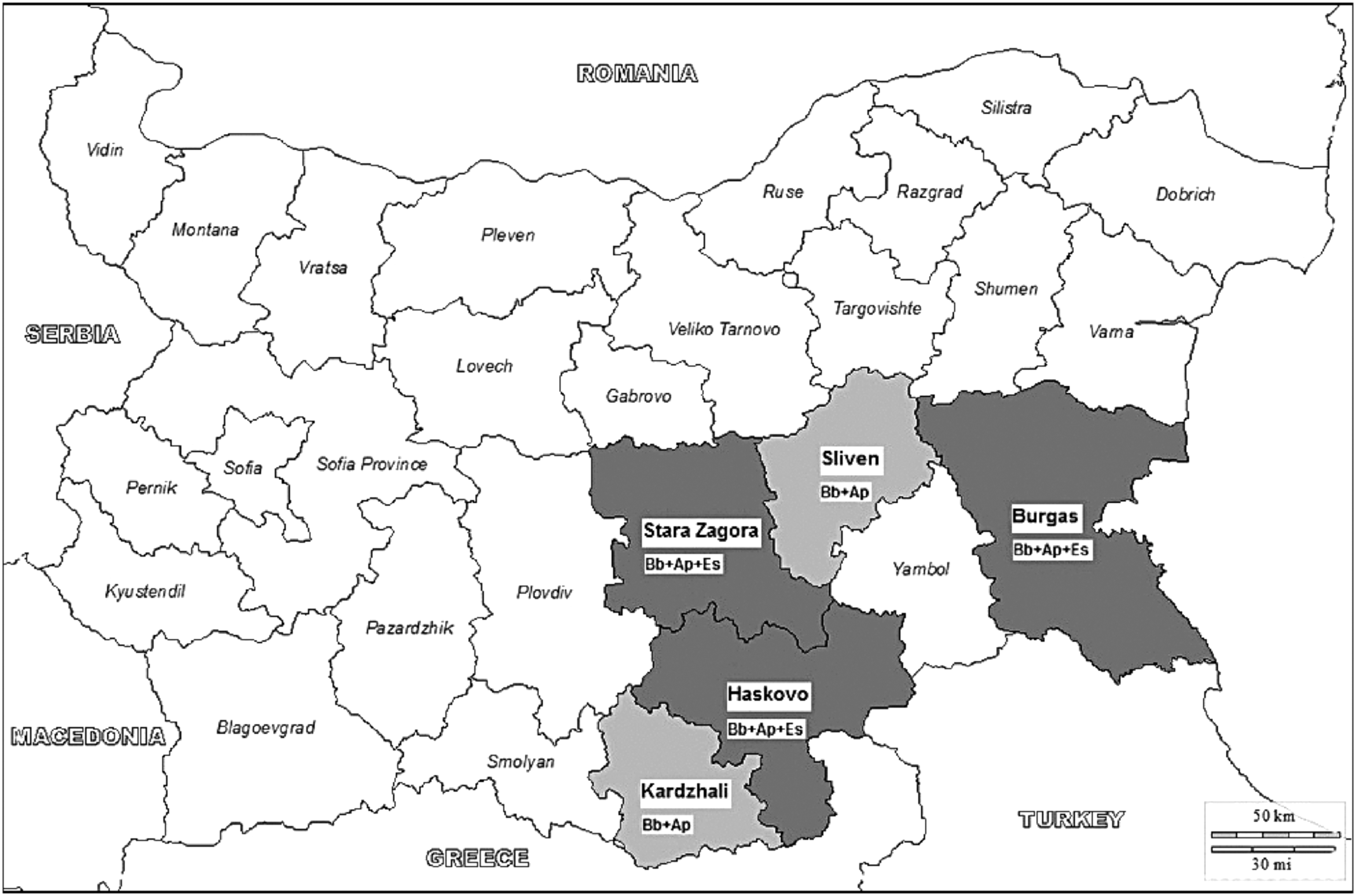
Geographic distribution of equine tick-borne pathogens in Southeastern Bulgaria. Ap, Anaplasma phagocytophilum; Bb, Borrelia burgdorferi; Es, Ehrlichia spp.
Sampling
Venous blood from the jugular vein was obtained with a vacutainer tube. The samples were incubated for 2 h at room temperature and the sera were separated by centrifugation (1500 g) for 10 min. The sera were stored at −20°C until test performance.
Detection of antibodies
Serum samples were tested for B. burgdorferi (s.l.), A. phagocytophilum, Ehrlichia spp. antibodies using a commercial ELISA rapid test (SNAP 4Dx Plus Test; IDEXX Laboratories, Inc., Westbrook, ME). Similar to the earlier generation device (SNAP 4Dx Test), this in-clinic test detects specific antibodies to A. phagocytophilum/A. platys (peptide from the major surface protein p44/MSP2). In contrast to the whole-cell antigen present on A. phagocytophilum IFA slides, no genus level cross-reaction between Anaplasma and Ehrlichia is observed within this device based on the utilization of specific peptides (Diniz and Breitschwerdt 2012, Harrus et al. 2012). The device additionally detects antibodies to E. ewingii (peptide derived from p28 outer surface protein family) (Stillman et al. 2014). The SNAP 4Dx Plus Test is licensed for dogs. As an all-species-conjugate is used in the kit, it is not species-specific in terms of animal species tested, and has also been validated for feline (Pantchev et al. 2016) and equine sera (Chandrashekar et al. 2008). The latter study compared the test performance in regard to A. phagocytophilum against IFA and to Lyme western blot assay, and found a sensitivity and specificity of 100% in regard to Anaplasma and 100% and 95% in regard to Borrelia. Furthermore, Wagner et al. compared the test in regard to Borrelia against multiplex analysis of antibodies to OspC, OspF, and C6 peptides in 191 equine sera and found a sensitivity of 93% and a specificity of 96% (Wagner et al. 2013). A European study concluded that the utilized test system detects antibodies to different B. burgdorferi genospecies in horses (e.g., B. valaisiana and B. afzelii), and to be even more sensitive than a whole-cell-based ELISA (Butler et al. 2016b). Latter study also found a comparable sensitivity to A. phagocytophilum IFA in terms of sensitivity.
Ethics statement
The laboratory and diagnostic procedures of this study were approved by the Local Ethics Committee of Trakia University, Stara Zagora, Bulgaria (University Campus, 6000 Stara Zagora). Written informed consent was taken from the horses' owners.
Statistical analysis
Data for the seroprevalence were compared among the different regions by chi-square and unpaired F (Kruskal—Wallis) tests. Statistical analysis was performed by Excel 2007 (Microsoft, Redmond, WA) and SPSS Statistics 19.0 (IBM Corp., Armonk, NY). A p value <0.05 was considered statistically significant.
Results
In all five southeastern Bulgarian regions represented in the study (Table 1)—Burgas, Sliven, Stara Zagora, Haskovo, and Kardzhali—antibodies against B. burgdorferi were detected in 36/155 horses (23.2%; 95% CI: 16.8–30.7%). The seroprevalence ranged between regions from 6.4% to 50%. Antibodies against A. phagocytophilum were found in all five regions in 31/155 horses (20%; 95% CI: 14–27.2%) with seroprevalence varying between regions from 10% to 30.8%. In three out of the five regions—Burgas, Stara Zagora, and Haskovo—antibodies against Ehrlichia spp. were detected in 6/155 (3.9%; 95% CI: 1.4–8.2%) of the horses, spanning a 5.7–6.4% range between the regions. One case of A. phagocytophilum/Ehrlichia spp. (0.6%; 95% CI: 0–3.5%) and two cases of B. burgdorferi/Ehrlichia spp. (1.3%; 95% CI: 0.2–4.6%) coexposure were found, while samples with simultaneous detection of antibodies against B. burgdorferi and A. phagocytophilum were most common (11/155; 7.1%; 95% CI: 3.6–12.3%).
NA, not applicable.
Discussion
In Bulgaria, tick-borne infections by B. burgdorferi, A. phagocytophilum, and E. canis have been detected and are well-studied in dogs from Southern and Northern Bulgaria (Tsachev 2006a, 2009, Tsachev et al. 2006b, 2006c, 2008a, 2008b). In humans, granulocytic anaplasmosis and Lyme borreliosis are of concern in the southern regions of the country (Christova and Dumler 1999, Christova and Komitova 2004, Pishmisheva et al. 2017), but high seroprevalence of B. burgdorferi in horses was found in all five studied regions in the present study. This might be related to different tick exposure and infestation of horses in contrast to humans in different regions. The established seropositive rate for B. burgdorferi (23.2%) was similar to the average seroprevalence found in a similar study with the same technology in Denmark (29%; Hansen et al. 2010), and lower compared to a similar study performed with same technology in The Netherlands (45%; Butler et al. 2016b).
The seropositive rates to A. phagocytophilum in the present study place Bulgaria in the group of most affected countries, for example, similar to the seroprevalence of 23% found in The Netherlands (Butler et al. 2016b). It is known that the common vector of B. burgdorferi and A. phagocytophilum infections in Bulgaria is the tick Ixodes ricinus. B. burgdorferi was detected in 22.3% and A. phagocytophilum in 8.4% of Bulgarian ticks (Christova et al. 2001). A study from The Netherlands found that out of 130 ticks collected from 56 horses in 2008–2009, 126 belonged to genus Ixodes, apart from 2 Dermacentor reticulatus and 2 Hyalomma marginatum ticks (Butler et al. 2016a). Eleven horses showed a simultaneous presence of antibodies against Borrelia C6 antigen and Anaplasma p44 peptide in the present study. It is comparable to results achieved in The Netherlands with a similar test system (6.4%; Butler et al. 2016b). It is known that mixed infection with Lyme borreliosis and A. phagocytophilum increases the potential of a dog to develop clinical signs, in contrast to infections with a single agent (Beall et al. 2008). For example, in a previous study seven horses with seroconversion to Borrelia antigen, only one animal showed clinical signs compatible with borreliosis or anaplasmosis (Butler et al. 2016b). The authors discussed a low prevalence of B. burgdorferi sensu stricto in ticks from the same area (2%; Butler et al. 2016a). Whether a coexposure to both pathogens would also exaggerate clinical signs in horses needs further investigation.
Although seropositivity to Ehrlichia spp. is widely prevalent among dogs in Bulgaria (Tsachev 2006a, Pantchev et al. 2015), and there is at least one microscopically confirmed case of canine monocytic ehrlichiosis published (Tsachev et al. 2008a), the detection of 3.9% Ehrlichia spp. antibodies in studied horses was intriguing. The established seroprevalence was lower than in Brazil, Nicaragua, and the United States (Vieira et al. 2013, 2016, Carmichael et al. 2014, O'Nion et al. 2015). However, Ehrlichia spp. antibodies were not found in studies using the same commercial ELISA to survey horses from Denmark, France, French Guyana, and Africa (Maurizi et al. 2009, 2010, Hansen et al. 2010).
To date, six Ehrlichia species are recognized worldwide: E. canis, E. chaffeensis, E. ewingii, E. muris, E. ruminantium and E. mineirensis (Rar and Golovljova 2011, Cabezas-Cruz et al. 2015). Other species identified molecularly in dogs in North America are PME (Qurollo et al. 2013) and E. muris (Hegarty et al. 2012). In the present study, the serological cross-reactions between Ehrlichia species by the ELISA test used and the lack of molecular diagnostic data do not allow for the identification of the involved Ehrlichia species. Although equids are not known hosts for E. chaffeensis, bacterial DNA has been amplified from ticks (Dermacentor nitens, 2.6%, and Amblyomma cajennense, 8.8%) collected from horses in Panama (Bermudez et al. 2009). It appears unlikely that E. chaffeensis was the cause for positive reaction in the present study as these tick species are not present in Bulgaria. In contrast, potential vectors for E. muris are widespread (e.g., Ixodes spp.), and a serological cross-reactivity of mice sera to E. canis and E. chaffeensis antigens was proposed (Wen et al. 1995). E. muris was detected molecularly in a naturally infected dog in the United States (Hegarty et al. 2012), although no serologic reaction was found by ELISA (SNAP 4Dx Test) and E. canis-based IFA. The lack of antibodies in the E. muris dog reported by Hegarty et al. (2012) may have been related to blood being collected during the very early stages of illness onset, before seroconversion, which could have been suppressed by administration of tetracycline antibiotics. Furthermore, E. muris strain AS145T (isolated from a spleen of a mouse) did not establish an infection in experimentally infected dogs, as determined by IFA test results obtained with the sera, among others (Wen et al. 1995). E. muris infections in horses are unproven to date, and no DNA could be detected in ticks collected from horses (Butler et al. 2016a). Although the test utilized in the present study would be expected to detect E. muris antibodies and the respective tick vector that would be present in Bulgaria, it is likely that the seropositivity to Ehrlichia spp. was due to a novel Ehrlichia species. In the above-mentioned study from The Netherlands, another agent could be detected in 11% of ticks collected from horses (“Ehrlichia schotti”/currently named Candidatus Neoehrlichia mikurensis; Butler et al. 2016a). To date, no published reports are available that this agent is able to infect horses (Silaghi et al. 2016), and one infected dog in Germany showed no serological reaction to E. canis by means of IFA (Diniz et al. 2011).
Neorickettsia risticii (formerly Ehrlichia risticii) is the etiologic agent of equine monocytic ehrlichiosis. It is not transmitted by ticks, and confirmed cases (isolation or PCR) are not known from Europe. In dogs, cats, and horses few seropositive animals for N. risticii were found, although they are believed to be cross-reactions within the performed whole-cell-based IFA tests (van der Kolk et al. 1991, Ayllon et al. 2012). Moreover, N. risticii do not induce antibodies that react to the p30 protein (Carmichael et al. 2014), which is the base of the test in the present study. Altogether, results in Nicaragua and Brazil point to a novel Ehrlichia species infecting horses (O'Nion et al. 2015, Vieira et al. 2016). The four isolates from Nicaragua showed a maximum sequence similarity of 96.5% (16S rRNA gene) to established Ehrlichia species, which is below the identity threshold of 97–99.5% needed to define a species (O'Nion et al. 2015). Further PCR research on equine blood samples from Bulgaria as well as detection in specified ticks collected from horses should be performed to address this question. Moreover, further research is necessary to evaluate the role of Ehrlichia as a potential cause of illness in horses.
Conclusions
B. burgdorferi, A. phagocytophilum, Ehrlichia spp. antibodies and A. phagocytophilum/Ehrlichia spp., B. burgdorferi/Ehrlichia spp., and B. burgdorferi/A. phagocytophilum coexposure were found in horses from Southeastern Bulgaria. Whether a coexposure to pathogens would also exaggerate clinical signs in horses needs further investigation. The report presents the natural exposure to these bacteria in horses in Bulgaria and therefore the detection of antibodies to Ehrlichia spp. in horses in Europe.
Footnotes
Acknowledgments
This study was funded by the Trakia University, 6000 Stara Zagora, Bulgaria (grant no. SP 10/2016).
Authors' Contributions
I.T.—study design, data collection, statistical analysis, data interpretation, article preparation, literature search, funds collection; N.P.—study design, statistical analysis, data interpretation, article preparation, literature search; P.M.—data collection, funds collection; V.P.—data collection, funds collection; D.G.—funds collection; M.B.—study design, data interpretation, article preparation, literature search. All authors read and approved the final version of the article.
Author Disclosure Statement
No competing financial interests exist.