




Abstract
Background:
Sickle cell disease (SCD) is the most prevalent hematologic genetic disorder. Acute vaso-occlusive painful crisis is the hallmark of the disease and may be related to subclinical infections. Bartonellosis, a rare and neglected infection, is caused by Bartonella spp., which can be found in donated blood. These bacteria cause intraerythrocytic and endothelial infection and pain, all of which occur in SCD. It is likely that this infection is transmitted to SCD patients during transfusion from donated blood, leading to pain. We, therefore, evaluated whether Bartonella henselae infection would cause hyperalgesia in mice with SCD.
Materials and Methods:
SCD mice were generated by transplantation of nucleated bone marrow cells harvested from transgenic Berkeley sickle mice into 2-month-old irradiated C57BL/6 mice. We infected four SCD mice by intraperitoneal inoculation with B. henselae, and inoculated four other mice with the same volume of saline. Mechanical hyperalgesia was determined using von Frey monofilaments by two blinded observers. Thereafter, the animals were anesthetized and euthanized to collect blood, liver, and spleen samples to seek B. henselae infection by PCR.
Findings:
We confirmed the experimental infection in all animals by PCR. Tremors and mechanical hypersensitivity were demonstrated by SCD mice infected with B. henselae infection but not in those receiving saline.
Conclusion:
B. henselae infection may be related to pain and other symptoms in SCD.
Introduction
S
Among the unusual bacterial infections, Bartonella spp. are emergent and neglected bacteria of worldwide distribution (Kaiser et al. 2011). They are gram-negative and facultative intracellular bacteria (Gutiérrez et al. 2017). The bartonellosis is a vector-borne disease and is potentially fatal, especially in immunodeficient patients (Kaiser et al. 2011). Our group found that 3.2% blood donors in Campinas, Brazil, have asymptomatic bloodstream infection due to Bartonella spp. (Pitassi et al. 2015) and that Bartonella henselae can survive long storage periods in blood bags (Magalhães et al. 2008). Because of bartonella's fastidious nature, these bacteria are extremely difficult to isolate and their laboratory diagnosis remains challenging (Pitassi et al. 2015). Bartonella infection in humans is associated with exposure to animals including cats and dogs. Poor socioeconomic environment of many patients affected with SCD may further predispose them to infection through animals and their ectoparasites (Diniz et al. 2016). Therefore, in this study, we examined whether B. henselae infection in SCD mice leads to hyperalgesia.
Materials and Methods
These experimental procedures were carried out in accordance with the Principles of Laboratory Animal Care®, following approvals by the Institutional Animal Care and Use Committee of the University of Campinas (CEUA/UNICAMP, protocol 2848-1). Eight male chimeric SCD C57BL/6 mice were generated by transplantation of nucleated bone marrow cells. The cells were harvested from Berkeley SCD mice and transplanted to 2-month-old irradiated C57BL/6 mice. The chimeric mice expressed >97% human globin, after 3 to 5 months. These eight animals were obtained, as previously described (Almeida et al. 2012). They have medium body weight of 23 g and were divided randomly and maintained in ventilated isolator cages with filter top, in a 12-h light/12-h dark cycle, and food and water were available ad libitum.
The experimental design procedures performed are presented in Figure 1A. SCD C57BL/6 mice were infected by intraperitoneal inoculation of 30 μL of a suspension with 104 colony forming units (CFU)/mL B. henselae (Houston 1, ATCC 49882T; American Type Culture Collection, Rockville, MD) in sterile saline. For the control group, four mice were inoculated with the same volume of sterile saline. Clinical status was observed twice a day by two independent observers. Four days after inoculation, all animals were examined for mechanical hyperalgesia. The animals were then euthanized with thiopental. Whole blood, liver, and spleen samples were collected to perform B. henselae infection screening.
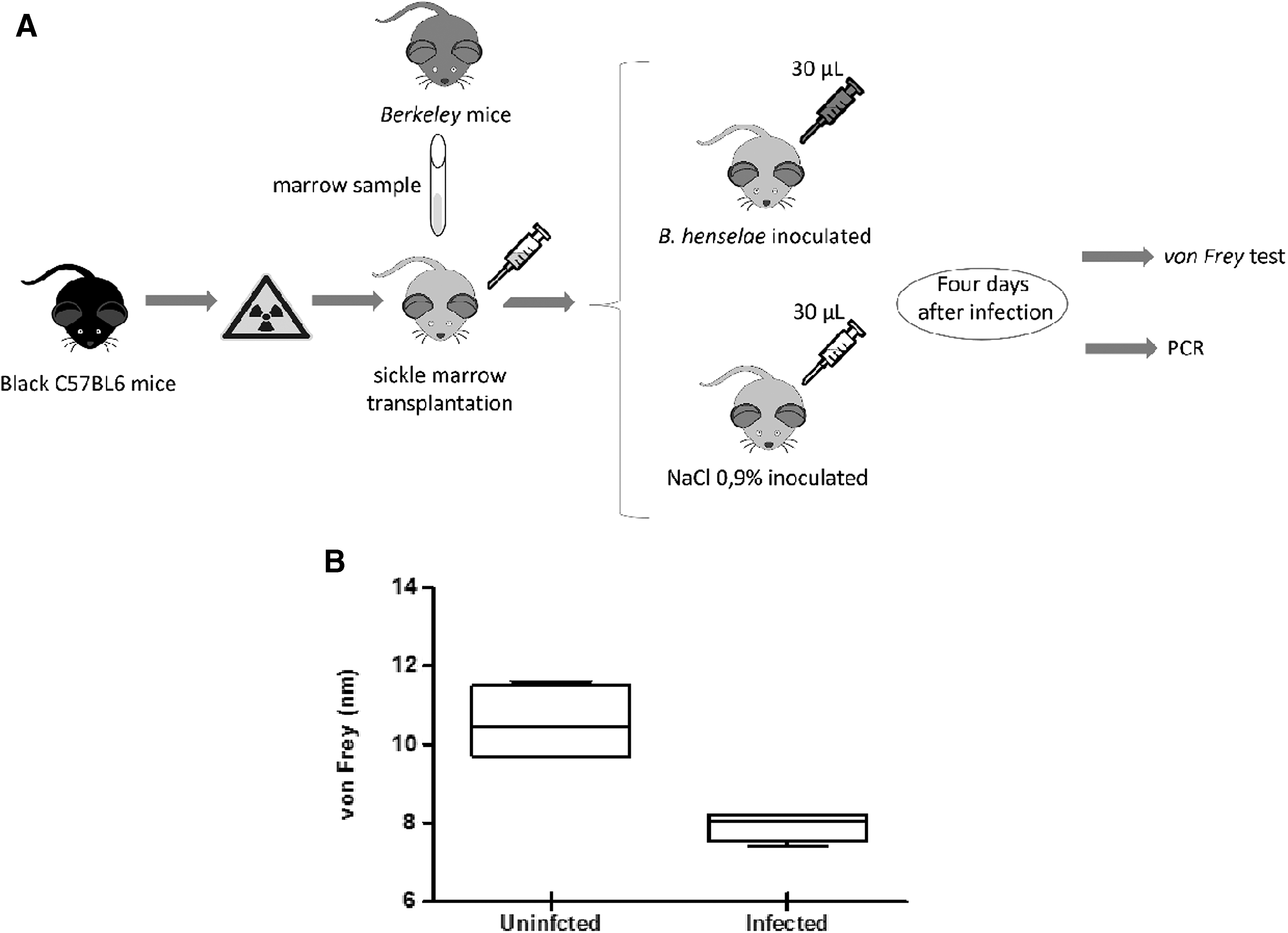
SCD animal transplant procedure and infection scheme and the von Frey assay.
We determined the paw withdrawal threshold in response to mechanical stimuli using a series of von Frey filaments (1601C; Life Science Instruments®) according to Vivancos et al. (2004). Four days after inoculation, animals were acclimatized for ∼30 min before testing, to allow behavioral accommodation. We stimulated the midplantar surface of the forepaw using von Frey monofilaments until the mouse withdrew its paw. The testing was initiated with the 0.1 g von Frey filament (range 0.1–80 g) and the results are shown in grams (g). We applied the filament with progressive pressure until the animal withdrew its paw. Paw withdrawal frequency in response to six applications of filaments per animal with a 5-min interval between each stimulus was observed by two blinded observers.
We extracted DNA using RTP Bacteria DNA Mini Kit (Stratec® Molecular) according to the manufacturer's instructions. DNA samples were tested by genus-specific conventional PCR targeting 16S-23S ribosomal RNA Intergenic Spacer (ITS) region (Pitassi et al. 2015). We also performed B. henselae species-specific nested PCR targeting FtsZ region (Silva et al. 2016). The primers used for the ITS region were 5′-CTTCAGATGATGATCCCAAGCCTT(Y)TGGCG-3′ and 5′-GAACCGACGACCCCCTGCTTGCAAAGCA-3′. For the FtsZ region, the primers used were 5′-GCCGCAAAGTTCTTTTCATG-3′ and 5′-AGGTGAACGCGCTTGTATTTG-3′ for the first reaction and 5′-CAAAACGGTTGGAGAGCGT-3′ and 5′-CGCCTGTCATCTCATCAAGA-3′ for the second reaction. To prevent contamination, these molecular tests were performed as described by Pitassi et al. (2015).
Results
The von Frey test data were analyzed using Student's t-test with Prism (GraphPad) and the graph was plotted as mean ± SD. The level of significance was set at p ≤ 0.05.
Two days after inoculation, all B. henselae-inoculated SCD animals showed a slight tremor that was not observed in control mice. They maintained this sign until day 4, the last day of observation. The paw withdrawal thresholds were significantly lower (p = 0.0009) in infected SCD mice (7.9 g ± 0.36) than in control animals (10.5 g ± 0.78) (Fig. 1B). For B. henselae, infection was confirmed by molecular methods in all bacterium-inoculated animals. In the bartonella infected mice, all liver and one spleen fragments were positive using nested PCR and three liver fragments were positive using conventional PCR. We could not detect bartonella DNA in the blood samples of either control or infected mice (Table 1). Our sensitivity in conventional and nested PCR was 50 genome equivalent (GE) and 10 GE, respectively.
Numbers shown are of positive samples/total specimens.
SCD, sickle cell disease.
Discussion
Bacterial infections produce pain in mice. Chiu et al. (2013) showed mice infected with Staphylococcus aureus were more hyperalgesic. The pain-like hypersensitivity detected by mechanical stimuli and defensive behaviors can evaluate the hyperalgesia in mice (Chiu et al. 2013) and has already been used in SCD mice (Kohli et al. 2010). Berkley mice expressing sickle hemoglobin exhibit spontaneous pain and mechanical hyperalgesia, which is further exaggerated upon hypoxia/reoxygenation simulating VOC-like pain (Kohli et al. 2010). Similar sensitivity to mechanical stimuli has been observed in patients with SCD using quantitative sensory testing (Campbell et al. 2016). In SCD, pain is often recalcitrant to analgesic therapy, but the reasons for this resistance to therapy remain unknown.
Our observations clearly demonstrate that B. henselae infection can be transmitted to mice with SCD. Using similar methods, Silva et al. (2016) observed positive nested PCR in the organs of two out of four Balb/c B. henselae-inoculated animals 4 days after inoculation. However, higher percentage of sickle animals showed the presence of bartonella after inoculation. Thus, under a sickle microenvironment, the likelihood of bartonella infection is higher than under normal conditions.
We found that SCD mice infected with B. henselae exhibit cutaneous hyperalgesia to mechanical stimuli compared with the saline-inoculated control group. It is noted that the infected animals had tremors and noninfected animals did not have tremors. Together, these observations raise the possibility of bartonella infection in SCD patients predisposed to animals bearing bartonella and/or receiving transfusions. Our study raises awareness about examining the presence of bartonella in blood for transfusion and in patients with SCD, particularly those showing symptoms such as pain that are resistant to therapy.
In summary, we show that B. henselae can be transmitted to SCD mice, leading to an increase in mechanical hyperalgesia. Therefore, B. henselae infection although rare may be considered as one of the infections that may exaggerate the symptoms of SCD and resistance to therapy.
Footnotes
Acknowledgments
The authors thank Dr. Rovilson Gilioli for providing research infrastructure to maintain the animals, Dr. Carlos Amilcar Parada for support and for von Frey test, and Camila Bononi Almeida, PhD, for providing sickle mice.
Author Disclosure Statement
No conflicting financial interests exist.