




Abstract
Surveys of Toxoplasma gondii infection in animals have been reported in Yunnan province, southwestern China. However, limited information is available regarding the epidemiology of T. gondii infection among persons participated in health screening in Yunnan. From January 2014 to December 2016, a large-scale and cross-sectional serological survey was conducted to reveal the seroprevalence of T. gondii infection in persons participated in health screening in three major hospitals. A total of 64,533 serum samples were collected and anti-T. gondii antibodies were examined by commercially available enzyme-linked immunosorbent assay kits. The total seroprevalence of T. gondii infection was 6.67% (4306/64,533). Of these, 3721 persons (5.77%, 3721/64,533) were positive for Immunoglobulin G (IgG) only, 473 persons (0.73%, 473/64,533) were positive for Immunoglobulin M (IgM) only, and 112 persons (0.17%, 112/64,533) were positive for both IgG and IgM. Female seroprevalence (6.83%, 3167/46,389) was higher than male (6.28%, 1139/18,144). The highest seroprevalence of T. gondii infection was found in the age range of 41–50 years (10.60%, 228/2150) (p < 0.001). The seroprevalence in 2014, 2015, and 2016 were 6.39% (1083/16,946), 6.24% (1261/20,201), and 7.16% (1962/27,386), respectively. The results showed that T. gondii infection is common in persons participated in health screening in Yunnan province, which has significant public health concern. Thus, improved integrated measures should be executed to prevent and control T. gondii infection humans and animals in Yunnan province.
Introduction
T
Serological survey of T. gondii infection in humans has been carried out in various parts and numerous different groups of people, such as pregnant women (Liu et al. 2009, Gao et al. 2012, Cong et al. 2015b), children and students (Meng et al. 2015, Xin et al. 2015, Yang et al. 2017), psychiatric patients (Cong et al. 2015a), cancer patients (Cong et al. 2015c, Wang et al. 2015a), arthritis patients (Tian et al. 2017a), patients with liver disease (Tian et al. 2017b), patients in the intensive care unit (Zhang et al. 2015), patients with hand, foot and mouth disease (Wang et al. 2015b), and AIDS patients (Shen et al. 2016) in China. However, most of these studies were conducted to explore the T. gondii seroprevalence in the special populations, limited information on the T. gondii seroprevalence in health screening populations is available.
Yunnan province is located in border in southwestern China, economic development behind other areas, but Yunnan has the richest biodiversity, including parasite species. It lies E 97°31′∼106°11′ and N 21°8′∼29°15′. The total land area of the province is 394,000 and 100 km2, which is at the junction of Burma, Laos, and Vietnam. At the end of 2016, the population of the province was approximately 48 millions. The climate basically belongs to the monsoon type of subtropical plateau. As the largest number of ethnic minorities and famous tourism place, Yunnan has various dietary habits, for instance, eating raw pork and/or liver is a custom of the Bai ethnic group in Dali Bai Autonomous Prefecture, Yunnan Province, which contributes directly to the widely epidemic of the toxoplasmosis in humans and animals. So far, there are a few research reports about prevalence of T. gondii in various animals, including pigs (Zou et al. 2009), pet dogs (Duan et al. 2012), peafowls (Pavo muticus) (Tian et al. 2012), horses, donkeys (Miao et al. 2013), black-headed gulls (Chroicocephalus ridibundus) (Miao et al. 2014), bats (Jiang et al. 2014), buffaloes, sheep, and goats (Zou et al. 2015), T. gondii oocysts in cat feces (Liang et al. 2016), and rodents (Wang et al. 2018). However, limited studies were conducted to reveal the T. gondii infection status in humans (Li et al. 2015, Chen et al. 2016). Thus, this survey was carried out to explore the seroprevalence of T. gondii infection in persons participated in health screening in Yunnan province. The results of the survey would provide baseline data as well as potential risk factors for prevention and control of T. gondii infection in humans in the area and other places.
Methods
Ethics approval and consent to participate
The sera were collected with agreement from the persons participated in health screening, and this study was approved before its commencement by the second Affiliated Hospital of Kunming Medical University, the Second People's Hospital of Yunnan Province and Yunnan Red Cross Hospital, and Yan'an Hospital of Kunming City and Yan'an Hospital Affiliated to Kunming Medical University. The purpose and procedures of the study were explained to all participants.
Study site and data collection
From January 2014 to December 2016, a cross-sectional serological survey was conducted to learn the seroprevalence of T. gondii infection in persons, who live in Yunnan and participated health screening in three major hospitals of Kunming City (N 25°02′11″, E 102°42′31″), the capital of Yunnan. The population was not selected, including all the people who came to the hospital, almost normal physical examination population. These people went to hospital for toxoplasmosis examination. A combination of items called “TORCH” includes examination of T. gondii. In addition, there are some regular physical examinations.
At last, a total of 64,533 serum samples were collected from three hospitals (a. The Second People's Hospital of Yunnan Province and Yunnan Red Cross Hospital, n = 16,929; b. Yan'an Hospital of Kunming City and Yan'an Hospital Affiliated to Kunming Medical University, n = 10,570; c. The Second Affiliated Hospital of Kunming Medical University, n = 37,034). The three hospitals are located in Kunming city, the capital of Yunnan province (Fig. 1). All persons come from different places of Yunnan. Demographic variables, including gender, age, and area of residence, which were selected based on individual information, were obtained from the computerized inpatient registry. Personal information of the participants of the survey were anonymized and kept confidential (Table 1).
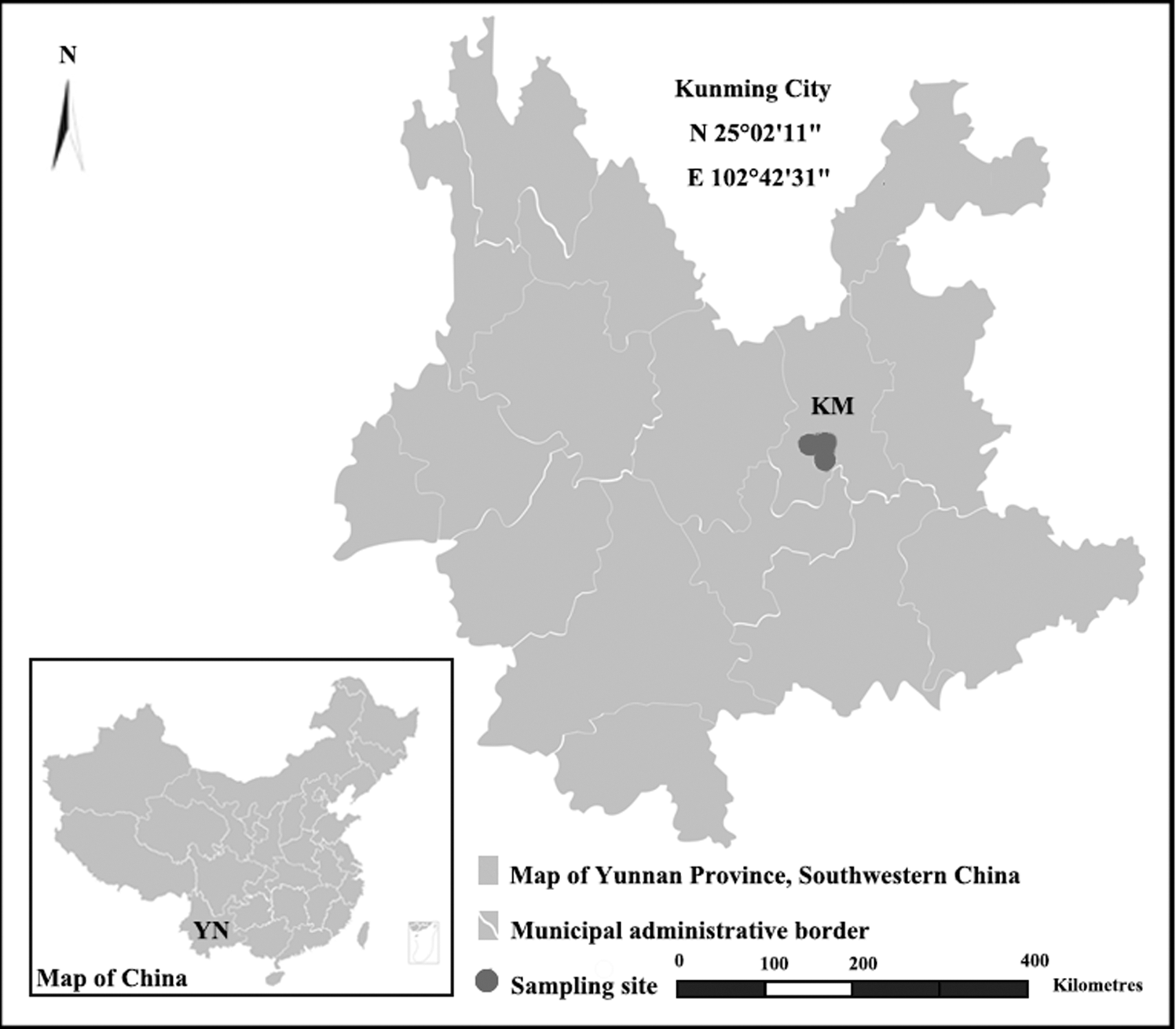
Maps showing KM city, the capital of YN, southwestern China, where the persons participated in health screening were sampled. KM, Kunming; YN, Yunnan Province.
Sociodemographic Characteristics and Seroprevalence of Anti-Toxoplasma gondii Antibodies Among Persons Participated in Health Screening in Yunnan Province, China, from January 2014 to December 2016
Estimated using the chi-squared test.
95% CI, 95% confidence interval; OR, odds ratio.
Collection and storage of serum samples
Venous blood samples of ∼5 mL was taken from participants who gave their consent to participate in this study. Blood samples were allowed to clot overnight at room temperature, and then centrifuged at 1000 g for 10 min. The sera were collected in 1.5 mL Eppendorf tubes and kept at 4°C for 24 h. All the serum samples were tested in the collected hospital, where they were kept at −20°C until tested.
Serological assay
Anti-T. gondii Immunoglobulin M (IgM) and Immunoglobulin G (IgG) antibodies in the sera were examined using enzyme immunoassay kits, which were commercially available (Beijing Beier Biological Engineering Co. Ltd., Beijing, China) following the manufacturer's recommendations. Optical densities were measured photometrically at a wavelength of 450 nm. Values higher than the cutoff were considered positive. Samples with values ±20% of the cutoff were retested. Positive and negative control serum samples were included in every test. To avoid biased results, the serological examination was performed double blinded.
Statistical analysis
Data were entered using the Microsoft Excel for Windows, version 2016 (Microsoft Corp., Redmond, WA). Statistical analysis of T. gondii seroprevalence in different gender, age group, and hospitals was performed using chi-squared test in the SPSS software (Release 22.0 IBM Corp., Armonk, NY). A p value <0.05 was considered statistically significant.
Results and Discussion
The total seroprevalence of T. gondii infection was 6.67% (4306/64,533, 95% confidence interval [CI] = 6.48%–6.87%). Of these, 3721 persons (5.77%) were positive for IgG only, 473 persons (0.73%) were positive for IgM only, and 112 persons (0.17%) were positive for both IgG and IgM.
Years of seroprevalence studies seem to suggest that T. gondii infection rates in humans increased for the past years in China. The overall infection rate was 5.2% in the first national survey implemented between 1988 and 1992 (Yu et al. 1994), then rose to about 8% between 2001 and 2004 (Zhou et al. 2008). It was also lower than 32.3% in Bai ethnic groups reported earlier in Dali of Yunnan (Li et al. 2015). Possible reasons for such change include increased meat consumption and pet cat numbers as a consequence of economy development. At present, it is estimated that 10% of humans in China are infected, but the distribution is not even. The reasons for different seroprevalence could be many, such as different socioeconomic, ecological conditions, and customs for diets, it is good to be reminded that some ethnic minorities of Yunnan have the habit of eating raw or half raw pork, it certainly promote the possibility of T. gondii infection.
In this study, female (6.83%, 3167/46,389; odds ratio [OR] = 1.09, 95% CI = 1.02–1.17, p = 0.012) has a significantly higher seroprevalence than male (6.28%, 1139/18,144) (Table 1), which may be due to many factors. In China, women usually have more contact with pet cats at home, and touch raw meat and vegetables more frequently than men because they are usually responsible for cooking at home. Therefore, it is very necessary to promote the disease protection knowledge in public, including wearing gloves and masks when handling feces, feces harmless treatment, and frequent handwashing, especially for the female groups.
For this research, there was a significant difference in T. gondii seroprevalence among different age groups (p < 0.01). The highest T. gondii seroprevalence was found in the age range of 41–50 years (10.60%, 228/2150; OR = 2.20, 95% CI = 1.75–2.74, p < 0.01), this is similar to that reported by others (Agmas et al. 2015, Cong et al. 2015b). The probability of having higher seroprevalence in the age group had long duration of exposure and weak consciousness of prevention because people in this age group did more work on farming and cleaning up their homes and pet poop compared with other age groups. Thus, they may have more chance to contact with T. gondii oocysts.
In addition, the infection rate in 2016 year (7.16%, 1962/27,386; OR = 1.16, 95% CI = 1.07–1.24, p < 0.01) was slightly higher than other 2 years. Perhaps with the improvement of the living standard of urban residents, increasing number of pets are being kept. In addition, the total number of inspections is increasing year by year. Meanwhile the difference of the prevalence between hospital a, b, and c were remarkable significant, which were the prevalence in hospital a was significantly higher than hospital b and c (8.30%, 1405/16,929; OR = 2.21, 95% CI = 1.97–2.47, p < 0.01). In this research, there is a difference in the positive rate of antibody to T. gondii in three hospitals, which may lead to a slight difference in factors such as the main population and the distribution of sources in the three hospitals. For example, the main population of hospital c is pregnant women and children.
Last but not least, the reported prevalence of T. gondii in various animals in Yunnan are relatively high, which will become a significant source of infection. These animals can be classified into four main categories: pet dogs (21.6%, 132/611) and livestock, including pigs (16.97%, 141/831), buffaloes (7.5%, 32/427), sheep (9.7%, 15/154), goats (17.6%, 69/392), horses (30.5%, 81/266), and donkeys (20.3%, 27/133) (Zou et al. 2009, 2015, Duan et al. 2012, Miao et al. 2013). T. gondii-like oocysts were detected in 4% (5/115) of cat feces using light microscopy in Kunming (Liang et al. 2016). The wild animals of the genus abbreviate include bats (59/608, 9.7%) (Jiang et al. 2014) and rodents (32/261, 12.26%) (Wang et al. 2018). In addition, birds had peafowls (35/277, 12.64%) (Tian et al. 2012) and black-headed gulls (131/659, 19.9%) (Miao et al. 2014). There is a lack of studies on the main sources of human toxoplasmosis, including foodborne, soil-borne, and water-borne. At the same time, T. gondii infection among different species and the genetic polymorphism and virulence of T. gondii are urgently needed.
In a nutshell, hygienic diet, basic research, and quarantine supervision are significant to prevention, treatment, and control of T. gondii. Therefore, corresponding effective measures should be taken educationally, financially, and legally to boost it.
Conclusions
This serological survey indicates that T. gondii infection is common and has a raising trend in the healthy population in Yunnan province, southwestern China, which raised a public health concern. More surveillance should be executed in pet cats, various animal meat products, and specific populations to better understand the epidemiology and transmission of associated risk factors for T. gondii infection in humans in this province.
Footnotes
Acknowledgments
This research was supported by the National Natural Science Foundation of China (grant no. 31760730), the Special Fund for Outstanding Talent of Yunnan Agricultural University, China (grant no. 2015JY03), Yunnan Health Training Project of High-Level Talents (grant no. H-201629), and the Student Science and Technology Innovation and Entrepreneurship Fund Project of Yunnan Agricultural University (grant no. 2018ZKX041).
Author Disclosure Statement
No conflicting financial interests exist.