




Abstract
Bluetongue (BT) is a noncontagious disease affecting domestic and wild ruminants. Outbreaks of BT can cause serious economic losses. Although the causative agent, BT virus (BTV) is endemic in China, a comprehensive analysis has yet to be conducted examining the spatial distribution and risk factors of the virus throughout the Inner Mongolia province. Between June 2013 and February 2015, a total of 6199 blood samples of goats and sheep were collected from 11 leagues and cities. To investigate the distribution characteristics of BTV, spatial autocorrelation analysis, including both global and local spatial autocorrelation, was conducted. To develop a model for the association between BTV infection and specific risk factors, a multiple logistic regression analysis was performed. The global spatial autocorrelation data on the distribution of BTV exhibited a random pattern. Alashan was observed to be a cold spot for BTV infection. During the study period, no hot spots were detected. An increased risk of BTV infection in Inner Mongolia was associated with the breed and age of the animal.
Introduction
Bluetongue (BT) is a noncontagious disease affecting ruminant and camelid species (Maclachlan et al. 2009). The causative agent of BT, BT virus (BTV), is a vectorborne disease transmitted between ruminant hosts by blood-feeding midges of the Culicoides spp. Hosts of BTV infection are typically domestic and wild ruminants, including sheep, goats, and cattle.
In general, cases with severe clinical symptoms are often observed in certain sheep breeds, including European fine wool and mutton (Maclachlan et al. 2009). The most commonly observed clinical signs include fever, hyperemia in the nasal and oral mucosa, edema of the lip, ulcers of the oral mucosa, cyanosis of the tongue, and skeletal muscle deformation. Cyanotic tongues are the most obvious characteristic in infected sheep, partly simplifying the differential diagnosis.
Within the Orbivirus genus of the Reoviridae family, BTV is the prototype member (Coetzee et al. 2012). Currently, 26 serotypes (BTV 1 to BTV 26) have been serologically identified (Maan et al. 2011). The BTV genome consists of 10 linear dsRNA genome segments (Verwoerd et al. 1970), which encode 7 structural (VP1–7) and 5 nonstructural proteins (NS1, NS2, NS3, NS3/A, and NS4) (Van Dijk and Huismans 1988, Belhouchet et al. 2011). Differences between the outer capsid proteins, particularly VP2 (Huismans and Erasmus 1981), determine which of the 26 serotypes the virus belongs to.
At present, there are no effective prophylactic or therapeutic treatments available to aid in control of the disease (Miao et al. 2010). Thus, the development of measures to prevent and control outbreaks of BT is of critical importance. At the time of publication, various types of vaccines, including inactivated, attenuated, virus-like particles (VLP), and recombinant subunit vaccines, were developed to control BTV (Coetzee et al. 2012). The inactivated and attenuated vaccines have been approved for use in the control and prevention of the disease. The inactivated vaccine has been used in South Africa for more than 50 years, the protective efficacy of which appears to be long lasting (Alexander and Haig 1951). Currently, VLP and recombinant protein vaccines are being developed, but they are still in the preclinical stages of testing (Mcvey and Maclachlan 2015).
Late in the eighteenth century, BT was first officially reported in the Cape of Good Hope, South Africa. After a systematic clinical study, the disease was named “bluetongue” in 1905 by Spreull, with reference to the characteristic cyanotic tongues observed in infected sheep (Spreull 1905). In 1943, an outbreak of BT occurred in Cyprus, which is believed to be the first such case occurring outside of Africa (Gambles 1949). Since that time, BT has subsequently occurred in many regions of the world, with Antarctica being the only continent free of BTV infection at the present time (Maclachlan et al. 2009).
In 1979, the first case of BTV infection in China was identified and the virus was isolated in Yunnan Province (Zhang et al. 1989). Soon thereafter, cases of BT were diagnosed in Hubei, Anhui, Sichuan, Gansu, and Shanxi Provinces (Zhang et al. 2016a). Concurrently, BTV seropositive animals were found in 29 provinces throughout China (Li et al. 2018), including Guangdong, Guangxi, Jiangsu, and Xinjiang, to name a few, which alarmed for BTV prevention and control throughout the country. A previously published study covering 27 provinces throughout China, during a period spanning 1987 to 1989, indicated a nationwide BTV seroprevalence of 4.73% in sheep and goats (Lv et al. 2016). In a similar study, the highest seroprevalence was observed in Guangxi Province in 2001, with 31.7% of sheep and goats testing positive for BTV infection (Huang et al. 2001). Based on these studies and others, the evidence indicates that BTV has become widely established in China, and it has been for several decades. At present, 11 serotypes of BTV have been isolated in China (Zhang et al. 1999, Yang et al. 2016), with BTV-1 and BTV-16 being the most commonly isolated serotypes (Zhang et al. 1999, Fan et al. 2011). In 1986, cashmere goats were set to be exported from Bayannaoer, Inner Mongolia, to North Korea. During the export quarantine period at the quarantine station in Inner Mongolia, the goats that tested positive for antibodies against BTV were detected. In another case, BTV was isolated from clinically healthy goats in 1989 (Lv 2015).
Outbreaks of BT can create serious economic consequences. Extensive measures are required to control the spread of the virus among infected and co-housed healthy livestock. It is estimated that the 1996 outbreak of BT in 1996 resulted in more than $3 billion USD in economic losses worldwide (Tabachnick 1996). As a result, BT was included on the Office International des Epizooties (OIE) list of notifiable diseases in the mid-1960s (Verwoerd 2009), and it was classified as a list A infectious disease in 2004 by the OIE. Further, the Chinese government has classified BT as a Class I disease of concern (Han et al. 2010).
In this study, epidemiological survey data of BTV from June 2013 to February 2015 in Inner Mongolia, China, were further analyzed. To investigate the distribution characteristics of BTV, global and local spatial autocorrelation analyses were performed. Further, a logistical regression model was built to assess the risk factors for BTV infection. It is believed that the data and conclusions derived from this study will subsequently provide useful information for the development of effective strategies for the prevention and control of future BT outbreaks, thus minimizing the impacts to animal health as well as the economic losses.
Materials and Methods
Study area
The Inner Mongolia Autonomous Region is located along the northern border of China (Fig. 1). This region extends between latitude 37°24′ N and 53°23′ N, and longitude 97°12′ E and 126°04′ E, and climatologically is categorized as both a temperate continental climate and a temperate monsoon climate. With abundant natural resources, Inner Mongolia is the largest grassland pastoral area in China. This region has a total area of ∼1,183,000 km2, which is home to 40,162,000 sheep, 15,531,000 goats, and 6,306,000 cattle distributed across 866,670 km2 of grassland in 2015. According to data released by the National Bureau of Statistics of the People's Republic of China (
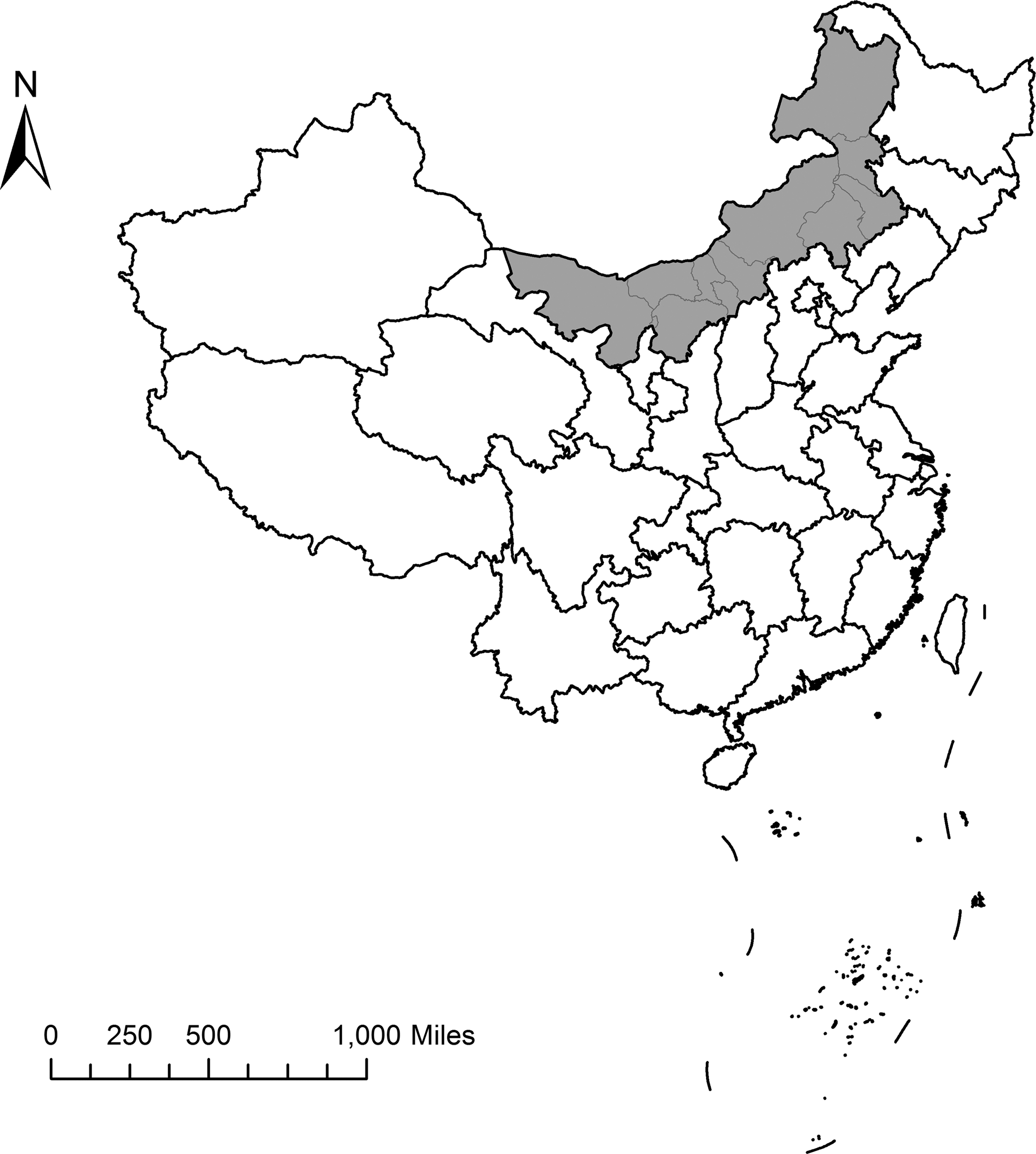
Location of Inner Mongolia Autonomous Region on the map of China.
Although no BT outbreak has been reported in Inner Mongolia till now, BTV antibodies in sheep, goats, and cattle in this province were detected by researchers (Zhang et al. 2014, 2016b). There are at least 36 species of blood-feeding midges living in Inner Mongolia in different months of a year (Zhang et al. 2017), which is alarming for the risk of BT occurrence.
Sample collection and processing
From June 2013 to February 2015, a total of 6199 blood samples (2243 in sheep and 3956 in goats) were collected from 11 leagues and cities, including Alashan, Wuhai, Bayannaoer, Ordos, Baotou, Huhhot, Wulanchabu, Xilinguole, Chifeng, Tongliao, and Xingan (Fig. 2), and the number of samples from each region is shown in Table 2. The leagues and cities were divided into three groups according to their locations and are defined in Table 2. All the samples were provided by the Veterinary Institute of the Inner Mongolia Academy of Agriculture and Animal Science. All sampled animals had been weaned and had not been previously vaccinated against BTV. The animals were randomly selected from herds, and no typical signs of BT were observed in any of these animals. The animals were divided into three groups by age: between 6 and 12 months of age, between 12 and 24 months of age, and older than 24 months of age.

Prevalence of BTV in Inner Mongolia, China, between June 2013 and February 2015. BTV, bluetongue virus.
Blood was collected from goats and sheep in anticoagulant ethylenediaminetetraacetic acid (EDTA) containing tubes, and it was immediately placed in a cooler. RT-PCR was performed as previously described (Hofmann et al. 2008) to detect the presence of BTV. All blood samples were tested by the Inner Mongolia Agricultural University.
Spatial autocorrelation analysis
In spatial autocorrelation analyses, the distribution of a phenomenon is presented as either a clustered, dispersed, or random pattern within a given space. This type of analysis was used here to investigate geographic patterns of BTV distribution throughout Inner Mongolia between June 2013 and February 2015. The positivity rate for BTV was used as the attribute value. Both local and global spatial autocorrelations were used to analyze the datasets.
Global spatial autocorrelation analysis
A global spatial autocorrelation analysis was performed to characterize the distribution of BTV, in which all leagues and cities were considered to be a single entity. Global Moran's I was used to measure the spatial autocorrelation of individual locations, as well as the BTV positivity rate. Global Moran's I data range from −1 to 1, which correspond to highly dispersed and highly clustered distributions, respectively. These parameters were calculated as follows (Cliff and Ord 1973):
where Xi
, the BTV positivity rate in the ith league or city;
Local spatial autocorrelation analysis
Local spatial autocorrelation was applied to examine the distribution mode of BTV within a particular league or city. The local Getis-Ord
where Xj
, the positivity rate of BTV in the jth league or city;
Analysis of risk factors for BTV infection
A logistic regression model was constructed to assess risk factors for BTV infection. Epidemiological questionnaires, including housing type, species, gender, age, and location of the sampled animals, were completed by farmers at the time of sample collection. These factors were converted to categorical variables (Table 1).
Categorical Variables Used as Risk Factors for Bluetongue Virus Infection in Inner Mongolia, China, Between June 2013 and February 2015
Baseline category.
Parameters with a p < 0.25 in the univariate analysis. These variables were selected for the subsequent multiple logistic regression analysis.
To assess potential risk factors for BTV infection, univariate logistic regression models were applied. The relationships between BTV infection and each risk indicator variable were evaluated by using mean odds ratios (OR), 95% confidence intervals (CIs) of OR, and p values. Variables with a p-value of <0.25 were selected for subsequent multiple logistic regression analysis (Greenland and Mickey 1989). Collinearity among variables was examined by calculation of the correlation coefficient and variance inflation factors (VIFs) (O'Brien 2007). Variables was considered co-linear if VIFs were >10. All variables with VIFs <10 were considered to have no collinearity between them, and they were entered into subsequent multivariable analyses.
To model the associations between BTV infection and risk factors, a multiple logistic regression analysis was performed (AndrewCucchiara 1989). The model used BTV positivity and negativity as binary outcomes and was performed by using the manual forward stepwise selection. The goodness of fit of the model was assessed by using the Hosmer-Lemeshow test. Statistical analyses were performed by using SPSS 22.0 (
Results
BTV prevalence
The BTV epidemiological survey was conducted from June 2013 to February 2015. A total of 75 farms participated in this survey, and all of them tested positive for BTV RNA. In total, 6199 animals were evaluated, and 2199 were tested positive for BTV, yielding a prevalence of 35.47% (95% CI: 32.85–38.29) (Table 2, mapped in Fig. 2).
Prevalence of Bluetongue Virus in Inner Mongolia, China, Between June 2013 and February 2015
Spatial autocorrelation analysis
The global spatial autocorrelation analysis produced a Global Moran's I of −0.1646, and the Z score was −0.3093 (p = 0.7570). These data suggested that BTV in Inner Mongolia was distributed randomly throughout the province.
The results of the BTV hotspot analysis are presented in Figure 3. As is demonstrated in the figure, Alashan (Z = −1.8354, p = 0.0664) was a cold spot for BTV infection. No hot spots were observed during the study period.
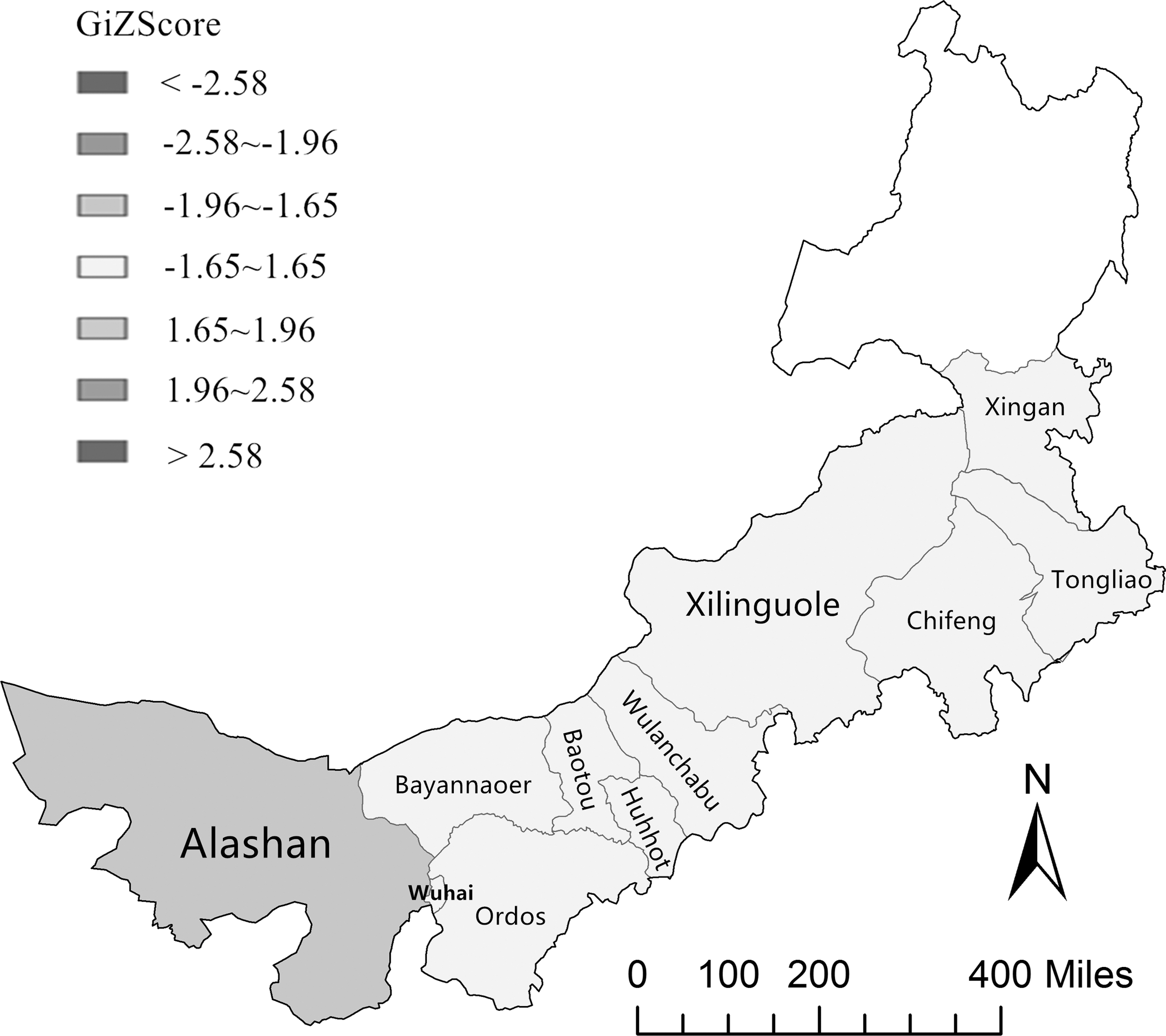
BTV hotspot analysis in Inner Mongolia, China, between June 2013 and February 2015.
Risk factor
Univariate logistic regression analyses of potential risk factors for BTV infection excluded two of the examined factors, based on a lack of statistical significance (p > 0.25). This included housing type and location. No collinearity was observed between the variables. Species, gender, and age were identified as significant risk factors, and they were therefore included in subsequent multivariable logistic regression analyses (Table 1).
The results of multivariate analyses of risk factors for BTV infection are presented in Table 3. The final multivariate logistic regression model suggested that an increased risk of BTV infection may be associated with the species and age of the animal. The odds of BTV infection were significantly higher in animals that were at least 24 months of age [OR 4.267 (95% CI 1.247–6.370)] than those between 12 and 24 months of age [OR 2.965 (95% CI 1.607–4.945)] and those between 6 and 12 months of age. Further, significantly higher odds of BTV infection were observed in sheep [OR 1.353 (95% CI 0.916–3.104)] than goats. The Hosmer–Lemeshow chi-square type goodness-of-fit test of this model was 4.376 (p = 0.672).
Multivariate Logistic Regression Analysis of Relationships Between Risk Factors and Bluetongue Infection in Inner Mongolia, China, Between June 2013 and February 2015
Discussion
Spatial epidemiology plays an important role in the study of infectious diseases in the field of public health. One such method, spatial autocorrelation, has been widely used (Al-Ahmadi and Al-Zahrani 2013, Ma et al. 2017, Ratovonirina et al. 2017). According to the data presented in this article, BTV in Inner Mongolia was randomly distributed, with no BTV hotspots observed during the study period. It has been proposed by others that randomly occurring case clusters have an effect on the spread of an infectious disease (Jeefoo et al. 2011). Adult female hematophagous midges of the Culicoides spp. are the only known vectors, and they are currently the only known mode of transmission through which BTV can spread between susceptible ruminant hosts (Liu et al. 2018). Therefore, factors affecting the geographical distribution of hematophagous midges require much consideration.
Researchers have reported that the epidemic distribution of BT is closely related to the activity of the midge vector, which is generally distributed between 40°N and 35°S latitude (Gibbs and Greiner 1994). Inner Mongolia extends between latitude 37°24′ N and 53°23′ N. Interestingly, leagues and cities located between 40° N and 35° S latitude did not exhibit a clustered distribution for BTV infection. One possible explanation for this unexpected observation is the expansion of the vector midge's habitat range. In Sweden, potential vector species of BTV occurred as far north as latitude 65° N (Ander et al. 2012). Culicoides biting midges were also found in cities north of latitude 40° N in Inner Mongolia, such as Bayannaoer city and Huhhot city (Zhang et al. 2017). A study shows that Culicoides abundance was linked to livestock density and land use. The distribution of pastoral areas in Inner Mongolia is relatively uniform, and maybe it has a connection with the distribution of BTV vector. Further, both biological factors (vegetation, human and animal activities, etc.), and natural environmental factors (light, temperature, atmospheric gases, etc.) may have impacts on the spread of Culicoides spp. (Blanda et al. 2018). The effects of seasonal and metereological parameters on the existence of Culicoides have been thoroughly investigated (Racloz et al. 2008, Sanders et al. 2011, Ander et al. 2012). For example, weather condition and wind pattern were favorable for BTV-infected midges transportation (Guis et al. 2007). The specific environmental factors that lead to a random distribution of BTV in Inner Mongolia need further investigation. As the highest league in Inner Mongolia, Alashan was observed to be a cold spot for BTV infection in this study. The average altitude of Alashan is about 1673 meters. Temperature and atmospheric moisture content generally decreases with an increase in altitude. Evidence from a relevant study showed that low humidity is detrimental for the survival of Culicoides at low temperatures (Green et al. 2005), whereas Alashan may represent an unfavorable environment for BTV transmission.
Multivariate logistic regression is a recognized statistical method for the assessment of associations between risk factors and the probability of disease occurrence (Lee 1986). According to this study, the risk of a sheep being infected with BTV was significantly higher than that of goats. These observations are consistent with those previously reported by others (Elbers et al. 2008a, 2008b). This finding suggests that farms with a large number of sheep are at greater risk of being infected by BTV, which reminds farmers to take preventive measures.
The risk of BTV infection was observed to be significantly higher in animals older than 24 months of age compared with both those between 12 and 24 months and those between 6 and 12 months of age. This result is in agreement with previous descriptive studies of BTV in 2012 in Iran (Mohammadi et al. 2012). Age susceptibility to clinical disease varies with different outbreaks. An increased duration of exposure to virus can lead to seroprevalence increase (Radostits et al. 2007). It is likely that an older animal is longer exposed to BTV, resulting in greater infection risk. However, one other study reported that the age of susceptible animals was not associated with BTV infection (Green et al. 2005). More investigation into the effect of age on BTV susceptibility is needed to clarify the apparent discrepancies in the literature.
Although we believe our research is comparably reliable, limitations still exist. Animals in different farms of different regions were sampled for different periods, which could cause some bias in our data. Additional data are needed to confirm whether the results in this work have sufficient predictive value for formulating BTV policies for the government.
Conclusions
The global spatial autocorrelation data on the distribution of BTV in Inner Mongolia during the period from June 2013 to February 2015 suggested a random distribution. Alashan was observed to be a cold spot for BTV infection, and no hot spots were observed during the study period. An increased risk of BTV infection in Inner Mongolia was associated with both the species and age of the animal.
Footnotes
Acknowledgments
The authors would like to thank the Veterinary Institute of the Inner Mongolia Academy of Agriculture and Animal Science as well as the Inner Mongolia Agricultural University, in addition to all of the veterinarians who contributed to this study. They would also like to thank the Heilongjiang Key Laboratory for Laboratory Animals and Comparative Medicine, and the Key Laboratory of the Provincial Education Department of Heilongjiang for Common Animal Disease Prevention and Treatment. This work was supported by the National Key R & D Program of China under grant number 2016YFD0501106.
Author Disclosure Statement
No conflicting financial interests exist.