




Abstract
In 2005, the zoonotic acute sleeping sickness was spreading rapidly from the endemic areas of southeastern Uganda with potential for merger into areas affected by the chronic form of the disease in northwest Uganda. Movement of cattle reservoirs due to restocking was blamed for the rapid spread. To stop the spread of the zoonotic sleeping sickness, cattle in the disease endemic areas had to be treated with trypanocidal drugs and sprayed with deltamethrin to promote the live bait technology that helps suppress the tsetse vector. The initiative that started in five high-risk districts in 2006 with a mix of using several undergraduate veterinary students has now been integrated in the local government veterinary service delivery in 23 high-risk districts. By 2016, the annual spray of cattle with deltamethrin and treatment with diminazene aceturate had reached one million with 1,065,444 cattle sprayed in the reporting year July 1, 2016 to June 30, 2017. This is believed to have contributed significantly to the reduction in the number of Trypanosoma brucei rhodesiense sleeping sickness cases (from 473 recorded in 2005 to 14 in 2016, and only about 10 reported to the Coordinating Office for Control of Trypanosomiasis in Uganda [COCTU] in 2017). The initiative that started as the Stamp Out Sleeping Sickness Consortium with a public good approach, implemented in a public–private partnership with the faculty of Veterinary Medicine, Makerere University, has today been integrated in both private and public sectors to fast-track the elimination of T. b. rhodesiense sleeping sickness with active financial contribution from the affected communities in sustaining the delivery of live bait technology.
Introduction
The spread of Trypanosoma brucei rhodesiense sleeping sickness in Uganda has always been associated with the cattle reservoir and cattle restocking exercises (Fèvre et al. 2001, Welburn et al. 2001, Waiswa et al. 2003, Picozzi et al. 2005). At the beginning of this century, a lot of restocking was being carried out in all areas in the eastern and northern parts of Uganda that were recovering from the armed rebellion, as a strategy to improve on household income and nutrition (Waiswa and Rannalette 2010). Since cattle had been blamed for the epidemic, the entry point in containing the spread was to use trypanocidal drugs such as diminazene aceturate that had earlier proved to be effective at treating T. brucei sl infections in cattle (Clausen et al. 1999).
In addition, the live bait technology in tsetse control had been documented as an ideal tool in the control of Glossina fuscipes fuscipes (Okiria et al. 2002), which is the major vector for sleeping sickness in the T. b. rhodesiense endemic areas of Uganda (Waiswa et al. 2006). As has been emphasized by other scientists, the management of zoonotic disease risk arising from interactions between animals, humans, and the environment demands integrated action from both human and animal health disciplines plus support from other sectors in a one health approach (Welburn and Coleman 2015). Similarly, in 1992, the Uganda Trypanosomiasis Control Council (UTCC) and its secretariat, Coordinating Office for Control of Trypanosomiasis in Uganda (COCTU), were put in place to serve as a platform for multi-stakeholder partnerships and promote a “one health approach” in the control of tsetse and trypanosomiasis in Uganda.
The Stamp Out Sleeping Sickness (SOS) initiative, a public–private partnership launched in 2006, is a good example of one health in operation that has provided several lessons and insights in addition to its cost analysis plus collateral benefits (Waiswa and Kabasa 2010, Bardosh et al. 2013, Shaw et al. 2013, Muhanguzi et al. 2014b, 2015, von Wissmann et al. 2014). These lessons have been used to design a sustainable implementation of live bait technology in the elimination of sleeping sickness as a public health constraint, building on a private-public partnership approach in Uganda. The accompanying benefits in the control of other vectors such as ticks and the theory of practice of integrated health approaches and how they relate to the control of zoonotic sleeping sickness have been adequately outlined by some researchers (Okello et al. 2015, Welburn and Coleman 2015).
However, since the launch of SOS in 2006, there have been challenges in the developing and scaling-up of entrepreneurial approaches to demonstrate sustainability. Moreover, it is now known that treatment of cattle to remove the reservoir of rhodesiense human African trypanosomiasis (rHAT) infection offers a promising and cost-effective approach for the control of rHAT (Fyfe et al. 2016). Since cattle movements and restocking in postconflict Uganda has been a factor in the spread of Rhodesian sleeping sickness, and available data from 8 out of 47 identified markets showed that 39.5% (5238/13,267) of the inter-district cattle trade between mid-2006 and mid-2008 involved movement from endemic areas to pathogen-free districts (Selby et al. 2013), it is important that cattle are treated before relocation from disease-endemic foci.
This article aims at documenting the successes and challenges related to the community entrepreneurial approach in the use of live bait technology and sharing future insights as Uganda focuses on the elimination of sleeping sickness. The analysis will also help inform the implementation of several initiatives that relate to the trypanosomiasis challenge in Uganda.
Materials and Methods
Intervention areas targeted by the entrepreneurial model using live bait
In addition to the areas in northern Uganda where the SOS initiative started in 2006, then covering five districts as described and published (Waiswa and Kabasa 2010, Waiswa and Rannalette 2010), a purposive expansion of the approach to the known endemic subregions of southeastern Uganda and Bunyoro has been undertaken as these were being blamed for being the source of cattle that were carrying T. b. rhodesiense to the new epidemic areas. An additional 18 districts (Fig. 1) were recruited in the scaling-up of the model that began in 2013.
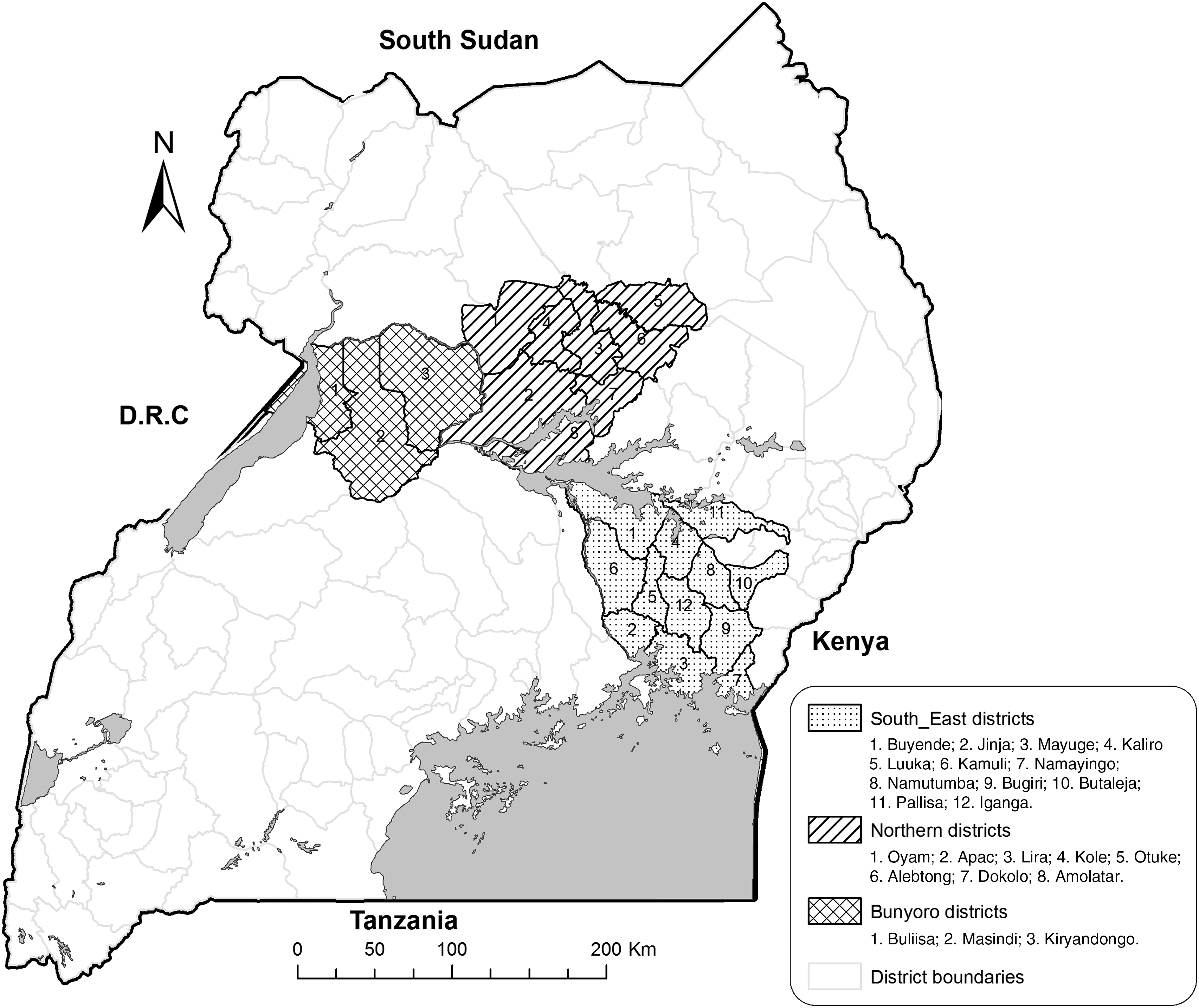
Map of Uganda showing zoonotic trypanosomiasis-endemic areas where COCTU and its partners have affirmatively promoted live bait technology interventions since 2013.
Number of cattle targeted
The approach was to use the catalytic model and set as an initial target to have 25% of the cattle (412,521) sprayed on a regular basis as earlier studies had indicated that this could lead to sustainable suppression of the tsetse vector and significant reduction in the transmission of trypanosomiasis (Kajunguri et al. 2014, Muhanguzi et al. 2014a, 2015). The estimated cattle population in the operational 23 districts of Luuka, Iganga, Kamuli, Mayuge, Namutumba, Bugiri, Namayingo, Jinja, Kaliro, Buyende, Pallisa, Butaleja in southeastern Uganda (Busoga and Bukedi subregions); Bulisa, Masindi, Kiryandongo (in Bunyoro subregion); and Dokolo, Alebtong, Lira, Apac, Amolatar, Kole, Otuke, and Oyam in northern Uganda (Lango and Acholi interface subregions) was ∼1,650,000.
The model was designed to leverage a catalytic action where 25% of the cattle are sprayed with the cost met by COCTU and the rest of the cattle/spray costs are met by the owners who recognize the benefits of vector control that also included ticks. Both public and private animal health workers continue promoting the approach to the communities with the treatments targeting all the cattle in the target districts (Fig. 1).
Drugs and chemicals used
Diminazene aceturate (Veriben B12®; Ceva Santé Animale [“CEVA”]) and deltamethrin (Vectocid®; CEVA) have been used for the interventions since the inception of SOS and are also the ones primarily adopted by the communities for scaling-up. Private sector-led veterinary drug shops promoting this approach, plus providing the supply chain network necessary for creating sustainability under the SOS initiative as described and earlier published (Waiswa and Rannalette 2010), stocked and supplied the needed chemicals and drugs.
Scaling up business for the sustainability of live bait model
The willingness of cattle owners to pay for the products and of the veterinary extension staff to promote the catalytic approach with a cost recovery approach provided the perfect opportunity to expand to additional areas endemic or regarded as high risk for zoonotic sleeping sickness. The veterinarians identified persons in the district/villages who were trained using the spray persons' approach (Waiswa and Rannalette 2010), including additional knowledge given on basic animal health handling and were code-named Animal Resource Key (ARK) persons. These now provided additional link points for cattle owners to access the needed drugs and chemicals from the area veterinarian as the demands could be placed within an average radius of 10 km2 since ARK persons are village-based.
Two of the initial successful five young veterinarians (Waiswa and Rannalette 2010) were mandated to undertake various entrepreneurial trainings of ARK persons with facilitation provided from COCTU under the catalytic public investment window geared toward creating sustainable ways of controlling sleeping sickness. The training involved understanding the basics of acaricide dilution, proper handling of chemicals involved, animal spraying techniques, entrepreneurship, as well as the scientific basis for spraying animals as one of the control measures of tsetse and trypanosomiasis.
While the scaling-up model was designed to rely on community spray pumps already available at the parish level under the various tick control initiatives, COCTU provided an additional five bucket spray pumps per district targeted. The additional pumps were centrally located at the district veterinary office to enable ARK persons to borrow them in case they had challenges with the community pump or where they succeeded in training a helper as an additional spray person. In addition, ARK persons were provided with the greatly needed protective wear as an additional catalytic investment by UTCC through its secretariat, COCTU.
Initially, each district was given the opportunity to treat and spray 10% of the animals of individual farmer herds for free using donated diminazene aceturate and deltamethrin spray as catalyst and encouraging the owners to pay for the rest of their animals. Small-holder livestock owners with few animals (<10) would get >10% sprayed for free but would be asked to pay for all the sprays at subsequent monthly sprays. While the cleansing with diminazene aceturate is only done once, the model is designed to have monthly sprays with deltamethrin. It is this live bait technology that has been used for the financial analysis done in this article.
The earnings from the commercial spraying of cattle at a fee of 500 Uganda Shillings (∼0.14 USD) per head of cattle would be used to buy more insecticide needed in case the catalytic quantity was used up. Each district was kick-started with 2000 head of cattle sprayed and that would be paid for by UTCC/COCTU in cash to the spray person regardless of the fact that they had also been facilitated with the donated deltamethrin for free under the catalytic approach. This was intended to enable them to cover their own operational costs as they visited and explained the model to the livestock owners, and were thus also given a chance to continue with the catalytic approach to cover further trypanosomiasis risk areas of the district.
The live bait technology was promoted as this had been described to be the most cost-effective (Shaw et al. 2013) and would enable these local village sprayers to procure deltamethrin at a cost of US$ 0.042 per animal and remain with US$ 0.098 to cover their labor and any other related costs. This model was implemented according to earlier calculations (Waiswa and Rannalette 2010), where each veterinarian trains and helps ARK persons to spray a minimum of 50 heads of cattle per day for 20 days a month. This allows each ARK person to spray 1000 cattle a month and earn US$0.098 × 1000 = US$ 98, which would contribute significantly to their daily income since they typically only use a few hours for the activity and can engage in other income-generation activities during the rest of the day.
Results
Supply chain of drug and chemicals targeting tsetse and trypanosomiasis control
In each of the 23 target districts, one of the existing veterinary drug shops was identified and encouraged to stock deltamethrin and diminazene aceturate that were being promoted for use under the live bait technology model.
Empowering ARK persons to undertake the model
The live bait approach led to the training of ARK persons in 23 districts that were at high risk for zoonotic sleeping sickness. In total, 453 youths from five subregions of Uganda were trained during the period 2013–2017 and were also engaged in the model during the reporting period. Their distribution per region against the target cattle population is given in Table 1 with Figure 2 giving the proportion trained per each subregion.
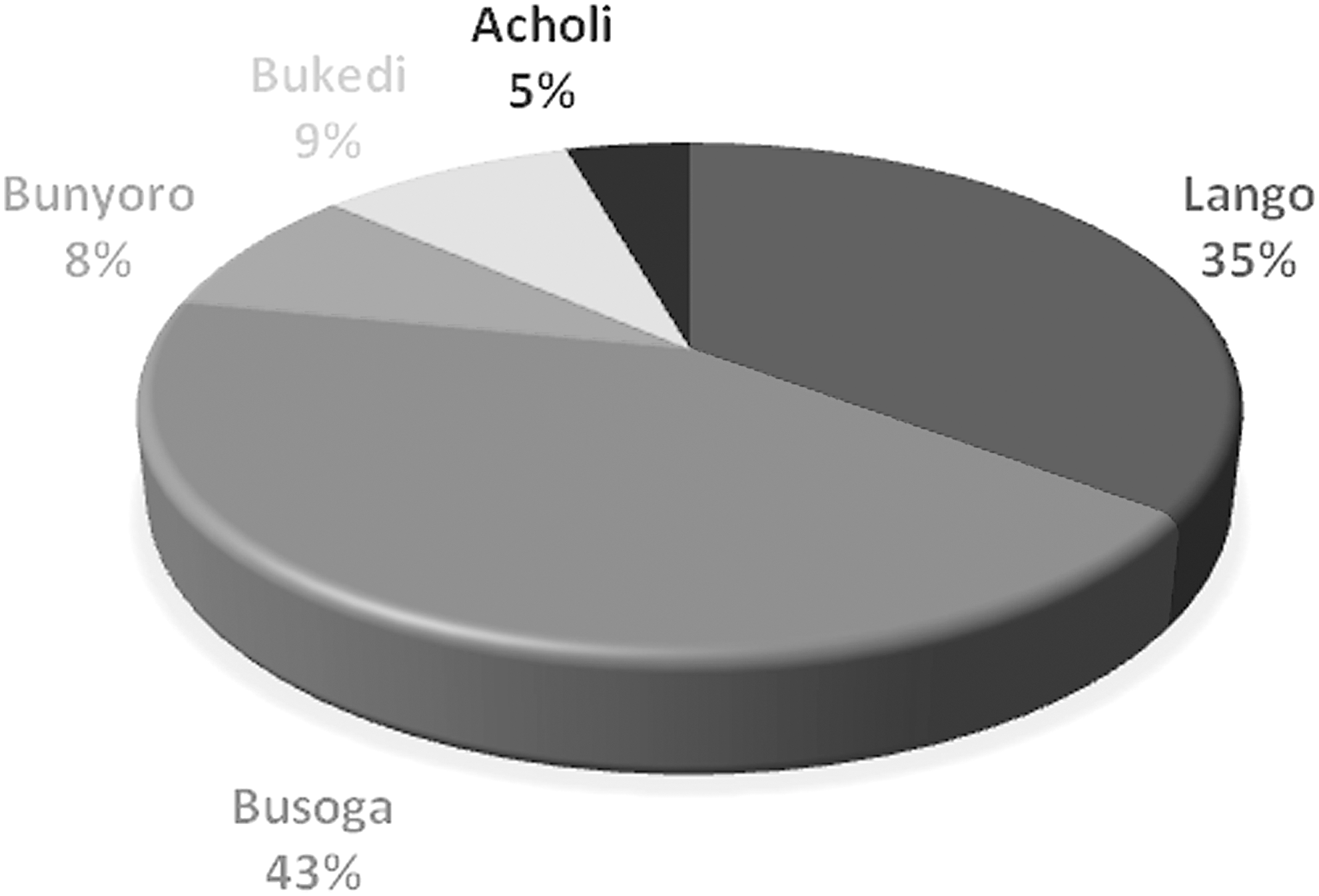
Proportion of ARK persons trained per subregion. ARK, Animal Resource Key.
Youth Trained per Sub-Region and Annual Target Cattle Sprays in the Control of Tsetse and Trypanosomiasis Over the Period 2013–2017
Tables 2–4 show the figures in cumulative coverage of livestock sprayed, cumulative financial contributions, and what it reflects in terms of percentage from the community.
Cumulative Coverage of Live Bait Technology per Sub-Region Over a 12-Month Period July 1, 2016 to July 30, 2017
COCTU, Coordinating Office for Control of Trypanosomiasis in Uganda.
Cumulative Contribution of the Community Towards Meeting the Cost of Live Bait Technology per Region Over a 12-Month Period July 1, 2016 to June 30, 2017
ARK, Animal Resource Key.
Percentage Contribution of Community to Supporting Live Bait Technology per Region Over a 12-Month Period of July 1, 2016 to June 30, 2017
A total of 181 L of deltamethrin was used for the catalytic sprays in the five subregions to spray about 181,274 heads of cattle, which is about 11% of the ideal target of 1,650,081 heads of cattle. After seeing the benefits of the technology, the community was able to pay for about 614 L of deltamethrin to spray an extra 614,878 heads of cattle, which is about 37% of the ideal target and accounting for 77% of the 796,152 cattle sprayed.
Discussion
In 2005, there were heavy concerns from Uganda and many other stakeholders on the rapid spread of T. b. rhodesiense sleeping sickness from the traditional endemic area of southeastern Uganda to areas northwards that had previously not been known to be affected with the disease. Evidence produced at the time indicated the potential merger with Trypanosoma brucei gambiense sleeping sickness-affected areas of northwest Uganda (Picozzi et al. 2005). The spread happened at a time when the veterinary and public health services were greatly inadequate in northern Uganda that was recovering from armed rebellion.
The threat of uncontrolled spread of sleeping sickness to areas where people were resettling after years of displacement by the Lord's Resistance Army (LRA) conflict led a group of stakeholders to form the SOS Consortium that engaged final-year Makerere University undergraduate veterinary students to carry out treatment of 250,000 cattle that were being blamed as the reservoirs leading to the spread of the disease (Kabasa 2007, Waiswa and Kabasa 2010, Waiswa and Rannalette 2010). The risk of the merger of the two forms of sleeping sickness that was seriously threatening has been greatly reduced, thanks to the continuous use of the live bait technology approach—initially provided as a public good and now promoted through entrepreneurial models using both public and private veterinarians plus ARK persons who use catalytic sprays as a tool to promote the technology.
In this approach, the cost of covering more animals is met by the livestock owners in the target districts, and it has led to the development of a model that allows participation at all levels (young veterinarians, village-based ARK persons, and animal owners) and the spread of control benefits to many tsetse and trypanosomiasis-threatened areas.
Although the training and engagement of ARK persons was open to both males and females, 95% were males and only 5% females, which can be attributed to the nature of spray activity that involves a lot of movement in villages, which is not culturally comfortable for females in the areas of operation, an issue that needs to be handled together with gender equality and other specialists to enable more female engagement in the model. Seventy-eight percent of the trainees were from Busoga and Lango subregions. This is because Busoga is historically an endemic area for acute rhodesiense sleeping sickness, and it was blamed for being the source of cattle reservoirs, while Lango was one of the key recipients during the cattle restocking program where the merger between chronic and acute forms of sleeping sickness was threatening to happen (Picozzi et al. 2005).
It should be noted that while as many as 453 youth were trained, there is a certain challenge that only 230 remained actively involved after 12 months in the spray activities, giving a retainership of ∼51% in the model. The youth drop-off is also attributed to the entrepreneurial success of the model due to the tendency of urban migration after accumulating some initial money to further one's education or move to invest in other business or crop production outside of their initial area of operations. Although 51% is still considered a good retention of the ARK persons in the model, it is important for COCTU and its partners to explore ways of engaging these persons in surveillance and other animal and human health programs to enhance retention and reduce training costs.
Additionally, it is important to target 100% of the herd as the model there becomes more attractive as it then also benefits the control of other vectors and their challenges to livestock, such as the tick-borne diseases. The current catalytic approach to stimulate sprays for the control of tsetse fly vector in the area was based on reaching at least 412,521 (25%) heads of cattle as earlier studies had indicated significant reduction in trypanosomiasis transmission with that level of coverage (Kajunguri et al. 2014, Muhanguzi et al. 2014a, 2015), although the ultimate goal of scaling up live bait in the target area was to reach out to the whole cattle herd of 1,650,081 in the 23 districts. The COCTU goes to the community and promotes the technology with catalytic sprays to allow the communities to see and experience the benefits of the technology with the intention of empowering the community to adopt the technology and pay for the service through the trained ARK persons and improving access to the needed insecticides and drugs.
During the reporting period (July 1, 2016 to June 30, 2017), the community was able to meet the cost of spraying 614,878 heads of cattle, which corresponds to about 37% of cattle population in the target area, confirming the community interest in the model and thus indicating great potential for it being sustainable. In addition, the approach demonstrates that it is possible to invest relatively little to stimulate the community to embrace a particular technology to control and possibly eliminate one of the neglected zoonotic diseases.
The financial contribution by livestock owners in the promotion of live bait technology for the period July 1, 2016 to June 30, 2017 has been captured as 307,439,000 Uganda Shillings (US$ 85,400), which is encouragingly higher than the UTCC/COCTU-supported catalytic investment that was equivalent to US$ 25,177 during the same period. This further emphasizes the communities' appreciation and adoption of the technology, and which over time has been manifested in the number of T. b. rhodesiense sleeping sickness cases reducing over these years from 473 cases in 2005 to 10 cases in 2017 as captured by the records available at the UTCC.
These achievements are encouraging and promote innovative approaches to problem-solving and the “art of thinking outside of the box,” and the importance of responsiveness to the needs of the community as advocated by some earlier researchers (Hendrix et al. 2005). The few cases and the drivers for the persistence of zoonotic sleeping sickness in a few villages and the role of cattle reservoir and/or other drivers of persistence, including silent disease carriers (Welburn et al. 2016), need urgent attention by the UTCC to get vital answers to enable the elimination of trypanosomiasis challenge in Uganda.
Finally, entrepreneurial models in the control of neglected tropical diseases is an area that has not been extensively exploited, and this report indicates that once the affected communities are introduced to the technology and as they recognize the benefits, they are able to contribute from the limited available resources as evidenced by them meeting the cost of spraying 77% of the total sprayed livestock in the subregions analyzed.
The major threat to the live bait model is the frequent stock-out of insecticides and drugs used due to the irregular supply levels of national distributors. It is anticipated that strengthening the private veterinary approach and the network, including the ARK persons, that evolved from the SOS initiative will help stabilize the supply chain for the benefit of all stakeholders.
Footnotes
Acknowledgments
This work was carried out with financial and nonfinancial support from the government of Uganda through UTCC and its secretariat, COCTU, district local government, animal owners, and ARK persons. This analysis benefited greatly from the work of the SOS initiative, although the views expressed in this publication are those of the authors and not necessarily those of the SOS Consortium.
Author Disclosure Statement
No conflicting financial interests exist.