




Abstract
Background:
The purpose of this report is to provide information on Culicidae diversity; biting behavior and spatio-seasonal variation of abundance of Anopheles gambiae s.l. and Culex quinquefasciatus in rural and urban settings of the Alibori and Donga regions, Northern Benin, where an indoor residual spraying (IRS) campaign to control malaria is planned.
Methods:
Both human landing catches, associated with pyrethrum spray catches were used to monitor the mosquito populations in 12 sites with 1 urban and 1 rural located in each of the 6 districts randomly selected in the two targeted regions. After morphological identification of all mosquito specimens, biting behavior and density of An. gambiae s.l. and Cx quinquefasciatus were studied. PCR was also performed on An. gambiae s.l., to identify sibling species and its seasonal variation.
Results:
A total of 10,367 mosquitoes were captured, related to 14 species of the genera, Anopheles, Aedes, Culex and Mansonia. Of the total species collection, 40.39% were An. gambiae s.l. and 56.85% were Cx. quinquefasciatus. An. gambiae s.l. was more abundant in Donga (2521 specimens) compared with Alibori (1666 specimens). The opposite trend was observed with Cx. quinquefasciatus (2162 specimens in Donga against 4028 in Alibori). An. gambiae s.l. was predominant and displayed a higher blood feeding rate in rural areas, whereas Cx. quinquefasciatus was in majority in urban areas. An. gambiae s.l. was more endophagic, whereas Cx. quinquefasciatus showed similar indoor and outdoor biting behavior. An. gambiae s.l. was composed of An. coluzzii found in majority in the drought, and An. gambiae, which was predominant in the rainy season.
Conclusion:
The predominance of the malaria vector, An. gambiae s.l. and their higher blood feeding rate and their significantly high endophagy in rural areas indicate that these areas should be primarily targeted with the IRS operations to have a substantial impact on malaria transmission. Endophagy, characteristic of An. gambiae s.l. in our study area, suggests that IRS will have a positive impact on vector control if implemented 1 week before June that is the onset of the rainy season.
Background
In public health, mosquitoes are considered as one of the most important groups of arthropods (Schaffner et al. 2001, Becker et al. 2010). Those belonging to the Anopheles, Culex, and Aedes genera, are the most studied because of their role in the transmission of a variety of human and animal diseases. According to the World Health Organization (WHO 2014), vector-borne diseases account for 17% of the estimated global burden of all infectious diseases; the main vector-borne disease in West Africa being malaria. In Benin, Anopheles gambiae s.l. is the major vector of malaria (Akogbeto 1992, Akogbeto and Di Deco 1995), which is the leading cause of morbidity and mortality in children under 5 years old (Ministère de la Santé/DPP 2013).
Long-lasting insecticidal nets (LLINs) massively distributed in the country in 2014 and indoor residual spraying (IRS) remain the strategic pillars in the prevention of malaria in Benin. In 2008, IRS was introduced in the Oueme department, Southern Benin with a carbamate insecticide (Bendiocarb) as the high pyrethroid resistance observed in malaria vectors (Akogbéto and Yacoubou 1999) has reduced the efficacy of standard LLINs (N'guessan et al. 2007). The strategy which displayed a great success (Akogbeto et al. 2011, 2015, Osse et al. 2012) was then relocated in the Atacora department, northern Benin from 2011 to 2015.
The technical rationale for this relocation was the short transmission period that can be easily covered by a single spray round in the new targeted department, allowing a better cost effectiveness. IRS success has also been recorded in other countries, namely Madagascar (Randriantsimaniry 1995), Equatorial Guinea (Bioko Island) (Sharp et al. 2007) and Southern Africa (Sharp et al. 2000, Mabaso et al. 2004). Despite these successes, major challenges remain, including the fact that some countries implement vector control interventions without reliable baseline on entomological data. Indeed, those data are necessary as they allow national malaria control program to know the exact places where vector biting rates or malaria transmission are high and also, the right moment for the implementation of a control intervention such as IRS to have the maximum impact on the peak in biting of malaria vectors.
For that, the availability of sufficient entomological baseline data should be a priority to guide the development of vector control policies (Marsh 2010). Success in the planning, implementation, and evaluation of vector control interventions depends on the knowledge of spatial and temporal variation of disease vectors (Killeen et al. 2011).
In Benin, since the advent of IRS, the monitoring of its impact has focused solely on the behavioral change of Anopheles, vectors of malaria (Akogbeto et al. 2011, 2015, Osse et al. 2012). However, Culex quinquefasciatus, which is a vector of lymphatic filariasis (Wuchereria bancrofti) (Maxwell 1990), have been neglected in entomological evaluations. Although high resistance to insecticides (Yadouleton et al. 2015) has been detected in Cx. quinquefasciatus, some authors have reported that some strategies could have a positive impact on the control of this mosquito (Hougard et al. 1993). So far, lymphatic filariasis has not been a public health problem in Benin, but the nuisance and even the daily stress caused by Culex bites are important factors that should not be neglected (Viniaker and Lavaud 2005).
In 2017, an IRS campaign with Actellic 300CS was planned to target the Alibori and Donga regions. As a prelude to this control campaign, this study was initiated in some urban and rural sites of the targeted regions to obtain information on the distribution, density, biting behavior, and seasonal variations of An. gambiae s.l., main malaria vector (Akogbeto 1992, Akogbeto and Di Deco 1995) and Cx. quinquefasciatus, mosquito of high nuisance (Agbanrin et al. 2015) in Benin.
Materials and Methods
Study area
Data collection took place in six districts located in two regions: the Kandi, Gogounou and Segbana (KGS) districts in the Alibori region, then the Djougou, Copargo and Ouake (DCO) districts in the Donga region. The Alibori region of is characterized by a Sudanese climate and the Donga region by a Sudano–Guinean climate. Both regions have a single dry season (December to May) and a single rainy season (June to November). Overall, the average monthly temperature varies between 23°C and 40°C. The region of Donga has more rivers than the region of Alibori. The DCO and KGS health zones cover an area of 5465 km2 and 12,943 km2 with a population of 424,425 and 325,522 inhabitants, respectively, mostly farmers. The incidence of malaria was 21.4% in the DCO health zone and 19.4% in the KGS health zone (SGSI/DPP/Zs-DCO/MS 2016) (SGSI/DPP/Zs-KGS/MS 2014).
In the current study, one urban and one rural sites were selected in each district for the monthly collections of mosquitoes. Urban sites have several development infrastructures, such as gutters, sewers, and roads, unlike rural sites that do not have. Urban/Rural villages were Bantansoue/Gounarou, Kossarou/Sonsoro, Segbana-Centre/Liboussou, Parakounan/Kataban, Zountori/Barienou, and Aboulaoude/Komde, respectively, in the districts of Gogounou, Kandi, Segbana, Copargo, Djougou, and Ouake (Fig. 1).
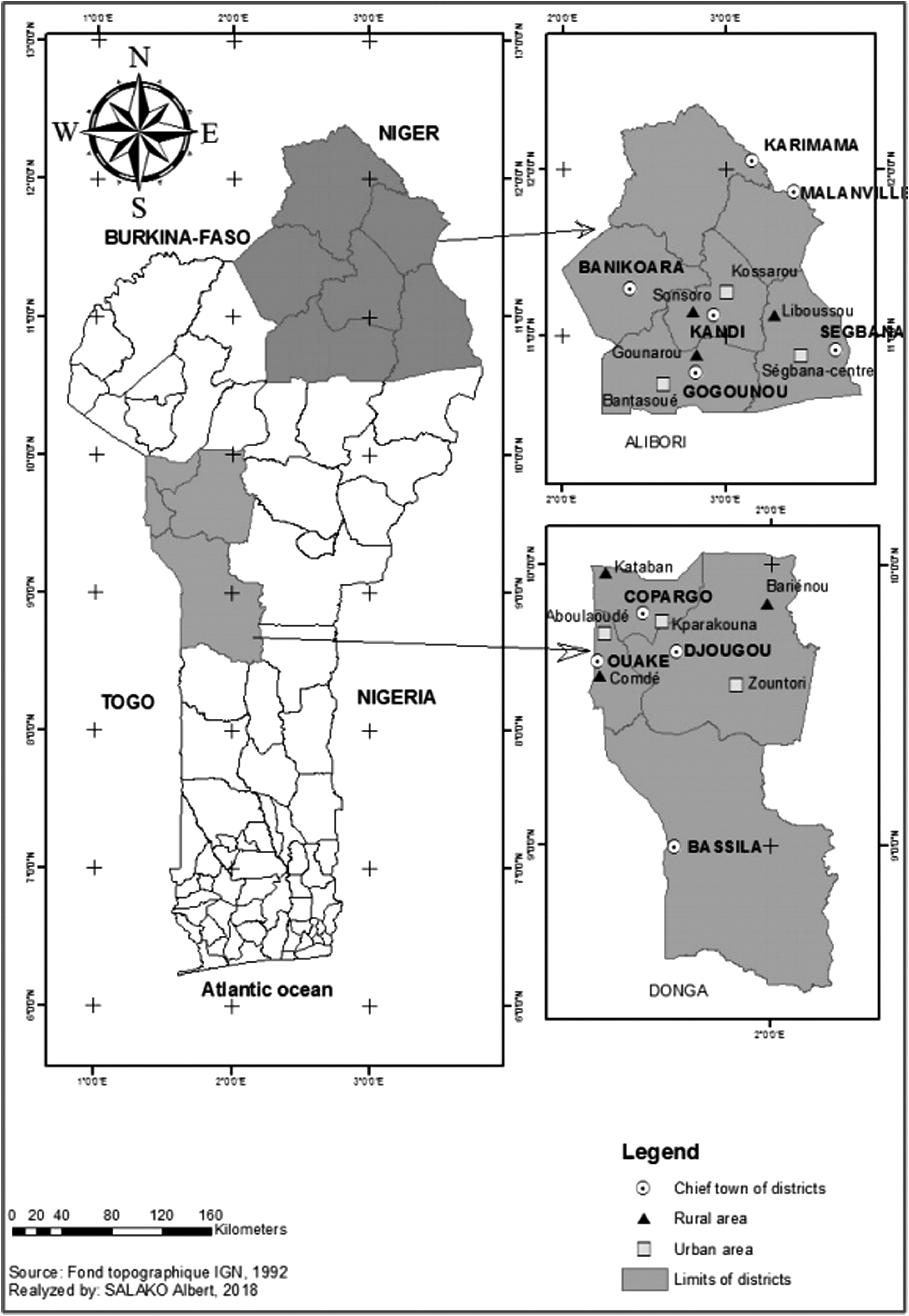
Map showing the study area.
Mosquito sampling
Human landing catches (HLCs) were conducted in two houses per village from 9 PM to 5 AM for two nights per month over 7 months (May 2016 to February 2017, with no data collected in September, November, and December 2016) to monitor the mosquito populations. At each house, one indoor mosquito collector and one outdoor mosquito collector collected all mosquitoes that landed on their feet (World Health Organization 1993). The number of collectors and the number of sessions were the same for all surveyed districts in each month. In each district, recorded data were used to evaluate the mosquito species composition and to determine the human biting rate (HBR) of Anopheles and Cx. quinquefasciatus.
In addition, pyrethrum spray catches (PSCs) were performed, as described by WHO 1993 for 20 rooms (10 in the urban site and 10 in the rural site) per month over the same 7 months to assess the resting behavior and the vectors' blood feeding rate in each of the six districts. The number of sessions and of investigated rooms were the same for all surveyed districts in each month. PSCs consisted of covering the floor with white sheets, spraying the rooms and collecting all fallen mosquito specimens. After collection, mosquitoes were counted and morphologically identified.
Processing methodology
After each collection, collected mosquitoes were counted and separated into Culicinae and Anophelinae using a stereomicroscope. Mosquitoes were identified using the taxonomic keys of Gillies and De Meillon (1968) and Gillies and Coetzee (1987). Specimens of An. gambiae s.l. were separated for further molecular analyses.
A sample of 8–68 female specimens of An. gambiae s.l., randomly sampled per district per month, bringing to a total number of 111–350 over the study period according to the district, was analyzed by PCR according to the protocol of Santolamazza et al. (2008) for the determination of the molecular species of the An. gambiae complex. Thus, specific primers (F6: TCG CCT TAG ACC TTG CGT TA and R6: CGC TTC AAG AAT TCG AGA) were used. The reactions were carried out in a total volume of 25 μL containing 10 pmol of each primer, 0.2 mM of each dNTP, 1.5 mM of MgCl2, 1 U of Taq polymerase and 0.5 μL of the template DNA.
The thermocycler conditions were 94°C for 5 min (step 1), followed by 35 cycles (94°C for 30 s [step 2], 54°C for 30 s [step 3], 72°C for 1 min [step 4]), and 72°C for 7 min (step 5). The products resulting from the amplification were analyzed on a 1.5% gel stained with ethidium bromide.
Data analysis
Species Richness (S), which corresponds to the number of collected species, and their relative abundance (Pi) were assessed (Pi = ni/N, where ni = number of species i; N = total number of species encountered, i = 1) by district.
The Shannon–Wiener index (H) shows that the species diversity was determined by district using the formula H = −∑ Pi × log (Pi) (Shannon 1948).
The equitability index was also calculated. It equals to the ratio of the Shannon index to the maximum value that this index could attain if all species in the district were represented in similar proportions.
The Simpson index (D), which is a dominance index was determined according to the formula: D = 1/∑ Pi (Simpson 1949).
The HBR for An. gambiae or Cx. quinquefasciatus was calculated as the number of collected mosquito species divided by the number of collectors and of nights of sampling effort. The mean indoor resting density of An. gambiae s.l. was determined by the following way: The total number of vectors collected by PSC/Total number of rooms surveyed. The Poisson method (Rothman 2012) was used to estimate confidence intervals for biting rates and compare them between districts, urbanization level (rural and urban), and location (indoors and outdoors). The same method was also used to compare the average indoor resting densities between rural and urban areas. Densities of An. gambiae (s.l.) with different superscripts (a, b) are significantly different (p < 0.05).
The abundance of a given species of mosquito was obtained by cumulating its total number obtained through both HLC and PSC. To assess the spatiotemporal variation of this indicator, it was blot versus monthly rainfall data obtained from Agence pour la Sécurité de la Navigation aérienne en Afrique et à Madagascar (ASECNA) using an excel spreadsheet.
The blood feeding rate of An. gambiae s.l. was obtained by dividing the number of fed and half gravid mosquitoes by the total number of collected mosquitoes. The chi-squared test of comparison of proportions was used to compare the proportions of sibling species of the An. gambiae complex on one hand, and the blood feeding rates of An. gambiae (s.l.) between the rural and urban areas on the other hand, using the R software, version 3.3.2.
Ethics approval
This study was approved by the Institutional Ethics Committee of CREC (IECC) (N°338/MS/DC/SGM/DRFMT/CREC/CEI-CREC/SA).
Mosquito collectors were regularly monitored. In case of confirmed malaria, they were immediately taken care of by the medical doctor of the team according to protocol.
Results
Mosquito species composition
A total of 10,367 mosquitoes were captured during the study period in the six districts using both HLC and PSC. The mosquitoes belonged to 4 genera (Anopheles, Aedes, Culex, Mansonia) and 14 species. Overall, seven Anopheles species were harvested, including the two main malaria vectors: An. gambiae s.l. (40.39%) and An. funestus: (0.98%) (Table 1). As shown by the Table, the other species of Anopheles captured included An. nili (0.01%), An. pharoensis (0.03%), An. ziemanni (0.02%), An. paludis (0.01%) and An. coustani (0.09%) (Table 1).
Mosquito Species Composition and Density in the Study Sites with the Two Collection Methods (Human Landing Catch and Pyrethrum Spray Catch Methods)
Cx. quinquefasciatus was collected at high densities (56.85%) unlike other Culex species, such as Cx. nebulosus and Cx. decens. Cx. quinquefasciatus was the most captured mosquito species in Segbana (81.15%), Gogounou (75.71%), Kandi (56.76%), Ouake (55.72%), and Djougou (49.53%). Mansonia africana was also collected in most districts but at very low frequency (0.22% on overall) (Table 1).
The species richness observed at Copargo (11 species) is similar to that of Kandi (10 species), Gogounou (9 species), Djougou (8 species), Segbana (7 species), and Ouake (6 species) (p > 0.05).
The Shannon–Wiener index was 0.89 [0.87–0.92] in the DCO health zone against 0.69 [0.68–0.72] in the KGS health zone (p < 0.05). The Simpson indices were 0.56 [0.53–0.58] and 0.43 [0.42–0.44], respectively, in the DCO health zone and the KGS health zone.
Monthly variation of abundance of An. gambiae s.l. and Cx. quinquefasciatus in Alibori and Donga
An. gambiae s.l. and Cx. quinquefasciatus were present permanently throughout the study period in Alibori and Donga regions, but the abundance of both species varied seasonally. The density of An. gambiae s.l. was more abundant during the rainy months in the two regions with a single peak in Alibori (October) compared with two peaks in Donga (July and August). Conversely, the density of An. gambiae s.l. was relatively low from January to May during the drought and the Harmattan period (Fig. 2). For Cx. quinquefasciatus, the period of highest density coincided with the driest and warmest months, whereas the period of lowest density corresponded with the rainy months.

Spatiotemporal distribution of abundance of Anopheles gambiae s.l. and Culex quinquefasciatus according to the rainfall in Alibori and Donga
Spatiotemporal distribution of species of the An. gambiae s.l. complex
Out of the 1497 specimens of An. gambiae s.l. analyzed by PCR, two sibling species were observed: An. coluzzii (56%, n = 835) and An. gambiae (44%, n = 662) (p = 0.0000324). The distribution of these species varied in time and space (Fig. 3). Overall, in Alibori (KGS combined), 69% (452/658) of specimens were An. coluzzii and 31% (n = 206/658) were An. gambiae (p = 0.00000022). In Donga (DCO cumulated), 54% (n = 456/839) of specimens were An. gambiae and 46% (n = 383/839) were An. coluzzii (p = 0.00043). Both species were present throughout the study period, except between January and February when An. gambiae was not found in most of the surveyed districts (Fig. 3). An. coluzzii predominated during the dry season (Periods May to June and February to January), whereas An. gambiae predominated from June to October (rainy season) (Fig. 3).
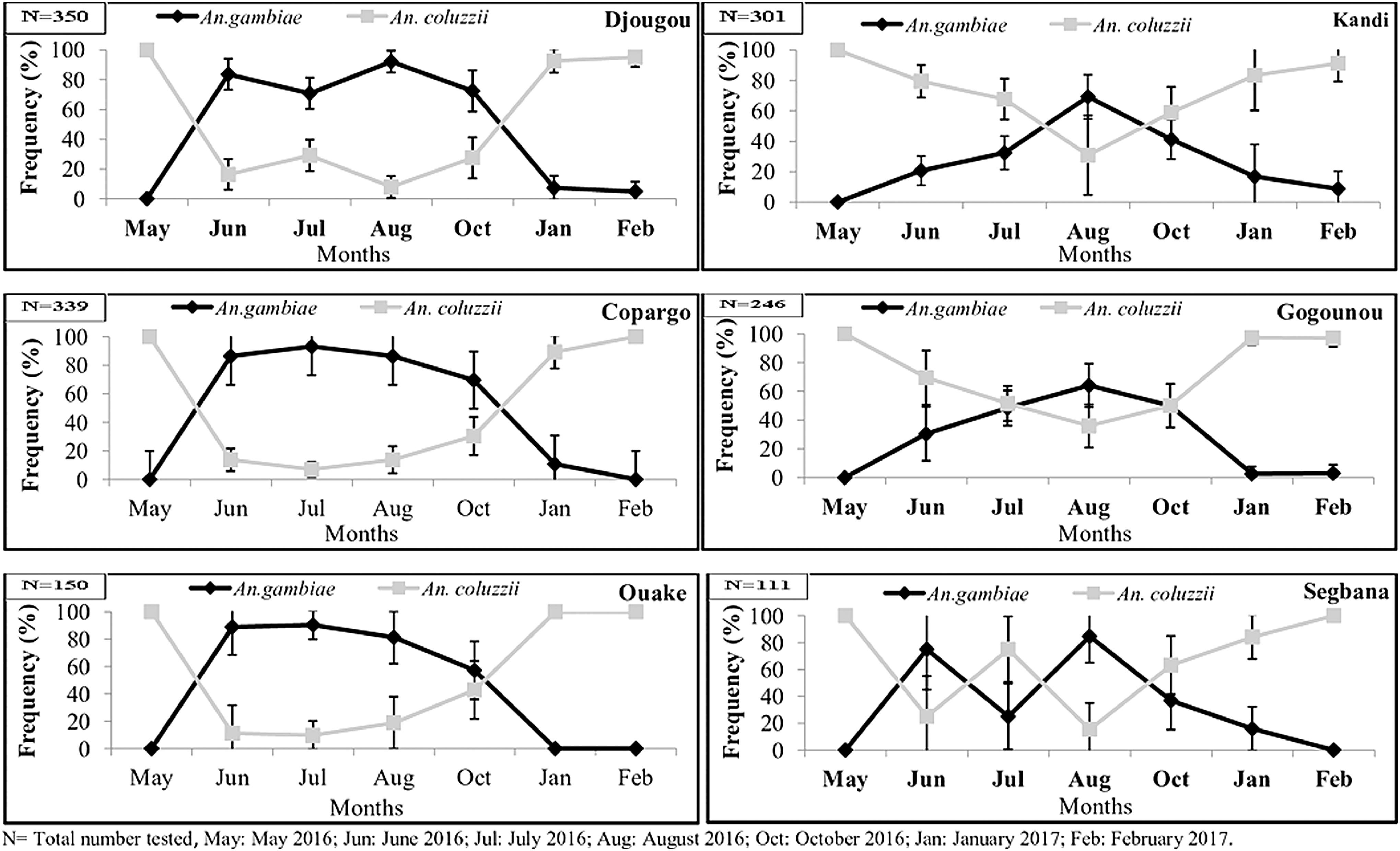
Spatiotemporal distribution of species of the Anopheles gambiae s.l. complex in Alibori and Donga.
HBR of An. gambiae s.l.
The HBR of An. gambiae s.l. varied significantly from one region to another (p < 0.001) with 132–143 bites/man/month in Alibori and 196–225 bites/man/month in Donga (Table 2). Overall, the HBR was four times higher in rural areas than in urban areas (rate ratio = 4.27; p < 0.001) and was higher indoors (191.25 bites/man/month) than outdoors (157.78 bites/man/month) (p = 0.0000002) (Table 2).
Variability of A nopheles gambiae s.l. Biting Rate
Nb, number; HBR, human biting rate; CI, confidence intervals.
HBR of Cx. quinquefasciatus
The HBR of Cx. quinquefasciatus was higher in Gogounou, Kandi (Alibori region), and Djougou (Donga region) (Table 3). Contrary to An. gambiae s.l., the HBR of Cx. quinquefasciatus was significantly higher in urban areas than in rural areas (p < 0.001) with 291 bites/man/month in urban areas compared with 128 bites/man/month in rural areas. Moreover, this species exhibits similar biting behavior indoors (201.63 bites/man/month) and outdoors (217.78 bites/man/month) with an endophagic index of 0.48 [(1398)/(1398 + 1510)] against an exophagic index of 0.52 [(1510)/(1398 + 1510)] (Table 3).
Variability of Culex quinquefasciatus Biting Rate
Blood feeding rate, indoor resting density of An. gambiae s.l.
Table 4 shows the blood feeding rate and the indoor resting density of An. gambiae s.l. in rural and urban areas of the Alibori and Donga regions.
Blood Feeding Rate and Indoor Resting Density of Anopheles gambiae s.l. Collected by Pyrethrum Spray Catch Method in Rural and Urban Areas of Alibori and Donga
p-Value: p-Value of comparison of the blood feeding rate of Anopheles gambiae s.l. between rural and urban areas; densities of Anopheles gambiae s.l. with different superscript (a, b) are significantly different (p < 0.05).
KGS, Kandi, Gogounou and Segbana; DCO, Djougou, Copargo, and Ouake.
Overall, cumulated data show that vector density was higher in rural than in urban areas in each of the two regions (2.3 An. gambiae s.l./room vs. 0.56 in Donga [p = 0.000] and 1.35 An. gambiae s.l./room vs. 0.49 in Alibori [p = 0.0001]).
The blood feeding rate was high and similar in urban and rural areas of Donga, 93.27% and 96.11% (p = 0.111), respectively. By contrast, a significant higher blood feeding rate was observed in rural (93.64%) than in urban (86.17%) areas (p = 0.002) of Alibori. Similarly, combined data of both regions show a higher blood feeding rate in rural areas (95.17%) as compared with urban areas (89.9%) (p = 0.00016).
Discussion
This study provides some entomological baseline data on mosquito population dynamics in Alibori and Donga regions, two areas in northern Benin, where IRS was planned to be applied. A total of 14 different species of mosquitoes were collected during this study, compared with 13 and 15 species collected in southeastern Benin by Huttel (1950) and Hamon (1954), respectively. Our data are similar to those of Gnanguenon et al. (2014) who reported 12 species of mosquitoes in sentinel sites, including the Borgou region, which is not far from Alibori and Donga.
The Shannon–Wiener and Simpson indices, which are higher in the DCO health zone compared with the KGS health zone show that mosquito population is more diverse in the DCO health zone than that of KGS.
The abundance of An. gambiae s.l. in both regions confirms earlier findings of studies carried out in northern Benin (Aïkpon et al. 2013, Gnanguenon et al. 2014). The relative abundance of Cx. quinquefasciatus in urban sites would be due to the presence of several larval habitats (sewers, abandoned wells, and cisterns) containing organic matters, and which were favorable to the development of Cx. quinquefasciatus, around houses.
In rural areas, where there is a lack of development infrastructures, such as gutters, drainage channel, and roads, much less polluted breeding sites that are conducive to the development of Anopheles, were formed in large numbers after rains. Such larval habitats were very close to the rural agglomerations made of several houses, which facilitated the blood meal intake and the oviposition of Anopheles gambiae s.l. resulting thus in their proliferation as observed by Govoetchan et al. (2014). Similarly, Fontenille et al. (1997), Gila et al. (2003), and Hay et al. (2005) have noticed a higher risk of malaria transmission in rural areas than in urban areas. This suggests that, vector control interventions, such as IRS operations must focus more on rural areas so as to have a substantial impact on malaria transmission.
Indoor and outdoor HBR of the two species differs by study site. Contrary to Cx. quinquefasciatus, which had similar indoor and outdoor trophic activity, the proportion of An. gambiae s.l. inside dwellings was relatively high throughout the study areas. The indoor biting behavior observed in An. gambiae s.l. is justified by its anthropophilic characteristics and by the fact that people do not typically rest outside their dwellings in the study area during the rainy season, which is also the period with the highest vector abundance. These observations support the plans to implement IRS, which preferentially targets endophagic and/or endophilic vectors.
Moreover, the data collected simultaneously on the levels of resistance to different classes of insecticide showed resistance to pyrethroids (permethrin and deltamethrin), emerging resistance to bendiocarb and full susceptibility to pirimiphos-methyl in An. gambiae (s.l.) populations in both targeted regions (Salako et al. 2018). However, the short residual life (3 months) of pirimiphos-methyl observed by Aïkpon et al. (2014) in the neighboring region of Atacora suggests the use of another effective insecticide that has at least 6 months of remanence. For that, Fludora® Fusion, a mixture of clothianidin and deltamethrin that displayed a residual life of 10 months (Agossa et al. 2018) in a small-scale field evaluation carried out in Benin could be a good candidate.
Given the relationship between increasing rainfall and increasing density of An. gambiae s.l., it is likely that rainfall is a key factor in determining the existence and abundance of Anopheles species and the duration of seasonal malaria transmission (Lindsay and Birley 1996, Besancenot et al. 2004). In the Sahel in Senegal, Fontenille et al. (2003) noticed a decrease in Anopheles density following a decrease in precipitation. That should be taken into account in setting the spraying schedule. Indeed, for a more efficient insecticide treatment, the spraying campaign should start 1 week before June, the onset of the rainy season to protect people against malaria when the bites of Anopheles are likely to be high.
Only two species of the An. gambiae s.l. complex, An. gambiae and An. coluzzii, were involved in malaria transmission in both regions (Akogbéto et al. 2018) with predominance of An. coluzzii further north in Alibori probably due to higher aridity as reported in some studies in Nigeria (Coluzzi et al. 1979, 1985), Cameroon (Onyabe and Conn 2001, Simard et al. 2009), and Burkina Faso (Diabate et al. 2005). In the Alibori, a region in the extreme north of Benin, where the degree of aridity is high, An. coluzzii was predominant (69%) during most of the study period. On the other hand, in the more southern Donga region, An. gambiae was predominant. These results confirm the works of Toure et al. (1994) who reported a gradual decrease in the frequency of An. coluzzii when moving from a Sahelian environment in the north to a forest environment in the south.
The abundance of An. gambiae during the rainy season is due to the creation of numerous temporary larval breeding sites during raining season (Diabate et al. 2008, Lehmann and Diabate 2008). No specimen of An. arabiensis, a malaria vector of dry savanna areas, was found in our samples, whereas Akogbeto (1992), Akogbeto and Di Deco (1995), and Djogbenou et al. (2010) previously reported their presence in sympatry with An. gambiae s.s. in northern Benin.
Our results confirm works by Aïkpon et al. (2014), which also reported the only presence of An. gambiae and An. coluzzii in Kouande, Tanguieta, and Copargo districts, which are quite close to our study area. The absence of An. arabiensis could be due to an accelerated urbanization that destroyed the natural habitats of this species, which are mostly dry savannas (Dukeen and Omer 1986). This species is also known as being zoophilic (Duchemin et al. 2001), but the longer droughts observed in recent years in northern Benin have created a lack of grazing leading to the displacement from the north to the center of the country of most animals on which An. arabiensis used to feed blood, hence its absence.
The blood feeding rate, which is a proxy indicator of the man–vector contact frequency and of malaria transmission risk (Garrett-Jones and Shidrawi 1969) was overall higher in rural than in urban areas (p = 0.00016). This could be due to a stronger man–vector contact facilitated by the proximity, between numerous breeding sites of Anopheles and the houses in rural areas. Another contributing factor could also be, the fact that most rural populations might have spent more time outdoors before sleeping under their nets or preferred to spend most nights outside their nets, because of their low level of education that does not allow them to know the importance of the use of LLINs to avoid infected bites of mosquitoes as compared with urban populations. This suggests that people from rural areas need more sensitization.
The cross-sectional nature (only 7 months) of the current study stresses the need for further elaborate studies to complete the picture of population dynamics of vectors for all seasons.
Conclusion
This study revealed that An. gambiae s.l. and Cx. quinquefasciatus were the most abundant mosquito species in our study area, but with different levels according to the region. The endophagy character of An. gambiae s.l. noted in the study is an asset for IRS implementation 1 week before June, which is the start of the rainy season. Cx. quinquefasciatus had a similar indoor and outdoor trophic habit and predominated during the dry season, during which time IRS has little residual efficacy. The high abundance of An. gambiae s.l. and its higher blood feeding rate in rural areas stress the need for those areas to be primarily targeted by the IRS operations to have a substantial impact on malaria transmission. A longitudinal study covering at least all 12 months of a year is required to have sufficient data on the vector population dynamics for all seasons.
Ethics Approval and Consent to Participate
The protocol of this study was reviewed and approved by the Institutional Ethics Committee of CREC (IECC). Before mosquito collectors were involved in this study, they gave their consent to participate. They were vaccinated against yellow fever, regularly checked up by a medical doctor, and taken care in case of confirmed malaria case.
Availability of Data and Materials
The data used and/or analyzed in this study are available from the corresponding author on reasonable request.
Footnotes
Author's Contributions
A.S.S., R.O., R.A., G.G.P., and M.C.A. conceived the study. A.S.S., R.A., C.K., H.S., and M.C.A. have participated in the design of the study. A.S.S., G.G.P., R.O., C.K., H.S., and R.A. carried out the field activities and the laboratory analysis. A.S. and M.C.A. drafted the article. A.S.S., A.S., F.D., M.S., and M.C.A. critically revised the article for intellectual content. All authors read and approved the final article.
Acknowledgments
The authors are grateful to the President's Malaria Initiative, which supported this study financially. The authors thank Bruno AKINRO for statistical analysis and André SOMINAHOUIN for the realization of the map of the study area. The authors would also like to thank the populations of Sonsoro, Kossarou, Gounarou, Bantansouè, Bariénou, Zountori, Kataban, Kparakouna, Komdè, Aboulaoudè, Liboussou, and Segbana center for their collaboration. This study was financially supported by the United States President's Malaria Initiative (PMI) through the United States Agency for International Development (USAID) Africa Indoor Residual Spraying Project (AIRS) Project.
Author Disclosure Statement
No conflicting financial interests exist.