




Abstract
Background:
To date, there have been few investigations on Candidatus Rickettsia tarasevichiae in rodents carried out in China. In this study, we conducted surveillance for Candidatus R. tarasevichiae infection in rodents. A total of 463 rodents were captured at five survey sites in Mudanjiang, Heilongjiang province, where Candidatus R. tarasevichiae patients have been reported. PCR targeting citrate synthase and outer membrane protein genes was performed and positive amplicons were sequenced.
Result:
Candidatus R. tarasevichiae was detected in 1.29% of the 463 rodents sampled from the five survey sites in Mudanjiang, Heilongjiang province. Only 2 out of 13 (15.38%) Rattus norvegicus and 4 out of 80 (5%) Clethrionomys rufocanus collected from Dashigou forestry were positive for the gltA and ompA genes of Candidatus R. tarasevichiae DNA. The detected Candidatus R. tarasevichiae was in the same clade of sequences from patients in Mudanjiang based on phylogenetic analysis.
Conclusion:
Rodents are major host of ticks and also serve as reservoirs of spotted fever group (SFG) Rickettsia. Although this is the first confirmation of Candidatus R. tarasevichiae detected in rodents in China, further investigations are needed to clarify the distribution of Candidatus R. tarasevichiae in rodents elsewhere and what role they play as reservoirs.
Introduction
C andidatus Rickettsia tarasevichiae, an emerging tick-borne human pathogen, is an obligate intracellular gram-negative bacteria belonging to the spotted fever group Rickettsia (SFGR) (Walker and Ismail 2008). It was first detected in Ixodes persulcatus ticks collected in 2003 from the southern Urals and from Siberia in Russia (Shpynov et al. 2003), and then found in I. persulcatus collected in Vologda province and a Haemaphysalis tick from the Khabarovsk area of Russian Far Eastern regions in 2006 (Eremeeva et al. 2007). A Candidatus R. tarasevichiae-like isolate was also detected from Ixodes sp. in Hokkaido, Japan in 2005 (Hiraoka et al. 2005), and then in I. persulcatus on the Chinese–Russian Border (Sun et al. 2014). Human infection with Candidatus R. tarasevichiae was first reported in 5 misdiagnosed patients in northeastern China in 2013 (Jia et al. 2013) and then 56 patients in eastern central China (Liu et al. 2016). However, there are few reports about this pathogen's natural host(s), besides one study indicating it was found in Clethrionomys rutilus (Igolkina et al. 2006).
In China, there have been no previous reports on the detection of Candidatus R. tarasevichiae in rodents. Since rodents are the common host animals of most rickettsia, they play a key role for maintaining tick-borne diseases in the environment (Schex et al. 2011). Therefore, it is necessary to investigate Candidatus R. tarasevichiae infection status in rodents. To this end, we conduct screening for Candidatus R. tarasevichiae infection in rodents collected from the same region where there have been previous reports of Candidatus R. tarasevichiae patients. The purpose of this study was to identify and confirm potential reservoirs of this tick-borne agent.
Materials and Methods
Sample collection
Rodents were captured by snap trap using a peanut-based bait. A total of 150 mousetraps were placed every 5 meters in five survey sites covering different habitat characteristics, including forestry, cultivated land, and suburban community, which are located in Dashigou, Heiniubei, Hailang, Suifenhe, and Dongning around Mudanjiang city, Heilongjiang province, northeastern China (Fig. 1). After identification of species, dissection in a sterile environment was performed after 15 min of ether fumigation, and the spleen was removed from the captured rodents and shipped on dry ice to Beijing Institute of Microbiology and Epidemiology, Beijing, China, for analysis. Samples were stored at −70°C until tested. For unidentified species in the field, the craniums were brought to the laboratory for further identification.
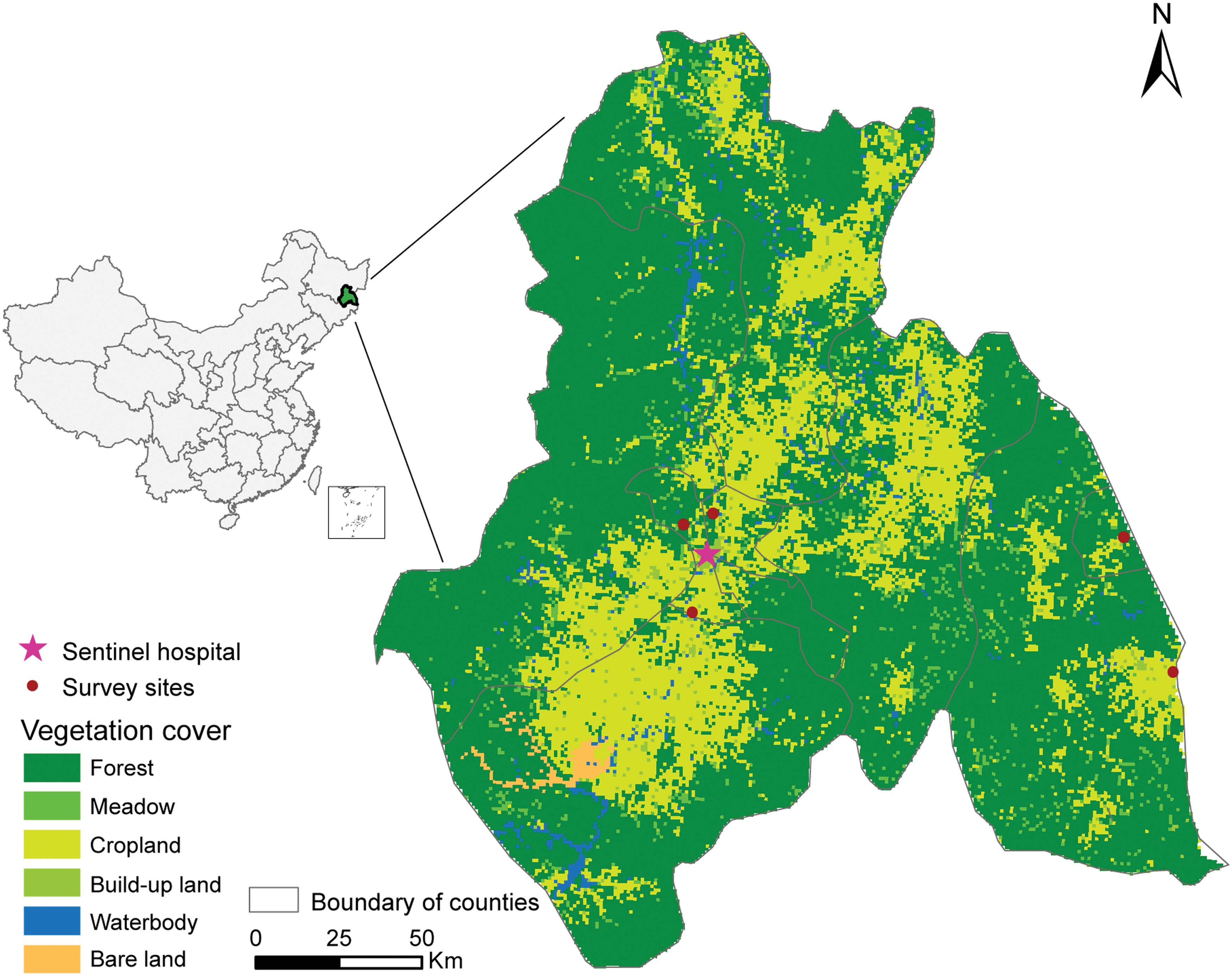
Localization of tick collection sites. The map shows the Mudanjiang city. The five red dots represent survey sites and pink star represents the sentinel hospital that reported of Candidatus Rickettsia tarasevichiae-infected patients. Color images are available online.
Nucleic acid extraction
For extraction of PCR-amplifiable DNA, the rodent's spleen specimens were homogenized in 1.5-mL centrifuge tube using an automated tissue homogenization in a sterile environment. DNA extraction was performed with the DNeasy tissue kit (QIAGEN) according to the instructions provided by the manufacturer.
Detection of rickettsiae in samples
All extracted DNA samples were initially screened by nested-PCR to amplify the partial sequences of the citrate synthase (gltA) gene. The first round primers CS2d and CSEndr and the second round primers RpCS877f and RpCS1258r, as previously described (Parola et al. 2013), were used and expected to yield a 380-bp product. According to its genus specificity and conservativeness, all positive extracts were detected to amplify outer membrane protein A gene (ompA). The primers Rr190.70p and Rr190.602n for initial amplification and Tara38S1 and Tara384R1 for a subsequent nested PCR previously reported by Roux et al. (1996) were then used and expected to yield a 346-bp product for further confirmation. DNA samples were considered positive for spotted fever group (SFG) Rickettsia when gltA and ompA both tested positive.
Nucleotide sequencing and phylogenetic analysis
All positive amplified products were sequenced using the Sanger method. Sequences obtained from this analysis were compared with DNA sequences of other rickettsial strains previously deposited in GenBank using the BLAST program (NCBI, Bethesda, MD) (Thompson et al. 1997). Phylogenetic organization of rickettsial strains of this study with other referenced rickettsial strains was constructed using MEGA version 6.0 software based on the DNA sequence variation of partial gltA and ompA, respectively.
Statistical analysis
Data were analyzed with SPSS 20.1 software. A chi-squared test was used to compare infection rates (or Fisher's exact test). A two-sided p < 0.05 was considered statistically significant.
Results
Rodent infections
A total of 463 rodents belonging to 11 species were captured at five survey sites (Fig. 1), including 211 Apodemus agrarius, 95 Clethrionomys rufocanus, 58 Rattus norvegicus, 35 Apodemus peninsulae as dominant species, as well as 14 Tscherskia triton, 17 Sorex Linnaeus, 16 Cricetulus triton, 2 C. rutilus, 5 Cricetulus barabensis, 4 Microtus fortis, and 1 Tamiops macclellandi based on morphological features (Table 1). The overall positive rate for Candidatus R. tarasevichiae was 1.29%. Only 2 out of 13 (15.38%) R. norvegicus and 4 out of 80 (5%) C. rufocanus collected from Dashigou forestry were positive for the gltA and ompA genes of Candidatus R. tarasevichiae DNA, and there were no significant differences in Candidatus R. tarasevichiae infection rate of rodents in Dashigou forestry (p = 0.196). In these survey sites, the positive rate in R. norvegicus was 3.45% and 4.21% in C. rufocanus, respectively. The sequences of Candidatus R. tarasevichiae strains R-6, R-43, R-48, R-66, and R-79 obtained from rodents showed 99–100% identities among nucleotide sequences for gltA gene and were closely related (99–100%) to the sequences from I. persulcatus tick isolates from Russia (AF503167) and China (KF003005), as well as those recovered from patients (JX996054) in these regions (Fig. 2A). The partial ompA sequences of these rodents also showed the homology (99–100%) with the China strain MDJ14 from a patient (JX996053) (Fig. 2B). Furthermore, the phylogenetic tree based on gltA and ompA gene revealed that the strains R-6, R-43, R-48, R-66, and R-79 belong to the same clade with Candidatus R. tarasevichiae.
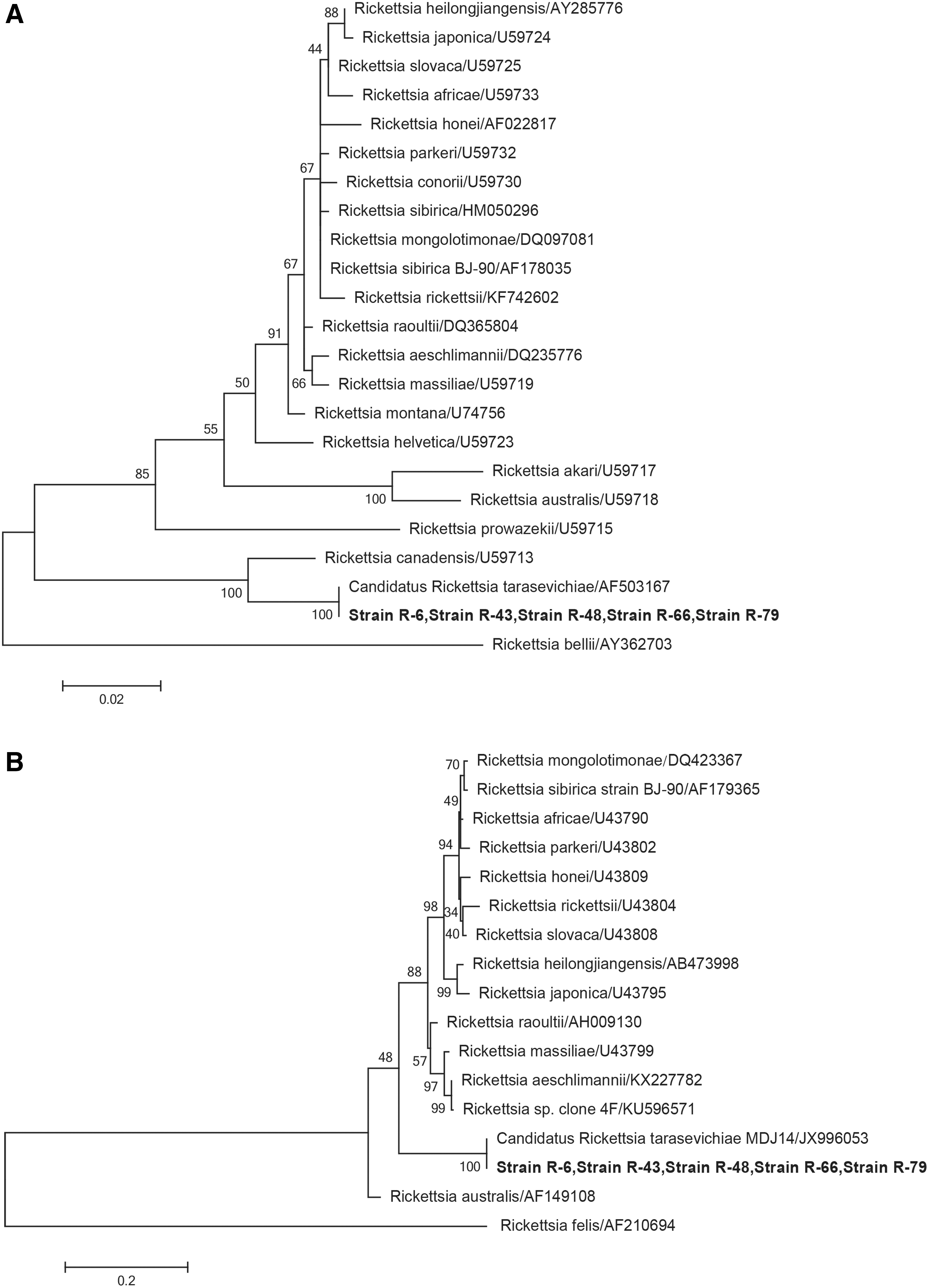
Phylogenetic tree of Candidatus Rickettsia tarasevichiae based on the gltA gene (381 bp)
The Infection of Candidatus Rickettsia tarasevichiae of Different Rodents Species in Mudanjiang Area
Discussion
To our knowledge, this study is the first confirmation of Candidatus R. tarasevichiae infection in rodents in China. The results indicated that C. rufocanus and R. norvegicus in Dashigou, Mudanjiang, were infected with Candidatus R. tarasevichiae, both of which are dominant rat species in this region. Rodents may play an important role in the expanding endemic range of Candidatus R. tarasevichiae transmission.
In previous study, Candidatus R. tarasevichiae was proven to be widely distributed in ticks collected in Russia, with a variety of infection rates: 20.5% in Chelyabinsk region (Southern Urals), 5.3–89.7% in Western Siberia (Tyumen, Omsk, and Novosibirsk regions), and 10.0% in Eastern Siberia (Krasnoyarskiy Krai). Candidatus R. tarasevichiae were also found in 2.75% and 1.6% of I. persulcatus ticks from Arkhangelsk and Novgorod province, respectively (Eremeeva et al. 2007). In addition, in previous reports, Candidatus R. tarasevichiae has been identified in blood samples from C. rutilus collected in the Northern Ural (Igolkina et al. 2006). Five cases of human infection with Candidatus R. tarasevichiae were first reported in northeastern China in 2013 (Jia et al. 2013) and then in eastern central China (Liu et al. 2016), In neighboring Mongolia, the infection rate of Candidatus R. tarasevichiae in I. persulcatus ranged from 19.5% to 46.6% (Boldbaatar et al. 2017). Candidatus R. tarasevichiae is gradually being recognized in China, but there are few studies focusing on the host animals. R. norvegicus, which has generally less tick infestation, is the most common rodent found in residential area. C. rufocanus is the dominant species in the coniferous and broad-leaved mixed forest in northern China. Based on these two specific habitats, it is likely there are other reservoir hosts in eastern central China, where patients have been reported.
Although this is the first confirmation of Candidatus R. tarasevichiae from rodents in China, further investigations are needed to clarify the distribution of Candidatus R. tarasevichiae in rodents and the ticks they carry to identify the range of hosts that potentially maintain this disease.
Footnotes
Acknowledgments
This study was supported State Key Research Development Program of China (2016YFC1201902 and 2016YFC 1200301) and Natural Science Foundation of China (81673235 and 81621005).
Author Disclosure Statement
No conflicting financial interests exist.