




Abstract
Toxoplasma gondii infection is prevalent in humans and animals worldwide. In the present study, a total of 612 serum samples were examined using indirect hemagglutination test (IHAT) for T. gondii infection. Antibodies to T. gondii were detected in 49 (8.0%, confidence interval [95% CI]: 5.9–10.2) serum samples (IHA titer ≥1:16). The T. gondii seroprevalence ranged from 4.4% (95% CI: 0–10.5) to 14.3% (95% CI: 0–40.2) among different regions in Hunan province of subtropical China. The highest seroprevalence was found in breeding sows (18.8%). The T. gondii seroprevalence was higher in winter (18.3%, 95% CI: 8.5–28.1) and spring (10.9%, 95% CI: 5.7–16.1) than in summer (6.4%, 95% CI: 2.8–10.1) and autumn (4.9%, 95% CI: 2.2–7.7), and the differences were statistically significant excepting summer. In addition, developmental stage and season were identified as risk factors for T. gondii infection. Our findings revealed the seroprevalence of T. gondii in growth stages of pigs in the Hunan province of subtropical China, indicating that it may cause public health and economic problems. To our knowledge, this is the first report of the comprehensive survey of T. gondii seroprevalence in pigs in the Hunan province of subtropical China.
Introduction
Toxoplasma gondii, the causative agent of toxoplasmosis that is one of the crucial food-borne parasitic zoonoses, is a protozoan parasite that infects humans and many animals (Montoya and Liesenfeld 2004, Dubey 2010). Pregnant women infected with T. gondii may have serious results, such as abortion and stillbirth during pregnancy (Liu et al. 2012, Li et al. 2015). The T. gondii infection can cause severe neurologic and ocular disease, such as blindness in the fetus by congenital transmission, as well as cardiac and cerebral anomalies in immunosuppressed patients (Jones et al. 2018).
The pig is economically valuable in terms of meat production worldwide. Pigs are susceptible to T. gondii and pork is considered one of the major sources of human toxoplasmosis (Dubey 2009). In China, pork is the most commonly consumed meat, representing around 65% of meat consumption in this country (Wang et al. 2012a). China is also the largest pig producing country around the world, and Hunan province is one of the most important provinces in pork production. Previous studies have indicated that T. gondii infection in pigs is very prevalent in many provinces of China (Deng et al. 2018), but limited information is available about the seroprevalence of T. gondii infection in pigs in the Hunan province of subtropical China (Xu et al. 2014).
A preliminary pilot survey indicated the high seroprevalence of T. gondii infection in sows in the Hunan province of subtropical China (Xu et al. 2014). However, it is yet to be known whether T. gondii infection is present in other categories of pigs (including fattening pigs for human consumption) in this province. Importantly, a previous serological investigation also showed that T. gondii infection is prevalent in humans in the Hunan province (Zeng et al. 1986). Therefore, investigation of T. gondii infection in pigs has important implications for the prevention and control of T. gondii in humans and animals in the Hunan province of subtropical China.
The objective of the present investigation was to examine the T. gondii seroprevalence and risk factors in growth stages of pigs in Hunan province of subtropical China. The results should provide baseline data for recommendations with regard to prevention and control of T. gondii infection in pigs in this region and elsewhere.
Materials and Methods
Ethics statement
This study was approved by the Animal Ethics Committee of Hunan Agricultural University (No. 43321503). All animals were handled in strict accordance with good animal practice according to the Animal Ethics Procedures and Guidelines of the People's Republic of China.
Experimental design and sampling
A total of 612 blood samples (283 and 329 samples for 2017 and 2018, respectively) were collected from pigs in 5 representative administrative regions in Hunan province from August 2017 to July 2018 (Fig. 1 and Table 1). All animals were raised in eight intensive farms. The numbers of pigs reared on each farm ranged from ∼150 to 2000. The large-scale farms (population size >2000) were not included in this study because these animal owners were not present to give permission. From each farm, ∼5% of healthy animals were sampled. All pigs were randomly selected for each farm. All the blood samples were transported to the College of Veterinary Medicine, Hunan Agricultural University. Blood samples were then centrifuged at 1000 × g for 10 min, and serum was obtained and stored at −20°C until use.
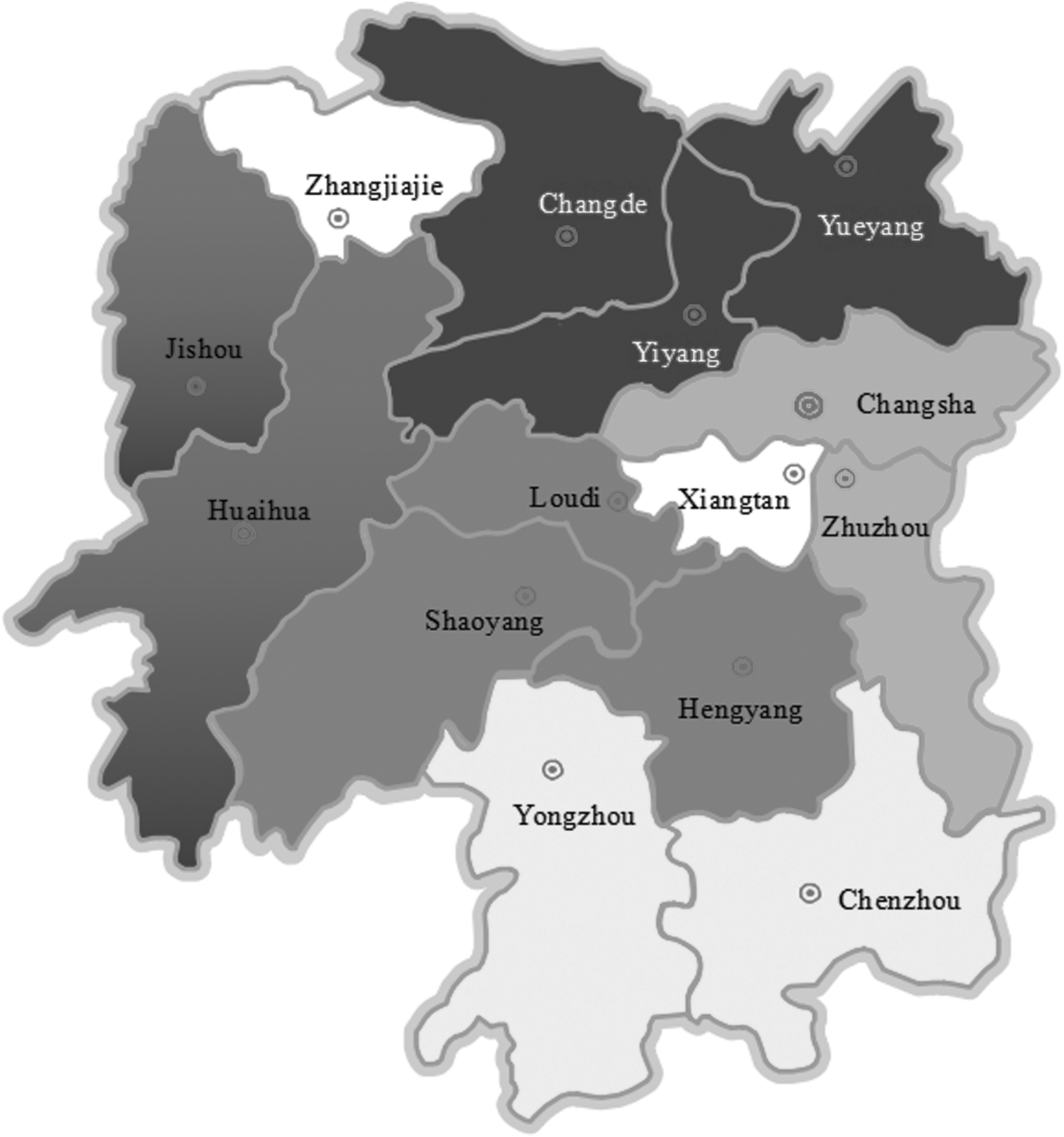
A map of Hunan province showing samples in different locations. White means no samples.
Analysis of the Variables Associated with Toxoplasma gondii Seroprevalence in Pigs in Hunan Province of Subtropical China
CI, confidence interval; OR, odds ratio.
Serological examination
T. gondii antibodies (IgG) in pigs were tested by the indirect hemagglutination test (IHAT) using a commercially marketed kit (NY/T 573-2002, Lanzhou Veterinary Research Institute, Chinese Academy of Agricultural Sciences) according to the manufacturer's recommendations and previous descriptions (Wang et al. 2012b, 2013). This kit has been extensively used for detecting specific antibodies to T. gondii in pigs, sheep, and other mammals in China for many years (Huang et al. 2010, Wu et al. 2011, Wang et al. 2012b).
Statistical analysis
Prevalence of T. gondii infection among different variables (including regions, seasons, and growth stages) was analyzed by the chi-square test using SPSS V20.0 (IBM, Chicago, IL). The differences were considered statistically significant when p < 0.05. Odds ratios (OR) and their 95% confidence intervals (95% CIs) based on likelihood ratio statistics were also analyzed in this study.
Results and Discussion
In this study, 49 of 612 (8.0%, 95% CI: 5.9–10.2) examined pigs were positive by IHAT (titer ≥1:16). T. gondii seroprevalence in pigs in the present study was significantly higher than that in the German (5.6%) (Schulzig and Fehlhaber 2005), Japan (5.2%) (Matsuo et al. 2014), Heilongjiang (4.6%) (Chang et al. 2013), and Qinghai (7.8%) (Wang 2012) provinces of China, but was lower than that in other provinces of China (Table 2). The differences in seroprevalence may be related to animal welfares, climates, environments, diseases, growth stages, sex, sample sizes, animal husbandry practices, and test methods.
The Seroprevalence of Toxoplasma gondii in Pigs in Different Regions of China
ELISA, enzyme-linked immunosorbent assay; IHA, indirect hemagglutination.
The seroprevalence in eight intensive farms ranged from 5.8% (95% CI: 2.9–8.8%) to 9.1% (95% CI: 5.7–12.6). However, there was no significant difference (p > 0.05) in the seroprevalence in pigs from different intensive farms. In the present study, breeding sows (18.8%; 95% CI: 5.2–32.3) had the highest T. gondii seroprevalence, followed by feeding piglets (12.0%; 95% CI: 5.6–18.4), fattening pigs (7.1%; 95% CI: 3.9–10.4), and nursery pigs (5.8%; 95% CI: 2.9–8.8) (Table 1), and these differences were not statistically significant (p > 0.05) excepting breeding sows. Our results have indicated that sows have more opportunities for contact with T. gondii oocysts. Logistic regression analysis showed that breeding sows had four times (OR = 3.7, 95% CI: 1.3–10.6, p < 0.05) higher risk of being seropositive compared with nursery pigs. Our result suggests that breeding sows and feeding piglets should be the preferred growth stages for the precaution and controlling of pig toxoplasmosis.
The T. gondii seroprevalence was different among seasons (Table 1). The prevalence of T. gondii infection in pigs was higher in winter (18.3%; 95% CI: 8.5–28.1), spring (10.9%; 95% CI: 5.7–16.1), and summer (6.4%; 95% CI: 2.8–10.1) than in autumn (4.9%; 95% CI: 2.2–7.7), and the differences were statistically significant excepting summer (p > 0.05) (Table 1). Logistic regression analysis showed that spring and winter had two (OR = 2.3, 95% CI: 1.1–5.2, p < 0.05) and four times (OR = 4.3, 95% CI: 1.8–10.4, p < 0.05) higher risk of being seropositive compared with autumn, respectively. The T. gondii seroprevalence in growth stages of pigs was different among seasons (Table 3). Nursery pigs in spring had the highest seroprevalence (32%; 95% CI: 13.7–50.3) (p < 0.05) and breeding sows in winter had the highest seroprevalence (44.4%; 95% CI: 12.0–76.9) (p = 0.05). The reason for this difference may be due to different environments, temperatures, and various sample capacities. Cooler temperatures are generally more favorable for oocyst survival (Frenkel et al. 1975), and each season has different sample capacities.
Analysis of the Growth Stages Among Seasons with Toxoplasma gondii Seroprevalence in Pigs in Hunan Province of Subtropical China
The T. gondii seroprevalence was different among regions (central Hunan: 14.3%; northern Hunan: 10.7%; eastern Hunan: 6.2%; western Hunan: 4.4%; and southern Hunan: 4.4%). The region of pigs is not a risk factor associated with T. gondii seroprevalence through logistic regression analysis (p > 0.05), although the seroprevalence in central Hunan was higher than that in western Hunan and southern Hunan. These results were inconsistent with a previous study (Wu et al. 2017). It suggests that management practices, presence of cats, production parameters, and level of management facilities and biosecurity measures are important risk factors because they increase the likelihood of positive animals on the farm (Pablos-Tanarro et al. 2018). However, such important information is unavailable from the present study. Therefore, this could be done in future work when more information becomes available.
Humans can become infected by T. gondii through ingestion of oocyst-contaminated food and water, or undercooked meat (Dubey 2010). Our results revealed the presence of T. gondii infection in pigs in the Hunan province of subtropical China, posing a risk for human infection with T. gondii. Pork (including fresh meat and preserved meat) is the most commonly consumed meat in the Hunan province of subtropical China. Although we did not test fresh meat and preserved meat from pigs in this study, T. gondii has been detected from pork in many countries (Wang et al. 2012a, Djokic et al. 2016, Hernández-Cortazar et al. 2016, Slany et al. 2016, Costa et al. 2018). These results have indicated that pigs can be a source of T. gondii infection for humans. Therefore, it is imperative to apply integrated control strategies and measures to prevent and control T. gondii infection in pigs in this province of subtropical China.
IHA is a highly sensitive, specific, and brief method for detecting T. gondii antibodies, which has been used widely in many domestic and wild animals, including cattle, goats, sheep, pigs, dogs, cats, chicken, coyotes, crows, raccoons, and gray foxes (Franti et al. 1976, Dubey et al. 1981, Hossain et al. 1986, Wu et al. 2017). In addition, some studies have suggested that the enzyme-linked immunosorbent assay (ELISA) may be a better tool for epidemiological studies of Toxoplasma infection on pig farms (Gamble et al. 2005, Hill et al. 2006). However, the main drawback of this method is the high cost. Therefore, the present study used IHA to detect T. gondii antibodies in pigs utilizing a commercially marketed kit.
In conclusion, our results revealed that T. gondii infection in pigs is prevalent in the Hunan province of subtropical China, which poses a potential risk for T. gondii infection in humans and animals in this province. To our knowledge, this is the first report of a comprehensive survey of T. gondii seroprevalence in pigs in the Hunan province of subtropical China.
Footnotes
Acknowledgments
This study was supported by the Training Program for Excellent Young Innovators of Changsha (grant no. KQ1802035) and the Planned Program of Hunan Province Science and Technology Innovation (grant no. 2018RS3085).
Disclaimer
The findings and conclusions in this report are those of the authors and do not necessarily represent the views of the funding agencies.
Author Disclosure Statement
No competing financial interests exist.