




Abstract
The use of conventional pesticides becomes a complicated issue as more species of insect pests become resistant to them. Nanopesticides suit new approaches in pest control. Herein, we tested the toxicological efficacy of imidacloprid compared with three of its nanoformulations (IMD01, IMD02, and IMD03) on second and fourth instar of Culex pipiens larvae. Furthermore, we assessed the synergistic actions of piperonyl butoxide (PBO) on imidacloprid and its nanoformulations against second and fourth instar of C. pipiens. The nanoformulation (IMD03) was the most potent insecticide (LC50 = 14, 6, and 2 ng/mL after 24, 48, and 72 h of exposure, respectively), whereas the lowest toxic nanoformulation was IMD01. However, imidacloprid had the lowest toxicity among the tested compounds (LC50 = 1015, 705, and 621 ng/mL after 24, 48, and 72 h of exposure, respectively). PBO significantly synergized imidacloprid and its nanoformulations. However, the most synergistic effects were on IMD03 and the lowest was imidacloprid itself. Based on our results, nanopesticides are currently the most promising tool to control C. pipiens mosquitoes. However, further semifield and field studies should be done to illustrate the efficacy of imidacloprid and its nanoformulations on C. pipiens mosquitoes.
Introduction
C ulex pipiens F. is considered one of the dangerous blood-feeding mosquitoes (Ahmed and Saba 2016). It is a vector for numerous diseases for instance, West Nile virus (WNV), Rift valley fever (RVF), Saint Louis encephalitis (SLE), and Eastern Equine encephalitis (EEE) (Elghareeb et al. 2018, Saba et al. 2018, Su et al. 2018, Zhou et al. 2018). Recently, the frequent use of pesticides has increased, which led to the resistant issue and environmental impact. In this regard, there is a great need to search for new strategies to respect the environmental components (Ahmed and Saba 2016, Ghorbani et al. 2018, Bkhache et al. 2019).
However, neonicotinoid pesticides are the most widely used class of insecticides worldwide which displays a wide spectrum of pest control, especially mosquitoes. Imidacloprid is considered a common neonicotinoid pesticide that disrupts the nicotinic acetylcholine receptor. However, a different application, especially mixing of imidacloprid with synergists, should be applied to enhance the efficacy of pesticide toxicity on mosquitoes by reducing the amount of the pesticide itself, which produces the same mortality rate for the purpose of resistance management and environmental protection (Ahmed and Vogel 2016a, Shah et al. 2016).
Plentiful studies focused on the prosperous use of synergists in controlling mosquitoes through their inhibitory action on esterase activity and mixed-function oxidases (MFOs), particularly in resistant strains (Ahmed and Vogel 2015, Devillers et al. 2018). However, piperonyl butoxide (PBO) has been playing an essential role to overcome resistance to insecticides. In general, PBO is known to act as an alternative substrate, competing with the insecticide and interfering with detoxification. Importantly, PBO also acts allosterically to inhibit the binding sites of esterases and MFOs, minimizing the amount of insecticide needed to control insects and the levels of environmental contamination by pesticide residues (Darriet and Chandre 2011, Ahmed and Vogel 2016a).
In this interim, nanotechnology demonstrates a unique opportunity of developing more effective and low environmental risk insecticides (Bhattacharyya et al. 2010, Sujitha et al. 2017, Murugan et al. 2018, Papanikolaou et al. 2018). In recent decade, nanopesticides may cover a broad range of pesticide formulations that proved valuable tools for use as carriers of potent pesticides (Rawani et al. 2013, Govindarajan et al. 2016, Mishra et al. 2017). Interestingly, these formulations are more water soluble in comparison with the excited pesticide due to the large surface area compared to their volume. Thus, these nanoformulations reduced the costs and the doses so far (Rajaganesh et al. 2016). Therefore, herein, we synthesized three different nanoformulations from imidacloprid pesticides and evaluated the synergistic action of PBO on the insecticidal activity of imidacloprid and its nanoformulations against second and fourth instar larvae of C. pipiens mosquito. However, the potential of this study is to shed light on new promising tools to control the filariasis vector C. pipiens mosquitoes.
Materials and Methods
Mosquitoes
The field strain (Assiut, Egypt) of C. pipiens was collected as larvae from Arab-Elmadabegh area in Assiut, Egypt, and then directly transferred to the research building of Plant Protection Department, at Faculty of Agriculture, Assiut University, Assiut, to conduct the experiments. To uniform the second and fourth instar larvae, the field strain was reared to the F1 generation and then used for all experiments. The rearing regime was as follows: Briefly, larvae were placed in enamel trays. Transformed pupae were collected from the trays then transferred to Petri dishes that were placed in the adult cages. The emerged adults were fed on 10% sucrose solution and artificial blood. Receptacles containing egg rafts were daily collected for the cages, and then the newly hatched larvae were transferred to breeding trays containing 2 inches of distilled water. Fifty milligrams of larval diet (dog food powder) was added to the water. The hatched larvae were held overnight in the same trays, and then 200 larvae were transferred to each 600-mL beaker containing 400 mL of distilled water. Larval diet was added to each beaker according to the following regime: day 1, 75 mg; day 3, 38 mg; day 4, 75 mg; day 5, 113 mg; and day 6, 150 mg. Adult mosquitoes were reared in an environmental chamber with a temperature ranging from 22°C to 30°C, 80% relative humidity, and a photoperiod of 14:10 (L:D) h.
Chemicals
Imidacloprid (99.5%) and PBO (99%) were purchased from Sigma-Aldrich Co. (St. Louis, MO).
Nanoformulation forms
To test the effect of nanoformulation forms of imidacloprid pesticide on second and fourth instar larvae of C. pipiens, this experiment was carried out under laboratory conditions on imidacloprid as purchased (microgram size) and the nanosize samples were prepared by treatment of the imidacloprid as starting (reference) material. The nanosized material was prepared by applying top-down approach for nanosynthesis. High-energy ball milling technique (Pulverisette 2; FRITSCH) was utilized for size reduction. The average crystallite size (D) was determined using Scherrer's equation:
where k is constant = 0.89, λ is X-ray radiation wavelength (λ = 0.1506 nm), β is the full width at half maximum, and θ is the Bragg's angle of diffraction (1). The average practice size for sample IMD01 (Fig. 1A) <D> = 23.01 ± 1.5 nm, for sample IMD02 (Fig. 1B) <D> = 18.71 ± 1.7 nm, and for sample IMD03 (Fig. 1C) <D> = 17.32 ± 1.2 nm.
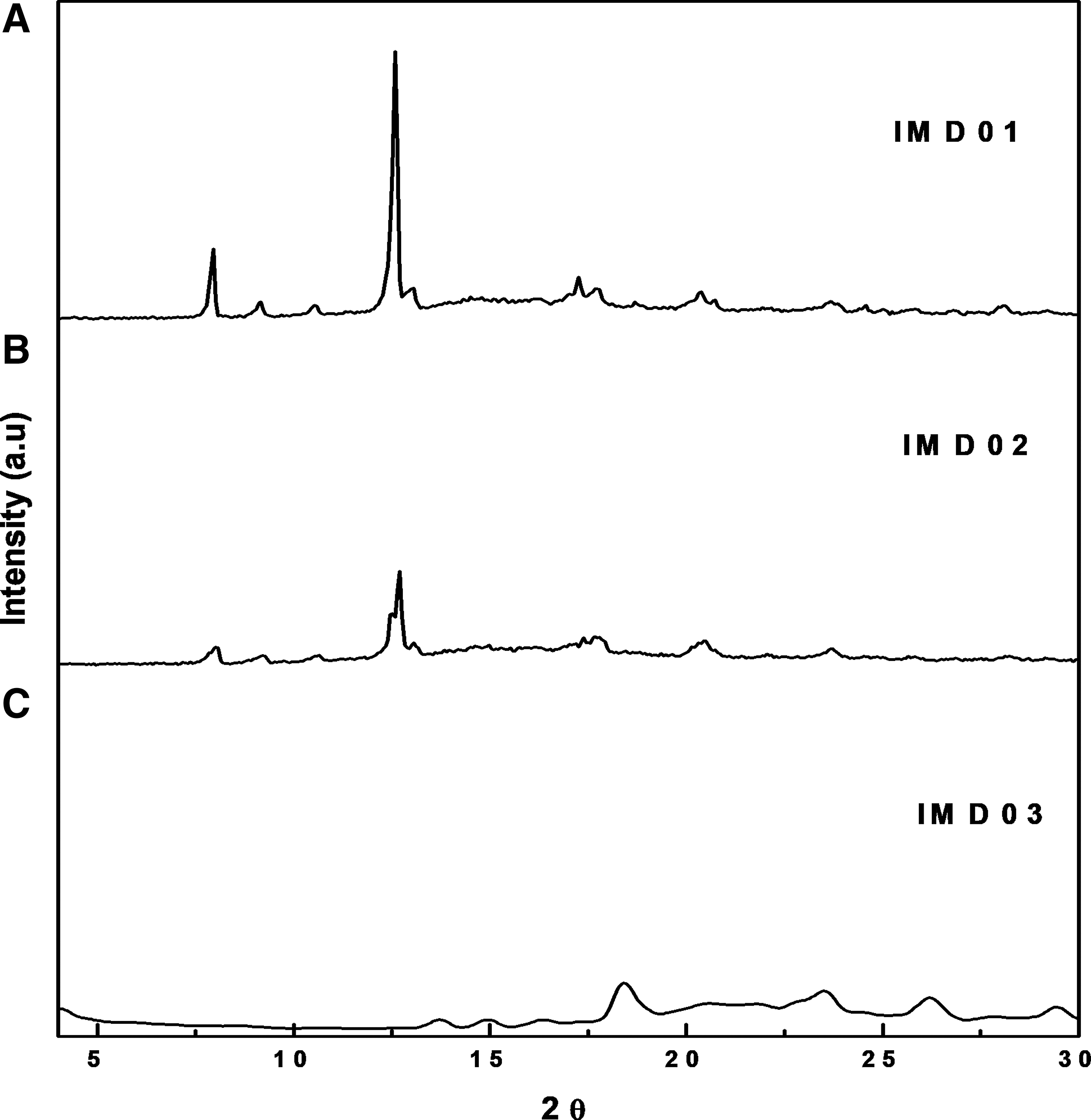
XRD patterns of imidacloprid nanoforms
Larval bioassays
Twenty from second and fourth instar larvae of uniform size were placed in 140-mL glass cups containing 99 mL of distilled water and 1 mL of insecticide (in acetone) solution. Only 1 mL of acetone was added for controls. Around 0.5 g dog food powder was added per replicate. Larvae were considered dead if they could not reach the surface of the water or they were unresponsive to touching with a probe. Based on the slow-acting nature of imidacloprid and its nanoformulation forms, mortality was determined after 24, 48, and 72 h of exposure.
Synergistic action bioassay
The synergistic action bioassay was conducted as described above for larvae bioassays. Controls received only acetone and were run concurrently with each series of tests. Each series of synergistic action tests was carried out by testing the lethal actions of varying concentrations of imidacloprid and its nanoformulation forms alone, or co-administered with 10 μg/mL of PBO dissolved in 1 mL of acetone. After the addition of the insecticides, the test solution was stirred briefly to ensure uniform mixture for larvae bioassays. Initial tests indicated that 10 μg/mL of PBO was the maximum sublethal concentration at which mortality was not observed and did not cause mortality during the 72-h test period on both second and fourth instar larvae of C. pipiens (Ahmed and Vogel 2016a). Furthermore, at least five concentrations were used for all bioassays, and every bioassay was held at 25°C. Three replicates were carried out for each concentration. Percentage mortality was recorded after 24, 48, and 72 h of exposure.
Statistical analysis
The corrected mortality was calculated according to Abbott's formula (Abbott 1925). Bioassay data (LC50 and 95% confidence limits values) were analyzed using IBM SPSS Statistics Desktop, V25 (SPSS, Inc., Chicago, IL). A synergistic action was determined to be significant at p ≤ 0.05 when the 95% confidence intervals for the LC50 values for larvae exposed to insecticide alone did not overlap with those for larvae exposed to insecticide plus synergist mixtures. Synergistic ratio (SR50) was calculated by dividing the LC50 value of the test insecticide by that of the LC50 obtained by the combined treatment with insecticide plus synergist. Figures were generated using Origin Pro 9.0 (Northampton, MA) and GraphPad Prism 6.01 software (San Diego, CA).
Results
The toxicity of imidacloprid and its nanoformulation on second instar larvae of C. pipiens after 24, 48, and 72 h of exposure is presented in Table 1. IMD03 was the most potent insecticide (LC50 = 14, 6, and 2 ng/mL after 24, 48, and 72 h of exposure, respectively), followed by IMD02 (LC50 = 54, 16, and 9 ng/mL after 24, 48, and 72 h of exposure, respectively). However, the lowest toxic nanoformulation was IMD01. The imidacloprid had the lowest toxicity among the tested compounds (LC50 = 555, 323, and 167 ng/mL after 24, 48, and 72 h of exposure, respectively).
Toxicity of Imidacloprid and Its Nanoparticle Forms on Second Instar of Culex pipiens After 24, 48, and 72 h of Exposure
n, number of larvae tested, including control.
Concentration is expressed in ng/mL and the response determined after 24, 48, and 72 h of exposure.
If g value <0.5, the data fit the probit model. Otherwise, the data do not fit the probit model and the analysis is invalid.
CL, 95% confidence limits; SE, standard error.
The toxicity of imidacloprid and its nanoformulations on fourth instar larvae of C. pipiens is presented in Table 2. However, the same trend of the above observation was demonstrated. IMD03 was the most toxic insecticide (LC50 = 257, 73, and 41 ng/mL after 24, 48, and 72 h of exposure, respectively), followed by IMD02 (LC50 = 338, 164, and 79 ng/mL after 24, 48, and 72 h of exposure, respectively). However, the least toxic nanoformulation was IMD01. Imidacloprid had the lowest toxicity among the tested compounds (LC50 = 1015, 705, and 621 ng/mL after 24, 48, and 72 h of exposure, respectively).
Toxicity of Imidacloprid and Its Nanoparticle Forms on Fourth Instar of Culex pipiens After 24, 48, and 72 h of Exposure
n, number of larvae tested, including control.
Concentration is expressed in ng/mL and the response determined after 24, 48, and 72 h of exposure.
If g value <0.5, the data fit the probit model. Otherwise, the data do not fit the probit model and the analysis is invalid.
The synergistic action of PBO on the toxicity of imidacloprid and its nanoformulations on second and fourth instar larvae of C. pipiens is presented in Tables 3 and 4. PBO significantly synergized imidacloprid and its nanoformulations. However, the most synergistic effect was on IMD03 and the lowest was imidacloprid itself. Plus, the highest synergistic ratio was observed after 72 h of exposure. The same trend was noticed on fourth instar larvae (Fig. 2).

Time-dependent changes in the synergistic ratio (SR50) as calculated from LC50 values from Tables 1 to 4 for combined treatments with PBO for second instar larvae
Synergistic Action of Piperonyl Butoxide on the Toxicity of Imidacloprid and Its Nanoparticle Forms on Second Instar of Culex pipiens After 24, 48, and 72 h of Exposure
Concentration of PBO was 10 μg/mL and larvae exposed to insecticide and PBO simultaneously.
n, number of larvae tested, including control.
Concentration is expressed in ng/mL and the response determined after 24, 48, and 72 h of exposure.
If g value <0.5, the data fit the probit model. Otherwise, the data do not fit the probit model and the analysis is invalid.
SR is calculated by dividing the LC for insecticide by the LC of insecticide+PBO.
SR significantly different from control without synergist ( = 1.0) at (p ≤ 0.05).
PBO, piperonyl butoxide; SR, synergistic ratio.
Synergistic Action of Piperonyl Butoxide on the Toxicity of Imidacloprid and Its Nanoparticle Forms on Fourth Instar of Culex pipiens After 24, 48, and 72 h of Exposure
Concentration of PBO was 10 μg/mL and larvae exposed to insecticide and PBO simultaneously.
n, number of larvae tested, including control.
Concentration is expressed in ng/mL and the response determined after 24, 48, and 72 h of exposure.
If g value <0.5, the data fit the probit model. Otherwise, the data do not fit the probit model and the analysis is invalid.
SR is calculated by dividing the LC for insecticide by the LC of insecticide+PBO.
SR significantly different from control without synergist ( = 1.0) at (p ≤ 0.05).
According to the toxicity index of imidacloprid and its nanoformulations of second and fourth instar larvae after 24, 48, and 72h of exposure (Figs. 3 and 4), IMD03 was more toxic than IMD02, IMD01, and imidacloprid by 4.50-, 78.13-, and 83.33-fold after 72 h of exposure, respectively. Furthermore, in the combination with PBO, based on the toxicity index values, IMD03 was still more potent than IMD02, IMD01, and imidacloprid by 6.67-, 161.29-, and 188.68-fold after 72 h of exposure, respectively. The same pattern of toxicity was observed on fourth instar larvae of C. pipiens.
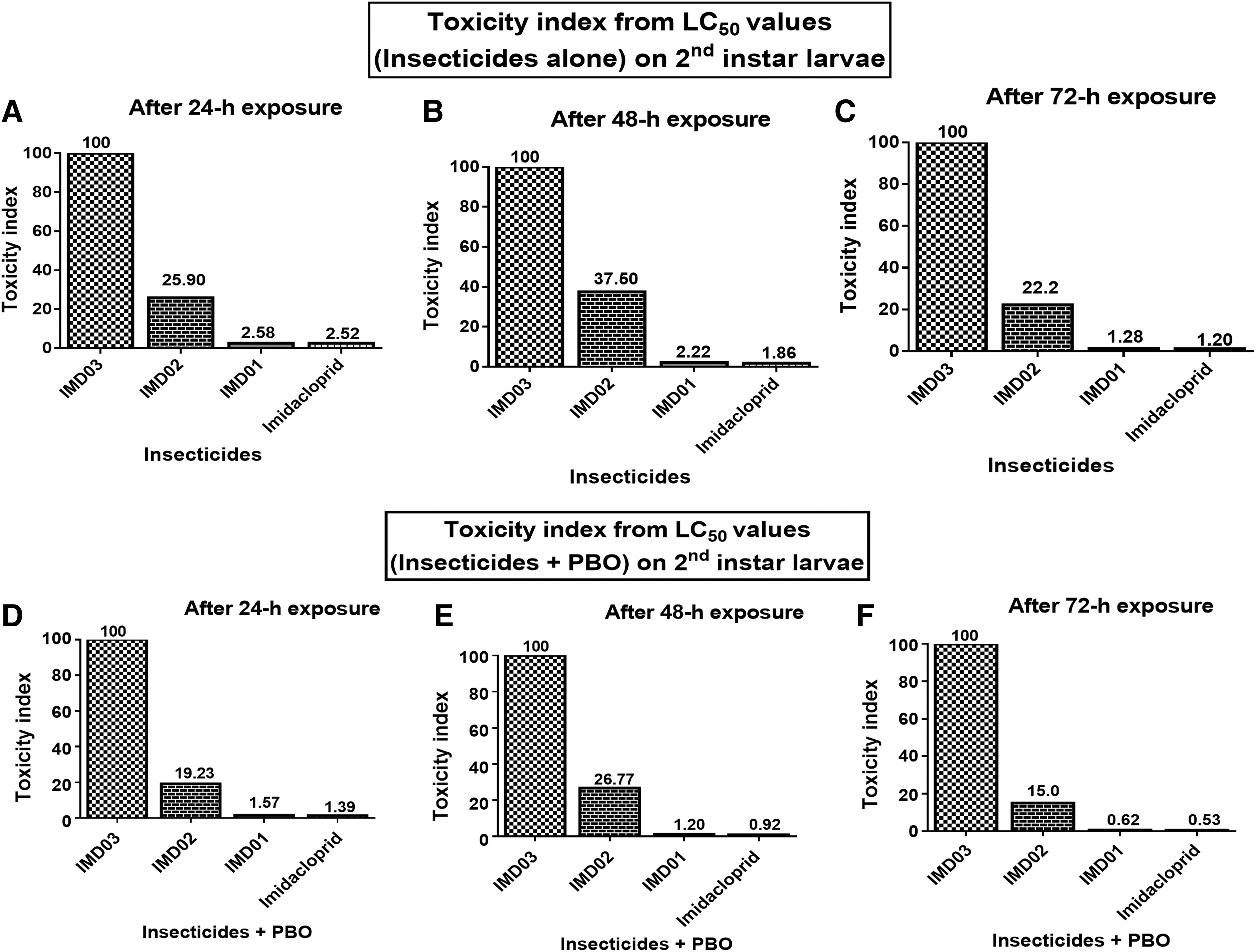
Toxicity index of imidacloprid and its nanoparticle forms
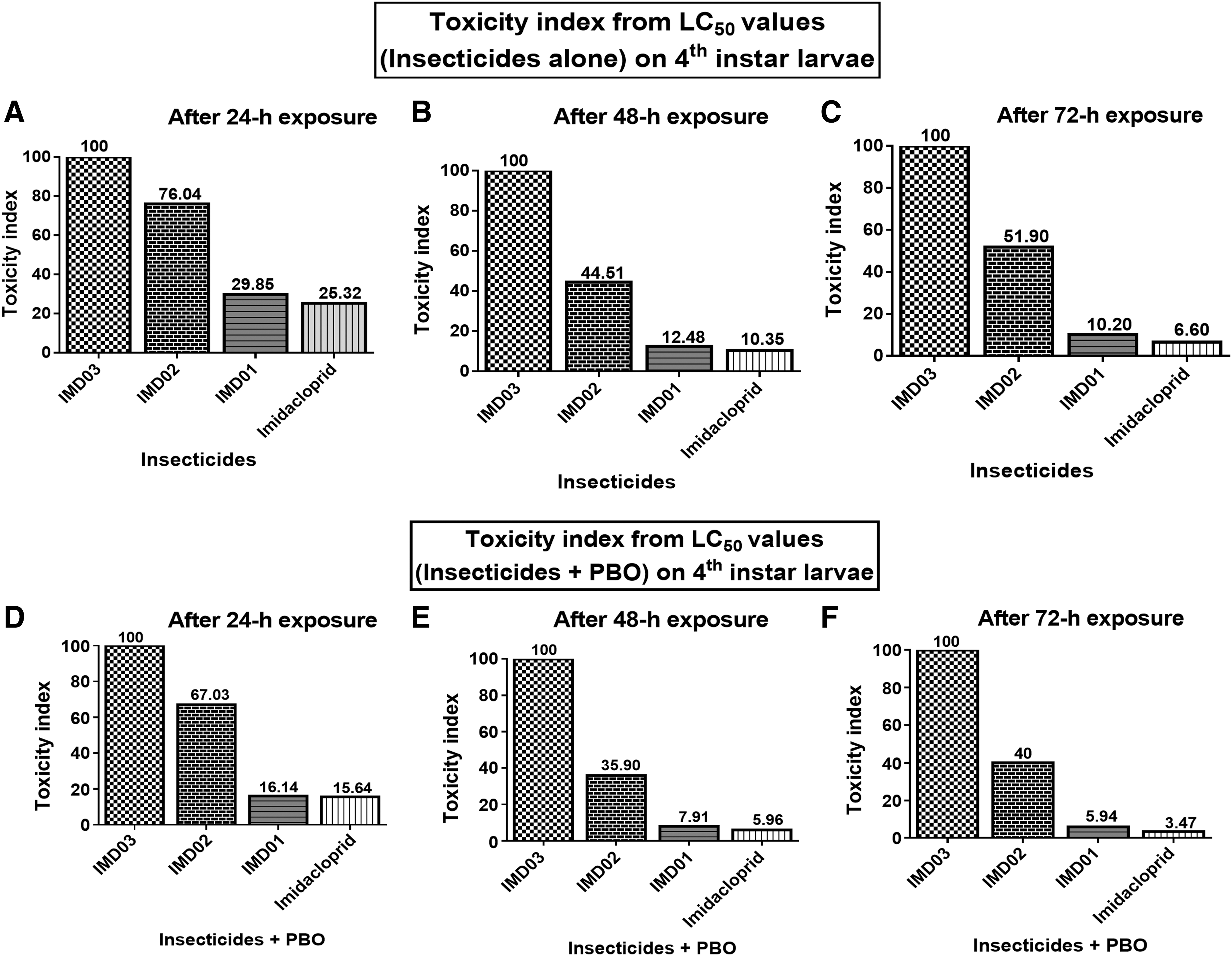
Toxicity index of imidacloprid and its nanoparticle forms
Based on the tolerance ratio values, the fourth instar larvae of C. pipiens showed a higher significant tolerance to imidacloprid and its nanoformulations than second instar, especially after 72 h of exposure for both compounds alone and in combination with PBO (Table 5).
Tolerance Ratio of the Fourth Instar Larvae of Culex pipiens to Imidacloprid and Its Nanoparticle Forms After 24, 48, and 72 h of Exposure on the Basis of LC50 Values
LC50 value for 4th instar larvae/LC50 value for 2nd instar larvae for each time-dependent.
Discussion
Nanotechnology has become one of the most promising new technologies in the recent decade. However, nanopesticides possess distinct physical, biological, and chemical properties associated with their atomic strength, rather than the conventional pesticides. In this study, we focused on the efficacy of imidacloprid and its nanoformulations on the second and fourth instar larvae of C. pipiens mosquitoes. Herein, the nanoformulations were more potent than imidacloprid itself. No previous datum could be reliable on the efficacy of nanoformulations of imidacloprid on C. pipiens. However, nanoimidacloprid has shown significant toxic effects on other insect pests. Sabbour (2017) demonstrated that, for the nanoimidacloprid that was applied on the leopard moth, Zeuzera pyrina (L.) (Lepidoptera: Cossidae), the LC50 recorded 47 ppm, whereas imidacloprid itself recoded 120 ppm. In another study, Sabbour and Solieman (2016) stated that under field conditions inside corn plantations, the number of infestations of grasshoppers was significantly decreased after nanoimidacloprid application. In the same trend, Sabbour and Abdel-Raheem (2016) emphasized on the power of nanoimidacloprid. They found that the LC50 of the desert locust, Schistocerca gregaria, recorded 344, 359, 366, 379, and 340 mg/L for the newly hatched nymphs, nymphs, last nymphal stage, and female and male adults, respectively, under laboratory conditions. While, under semifield conditions, the effect of the nanoimidacloprid recorded that the LC50 values of S. gregaria were 333, 343, 344, and 346 mg/L for newly hatched nymphs, nymphs, last nymphal stage, and female and male adults, respectively. Sabbour (2015) evaluated imidacloprid and one nanoformulation of it on three different olive insect pests: Bactrocera oleae, Ceratitis capitata, and Prays oleae under laboratory and field conditions. He illustrated that the nanoimidacloprid was more toxic than imidacloprid itself on each insect pest. He resulted that the LC50 of imidacloprid obtained 200, 221, and 225 mg/L for B. oleae, C. capitata, and B. oleae, respectively. The LC50 of the corresponding pests after nanoimidacloprid treatments obtained, 99, 111, and 115 mg/L, respectively.
On the other side, PBO was synergist imidacloprid on mosquitoes. Plentiful studies agreed with our findings. Ahmed and Vogel (2016b) demonstrated that PBO synergist imidacloprid on Aedes aegypti adults and the SRs were 133-, 263-, and 363-fold after 24, 48, and 72 h of exposure, respectively. Moreover, Paul et al. (2006) stated PBO synergist imidacloprid on fourth instar larvae after 72 h of exposure (SR = 7.6) and on female adults 48 h after treatment (SR = >2000). Furthermore, Darriet and Chandre (2013) found deltamethrin+PBO+imidacloprid mixtures, one of the groups that induce interesting, efficient synergies, most valuable for the management of Anopheles gambiae resistance mosquitoes to insecticides. Therefore, nanoformulations are more economical and ecofriendly due to controlled slow release of their nanoparticles rather than the conventional insecticides (Bhan et al. 2014).
Conclusions
The results of this study reveal that nanoformulations of imidacloprid are new promising insecticides, as demonstrated by its high level of potency compared to imidacloprid itself. Additional studied should be done to give better understanding of the efficacy under semifield and field conditions. Numerous pests have developed resistance to neonicotinoid pesticides; however, sulfoxaflor has different chemical and biological properties and is also active on a wide range of insect pests. Thus, sulfoxaflor has the potential to be an important component in the field of pest control. Further biochemical and molecular biological investigation will give a better insight in to sulfoxaflor's mode of action, and field experiments are needed to elucidate the promising efficacy of this unique insecticide.
Footnotes
Acknowledgment
The authors were grateful to Plant Protection Department and Physics Department, Assiut University, Egypt, for technical supports, academic advisors, synthetic of nanoforms, and instruction materials.
Author Disclosure Statement
No competing financial interests exist.