




Abstract
Trichinosis is a worldwide zoonotic disease closely related to cultural and dietary habits caused by a nematode Trichinella spp. The drugs for its prevention and treatment are still not thoroughly defined. Wortmannilactone F was used to value the therapeutic effects on the worm reduction rates, change of the intestinal mucosa, and the host's body's immune activity in this experiment. BALB/c mice were orally fed with 200 infective Trichinella spiralis larvae. Then, T. spiralis-infected mice were treated with wortmannilactone F (50, 100, and 200 mg/kg). The number and morphological analysis of adult worm, the expression of Factor associated suicide (Fas), and the level of SIgA in the mice were investigated. Wortmannilactone F showed dose-dependent anthelmintic effects by causing mortality of worms, obvious damaging effects on mature T. spiralis' surface and their digestive systems, decreasing the expression of mice's intestinal mucosa's Fas protein, and reducing intestinal mucosa's level of SIgA secretions. Wortmannilactone F is expected to be a potential therapeutic drug for trichinellosis treatment.
Introduction
Trichinellosis is an important food-borne zoonosis with an extremely wide host range and geographical distribution (Gottstein 2009, Rawla and Sharma 2019). Trichinella spiralis is the most pathogenic and prevalent species causing disease in human. Human infection with T. spiralis is due to ingestion of raw or insufficient cooked infected meat. Adult worms inhabit the upper part of small intestine, whereas larvae inhabit skeletal muscles. Human trichinellosis is characterized by high fever, facial edema, erythra, and myositis, which may be serious and fatal, particularly in severe cases. Data about T. spiralis from the literature are focused mainly on the biology, etiology, pathophysiology, and immunology (Qi et al. 2018, Jin et al. 2019). However, only few studies were developed on treatment protocols of infected cases (Soliman 2011, Attia et al. 2015).
Albendazole is the principle drug against trichinellosis recommended by WHO. However, it has some serious side effects including bone marrow suppression, liver inflammation, cerebral edema, and even brain herniation (Jaoko et al. 1996, Berhe et al. 1999, Samuel 2014). It is pregnancy category C in the United States and category D in Australia, meaning it may cause harm if taken by pregnant women. So, there is an intense need for safe and effective antitrichinellosis drugs with less toxicity to the host.
Mitochondria are essential organelles involved in energy metabolism through oxidative phosphorylation. To adapt to the low oxygen tension of the host, parasites have evolved to use a special metabolic system that is different from that of the host mammals. Researches on respiratory chain of the parasitic helminth have proved that the mitochondrial nicotinamide adenine dinucletide (NADH)-fumarate reductase system (NFRD) plays an important role in the anaerobic energy metabolism of adult parasites inhabiting hosts (Kita and Takamiya 2002, Mori et al. 2011). The differences in energy metabolisms between the host and helminths make the NFRD being attractive therapeutic targets of helminthiasis (Matsumoto et al. 2008, Sakai et al. 2012).
Wortmannilactone F, whose conjugated polyene was tetraene, was isolated from culture of Talaromyces wortmannii by our group. The wortmannilactones also showed selective inhibitory activities against NFRD with IC50 of 400 mg/kg (Liu et al. 2016a, 2016b). It inhibits respiratory electron transport chain and blocks metabolism in the parasite, eventually killing the parasite.
The aims of this research were to evaluate the therapeutic efficacy of Wortmannilactone F in killing Trichinella adult and how it will affect the parasites' bioactivity. At the same time, to observe the effect on the change of the intestinal mucosa and the host's body's immune activity before and after using Wortmannilactone F to treat the mice's trichinosis.
Materials and Methods
Experimental animals and model
Infective T. spiralis (ANNA) larvae were preserved by our department. All the animal experiments were carried out in accordance with the guidelines issued by the Ethical Committee of Dalian Medical University. Six to eight weeks old female BALB/c mice were obtained from Experimental Animal Center, Dalian Medical University. Mice were maintained under standard environmental conditions, fed with rodent diet. The animals (n = 8 per group) were acclimatized for 15 days in the laboratory before start of the experiments. Four groups of mice were infected orally with 200 encysted muscle larvae of T. spiralis (M-con: positive model group; WF1: low dosage treatment group [50 mg/kg]; WF2: middle dosage treatment group [100 mg/kg]; and WF3: high dosage treatment group [200 mg/kg]). An additional group of mice were used as normal controls (marked with N-con group).
Drug administration
Wortmannilactone F was isolated from the culture medium of T. wortmannii as reported in our previous study (Liu et al. 2016a, 2016b). After infected with the encysted larvae for 5 days, the mice were administered with wortmannilactone F intragastrically for 3 consecutive days (WF1: 50 mg/kg; WF2: 100 mg/kg; and WF3: 200 mg/kg). And mice in group M-con and N-con were administered with equal volume of vehicles (solvent of Wortmannilactone F includes 10% tween 80, 5% polyethylene glycol, 5% ethylis oleas, and 80% water). Three days later, all mice were sacrificed by cervical dislocation for further analysis.
Hematoxylin-eosin staining and transmission electron microscope examination
After the mice were sacrificed and dissected, the ileocecus was collected and washed with saline. Then the adult worms were obtained and worm reduction rates were calculated. The adult worms were further stained with carmine for morphological observation.
Transmission electron microscope (TEM) examination of the worms from different groups was conducted as previously reported with slight modifications. In brief, the adult worms were fixed in 2.5% glutaraldehyde and washed with PBS, three times for 15 min each. After being fixed in 1% OsO4 in PBS for 2 h, the samples were washed with cooled distilled water three times and dehydrated in serial ethanol concentrations for 15 min each. Thereafter, the worms were treated with 0.1 mL of epoxy resin and blocking liquid overnight. Then they were refreshed in blocking liquid and solidified in incubator at temperatures of 35°C, 45°C, and 60°C, 24 h for each temperature. Then, ultrathin sections were prepared and stained with uranyl acetate and lead citrate. All the slides were examined and photographed by TEM (JEM-2000, EX, Japan).
Cut worm rate
For counting the number of adult worms, the small intestine of each mouse was excised and transferred to a large Petri dish containing normal saline and opened longitudinally with fine scissors. The intestinal wall was scratched to collect embedded worms in the mucosa. The antihelminthic effect of each treatment group was evaluated by calculating the mean number of living worms per mouse and cut worm rate. Cut worm rate was calculated using the formula listed hereunder. The cut worm rate reached 100%, which indicated that no T. spiralis was found in mice.
(Number of control: mean number of living worms in positive model group; Number of sample: mean number of living worms in each treatment group.)
Immunohistochemistry of mice's intestinal mucosa
After blood collection, mice were sacrificed by anesthesia and a part of intestine (about 1 cm long) that is close to the ileocecal junction was excised, rinsed with saline, and fixed in 10% formalin. After embedding in paraffin, the intestine was processed in series sections at 3 μm and stained to detect the expression of Factor associated suicide (Fas) protein. In brief, endogenous peroxidase was blocked with 3% hydrogen peroxide for 10 min. The samples were rinsed three times with PBS, incubated for 15 min at room temperature with a protein-blocking solution of 5% normal horse serum in PBS (pH 7.5), washed three times with PBS, and subsequently incubated with the primary antibody (Fas 1:200, BA0484; Boster, China), at 4°C overnight. The samples were then rinsed three times with PBS and incubated for 40 min at 37°C with the relevant biotinylated secondary antibody for 30 min. Finally, the sections were incubated in diaminobenzidine for 5 min, and then counterstained with hematoxylin. For negative control staining, the primary antibody was omitted. Results were analyzed using Image-Pro 6.0 Microsoft software (Media Cybernetics Bethesda, MD).
SIgA detection in intestinal fluid
The intestinal segment close to the ileocecal region (∼5 cm long) was excised and opened longitudinally with fine scissors. Intestinal surface was rinsed with saline and scraped with glass slide. Mucus scraped from the surface of intestinal mucosa was put into the eppendorf tube and PBS was added (0.01 mol/L, 0.5 mL). Supernatant was used for SIgA detection after centrifugation (10,000 g, 15 min). SIgA levels were measured by enzyme-linked immunosorbent assay (ELISA) (Sino-American Biotechnology Co., LTD, China). Samples were placed in assay plate and incubated at 37°C for 30 min. After five washes, samples were added to HRP-conjugate reagent and incubated at 37°C for 30 min. Finally after another five washes, samples were incubated with chromogen solutions A and B at 37°C for 10 min then the reactions were read at 490 nm in a microplate reader.
Statistical analysis
Statistical analysis was performed using SPSS 17.0, and all of the results are expressed as the mean ± standard deviation. Comparisons between groups were analyzed using one-way analysis of variance followed by Tukey's multiple comparison test. A value of p < 0.05 was considered significant.
Results
Effects of wortmannilactone F against adult worms
Effects on the number of adult worms
The mean number of living T. spiralis worms per mice was counted and calculated in each group. A significant decrease in the mean number of adult worms was obtained in all treated groups (Fig. 1A, p < 0.05). Then worm reduction rate was used to evaluate the effects of wortmannilactone F on T. spiralis. Compared with the positive model group (group M-con), all treatment groups could reduce the number of T. spiralis in intestinal tissue of mice (p < 0.05). Significant differences were found among the doses of wortmannilactone F (p < 0.05); the worm reduction rates were 57.1%, 78.1%, and 96.2% for the doses 50, 100, and 200 mg/kg (Fig. 1B).

Effects on the number of adult worms
Effects on the size and feature of adult worms
Adult worms obtained from each group were stained by carmine. The measure of body length and width showed that there were no significant differences in the four groups (Fig. 2A). There were no obvious morphological changes among the four groups (Fig. 2B).

Effects on the size and feature of adult worms.
Ultrastructural changes of adult worms after wortmannilactone F treatment
To make further observation about morphological changes caused by wortmannilactone F, ultrastructures of cuticles and intestine in adults were observed under TEM. Cuticles of T. spiralis in the positive model group (group A) were complete, smooth, and intact. Muscle fibers arranged regularly and clearly in subcutaneous muscular layers (Fig. 3A). Microvilli on the surface of mucosa cells of parasite's small intestine are tidily arranged and formed brush border (Fig. 3E). Because of the effect of wortmannilactone F, there appeared some spinous protuberances on the surface of cuticles of adults in groups WF1 and WF2 (Fig. 3B, C), but these protuberances disappeared in group WF3 and muscle fibers began to dissolve and disappear (Fig. 3D). As the doses of the drug increased, part of the microvilli brush border fell off in group WF1 (Fig. 3F), then the microvilli became shorter and sparse, even lost and inversed in groups WF2 and WF3 (Fig. 3G, H).
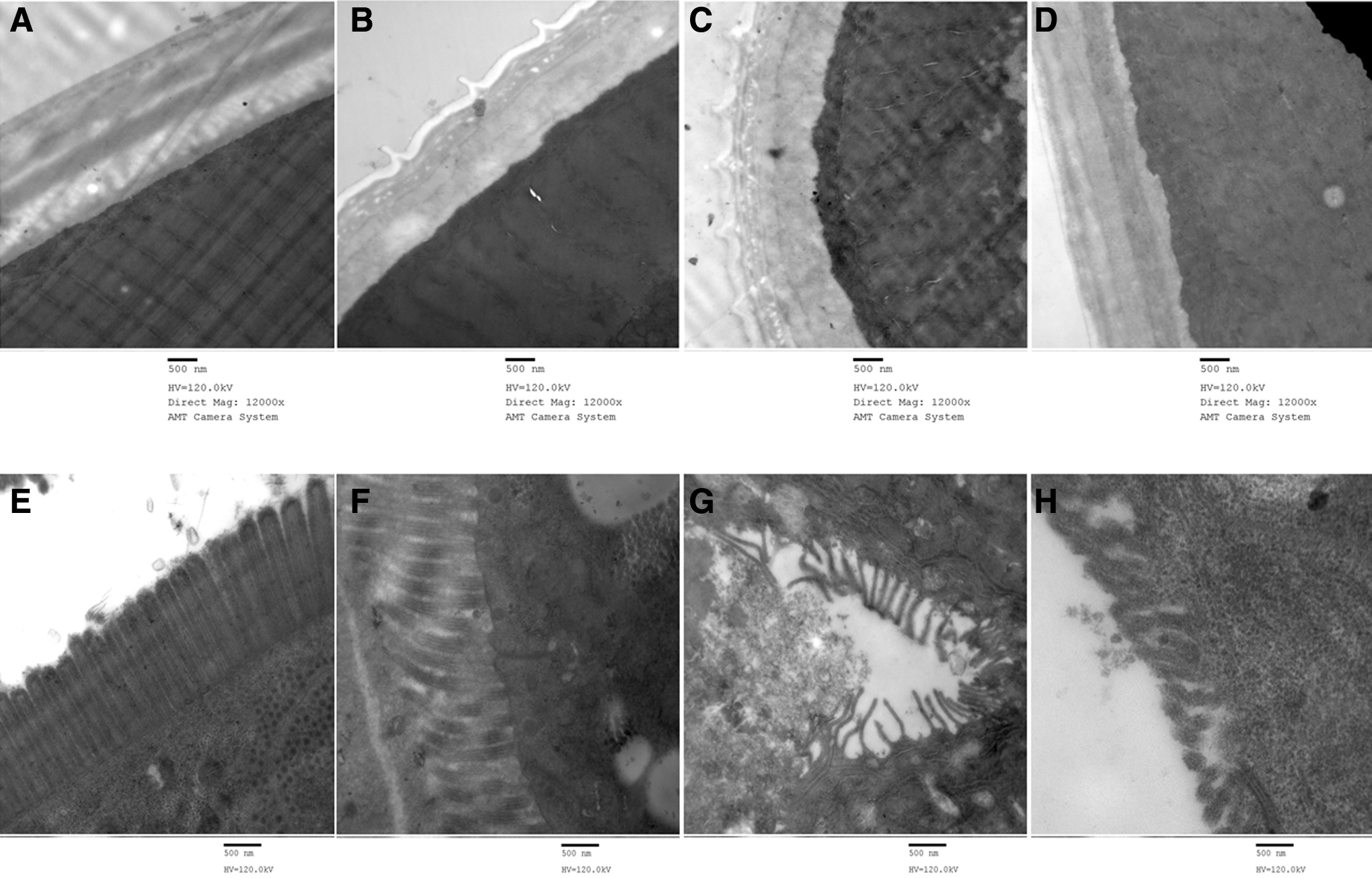
Ultrastructural changes of adult worms after wortmannilactone F treatment. The top row of images represents cuticle change of T. spiralis in different experimental groups
Influence of wortmannilactone F on immunity function in mice
Expression levels of FAS in mice were assessed by the immunohistochemical method and analyzed by gray analysis software. Increased expression of FAS was detected in mouse intestinal epithelium in the positive control group. Wortmannilactone F significantly suppressed the expression of Fas compared with the positive control group (p < 0.05, Fig. 4A, B). Levels of SIgA in intestine fluid were detected by ELISA. Secretion of SIgA was found to be increased in the positive control group. Treatment with wortmannilactone F significantly inhibited the secretion of SIgA compared with positive control group (p < 0.05, Fig. 4C).

Influence of wortmannilactone F on immunity function in mice.
Discussion
Researches on respiratory chain of the parasitic helminth have proved that the mitochondrial NFRD, which is composed of complex I (NADH–rhodoquinone reductase), rhodoquinone, and complex II (rhodoquinol–fumarate reductase), plays an important role in the anaerobic energy metabolism of adult parasites inhabiting hosts (Kita and Takamiya 2002, Mori et al. 2011). The NFRD enzyme system has been found to be ubiquitous in helminths such as nematodes, trematodes, and cestodes, but not in the normal metabolism of mammals. So, the NFRD enzyme system is considered to be the ideal target for a new anthelminthic drug (Matsumoto et al. 2008, Masuma et al. 2009). Actually, the inhibitor screen of worm mitochondrial complex I has gained more attention (Omura et al. 2001). Screening of anthelmintic drugs targeting NFRD and helminth complex I showed that some fungal metabolites showed better inhibitory activity, such as avermectin and ivermectin: the antinematodes and arthropod drugs. The drug-targeting helminth mitochondrial complex I has novel mechanism of action and low toxicity to the host, and is expected to become a new broad-spectrum helminth drug.
The experimental results showed that wortmannilactone F had a good anthelminthic effect and worm reduction rate for the intestinal period of T. spiralis. The concentration of wortmannilactone F that was 200 mg/kg can achieve the best insecticidal effect, and the reduction rate can reach 96.2%. It was proven by experiments that the anthelminthic effect of wortmannilactone F on the treatment of T. spiralis adults can be comparable with albendazole and tribendimidine (Shi Wei 2009, Liu et al. 2018). As a biological preparation, since it selectively acts on worms and has fewer side effects on the host, it can be said that it is superior to the mentioned two drugs to some extent. However, this experiment only tested the adult stage of Trichinella, and did not involve the killing effect of this drug on the migration period and the encystation stage of Trichinella. So whether wortmannilactone F can replace these traditional drugs would still need further research. However, this test at least indicates that for the adult stage of Trichinella, the therapeutic effect of this drug is significant, and if wortmannilactone F is used for treatment in the early stage of Trichinella infection, it can certainly be very effective.
Each group of worms was collected for carmine staining and the size of the worms was measured. It was found that there was no statistically significant difference among the groups (p > 0.05). The possible reasons are, on the one hand, it could be due to the short treatment time. In the short term, the damage of the worm has not developed to the extent that the worm's size has changed significantly; on the other hand, it could be due to the rapid death of the worms after the drug is administered. By the time we quickly dissect the diseased mouse to separate the worm, the biological changes in the appearance of the worm are no longer obvious. Although the size of the worms did not change significantly, the internal structure of the worms in three different concentrations of the drug treatment group changed significantly under TEM. From our experimental observations, it is speculated that the pharmacological mechanism of the drug's inhibitory insecticide is due to the selective inhibitory activity against NFRD, which induces the fastest metabolism of T. spiralis, the small intestine microvilli growth and development is inhibited and damaged, causing the parasite to not absorb the nutrients of the host well, and finally leading to the death of the parasite, thereby achieving the purpose of reduction of the worms.
The interaction between worms, hosts, and drugs was observed by detecting the expression of Fas protein in the lamina propria of the intestinal mucosa and the secretion of SIgA in the intestinal fluid. We know that Fas protein is a kind of protein that regulates apoptosis. It may increase the expression level of Fas protein and increase the apoptosis of cells after infection with T. spiralis, due to mechanical damage and immune pathological factors caused by infection. On the one hand, it leads to the decline of lymphocyte immune defense ability, and cannot resist the colonization of T. spiralis on the intestinal mucosa; on the other hand, the expression level of Fas protein is increased, and the immune response of the intestinal tract is also downregulated, which induces the mechanism of immune evasion in the host, allowing the adults of T. spiralis to survive in the intestine and escape the clearance of the intestinal immune system. T. spiralis can survive the reaction smoothly to the migration stage or even the cystic stage, and maintain the living state in the host. With the use of wortmannilactone F, the expression of Fas protein is significantly reduced, so that the apoptosis is reduced, the intestinal immune system is well repaired, and a good immune response can be produced against the foreign antigen of T. spiralis. Through experiments, we can speculate that wortmannilactone F can kill adult worms by regulating the immune response of the host organism.
Intestinal mucosal secretion of SIgA is a very important factor in the intestinal immune system. By identifying and binding with foreign antigens in the intestinal lumen, it can effectively neutralize biologically active molecules and inhibit the adhesion and colonization of pathogenic organisms on the mucosa. Ji Yuli et al. (2007) found that the amount of SIgA secreted by the intestinal mucosa decreased after infection with Cryptosporidium in mice, and the amount of SIgA secreted after treatment with Dangguibuxue decoction polysaccharide was greatly increased. This is contrary to our experimental results, probably because Cryptosporidium is a parasitic disease present in the immunodeficient state of the body, and in our experiment, the infection of T. spiralis was present in normal immune function, so the results are different. After T. spiralis infects the body, the body stimulates the mucosal immune response against this foreign antigen, and immediately mobilizes the immune system to eliminate foreign antigens, resulting in a substantial increase in the secretion level of SIgA. However, after the fungal extract was treated, it was found to have a good reduction effect. The reduction rate of the high-dose concentration group reached 96.2%, and the intestinal worms were greatly reduced, which also reduced the external stimulating antigens, thereby reducing the stimulation to the intestinal mucosa, so that the secretion of SIgA was finally significantly reduced compared with the positive control group. The level of SIgA in the high-dose treatment group had approached the level of the mice in the healthy group, and it can be seen that the treatment of the fungal extract has achieved good effects.
In summary, through the observation of this experiment, wortmannilactone F, as a lipid biological agent, can affect the growth and metabolism of T. spiralis by inhibiting activities against NFRD, then inhibiting respiratory electron transport chain and blocking metabolism in the parasite. At the same time, wortmannilactone F can regulate the immune response of the host organism by stimulating the expression level of Fas protein and the amount of SIgA secretion in the small intestine in the host, eventually killing the parasite.
Footnotes
Author Disclosure Statement
No conflicting financial interests exist.
Funding Information
No funding was received for ths article.