




Abstract
In January 2019, the state of Minas Gerais experienced another environmental disaster with the collapse of a mining dam near the city of Brumadinho. This disaster has resulted in 256 deaths and 14 people still missing. Toxic mud has contaminated the Paraopeba River resulting in significant fish and wildlife deaths in the river and surrounding areas. The effect of environmental disasters such as this is felt across multiple sectors damaging ecosystems in agriculture, wildlife and human communities. Environmental disasters cause significant disruption of ecosystems, flooding, contamination of water supplies, and displacement of human populations, which can result in increases in transmission and outbreaks of mosquito-borne and zoonotic diseases that can become a serious and long-term public health problem for the region.
On January 25, 2019, the state of Minas Gerais in Brazil experienced another environmental disaster and human tragedy with the collapse of a mining dam near the city of Brumadinho. It is estimated that 11.7 million cubic meters of toxic mud consisting of finely ground rock waste, water, and chemicals that were used to extract metals breached the dam and travelled downhill toward Brumadinho at speeds up to 120 km/h. The immediate impact of this dam collapse has been devastating with at least 256 deaths, 14 others still missing, and destroying one of the suburbs of Brumadinho (Bochove 2019). In addition, the toxic mud has contaminated the Paraopeba River, and has already resulted in significant fish and wildlife deaths in the river and surrounding areas (Manufactured Disaster 2019). The effect of environmental disasters is felt across multiple sectors damaging ecosystems in agriculture and livestock industry, wildlife, and human communities; the intersection of these sectors is often hotspots for disease emergence/re-emergence and outbreaks. Environmental disasters cause significant disruption of ecosystems, flooding, contamination of water supplies, and displacement of human populations, which can result in increases in transmission and outbreaks of mosquito-borne and zoonotic diseases that can become a serious and long-term public health problem for the region.
The state of Minas Gerais has experienced several serious dam breaks in the past few decades, and this is the second major environmental disaster Minas Gerais has suffered in <5 years (Fig. 1). In 2015, a mining dam collapsed near the city of Mariana killing 19 people and displacing >1200 people, and at the time was considered the worst environmental disaster in Brazil's history. The impact of the Mariana dam collapse was widespread and long-lasting because of the contamination of the Doce river, which is a major water source for human consumption and a complex ecosystem where marine-estuarine species reproduce. Approximately 11 tons of dead fish were gathered from the river basin, and five species may have become extinct (de Souza Porto 2016). The agricultural impact is also significant with recent data from the Brazilian Agricultural Research Corporation (EMBRAPA) demonstrating that ∼1420 hectares of land in the cities affected by the mud, Mariana, Barra Longa, and Rio Doce, are not suitable for farming or livestock and may take years before the soil is recovered (de Souza Porto 2016). The impact on the environment, ecosystem, and the populations living in the affected areas can result in extensive public health issues. A study conducted in the 8 months after the Mariana dam break in 2015 reported a 8- to 48-fold increase in both infectious and chronic health problems in Barra Longa, a municipality located along the Rio Doce with an estimated population of 5200 (Freitas et al. 2019). Surveillance data from the state of Minas Gerais, Ministry of Health, showed a significant increase in confirmed cases of dengue in Barra Longa postdisaster with 171 confirmed cases in 2016 compared with 1 and 0 confirmed cases in 2014 and 2015, respectively (Boletim Epidemiologico de Monitoramento…).
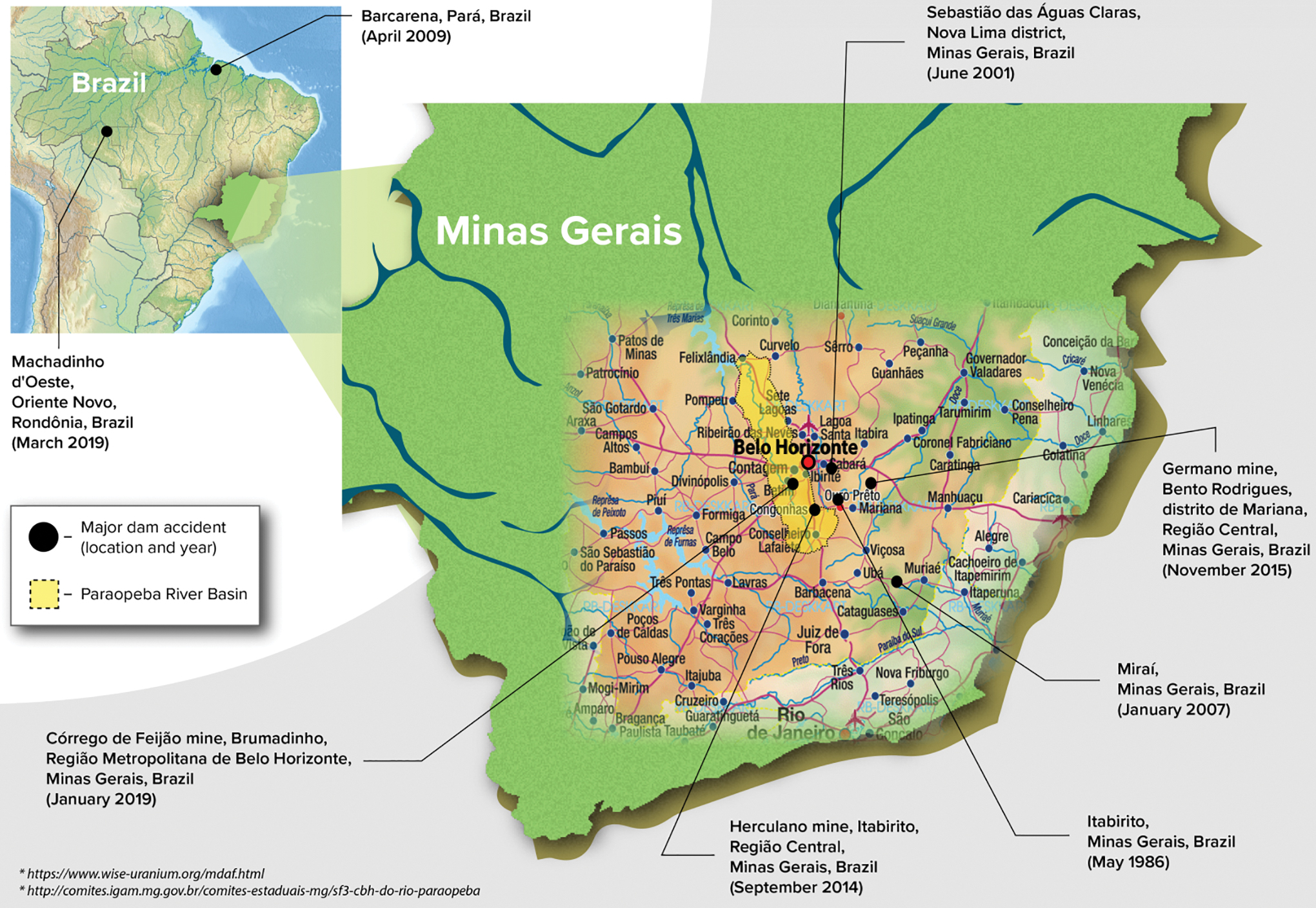
Major dam breaks in Minas Gerais, Brazil 1986–2019 and river basin of Rio Paraopeba. The highlighted section in yellow shows the river basin of Rio Paraopeba that was contaminated in the dam break in January 2019. Color images are available online.
There are limited data on the infectious disease impact of environmental disasters, but the closest correlate is natural disasters. Although natural disasters such as earthquakes, floods, and severe storms do not directly cause infectious disease outbreaks, these events often result in displaced populations and changes in the environment, which in turn can increase risk factors for disease transmission (Kouadio et al. 2012). With natural disasters, infectious disease outbreaks usually do not occur in the immediate aftermath of the disaster, but are more likely to occur in the days, weeks, and months after the initial disaster (Kouadio et al. 2012). Similarly, environmental disasters, such as this dam break, can cause environmental and ecological changes that contribute to increased risk of disease emergence and transmission. Furthermore, the affected populations experience health risks as a result of exposure to chemical toxins in the mud, which further complicates their health risks to possible infectious diseases. Health systems often become overburdened in these situations in handling the varying health conditions that may emerge from exposure to toxic chemicals and displacement, which can result in delayed detection of infectious disease emergence or outbreak.
The most recent dam collapse near Brumadinho occurred in a region that is more urban with greater population density than Mariana. Therefore, the extent of its impact and the secondary aftereffects may affect a larger population and be more prolonged and long-lasting. In the immediate aftermath of this disaster, it is apparent that the epidemiological factors associated with increased transmission of vector-borne or zoonotic diseases are already arising. The Rio Paraopeba, which is located downstream from the mining dam, and was a principal water source for several cities in the area, was contaminated resulting in fish and wildlife die-offs. The river basin for Rio Paraopeba is extensive (Fig. 1), and the contamination can potentially result in extensive alterations of the surrounding ecosystem affecting millions of people. Moreover, as the principal water source is no longer safe for consumption, people develop alternative and often inappropriate ways to store water, which can also serve as breeding locations for mosquitoes. The region is already endemic for dengue, Zika, and chikungunya, and the Aedes aegypti vector, which is a primary vector for arboviral infections, are able to easily adapt to urban environments enabling rapid spread of arboviral infections to areas of high population density. This situation increases exposure to mosquitoes, which could lead to increased mosquito bite frequency allowing persistence and potential expansion of the transmission cycle that is further complicated when displaced individuals begin to seek improved living situations expanding the geographic distribution of these mosquito-borne disease. Increases in infectious and mosquito-borne disease transmission are usually the secondary aftereffects occurring months after the initial disaster; however, this increased transmission could have an extended period of impact that could last years.
There is a high likelihood that there will be long-term consequences as a result of this dam break, and significant investment will be necessary across public and private sectors to deal with infectious disease threats that may continue to emerge for the next few years. Both national and international public health agencies must be enabled to develop and implement multisectoral long-term preparedness plans that are highly integrated and incorporates active disease surveillance across public health, animal health, agricultural, and environmental health sectors.
As with many environmental disasters, the public attention on Brumadinho may wane for the next several months; however, it is likely that the secondary effects related to infectious disease outbreak are on the horizon. The potential for an epidemic caused by a mosquito-borne or zoonotic pathogen is highly plausible based on the current environmental, ecological, and human conditions in the region, and could rapidly spread to other parts of the world having global implications.
Footnotes
Author Disclosure Statement
No conflicting financial interests exist.
Funding Information
No funding was received for this article.