




Abstract
This study was conducted to evaluate the use of Brucellergene skin test (BST) for the diagnosis of Brucellosis in camels (Camelus dromedarius) in comparison with Rose Bengal test (RBT) and competitive enzyme-linked immunosorbent assay (c-ELISA). A total of 68 apparently healthy adult dromedary camels of either gender from three different geographical locations of Abu Dhabi Emirate, United Arab Emirates (UAE), were included in the study. The skin test was applied on two shaved areas at the middle of the neck: one for the test and the other area was injected with normal saline as a control. Reading was done 72 h postinjection. Results were subjected to Bayesian analysis to assess the test performances in camels. The model estimated the following sensitivity and specificity median values: BST: Se = 70.72%, Sp = 98.82%; RBT: Se = 93.27%, Sp = 97.79%; and c-ELISA: Se = 94.78%, Sp = 98.48%. As the BST investigated in this study proved to be a highly specific test, we propose using it as a confirmatory test in camels particularly when the serological tests give doubtful results on individual animals.
Introduction
Camels (Camelus dromedarius) are the animal species most biologically adapted to one of the harshest climates on earth: the desert. They have been used for many purposes and particularly as the main source of milk and meat for pastoralists in Africa and Asia. Camels played a fundamental role in sustaining the life of Bedouins in the Arabian Gulf States long before the oil and wealth era. Nowadays, camels are a symbol of the local cultural heritage in these countries, as well as an attraction for tourists, and fans of camel racing. Camel beauty competition festival (Mazayna) is also considered as one of the most popular heritage events, particularly in the Kingdom of Saudi Arabia (KSA) and in the United Arab Emirates (UAE). Hygienic conditions for participation in Mazayna or racing competitions are that participating camels are free from diseases, especially brucellosis, which must be certified by competent authorities, such as the Abu Dhabi Agriculture and Food Safety Authority (ADAFSA) in UAE. Furthermore, the widespread custom of drinking raw rather than pasteurized or boiled camel milk among the population in the Gulf region and other camel rearing communities makes herd screening for brucellosis particularly important.
Camels are susceptible to brucellosis caused by Brucella melitensis and Brucella abortus (Abbas and Agab 2002). However, brucellosis in camels is an insidious disease, since it hardly provokes any clinical sign in contrast to its clinical course in cattle (Musa and Shigidi 2001). Several laboratory tests, including serological and molecular tests, can be used for the diagnosis of brucellosis in camels. The Rose Bengal test (RBT) and commercial enzyme-linked immunosorbent assay (ELISA) are commonly used for the detection of the antibodies against Brucella spp., the complement fixation text (CFT) is performed for confirmation purposes. However, none of these tests has been specifically validated in camels. Moreover, these serological tests have a wide range of test performance in terms of sensitivity and specificity.
Traditionally, the RBT has been used for serological testing in all animal species, and it is a serological method recommended by the World Organization for Animal Health (OIE) as the prescribed test for international animal trade. The test is a rapid slide-type agglutination assay performed with a stained B. abortus suspension at pH of 3.6–3.7 and plain serum. Its simplicity made it an ideal screening test for small laboratories with limited resources. However, this test has several limitations including false nonspecific agglutination reactions caused by fibrin particles in serum (Khan et al. 2016). In addition, drawbacks of RBT include low sensitivity particularly in chronic cases and relatively low specificity in endemic areas, making strongly positive sera appear negative in RBT (Díaz et al. 2011). The competitive-ELISA (c-ELISA) has been tested for the detection of Brucella antibodies in camels. According to Gwida et al. (2011), the c-ELISA detected the lowest number of positive cases (68.8%) compared with the fluorescence polarization assay (79.3%), CFT (71.4%), RBT (70.7%), and the slow agglutination test (70.6%).
The Bruellergene skin test (BST) is performed by using a product that contains a protein allergen and is used in sheep, goats, and cattle for detection of delayed hypersensitivity induced by brucellosis.
This study was conducted to evaluate the use of BST for the diagnosis of brucellosis in camels in comparison with RBT and a commercial c-ELISA. Results were subjected to Bayesian analysis to assess the test performance in camels.
Materials and Methods
This study was approved by the Scientific Research Ethics Committee of ADAFSA and oral informed consents were obtained from all camel owners to carry out the skin test.
A total of 68 apparently healthy adult camels (C. dromedarius) of either gender were included in this study. Camels were selected from three different geographical locations of Abu Dhabi Emirate, UAE, 30 camels from Sweihan, 20 camels from Taiba, and 18 camels from Wafia. The three areas were selected based on history of previous brucellosis cases and individual farms based on owner's willingness to perform the skin test on their animals.
Samples
Duplicate blood samples from all camels included in this study were collected using silicone coated serum collecting vacutainers and then transported at refrigeration temperature to the laboratory. The samples were centrifuged using standard centrifuge at 257 g for 10 min.
Serological tests
Sera separated from all blood samples were tested by RBT and c-ELISA tests using commercially available kits and were performed according to the recommendations of OIE (2019). RBT was conducted using BENGATEST Kit (Zoetis, France) by the rapid slide agglutination method, and by placing 30 μL of each serum and 30 μL of antigen onto a plate. The serum and antigen were blend carefully with an applicator. The plate was slowly shaken by a mechanical shaker and the results were read after 4 min. Samples having no agglutination were considered as negative, whereas those having even slight agglutination were considered as positive. The c-ELISA was performed using APHA Scientific Brucella-Ab c-ELISA kit (APHA Scientific, Surrey, United Kingdom), and results were interpreted according to the instructions of the manufacturer.
Allergic test
After collecting the blood samples for serological tests, all camels were subjected to Bruellergene skin test (BST) for detection of brucellosis, using Brucellergene OCB, manufactured by Zoetis. Brucellergene is a commercial allergen prepared from B. melitensis strain B115 and containing at least 20 cytoplasmic proteins (Denoel et al. 1997). The injection of Brucellergene was followed by a local inflammatory response in a sensitized animal. Two circles of ∼10 cm diameter each, on either side of middle third of neck region, of all camels were shaved (Fig. 1A). After cleaning with 70% alcohol, 100 μL (0.1 mL) of Brucellergene was injected intradermally on the right shaved circle, whereas 100 μL of normal sterile saline solution was injected on the left shaved circle for comparative purposes. The injected sites were monitored after 48 and 72 h postinjection, respectively, for the development of delayed hypersensitivity reaction by pressing the skin at the inoculation site by the fingers of both hands (Fig. 1B, C). Camels that developed edema, redness, and remarkable skin thickening on the right circle (Brucellergene injected area) within a period of 24–72 h postinoculation were considered positive for brucellosis.
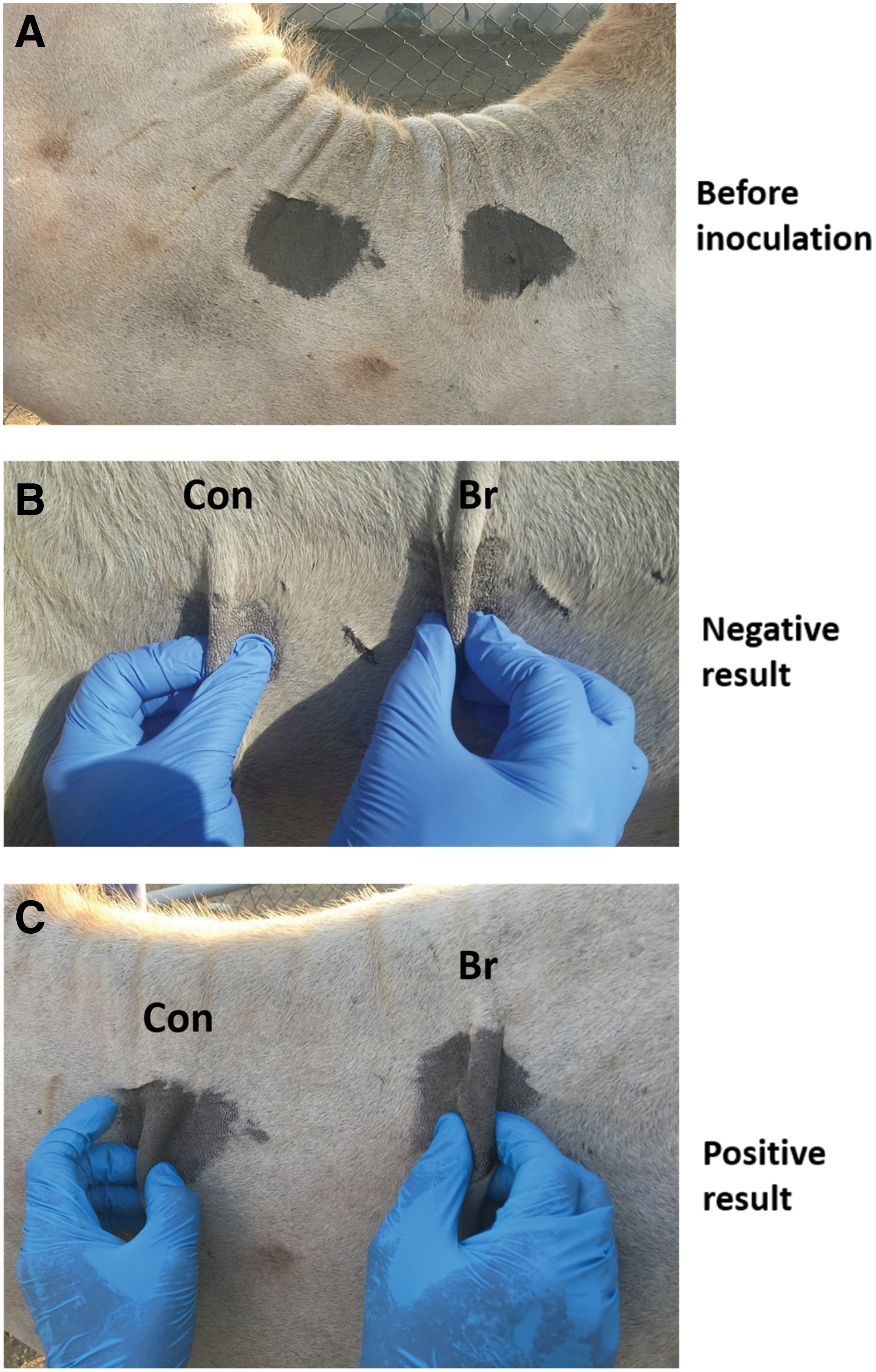
Application of the Brucellergene skin test on dromedary camels.
Statistical analysis
A Bayesian model based on MCMC (Markov Chain Monte Carlo) approach has been followed and the JAGS (Just Another Gibbs Sampler) package (
Considering that the animals examined in this study were not randomly selected and, therefore, they cannot be considered a representative sample of the camel population in the selected locations, no statistical analyses were performed to verify the significance of the apparent difference in prevalence results among locations.
Results
Overall, 36 out of 68 samples (52.94%) resulted positive to RBT. Three out of 30 samples (10.00%), 17 out of 20 samples (85.00%), and 16 out of 18 samples (88.89%) resulted in positive response by RBT in Sweihan, Taiba, and Wafia areas, respectively (Table 1). The c-ELISA gave the exact same number of positives of the RBT (Table 1), but two animals in Wafia area gave a discordant result between RBT and c-ELISA.
Results of the Camels Tested by Rose Bengal Test, Competitive-Enzyme-Linked Immunosorbent Assay, and Brucella Skin Test (n = 68)
Different superscript letters indicate a statistically significant difference (chi-square test, p < 0.05).
BST, Bruellergene skin test; c-ELISA, competitive-enzyme-linked immunosorbent assay; RBT, Rose Bengal test.
Concerning the results to BST, none of the camels developed redness, edema, or thickening of skin at sites of normal saline injection. Overall, 29 out of 68 animals (42.65%) were positive to the BST. Three animals out of 30 from Sweihan area (10.00%) were also positive to the test, whereas 14 out of 20 (70.00%) and 12 out of 18 animals (66.67%) were positive to BST in Taiba and Wafia areas, respectively (Table 1).
Concerning the sensitivity and specificity of the three tests, the MCMC model estimated the following sensitivity and specificity median values: BST: Se = 70.72%, Sp = 98.82%; RBT: Se = 93.27%, Sp = 97.79%; and c-ELISA: Se = 94.78%, Sp = 98.48% (Table 2).
Results of the Markov Chain Monte Carlo Model
Summary statistics.
CL, confidence limit.
In Fig. 2 the density distributions of the estimated values of sensitivity and specificity for the three types of tests are reported.
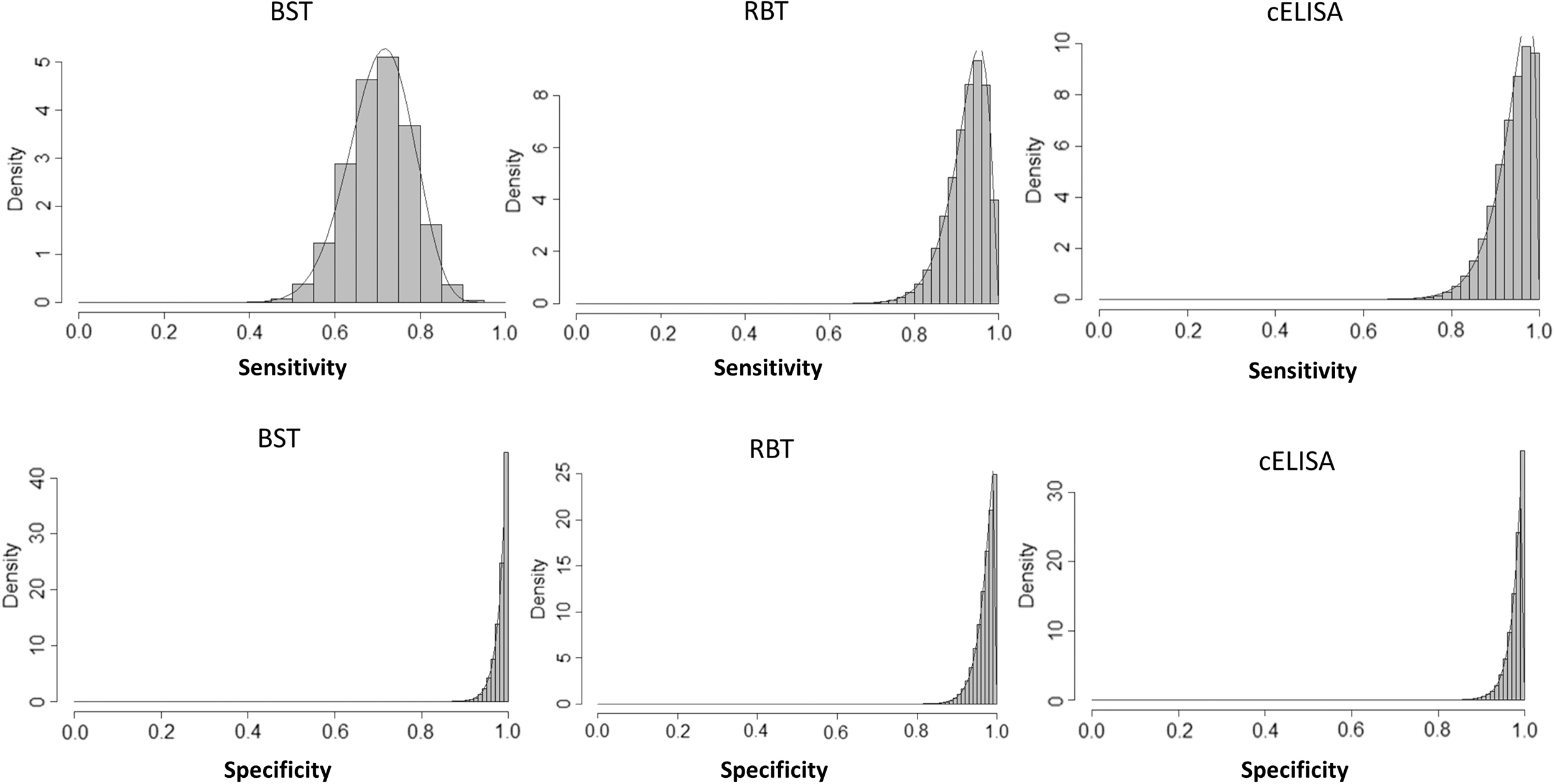
Estimated distributions of sensitivity and specificity values for BST, RBT, and c-ELISA. BST, Bruellergene skin test; c-ELISA, competitive-enzyme-linked immunosorbent assay; RBT, Rose Bengal test.
Discussion
Allergens detecting the specific cellular immune response induced by Brucella spp. infection have been used for the diagnosis of brucellosis in sheep, goats, and cattle (reviewed by Saegerman et al. 1999). This delayed type hypersensitivity (DTH) reaction is measured by the increase in skin thickness at the site of inoculation. This skin test is highly specific, but its weak sensitivity makes it a useful test for herds (OIE 2019) but not for individual certification (Godfroid et al. 2010). Nevertheless, BST could be used as a confirmatory test on animals nonvaccinated against brucellosis as it was more specific than RBT and CFT (Pouillot et al. 1997).
Therefore, in this first investigation on brucellosis skin testing in dromedary camels, we aimed to decide whether the skin test can be used as an alternative test. To this end we compared the Brucellergene (Zoetis company) with the commonly used RBT and the most sensitive c-ELISA.
According to the manufacturer instructions, the best reading time could range between 2 and 3 days. Our observations show that the intensity of the DTH reactions in camels peaked 72 h after inoculation.
The characteristics of the three tests performed in the study were estimated using a Bayesian model based on an MCMC approach. The estimated median values of the BST sensitivity and specificity were 70.72% and 98.82%, respectively, compared with 93.27% and 97.79% for RBT and 94.78% and 98.48% for the c-ELISA. The c-ELISA was found to be the best sensitive and specific method for camel brucellosis compared with both RBT and BST, in accordance with many previous studies in other animal species. Also, the lower value of BST sensitivity in comparison with the serological methods as well as the high specificity value of this test, possibly higher than RBT, agrees with previous studies performed in other animal species. Regardless of its comparatively lower sensitivity, the BST may be useful as a Brucella confirmatory test in camels especially when there is a doubtful result because of its high specificity. Brucellin preparations must be free of smooth lipopolysaccharide (S-LPS), as this may provoke nonspecific inflammatory reactions or interfere with subsequent serological tests (OIE 2019). Therefore, the intradermal inoculation of Brucellin does not induce the production of antibodies detectable with classical serological tests (e.g., RBT and CFT), which are based on S-LPS as antigen. Brucellergene OCB is prepared from a rough (deficient in S-LPS) mutant of B. melitensis B115 and thus supposedly without any Brucella and Yersinia enterocolitica serotype O:9 cross-reactive antigens (Riber and Jungersen 2007). However, to prove this assumption, more research is needed.
Like all other tests, this BST has its own limitations. These are mainly related to the technical complexity related to animal restrain, shaving, need for a skilled person to inoculate animals, and the need for a second visit in 3 days to read the result. In contrast, camel owners strongly resist collecting blood from their camels, especially pregnant animals, yet they are less inclined to a resent skin test.
The OIE recognized various serological tests for the diagnosis of brucellosis, including RBT, CFT, ELISA, and the DTH skin test, yet it points out that a positive result should always be verified using a confirmatory test. As the Brucellergene skin test investigated in this study proved to be comparatively specific, we propose using it as a confirmatory test in dromedary camels, particularly when the primary test of individual animals gives a doubtful result.
Footnotes
Acknowledgment
We thank Zoetis company (France) for providing the Brucellergene test kits used in this study.
Author Disclosure Statement
No conflicting financial interests exist.
Funding Information
The authors of this work received no specific funding for this work.