




Abstract
A longitudinal study was carried out in Middle atlas, Morocco (locality of Had Oued Ifrane) in a population of 255 dogs from three localities, including two categories of dogs (owned and stray dogs). The dogs were investigated three times over a period ranging from 4 to 8 months between December and August. At each investigation, dogs were treated with arecoline, inducing defecation and allowing feces collection. Dogs were further treated with praziquantel to clear them from Echinococcus granulosus. Microscopic examination of feces was performed to assess the infection status of dogs at each investigation, and positive samples underwent copro-PCR to determine the circulating strain of E. granulosus. A high prevalence of infestation ranging from 23.5% to 38.8% and from 51.3% to 68.5% was, respectively, found in owned and in stray dogs. The PCR results revealed the presence of G1 strain in all positive samples. A logistic regression model was used to determine the incidence of infestation and showed that stray dogs underwent a significantly higher risk of infection (odds ratio = 14; 95% confidence interval: 6–30; p < 0.001) compared with owned dogs. Only anthelmintic treatment intervals of 2 months efficiently prevented egg shedding in owned and stray dogs. The seasonal effect was also significant, with the highest risk of reinfestation in winter and the lowest risk in summer. This study confirms that stray dogs undergo an increased risk of infestation by E. granulosus and indicate that infective pressure is influenced by season.
Introduction
E
Cystic echinococcosis (CE) is a highly endemic zoonosis in Morocco. The abundance of stray dogs and slaughter practices allowing dogs to have access to condemned offal, especially in rural areas, contribute to its persistence. This disease represents a serious public health problem and has a substantial socioeconomic impact. In 2015, 1627 human surgical cases (5.2 cases per 100,000 inhabitants) were recorded for the whole country (Chebli et al. 2017). Surgeries need to be repeated in 3% of cases, and a mortality of 3% was reported (Ministry of Health of Morocco 2012). The treatment costs were estimated to be approximately US$ 1700 and US$ 3200 for simple and repeat cases, respectively, and present an important financial burden to the health sector (Andersen 1997). Indirect costs due to recurrence and re-examination, reduced quality of life after surgery, morbidity due to undiagnosed CE, and loss of income in fatal cases were not considered in these burden calculations and would further increase this estimate (Ministry of Health of Morocco 2012).
In Morocco, current evidence indicates that the transmission cycle of E. granulosus relies primarily on a domestic cycle involving dogs and livestock species (sheep, cattle, camels, goats, and equines) (Azlaf and Dakkak 2006). Stray dogs in urban areas and free or roaming dogs in rural areas are the main definitive host and are pivotal in transmission in this context (Azlaf and Dakkak 2006, Azlaf et al. 2007, El Berbri et al. 2015a). A study conducted by Azlaf and Dakkak (2006) in several regions of Morocco revealed prevalence rates of 10.58% in sheep, 1.88% in goats, 22.98% in cattle, 12.03% in camels, and 17.8% in equines. The study conducted by El Berbri et al. (2015b) in the region of Sidi Kacem revealed a prevalence of 42.9% in cattle, 11% in sheep, and 1.5% in goats. In the slaughterhouses, organ refusal due to hydatidosis generates losses estimated at US$ 100,000 per year at the national level (Azlaf and Kadiri 2012). In dogs, the tapeworm prevalence varies between 22% and 68.2% across regions (Ouhelli and Kachani 1997). Consequently, this high prevalence leads to a very high contamination of the environment with eggs (Gemmell et al. 2001), and hence the risk of transmission to farm animals and humans is expected to be very high. For these reasons, and in line with WHO/OIE (2001), detection of infection in dogs is an essential component of epidemiological studies and implementation of CE control programs (Dakkak et al. 2016).
In rural regions of Morocco, owned dogs and free roaming or stray dogs are the definitive hosts of E. granulosus. Owned dogs are kept as house and livestock guards and are in tight contact with their owners, thereby increasing the risk of contamination of humans, especially women and children (Kachani et al. 1997). On the other hand, their role as shepherd strongly increases the risk of infestation of pastures, thereby leading to infestation of cattle, sheep, goats etc. Infected organs such as liver and lungs from home-slaughtered animals appear as a source of infection of owned dogs. Stray dogs are likely to be infested when roaming freely around slaughterhouses and weekly markets (souks) where animals are killed without any access restriction and no appropriate destruction of infected organs (Kachani et al. 1997).
Among the pharmacological options aiming at the reduction of the infective pressure for intermediate hosts and humans figure the vaccination of domestic herbivores against E. granulosus (Gauci et al. 2005) as well as the regular deworming of dogs (Larrieu and Zanini 2012). Indeed, a vaccine against de G1 strain of E. granulosus tested in Argentina prevented cyst development in sheep (Larrieu et al. 2013). Vaccination is, therefore, considered as a promising option if satisfying parasite control in dogs cannot be achieved. Indeed, effective chimioprevention in dogs can only be achieved if owned and stray dogs undergo deworming at regular intervals (Cabrera et al. 1996). Given the logistic difficulties of deworming campaigns in rural zones, the risk of infection in function of dog type (owned vs. stray dog) and in function of the parasite egg survival in the environment (winter vs. summer) appear as important points for the set-up of an efficient deworming strategy. Accordingly, this study aimed at identifying the circulating strain of E. granulosus in owned and stray dogs in Middle Atlas of Morocco and at assessing infection risk over time in both dog categories.
Materials and Methods
Description of the study area
The study was implemented in Had Oued Ifrane, located in the Middle Atlas, which extends from the southwest to the northeast for about 450 km and covers a total area of 27,550 km2, corresponding to 15% of Morocco's mountain area (Fig. 1). It is an agro-pastoral zone where agriculture and livestock are the main sources of income for the entire rural population. It is a mountainous area where altitude ranges from 800 to 3500 meters. The climate of the region is the mountainous continental Mediterranean type of mountain: cold, rainy, and snowy in winter; hot and dry in summer. Had Oued Ifrane was chosen as a case study site, due to the presence of a large canine population, many rural slaughterhouses, and a weekly ephemeral fairground market (souk). It is a region known for breeding, particularly sheep farming with a predominance of the Timahdit breed. Livestock production is the main activity for farmers in this region. A study on the prevalence of hydatid cyst in abattoirs in the same region showed that 30% of cattle, 13% of sheep, and 2% of goats carry one or more hydatid cysts in the liver and lungs, suggesting a strong E. granulosus infestation in dogs (Amarir, personal communication 2017).
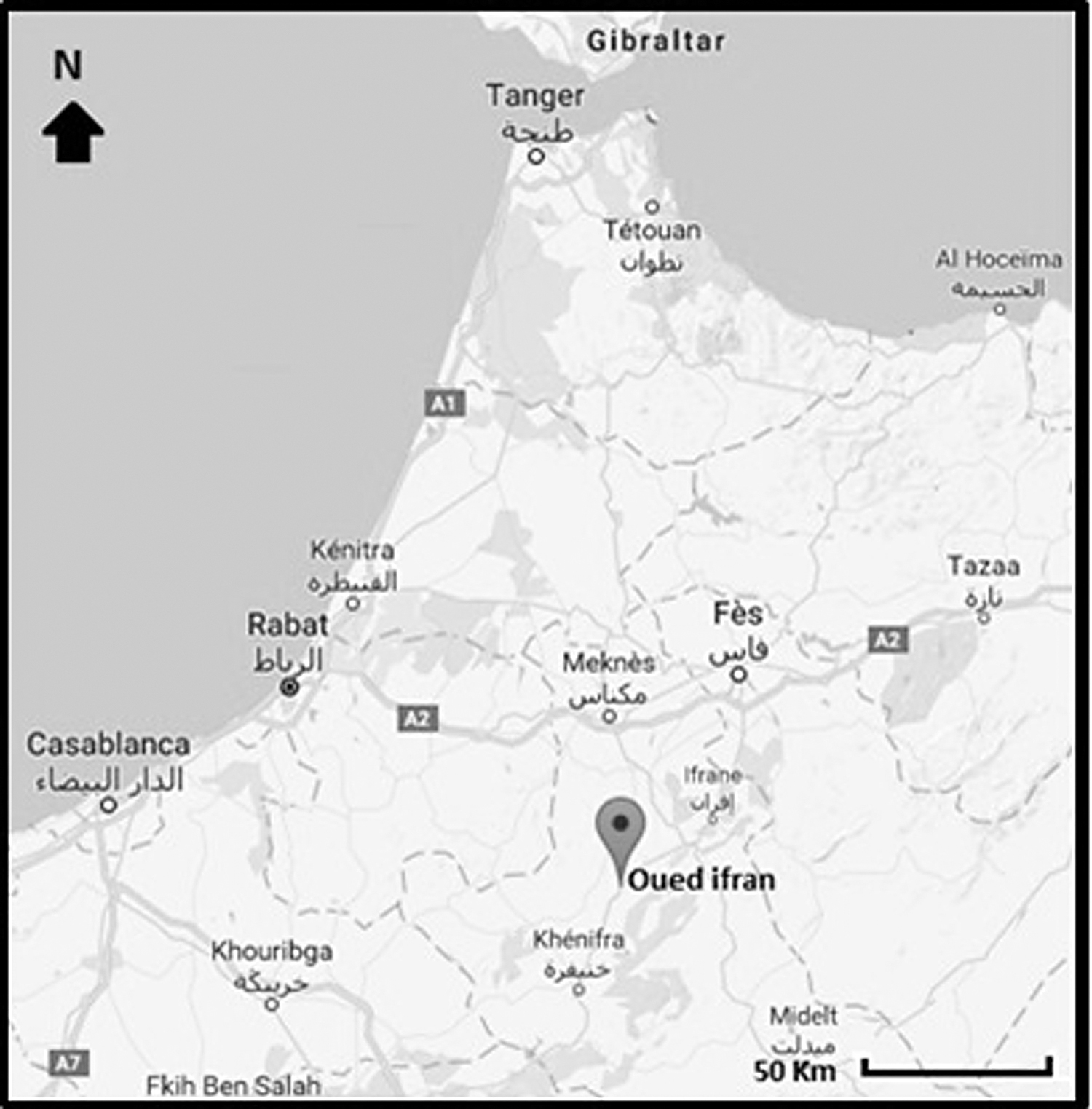
Geographical localization of study site Had Ouad Ifrane. Ref:
Study design
Two populations of dogs were targeted: owned dogs and stray dogs. At Had Oued Ifrane, three douars (villages) distant about 20–30 km from each other were selected. They were located near a weekly souk and a slaughterhouse. Their inhabitants were sheep and cattle breeders of similar herd size and with an average of two to three dogs per household.
Each douar was assigned to a dog treatment group (Group A: Douar Assaka, with a 2-month treatment interval, Group B: Douar Sanoual with a 3-month treatment interval, Group C: Douar Sidi Bel Khir with a 4-month treatment interval) and was composed by similar proportions of owned (60–75%) and stray dogs (25–40%). Praziquantel (5 mg/kg) was administrated on three occasions (T0, T1, T2) to owned and stray dogs older than 1 year at intervals of 2, 3, or 4 months to groups A, B, and C, respectively (Table 1 and Fig. 2). The choice to assess the risk of infestation in dogs at different treatment intervals was initially based on site accessibility and lack of knowledge of incidence. Long exposure time is, indeed, required to compare owned and stray dogs if incidence is low whereas shorter exposure time is indicated to compare higher incidences. All groups were tested for the first time in December 2016. Dogs missing a sampling session were no more investigated. Owned dogs were identified and recognized with the help of their owner, whereas stray dogs were identified and recognized on the basis of pictures.
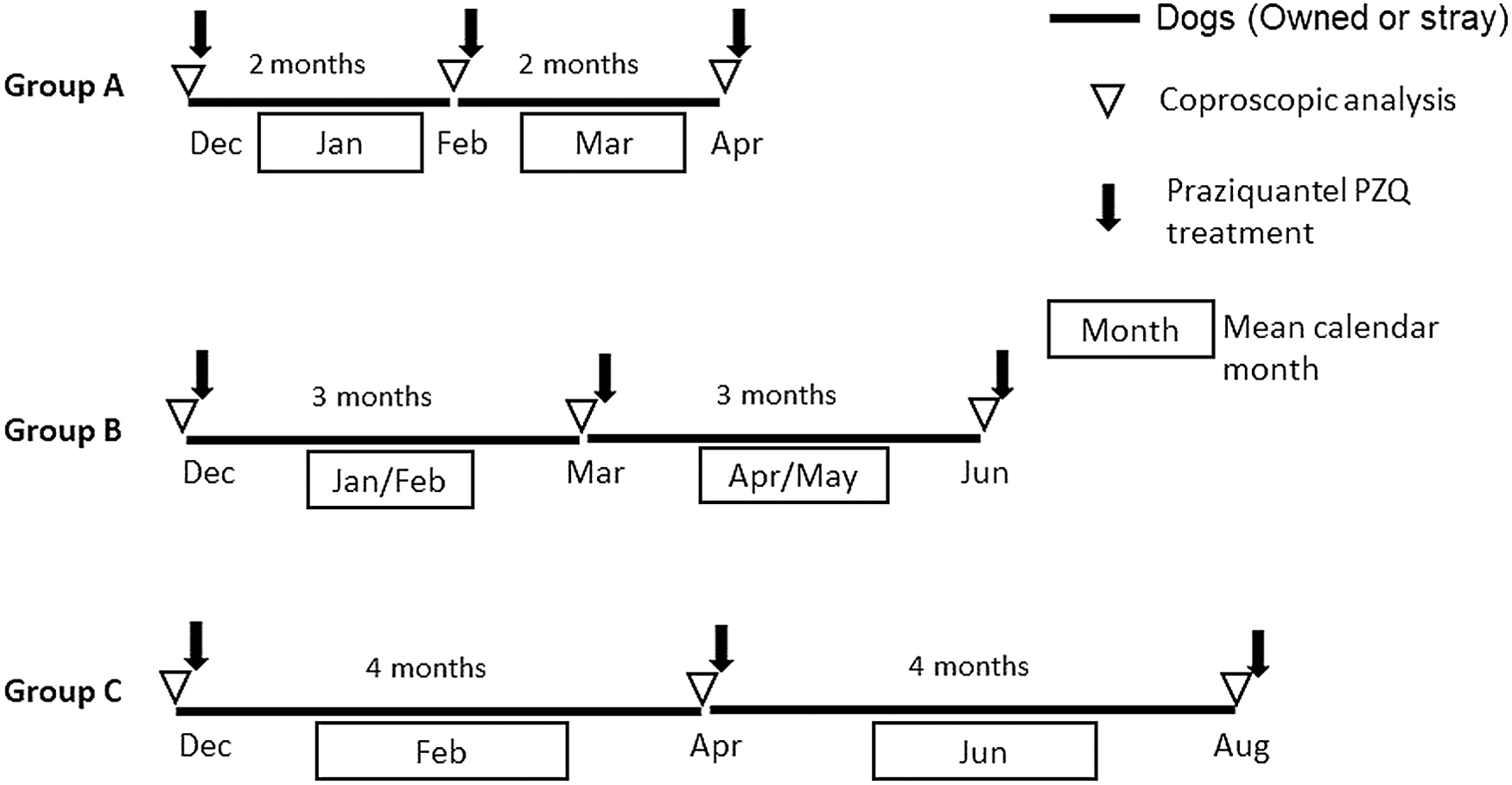
Study design.
Proportion of Infected Owned and Stray Dogs at Different Sampling Times in the Three Groups
Missing dogs were excluded for the rest of the study.
Fecal sample collection and analysis
To induce defecation and expulsion of eggs and worms, dogs received meat balls containing arecoline hydrobromide (approximate dose of 4 mg/kg BW). In case of defecation failure, a second dose of 2 mg/kg BW was administrated (Cabrera et al. 1995). After sample collection, remaining feces and defecation area were disinfected with alcohol for at least 5 min and burned (Dakkak et al. 2016). To collect feces from fearful stray dogs, levomepromazine (25 mg orally) was used for sedation before arecoline administration (according to the protocol described by OIE 2012).
The coprological flotation technique described by Riche and Jorgensen (1971) was applied on fecal samples for microscopic examination. Worms and eggs were identified according to Soulsby (1982).
Only samples positive at coprology were washed with PBS, and DNA extraction was performed according to Mathis et al. (2006) and Abbassi et al. (2003). The DNA was extracted by using the Bioline Kit (Bart et al. 2006). The DNA extracted from worms and eggs underwent a PCR amplification by use of the mitochondrial primers EgCOI 1/EgCOI 2 and EgNDI 1/EgNDI 2 according to the protocol described by Bart et al. (2006). Copro-PCR was reported to be highly sensitive to detect eggs and worms per animal and to identify species of the family Taeniidae (Mathis et al. 2006). The PCR program was made of 35 cycles with, for each cycle, a denaturation step (15 s at 95°C), a hybridization step (15 s at 50°C for EgCOI 1/2 and 52°C for EgNDI 1/2), and an elongation step (10 s at 72°C).
Other species of taeniid cestodes were observed during microscopic analyses of fecal samples, such as Taenia hydatigena and Dipylidium caninum.
Statistical analysis
Logistic regressions were used to analyze the infection status of dogs both before and after treatment. At T0, dog type, the location, and the interaction between them were used as discrete explanatory variables. T1 and T2 data were analyzed by using dog type (discrete), location (discrete), and mean calendar time of the exposure period (continuous from January to June; Fig. 2) as explanatory variables. First-level interactions were tested and ignored if p > 0.05. Linear estimates and the corresponding probabilities (i) were calculated with their 95% confidence intervals (CIs). Since exposure periods (e) ranged from 2 to 4 months, estimates were further transformed in monthly risks (r) assuming a prepatent period (p) of 1 month.
Results
Strain identification by coproPCR
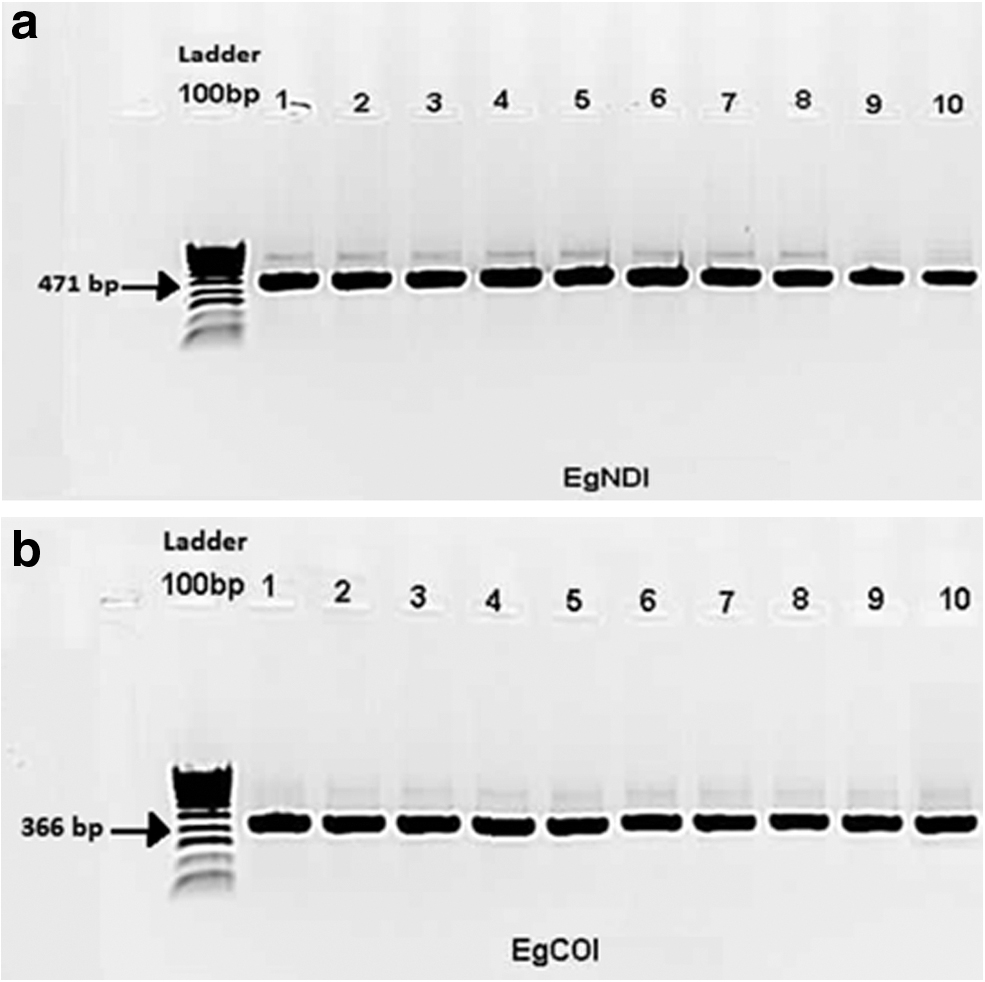
The analysis of the PCR product of 104 positive fecal samples revealed the presence of a single genotype of E. granulosus, the G1 that belongs to the sheep strain, characterized by the presence of a single band of molecular weight of 366 bp for COI and 471 bp for NDI (Fig. 3a, b).
Prevalence of dog infections
Results regarding E. granulosus infestation of dogs are shown in function of site (A–C), dog type (owned vs. stray dogs), and time (Table 1). At the beginning of the study, the prevalence was significantly higher in stray dogs than in owned dogs (odds ratio [OR] = 14; 95% CI: 6–30; p < 0.001). Dogs of group A were less infected than dogs of group B (p = 0.03) and group C (p = 0.04). Interactions between sites and dog types were not significant (likelihood ratio test: p = 0.48) (Fig. 4).

Initial prevalence of E. granulosus infection in owned and stray dogs in three study sites
Risk of dog infections
Modeling the monthly incidence of infection in owned and stray dogs revealed that stray dogs had a significantly higher risk of infection than owned dogs (OR = 14; 95% CI: 6–30; p < 0.001). The site effect (including effects caused by different locations and exposure times) was also significant. In addition, in the multivariable model, calendar time also had a significant effect (p < 0.001), indicating that the risk of infection was significantly higher in winter than in spring and summer (Fig. 5). The interaction between site and dog type could not be evaluated since no owned dog was found to be positive in site A at T1 and T2. Interactions between time and dog type and between time and site were not significant (p = 0.9 in likelihood ratio test between models with and without first-level interactions), indicating that the effect of time was the same in all sites and categories.
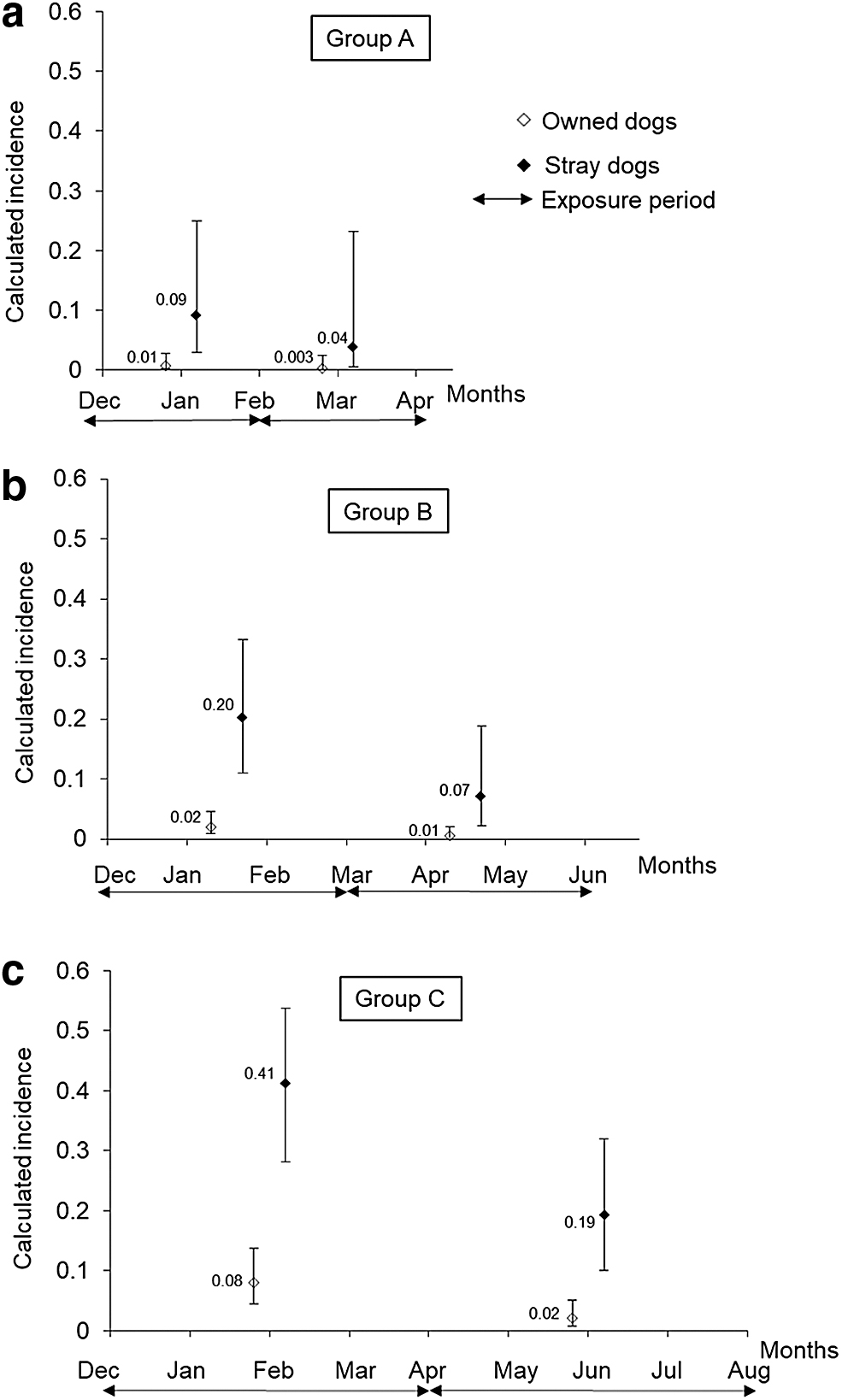
Modeling of the monthly incidence of infestation with confidence interval (95%)
To allow the comparison of incidence between the sites, the model predictions and CIs were transformed in monthly risks. Assuming a constant risk during each exposure period and a prepatent period of 30 days, the monthly risk was lower in site A compared with sites B and C. The monthly incidence in site C appeared much higher than in sites A and B (Fig. 5).
Discussion
This is the first article on E. granulosus in dogs in Had Oued Ifrane region of the Middle Atlas, Morocco. Our study revealed the presence of the G1 strain in both owned and stray dogs, which is in line with previous studies (Azlaf et al. 2007, El Berbri et al. 2015a) and which confirms the major involvement of dogs in this strain transmission. Moreover, this study is, to our knowledge, the first to determine the prevalence and the incidence of infection with E. granulosus in function of the dog type (stray vs. owned dogs) and in function of exposure time. As reported by Dakkak et al. (2016), determining such indices is believed to be the best indicator regarding the risk of E. granulosus transmission in a region.
Our three work sites were carefully selected and were similar regarding climatic and socio-environmental conditions. The prevalence of dog infestation by E. granulosus was expected to be similar between sites A, B, and C. As a first drawback of this field study, a significantly lower prevalence in dogs of site A (Fig. 4) has to be mentioned. Second, the different anthelmintic treatment intervals of 2, 3, and 4 months leading to different exposure times should ideally have been applied in all sites. However, given that treatment of stray dogs was complex, the investigators preferred a setting where all dogs of a same site underwent a same treatment schedule. Moreover, treatment of owned dogs strongly depended on owner compliance, which could have been reduced if treatment schedules differed between dogs of the same owner or of a neighbor. Consequently, differences of the baseline (T0) values somewhat weaken the comparisons of absolute prevalence and incidence values in owned and stray dogs.
A last weakness of the design of this field study is the variable length of investigation: Indeed, the number of investigations per site was identical, but the total time span varied from 4 to 8 months, thereby introducing a supplementary variable, is climatic conditions that might influence infectious pressure by increasing or decreasing hydatic cyst survival in the environment. Ideally, the number of investigations should have been adapted to achieve an identical length of observation in all sites. On the other hand, contrary to studies where the effect of long-term anthelminthic treatment at different intervals aimed at reducing the development of hydatic cysts in the intermediate host (Cabrera et al. 2002, Zhang et al. 2009), our study assessed the impact of the time of exposure on infective material of the definite host to estimate the risk of reinfection after dogs' treatment. Considering that egg excretion by dogs is the source of infection of humans, especially in the case of owned dogs living nearby to their owners, valuable information regarding anthelmintic treatment intervals is crucial.
Regarding the sample analyses, an underestimation of infestation by E. granulosus cannot be excluded because only coproscopically positive samples underwent PCR analysis. Indeed, Lahmar et al. (2007) revealed that coproscopic control was highly specific but less sensitive (64%) than PCR (almost 100%). It might, nevertheless, be mentioned that all coproscopically positive samples were confirmed by PCR.
Before any treatment, the prevalence was high in both the stray and owned dogs (ranging from 23.5% to 51.3%; Fig. 4), and this difference was present in all sites. In a study carried out in Lybia, Buishi et al. (2005) reported slightly lower prevalences of 21.6% and 25.8% in stray and owned dogs, respectively. In Tunis, Lahmar et al. (2001) reported a prevalence of 21.0% in stray dogs. The high prevalence in stray dogs in our study can be explained by an increased infectious pressure due to free access to harvested and infested organs around slaughterhouses and weekly souks.
As shown in Fig. 5, the calculated incidence of reinfection varied in function of dog type and site. Independent of study site, risk of reinfection was significantly higher in stray dogs than in owned dogs, which can be related to an increased access to infected organs by stray dogs. Interestingly, the time span of 2 or 3 months between two anthelmintic treatments in owned dogs poorly changed the risk of reinfection of owned dogs and a decrease of reinfection was observed after the second treatment (Table 2). These results indicate that a treatment interval of 2 or 3 months efficiently controls E. granulosus egg shedding in owned dogs. Provided the investigation of owned dogs was strongly dependent on owner compliance, it might be hypothesized that owner awareness for this zoonosis increased over time, thereby changing the feeding strategy of their dogs. Indeed, Marcotty et al. (2012) have shown that the population's perception and knowledge of the disease appears as a determining factor for the success of control measures.
Multivariable Logistic Regression of Infection Risk; Group A and Owned Dogs Are the Bases of the Site and Dog Type Discrete Explanatory Variables, Respectively; Time Is Expressed in Months from January (1) to June (6)
CI, confidence interval; OR, odds ratio.
Regarding the risk of reinfection of stray dogs, even the short interval treatment did not completely prevent reinfection, but it considerably reduced its risk (Table 1 and Fig. 5). These results underline to which extent the exposure to infected organs appears to be high in stray dogs. Strikingly, a reduction of reinfection risk was observed in stray dogs between the second and third investigation, despite the absence of a changed feeding strategy as supposed for owned dogs. We hypothesize that this significant effect of time (Table 2) is due to climatic conditions. Indeed, the 4-month interval investigation started in December and ended in August, which means that the second exposure period took place under dry and warm conditions. Accordingly, hydatid cysts survival in the environment might have been reduced during this period. If the impact of temperature and humidity is well known with regard to E. granulosus egg survival, knowledge is reduced regarding cyst survival in the environment (Atkinson et al. 2012). It might furthermore be assumed that the environmental load is highest in late autumn and during winter, because the proportion of slaughtered and potentially infested animals increases at this time point (Thevenet et al. 2005).
In conclusion, this study confirmed by molecular typing the presence of the G1 E. granulosus strain in owned and stray dogs in the Middle Atlas of Morocco. Prevalence and incidence of E. granulosus was significantly higher in stray dogs. Dogs' reinfestation rate increased when treatment intervals increased. Only interval treatments of 2 months appeared to efficiently control egg shedding in owned and stray dogs. A significantly higher calculated incidence of infestation was found in owned and stray dogs during winter periods than during spring/summer periods, suggesting a seasonal change of infective pressure. Accordingly, for an effective control strategy in this endemic region of Morocco, those factors must be taken into account.
Footnotes
Acknowledgments
The authors thank Pierre Dorny of the Institute of Tropical Medicine in Antwerp, Belgium, for providing the positive control of E. granulosus G1 strain; Luc Duchateau of the Biometrics Research Group, Faculty of Veterinary Medicine, Ghent University, Belgium, for his assistance in statistical data analysis; and Intissar Boukhari of the parasitology laboratory at the Agronomy and Veterinary Institute Hassan II, Rabat, Morocco, for his precious assistance in the field and in the laboratory.
Author Disclosure Statement
No conflicting financial interests exist.
Statement of Animal Rights
This work has been authorized by the animal welfare and ethics committee in Rabat, Morocco, in 2015. The protocol was applied according to the international standards cited in many scientific references and in the 2012 OIE Manual titled “Manual of diagnostic tests and vaccines for terrestrial animals.”
Funding Information
This study received funding from the Academy of Research and Higher Education (ARES) of Belgium and University of Namur, Belgium, and Institute of Agronomic and Veterinary Hassan II, Rabat Morocco.