




Abstract
Bluetongue is one of the most important vector-borne viral diseases that can lead to significant economic losses as a result of reduction of productivity and even death in some susceptible ruminants. However, epidemiological information on bluetongue virus (BTV) infection in cattle and goats is scarce in China. To determine the seropositive rate and risk factors of BTV infection in cattle and goats in Guangxi province, a subtropical region in Southern China, a total of 548 cattle serum samples and 6567 goat serum samples collected from 13 cities across Guangxi province during 2003–2015 were analyzed and found that the seroprevalence is 44.5% (244/548) in cattle and 28.0% (1837/6567) in goats and the main BTV serotypes are BTV-1, -2, -4, and -8. Climatic zone, age, and species are found to be the likely risk factors for BTV infection. To our knowledge, this is the first large-scale serological survey for BTV infection in domestic cattle and goats in Guangxi province, Southern China.
Introduction
Bluetongue (BT), a vector-borne noncontagious viral disease affecting domestic and wild ruminants, is transmitted by biting Culicoides midges (Maclachlan et al. 2009). Bluetongue virus (BTV) is the causative agent of BT—a member of genus Orbivirus of the family Reoviridae. The severity of the disease varies among different ruminant species with the most severe signs in sheep, resulting in reduction of productivity and deaths (Goto et al. 2004, Susmitha et al. 2012), and asymptomatic manifestation in cattle and goats. Worldwide, BTV infection is estimated to have brought direct (disease) and indirect (trade, prevention, control and eradication, etc.) losses of more than US$ 3 billion per year (Mellor and Wittmann 2002, Gethmann et al. 2015, Grewar 2016). Because BTV can be transmitted rapidly and leads to serious economic losses in affected countries, it has been listed as a notifiable disease by the World Organization for Animal Health (OIE) (Pascual-Linaza et al. 2014).
BTV occurs throughout most tropical and temperate regions worldwide (Osburn 1994, Maan et al. 2007). In general, this distribution can reflect the distribution of its Culicoides vectors and the temperature required for BTV replication in and transmission by vectors (Yeh et al. 2018).
Currently, serology has been applied to monitor the spread of BTV in deer, cattle, South American camelids, goats, and sheep in different countries (Di Ventura et al. 2004, Zanolari et al. 2010, Noaman et al. 2013, Graham et al. 2017, Yeh et al. 2018). In China, a number of reports have been published on BTV antibody surveillance in sheep, yaks, sika deer, and goats (Ma et al. 2017, Liu et al. 2018, Duan et al. 2019), and there have been extensive studies of BTV infection of cattle and goats in Yunnan province using sentinel cattle and goats (Kirkland et al. 2002, Duan et al. 2019), but little information is available on BTV infection in cattle and goats in Guangxi province. Therefore, the objective of this study is to provide epidemiological information and evaluate potential risk factors on BTV infections in domestic cattle and goats in Guangxi province.
Materials and Methods
Investigation sites
The present survey was conducted in 13 cities of Guangxi province, Southern China. Guangxi province is located in Southern China between north latitudes of 20°54′ to 26°24′ and east longitudes of 104°26′ to 112°04′, and has a typical subtropical monsoon climate with an average annual temperature of 20.7°C. The 13 cities are divided into three climatic zones based on thermal conditions, including mid-subtropical zone with accumulated temperature (AT) ≤6900°C (Liuzhou, Hezhou, Hechi, Guilin), south-subtropical zone with AT between 6900°C and 8000°C (Nanning, Wuzhou, Fangchenggang, Qinzhou, Yulin, Chongzuo, Laibin, Baise), and north-tropical zone with AT ≥8000°C (Beihai) (Fig. 1). AT is the total of daily temperature in 1 year, which is ≥10°C.
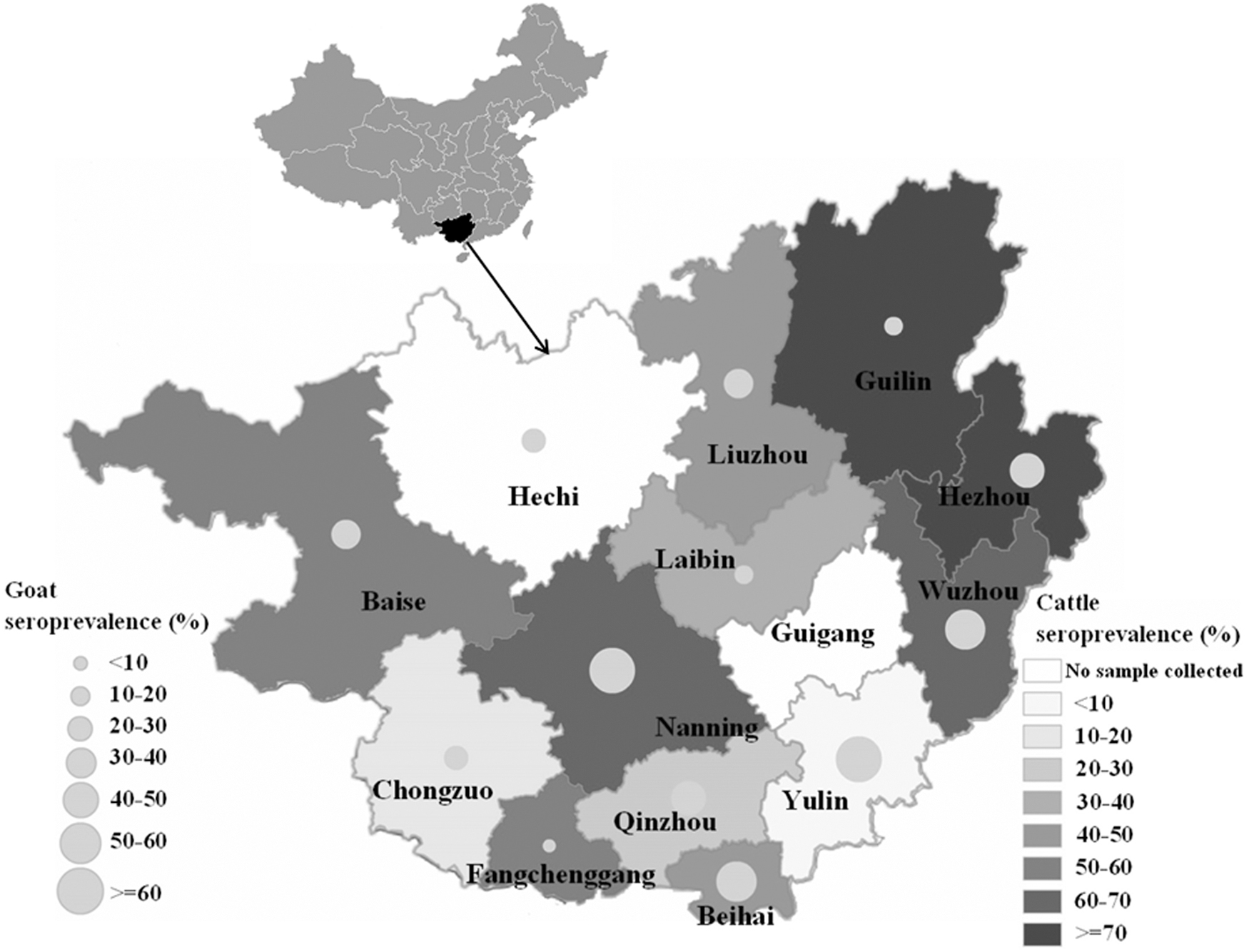
Seroprevalence distribution of BTV infection in domestic cattle and goats in 13 cities of Guangxi province, Southern China. BTV, bluetongue virus.
Serum samples
A total of 7115 blood samples were randomly collected from 548 cattle and 6567 goats in 13 cities of Guangxi province during 2003–2015, and detailed distribution of samples in each city is shown in Table 1. Among these blood samples, 2187 blood samples collected from goats were sorted by age (Table 2). The sera were separated by centrifugation at 3000 rpm for 5 min, and stored at −20°C until used.
Summary of Cattle and Goat Samples Collected for Bluetongue Virus Tests in Guangxi Province of China During 2003–2015
BTV, bluetongue virus; CI, confidence interval; NA, samples not available.
Likely Risk Factors Associated with Seroprevalence of Bluetongue Virus in Cattle and Goats in Guangxi Province of China
OR, odds ratios.
Serological detection
Group-specific antibodies against BTV were detected using a commercially available cELISA kit (VMRD, Veterinary Medical Research and Development, Inc., Pullman, WA) according to the manufacturer's instructions. The serum samples were considered positive if they produced an optical density that was <50% of the mean of the negative control optical densities, when the results of positive and negative controls were valid.
One hundred cELISA positive serum samples were further analyzed for BTV type-specific antibodies in Yunnan Tropical and Subtropical Animal Virus Diseases Laboratory (YTSAVDL) by serum neutralization test (SNT) using BTV-1 to BTV-24 reference strains, following the Manual of Diagnostic Tests and Vaccines for Terrestrial Animals (OIE 2008). In brief, serum samples were serially diluted in minimal essential medium, 50 μL volume of each dilution was transferred to each test well of flat-bottomed microtiter plates and then mixed with an equal volume of BTV reference serotypes (100 TCID50). After 1 hour incubation at 37°C in an incubator with 5% CO2, ∼104 BHK-21 cells were added per well in a volume of 100 μL. After incubation for 3–5 days, wells were observed for cytopathic effects under an inverted microscope and samples were considered to be positive for type-specific antibodies when the titer was ≥1/20 (Sairaju et al. 2013).
Statistical analysis
The seroprevalence of BTV infection in different climatic zones, age, and species was analyzed with a chi-squared test and the potential risk factors were analyzed with odds ratios (OR) and 95% confidence interval (CI) determined using SPSS (release 16.0 standard version; SPAA, Inc., Chicago). p < 0.05 was considered statistically significant.
Results and Discussion
In this study, 244 out of 548 (44.5%, 95% CI = 40.4–48.7) cattle sera were found positive for BTV group-specific antibodies, which is much higher than the 2.7% (24/892) and 1.5% (156/10585) in Iran and Illinois and western Indiana of the United States, respectively (Boyer et al. 2007, Noaman et al. 2013). The seroprevalence ranged from 17.1% (95% CI = 8.9–25.2) to 84.3% (95% CI = 74.3–94.2) among the cities in this study (Table 1 and Fig. 1). As there was no BTV vaccine being used in China, the seroprevalence is the result of natural infections.
The overall seroprevalence of BTV antibodies was 28.0% (95% CI = 26.9–29.1) in domestic goats (1837/6567) in the present investigation with the highest seropositive rate of 63.6% (95% CI = 43.5–83.7) in Yulin and the lowest seropositive rate of 6.3% (95% CI = 2.1–10.4) in Fangchenggang (Table 1 and Fig. 1). The overall seroprevalence in goats in this study was lower than the 47.3% (568/1202) in India and the 50.5% (47/93) in Yunnan province of China but higher than the 4.4% (38/870) in Albania (Di Ventura et al. 2004, De et al. 2009, Duan et al. 2019). Seropositive goats were found in all 13 cities of Guangxi province where samples were collected, indicating that BTV infection was extensive in this province.
The large differences on seroprevalence of BTV antibodies between Guangxi province of China and the countries and Yunnan province of China compared in this study could be due to a large number of factors, including the geographic differences, diagnostic methods, sample sizes, feeding conditions, and species. Therefore, it is hard to provide a specific reason for these differences.
As shown in Table 2, significant difference of seroprevalence of BTV infection was observed in different climatic zone in cattle (p < 0.01) and goats (p < 0.01). The cattle in mid-subtropical zone (59.8%) had nearly three times (OR = 2.8, 95% CI = 1.9–4.0) higher risk of being infected by BTV than the cattle in south-subtropical zone (35.0%). The goats in north-tropical zone (47.8%) had more than three times (OR = 3.6, 95% CI = 2.7–5.0) higher risk of BTV infection than the goats in mid-subtropical zone (20.1%), and the goats in south-subtropical zone (32.5%) had almost two times (OR = 1.9, 95% CI = 1.7–2.2) higher risk of BTV infection than the goats in mid-subtropical zone (20.1%). The risk factor analysis seemed to indicate that higher AT area may be more conducive to the spread of BTV in goats. However, the opposite appeared to be true for BTV seroprevalence in cattle, with the highest rate in mid-subtropical zone where the AT was the lowest among the three climatic zones. One probable reason for this discrepancy in goats and cattle may be the difference of Culicoides vector species in the different climatic zones; this will be needed to confirm by vector populations survey that a critical work for the investigation of transmission of vector-borne viral disease.
In the different age groups, the seropositive rate of BTV infection ranged from 23.2% (95% CI = 20.6–25.9) in 0 < year ≤1 group to 33.1% (95% CI = 30.0–36.2) in 1 < year ≤2 group in goats. This result showed a significant correlation between age and BTV seroprevalence (p < 0.01). However, the seroprevalence in goats of older age groups, 2 < year ≤3 group and year >3 group, displayed similar antibody levels of BTV infection to the goats in 0 < year ≤1 group. This result was inconsistent with previous report that BTV seroprevalence was higher in adults (>2 years) than the younger goats (Yeh et al. 2018). There is no obvious explanation for the observed differences. The results in this study might indicate that transmission has been intermittent, further investigation will be needed to determine the underlying factors.
The seroprevalence of BTV antibodies in cattle (44.5%) was higher than in goats (28.0%). The cattle had more than two times (OR = 2.1, 95% CI = 1.7–2.5) higher risk of BTV infections than the goats, which was consistent with previous study (Di Ventura et al. 2004). This difference in prevalence between the animal species was likely to be influenced by vector preference.
Unfortunately, we did not collect the same number of serum samples in cattle and goats from each climatic zone and age group because of our lack of consideration. In addition, the ages of all cattle and 4380 goats sampled in this study could not be recorded. These lead to the absence of more comprehensive and accurate analysis and interpretation of the results.
The occurrence and prevalence of BT is a complicated process and could be affected by a number of natural factors, including temperature, rainfall, and altitude. The interaction between temperature and rainfall probably affects vector distribution and abundance, which are ultimately the essential elements that determine prevalence and distribution of BTV infection. Therefore, more full-scale geographic and climatic information will be needed to collect, and vector populations will be needed to survey for further investigation of BTV infection.
Forty-eight cattle sera and 52 goat sera were further analyzed for BTV serotype-specific antibodies by SNT using reference strains for 24 BTV serotypes (Tables 1 and 3). Based on the SNT result, the serum samples had neutralizing antibodies against as many as 13 different BTV serotypes with serotypes 1 (63 serum samples), 2 (68 serum samples), 4 (47 serum samples), and 18 (44 serum samples) being the dominant ones. Eighty-two percent of the samples were found to have antibodies against more than one BTV serotypes suggesting likely coinfections by different BTV serotypes among the goats and cattle population in Guangxi province. The finding in this study is similar to a previous report on BTV isolation in neighboring Yunnan province, which showed the presence of BTV of different serotypes in the fields (Kirkland et al. 2002). It is worth mentioning that with BTV virus neutralization tests (VNTs) there can be extensive cross-reactivity, and especially at low dilutions. A high titer to one serotype can readily induce reactivity at a much lower titer to another serotype. It is difficult to make any absolute conclusion about the low titers. Therefore, the serum samples tested in this investigation probably obtained wrong results about BTV serotypes with low titers due to cross-reactivity.
Serum Neutralization Test Result of 100 cELISA Positive Samples Against 24 Bluetongue Virus Serotype Viruses
Forty-eight and 52 of the 100 cELISA positive samples were cattle and goat, respectively.
Conclusion
In conclusion, the results of this study showed that widespread presence of BTV antibodies in cattle and goats with seroprevalence at 44.5% and 28.0%, respectively. Neutralizing antibodies against as many as 13 BTV serotypes were detected among the samples with serotype 1, 2, 4, and 18 being the dominant ones in Guangxi province, Southern China. Climatic zone, age, and species were examined as the potential risk factors for BTV infection in this study, but a clear conclusion could not be made. To our knowledge, this is the first large-scale survey of BTV antibodies in domestic cattle and goats, which will provide baseline data for the strategic prevention and control of BT infections in cattle and goats in Guangxi province, Southern China.
Footnotes
Author Disclosure Statement
No conflicting financial interests exist.
Funding Information
Project was funded by the Special Fund for Agro-Scientific Research in the Public Interest of China (no. 201303035), the Open Project Foundation of State Key Laboratory of Veterinary Biotechnology (no. SKLVBF201613), and the Special Fund for Basic Scientific Research of Guangxi (no. Guike 16-4).