




Abstract
Background:
Leptospira is the causative agent of leptospirosis, a zoonotic disease of global importance. To have a better understanding on the host species of Leptospira, we investigated the prevalence of Leptospira species in hedgehogs in Central China.
Materials and Methods:
Hedgehogs were captured in Hubei Province, China in May and October, 2018. Total DNA was extracted from the kidney tissues of hedgehogs for determining the Leptospira species by PCR amplification of the rrs2, secY, and flaB genes with genus-specific primers.
Results:
PCR amplification indicated that the positive rate of hedgehogs to the rrs2, secY, and flaB genes were 19.5% (8/41), 12.2% (5/41), and 9.8% (4/41), respectively. The homology of the partial sequence of rrs2, secY, and flaB genes were 99.0–100% among the Leptospira strains from hedgehogs. Phylogenetic analysis revealed that Leptospira species detected in this study clustered together with Leptospira interrogans.
Conclusions:
We detected L. interrogans from hedgehogs in Central China, suggesting hedgehogs are the hosts of L. interrogans.
Introduction
L
Leptospira interrogans and L. borgpetersenii are the predominant pathogenic species causing leptospirosis (Zhang et al. 2012), and at least 75% of leptospirosis cases are caused by L. interrogans (Hu et al. 2014). Numerous studies indicated that rodents and insectivora are the important reservoirs of Leptospira (Rahelinirina et al. 2010, Ayral et al. 2016), whereas other small mammals such as bats are reported to carry Leptospira as well (Han et al. 2018, Zhao et al. 2019). Leptospira serovars usually do not cause disease in reservoir hosts (Ko et al. 2009), but humans can acquire infections by contact with infected animals, animal tissue, animal excretions, or by having abrasions, cuts in the skin, or conjunctiva coming into contact with contaminated water and food (Waitkins 1985).
Hedgehogs have been studied for their association with zoonotic pathogens in Europe (Kozuch et al. 1967, Majeed et al. 1989). However, hedgehogs as the natural reservoir of zoonotic-borne pathogens have been largely neglected in China. In this study, we determined the infection rate of hedgehogs with Leptospira to evaluate the role of hedgehogs in the epidemiology of Leptospira in Xianning City, Hubei Province of China, which is an endemic area of leptospirosis with incidence of leptospirosis 0.038/100,000 in 2011 (NBS of Xianning City, 2011).
Materials and Methods
Sample collection
Hedgehogs were captured during May and October of 2018 in forested sites near cesspools from Xianning City (29°53′N 114°13′E), which is located in Central China. Hedgehogs were identified through morphological observation. Hedgehogs were euthanized with an overdose of chloral hydrate and their kidneys were collected.
DNA extraction and PCR amplification
Total DNA was extracted from kidney tissues of hedgehogs using QIAamp DNA Mini Kit (Qiagen, Germany) according to the manufacturer's instructions. Leptospira in hedgehogs were amplified with nested PCR by using the 16S ribosomal RNA gene (rrs2), the flagellin B gene (flaB), and preprotein translocase gene (secY) primers (Table 1). Nuclease-free water was used as a negative control in each set of PCR. Both primary and nested PCRs were performed under the following conditions: 1 denaturing cycle for 5 min at 95°C followed by 35 cycles of denaturation for 30 s at 95°C, annealing for 30 s at 55°C, extension for 90 s (primary PCR) or 1 min (nested PCR) at 72°C and an additional final extension for 10 min at 72°C.
PCR Primers Used for Amplification of Leptospira interrogans
PCR products were analyzed using 1.2% agarose gel electrophoresis and detected with ethidium bromide under UV light. PCR products with expected sizes were excised from gels with a Gel Extraction Kit (TSINGKE, Beijing, China) and cloned into pMD19-T vectors (TaKaRa, Kusatsu, Shiga, Japan). Leptospira DNA in plasmid was sequenced on both directions.
Phylogenetic analysis
Sequences of rrs2, flab, and secY genes were searched using BLAST in the GenBank database (
Ethical approval
This study was approved by the Ethics Committee of Wuhan University (2018010). Hedgehogs were handled in accordance with good animal practices required by the Animal Ethics Procedures and Guidelines of the People's Republic of China.
Results
Hedgehog collection
A total of 41 hedgehogs were collected from Xianning City, of which 22 were collected in May and 19 were collected in October. Hedgehogs were identified through morphological observation as Erinaceus amurensis.
Detection of Leptospira spp. in hedgehogs by PCR
Leptospira species were tested by PCR using kidney specimens from 41 hedgehogs. In total, 19.5% (8/41) of hedgehogs were positive to Leptospira with one of three genes and the positive rate of all hedgehogs to rrs2, secY, and flaB genes were 19.5% (8/41), 12.2% (5/41), and 9.8% (4/41), respectively. Among the eight positive samples, three hedgehogs were positive for all three genes.
Sequencing and phylogenetic analysis
BLAST analysis showed that the homology of the partial sequences of rrs2, secY, and flaB genes were 99.0–100% among the Leptospira strains from hedgehogs, respectively. Phylogenetic analysis revealed that the Leptospira spp. detected in this study clustered together with L. interrogans (Figs. 1 –3).
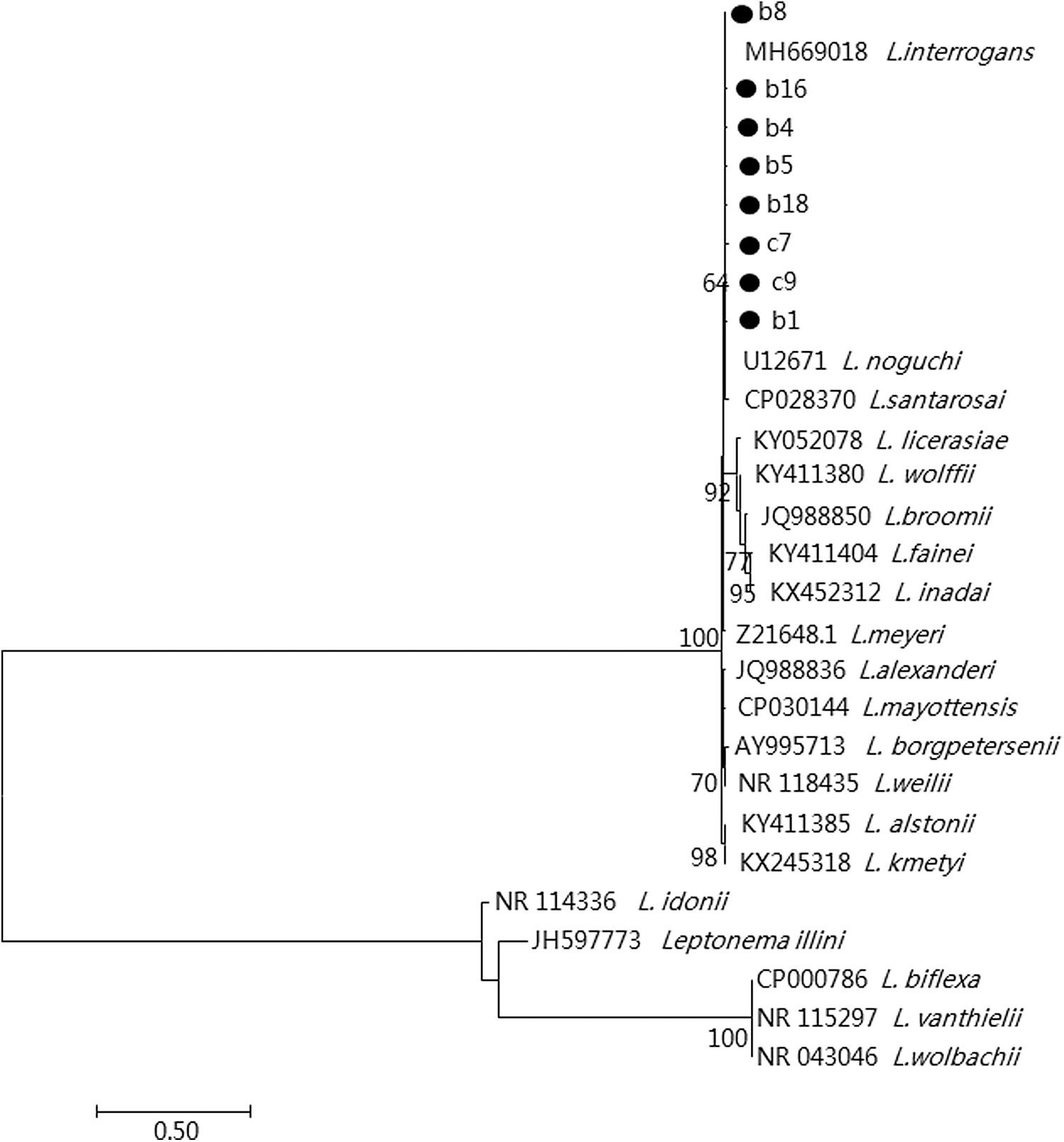
Phylogenetic tree based on rrs2 gene of Leptospira. The tree was constructed by using maximum likelihood method with MEGA 7.0 (
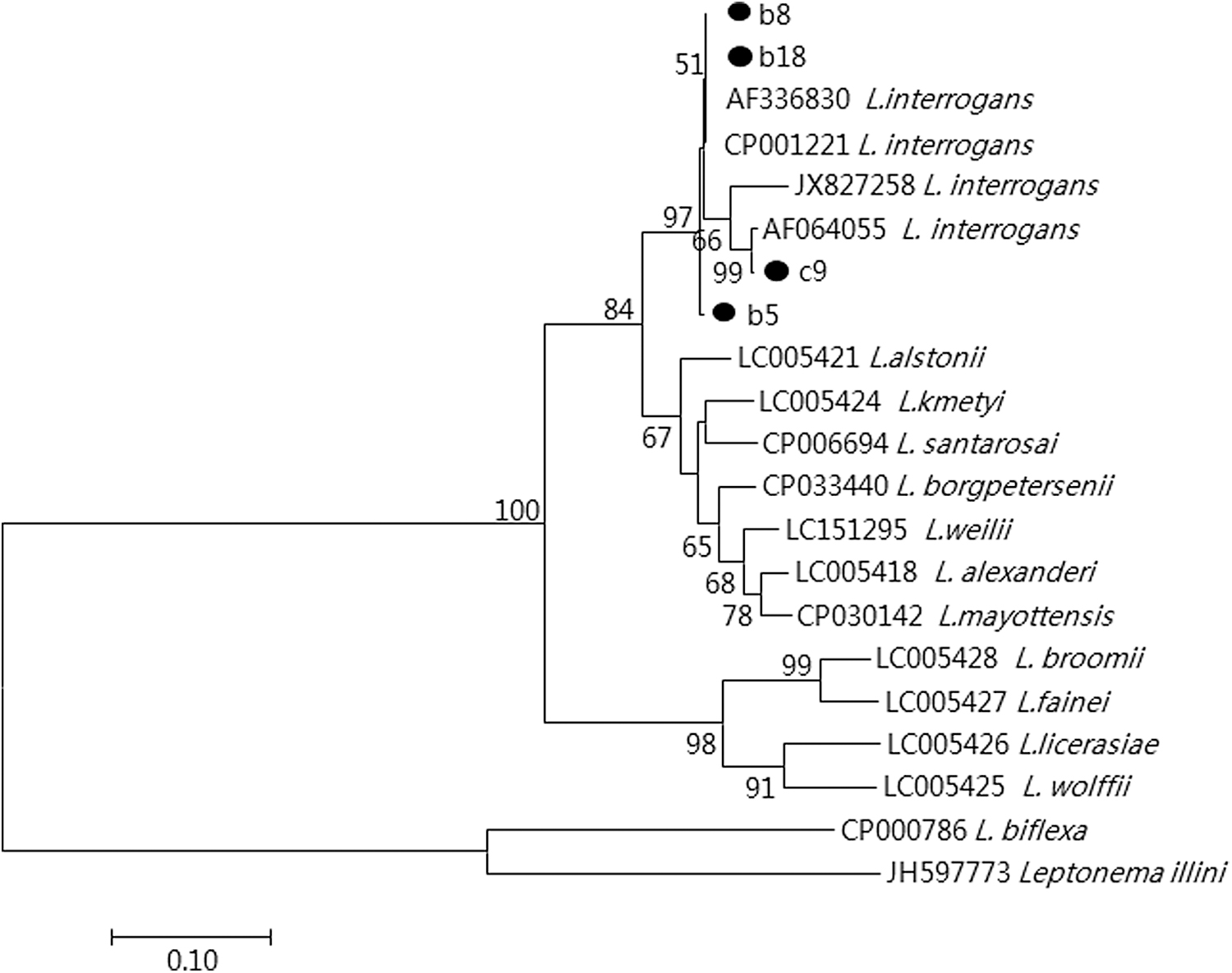
Phylogenetic tree based on flaB gene of Leptospira. The tree was constructed by using maximum likelihood method with MEGA 7.0 (
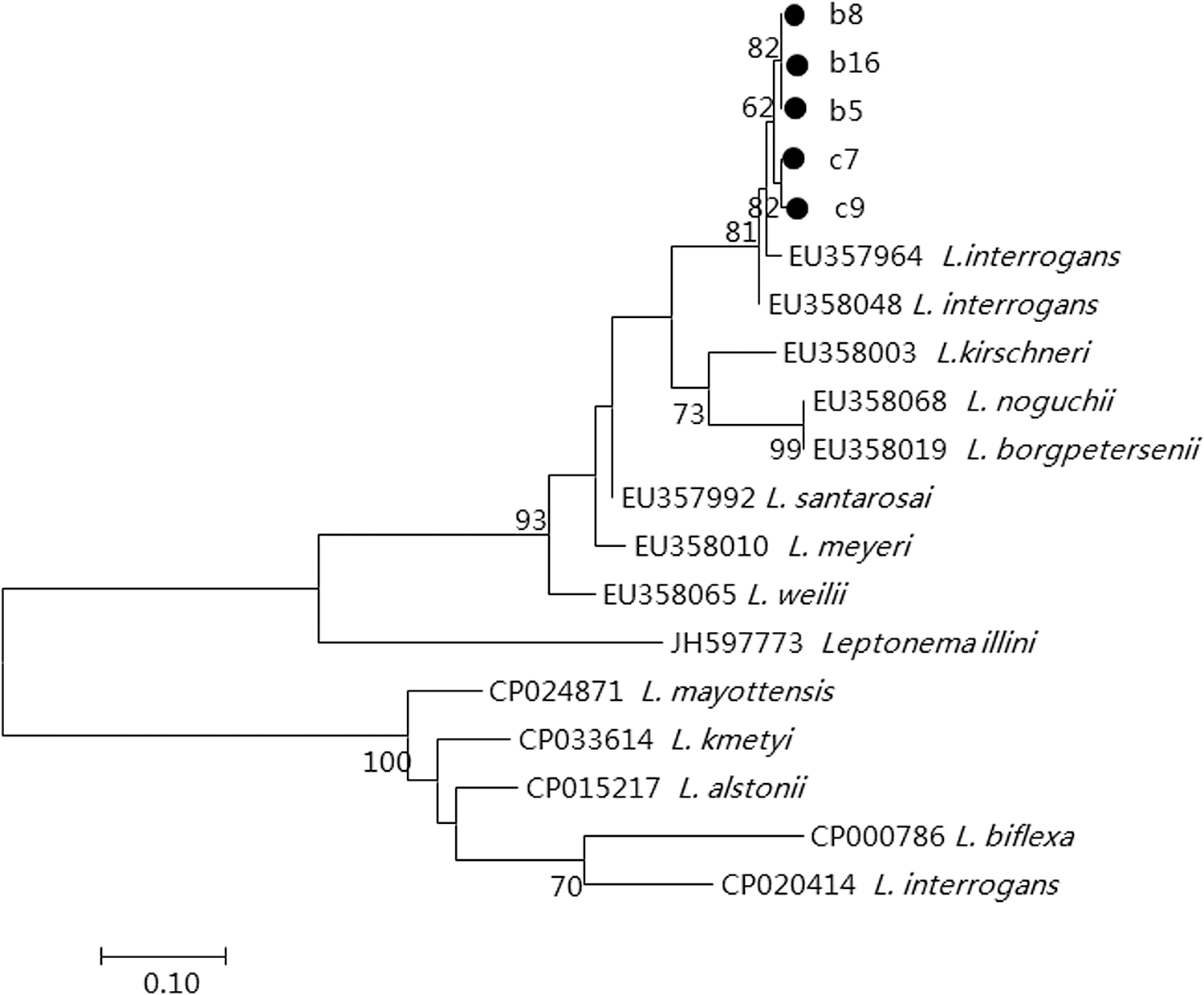
Phylogenetic tree based on secY gene of Leptospira. The tree was constructed by using maximum likelihood method with MEGA 7.0 (
Sequences from this study were deposited in GenBank with accession numbers: MK396786-MK396793 (rrs2gene), MK403978-MK403982 (secY gene), and MK403983-MK403986 (flaB gene).
Discussion
China is heavily affected by leptospirosis with several pandemics in the past (Shi and Jiang 2000). Since leptospirosis became a reportable disease in 1955 in China, >2.4 million cases have been documented nationwide (Shi et al. 1995, Shi 1999). More than 200 animal species, including Pisces, Amphibia, Reptilia, and Avesand Mammalia, have been found to be carriers of Leptospira worldwide (Adler et al. 1980, Anon 1999). Rodents and some domestic animals such as pigs, cattle, and dogs are the most important hosts that carry and spread this disease (Li et al. 2012, Zhang et al. 2012). In China, 67 species of wild and domesticated animal species have been confirmed as hosts of Leptospira (Zhang et al. 2012). Our study confirms that the hedgehog is highly positive to Leptospira, suggesting that hedgehogs could serve as an important source of Leptospira that infects humans and domesticated animals. These findings highlight the importance of Leptospira surveillance in hedgehogs.
The infection rates of Leptospira in wild and domesticated animals are varied in different places around the world. In Bangladesh, 13.1% (61/465) of trapped rodents were infected with pathogenic Leptospira (Krijger et al. 2019); in Cambodia, the infection rate of Leptospira in rodents was 11.1% (n = 642) (Ivanova et al. 2012); in Malaysia, the infection rate in rodents was 11.0% (n = 357) (Benacer et al. 2016); in China, it was 56.7% (34/60) in bats (Zhao et al. 2019) and 4.4% (3/69) in flying squirrels (Xiao et al. 2019). Previously Leptospira has been isolated from hedgehogs in several European countries, including France, Italy, The Netherlands, and Scotland, Israel, and New Zealand (Vander Hoeden 1958, Broom and Coghlan 1960, Babudieri and Farina 1964, Wolff and Bohlander 1965, Brockie and Till 1977, Ayral et al. 2016). Our study found that hedgehogs were heavily infected with Leptospira in Central China, which is consistent with previous reports on other animals in China. All Leptospira spp. detected in this study were L. interrogans. At least 75% of Chinese leptospirosis patients were caused by serovars of L. interrogans (Ren et al. 2003, Hu et al. 2014).
In China, most leptospirosis cases (80.3%) typically occur in the summer and early autumn. All hedgehogs in our study were collected in May and October, which is consistent with reports from countries in both temperate and tropical zones (Slack et al. 2006, Topic et al. 2010). We found that the infection does not seem to harm adult hedgehogs as even animals with active infections appeared to be in good health, consistent with the report that Leptospira serovars usually do not cause disease in their natural host (Ko et al. 2009). Hedgehogs are considered to be a tonic in traditional Chinese medicine, thus this species is frequently taken from the wild and eaten across Central China, and people may be infected in the process of capturing or slaughtering hedgehogs (Krijger et al. 2019). Therefore, increased awareness and protective measures are needed to prevent Leptospira infections.
Conclusions
Our study indicated that hedgehogs were heavily infected with Leptospira, suggesting that hedgehogs are the reservoir of Leptospira in China, and people who capture and handle wild hedgehogs are at risk of becoming infected by Leptospira.
Footnotes
Author Disclosure Statement
No conflicting financial interests exist.
Funding Information
This study was supported by the National Natural Science Funds of China (Nos. 31570167 and 81971939).