




Abstract
We sought to evidence the presence of emerging bacterial pathogens in clothes lice collected from sheltered homeless individuals from Marseille, France. During the 2013–2018 period, a total of 507 lice were collected from 37 individuals and were processed for molecular analysis. We reported a low prevalence of Bartonella quintana DNA carriage (1.2%). No louse tested positive for Rickettsia sp., Rickettsia prowazekii, Borrelia sp., Anaplasma sp., Yersinia Pestis, or Coxiella burnetii. A comparison with studies conducted before 2013 showed a 17.5-fold reduction in the rate of B. quintana DNA positivity. By contrast, a high prevalence of Acinetobacter species DNA carriage (40.8%), mostly A. baumannii (32.9%), was observed, tending to increase over time. In addition, we detected Acinetobacter ursingii DNA in clothes lice for the first time. Genotypic characterization and antimicrobial susceptibility testing of A. baumannii isolates from clothes lice are needed to assess whether these A. baumannii strains present in lice are similar to those responsible for human infections and harbor mechanisms of resistance against antibiotics.
Introduction
Human clothes lice have been reported to associate with homelessness due to precarious conditions and overcrowding in shelters. Three pathogenic bacteria are known to be transmitted by clothes lice: Rickettsia prowazekii (epidemic typhus), Bartonella quintana (trench fever), and Borrelia recurrentis (louse-borne relapsing fever). Yersinia pestis (plague) has also been suggested to be hosted and effectively transmitted by clothes lice (Drali et al. 2015). Coxiella burnetii (Q fever) was first isolated from clothes lice from individuals living in formerly epidemic areas in Rwanda and was recently found in clothes lice infecting Algerian homeless people, as well as in head lice from Mali (Louni et al. 2018). Anaplasma phagocytophilum has also been detected in Algerian lice (Louni et al. 2018). Acinetobacter baumannii was first isolated from clothes lice collected from homeless people in Marseille in 2004 and its DNA was subsequently proven to exist worldwide in clothes lice, together with Acinetobacter johnsonii, Acinetobacter berezeniae, Acinetobacter nosocomialis and Acinectobacter variabilis (Louni et al. 2018, Ly et al. 2019). In our study, we sought evidence of the presence of these emerging bacterial pathogens in clothes lice collected from homeless individuals living in Marseille, France, in recent years.
Materials and Methods
We recruited 786 homeless people living in two municipal shelters in Marseille, France, between 2013 and 2018. Clothes lice were observed on the clothes and body of 56 of 786 individuals (7.1%), of whom 23 were French and the rest were migrants. A total of 37 people allowed our team to collect their clothes lice and 507 lice were processed for molecular analysis as described previously (Louni et al. 2018). Total DNA was extracted using a BioRobot®EZ1 Advanced XL instrument (QIAGEN, Germany) and DNeasy® Blood & Tissue Kit, according to the manufacturer's instructions. Real-time quantitative PCRs were performed to screen all clothes lice DNA samples using previously published primers and probe sets specific to Rickettsia sp. and R. prowazekii, Borrelia sp., B. quintana (yopP gene), Y. pestis, Anaplasma sp., C. burnetii, and Acinetobacter sp. Specimens that were positive for Acinetobacter sp. were further tested for A. baumannii using PCR targeting the NAGS gene. Positive samples for B. quintana and A. baumannii were confirmed using a second real-time PCR targeting the fabF3 gene and the ompA/motB gene, respectively. Further genotyping of the Acinetobacter species in A. baumannii-negative samples was simultaneously performed using standard PCR and sequencing targeting the rpoB gene. All primers are detailed in Supplementary Table S1. Sequences were edited and assembled using Chromas Pro1.7.7 software (Technelysium Pty Ltd, Australia), aligned with Acinetobacter type strains from Genbank using Mega7.0 (
Results
In total, 6 of 507 lice (1.2%) were positive for B. quintana and were collected from 2 of 37 people (5.4%). A prevalence of 40.8% (207/507 lice) was found for Acinetobacter sp. including A. baumannii (167 lice, 32.9%). Dual B. quintana-A. baumannii carriage was detected in five lice. A total of 31 people (of 37, 83.8%) had at least one louse positive for A. baumannii. The prevalence of A. baumannii lice carriage increased significantly during the study period (Supplementary Fig. S1). For the molecular identification of Acinetobacter species other than A. baumannii, we succeeded in amplifying a portion of the rpoB gene (zone 1) in 32 out of 40 samples and obtained four different sequence types (from Seq01 to Seq04). These four variants showed 100% nucleotide identity with Acinetobacter type/reference strains in GenBank, including Acinetobacter ursingii (27/32), A. variabilis (3/32), A. johnsonii (1/32), and Acinetobacter sp. UA3 (1/32), which is closely related to Acinetobacter towneri (Fig. 1). No louse tested positive for Rickettsia sp., R. prowazekii, Borrelia sp., Anaplasma sp., Y. pestis, or C. burnetii.
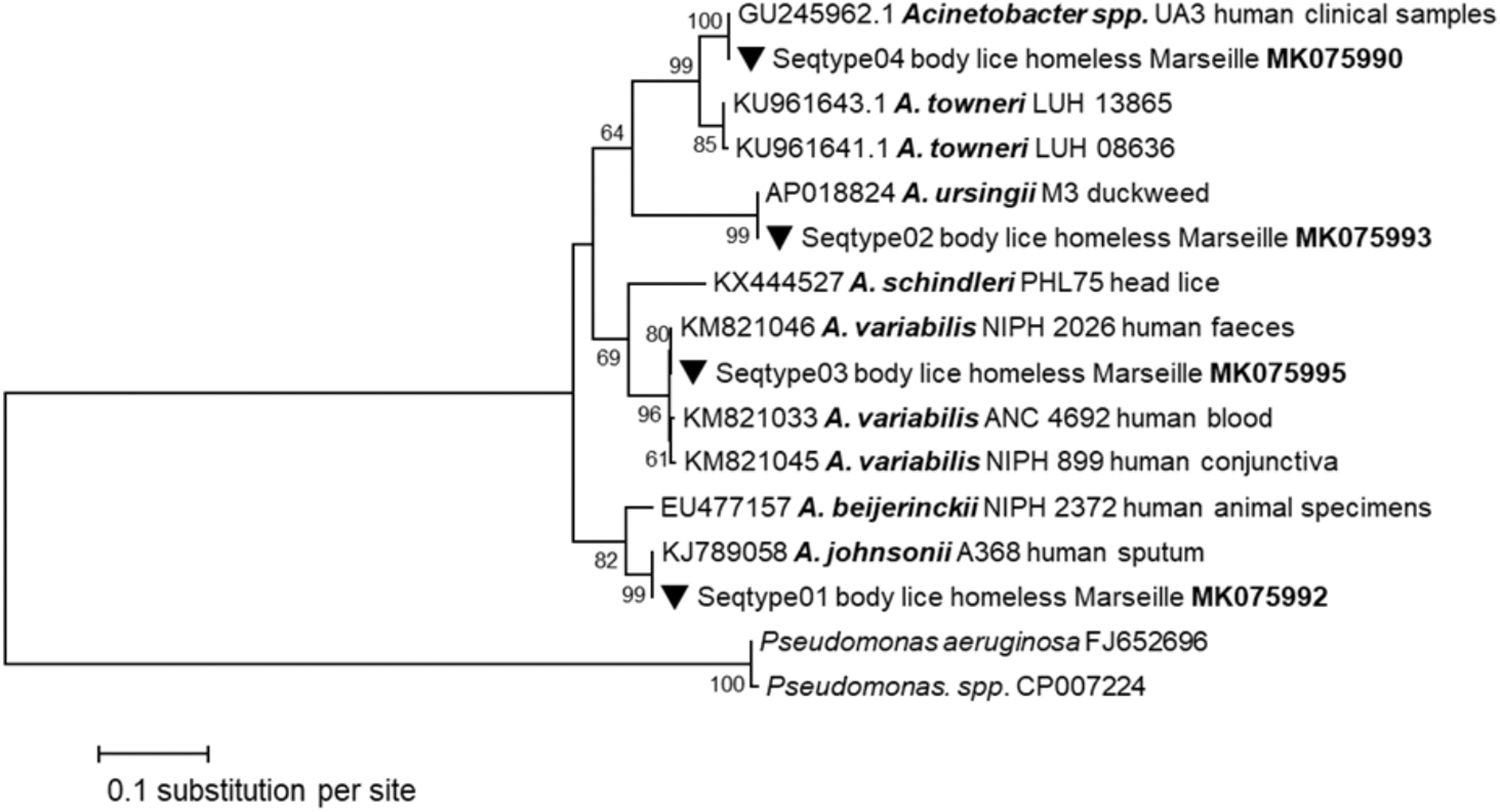
Maximum-likelihood phylogenetic tree highlighting the position of the Acinetobacter species (other than Acinetobacter baumannii) identified in clothes lice of homeless people from Marseille (▾) as compared with another Acinetobacter species available in the GenBank database and based on partial 350-bp rpoB gene with Pseudomonas sp. (Gen Bank accession no. CP007224) and Pseudomonas aeruginosa (Gen Bank accession no. FJ652696), used as outgroups.
Discussion
A high seroprevalence of anti-B. quintana (16%) was reported in 1993 among homeless people hospitalized in Marseille and significantly associated with the presence of clothes lice (Brouqui et al. 1996). Meanwhile, B. quintana endocarditis was reported in three homeless people (Drancourt et al. 1995). Since 2000, we have surveyed louse-borne diseases in homeless people living in shelters in Marseille. Over the 2000–2003 period, we recorded a prevalence of 14.9% of clothes lice that were positive for B. quintana, together with the presence of anti-B. quintana (7.4%), anti-R. prowazekii (0.8%), and B. recurrentis (1.6%) antibodies with high titers in homeless people. An autochthonous case of epidemic typhus was also described in a homeless individual (Brouqui et al. 2005). A study by Drali et al. over the 2012–2013 period revealed a high prevalence of B. quintana-positive clothes lice (20.7%) collected from 42 of 80 participants (52.5%) (Drali et al. 2014). A decreasing prevalence of clothes lice infestation in homeless populations living in shelters in Marseille has also been observed over time (Ly et al. 2017). There we show the concurrent decrease in the carriage of B. quintana (17.5-fold reduction), and absence of R. prowazekii and B. recurrentis in lice collected from this population. These could be due to the effect of delousing interventions conducted in the shelters after our recommendations (providing showers, clothes changing, laundry, and ivermectin treatment).
We evidenced a 32.9% A. baumannii DNA carriage prevalence in clothes lice consistent with other studies (3%–58%) (Candy et al. 2018, Louni et al. 2018). A. ursingii was reported only from head lice collected in Congo (Amanzougaghene et al. 2016); conversely, we detected this Acinetobacter specie in clothes lice for the first time. A strong association between clothes lice infestation and A. baumannii DNA skin carriage was observed in homeless populations, whereas blood samples were negative for A. baumannii, suggesting that lice probably get infected with A. baumannii while biting through the colonized skin and are likely to transmit the bacteria in their feces (Ly et al. 2019). A. baumannii are known to be opportunistic drug-resistant bacteria mostly responsible for human hospital-acquired infections (Howard et al. 2012). Genotypic characterization and antimicrobial susceptibility testing of A. baumannii isolates from clothes lice are needed to assess whether these A. baumannii strains present in lice are similar to those responsible for human infections and harbor mechanisms of resistance against antibiotics.
Footnotes
Acknowledgments
We are grateful to Annick Abeille and Younes Laidoudi for their excellent technical assistance.
Ethical Statement
Ethical approval was obtained from the Institutional Review Board and Ethics Committee of our institute: 2010-A01406-33. All participants signed an informed consent form.
Author Disclosure Statement
No conflicting financial interests exist.
Funding Information
This study was supported by the Institut Hospitalo-Universitaire (IHU) Méditerranée Infection, the National Research Agency under the “Investissements d'avenir” program, reference ANR-10-IAHU-03, the Région Provence Alpes Côte d'Azur and European funding FEDER PRIMI.
Supplementary Material
Supplementary Figure S1
Supplementary Table S1
References
Supplementary Material
Please find the following supplemental material available below.
For Open Access articles published under a Creative Commons License, all supplemental material carries the same license as the article it is associated with.
For non-Open Access articles published, all supplemental material carries a non-exclusive license, and permission requests for re-use of supplemental material or any part of supplemental material shall be sent directly to the copyright owner as specified in the copyright notice associated with the article.
