




Abstract
Here we assess the effect of weather and anthropogenic environmental variables, particularly urbanization, on cystic echinococcosis mortality in Chile from 2001 to 2011 using a nonparametric regression model, multivariate adaptive regression splines, and Poisson nonlinear regression models. This study integrated data from various sources on weather and anthropogenic variables. The canine population had the greatest influence on human cystic echinococcosis mortality during the period analyzed. Urbanization among anthropogenic variables and temperature and precipitation among the weather-related variables were the main factors related to cystic echinococcosis deaths. Deaths decreased with urbanization level. Temperature showed a nonlinear impact on mortality, with an optimum value ∼11°C. Public policies aimed at improving safe management of companion animal populations are crucial in controlling the spread of this disease. Effective animal management strategies would have wide-ranging public health benefits, advance the welfare of companion animals and livestock, and decrease the number of human cystic echinococcosis cases.
Introduction
Zoonotic diseases depress socioeconomic development in rural areas throughout the world because of loss of work and school productivity, morbidity, reduced quality of life, and even premature death. Zoonoses also affect livestock productivity, damage local ecosystems, and jeopardize the food security of vulnerable population segments (Canals and Cattan 2006).
Cystic echinococcosis is a common parasitic zoonosis, classified as a reportable disease in Chile. It is caused by larval forms of a parasite of the genus Echinococcus, class Cestoda, order Cyclophyllidea, family Taeniidae. There are eight recognized species and one genotype cluster (probably one to three species) of Echinococcus (Romig et al. 2015, 2017), four of which are recognized as pathogenic for humans: E. granulosus (an agent of cystic echinococcosis), E. multilocularis (an agent of alveolar echinococcosis), E. oligarthus, and E. vogeli. These last two species are the zoonotic agents of polycystic echinococcosis (Roses 2005).
The life cycle of the Echinococcus parasite involves two hosts. The definitive host is a carnivore, typically a dog. Larval cestodes inhabit the small intestine of the definite host, where they grow to the adult (strobilar) stage, and release eggs. The intermediate host is an herbivore or omnivore, such as a sheep, goat, cow, or pig. The eggs contain the infectious larval oncosphere, which penetrates the intestinal lining and migrates through blood and lymphatic vessels to the liver, lungs and many other sites, where the oncosphere develops into the metacestode. Within a metacestode, protoscoleces may develop, which represent the infectious unit for definitive hosts (Gottstein et al. 2014). Humans may become dead-end hosts (Osorio et al. 2008, sensu Romig et al. 2017) as dogs shed the parasite eggs in their feces. The eggs adhere to the dogs' fur, contaminating the environment. Humans may ingest the eggs by putting their hands near their mouths after petting their dogs or working in a contaminated garden or field, or by consuming vegetables or water that has come into contact with canine feces (Cortes el al. 2010). Although infection may occur at any age, it is most common in young children because of their play and hygiene behavior (Martínez 2014).
The geographic distribution of human cystic echinococcosis infection in Chile is highest in the south, in part because of the denser livestock populations in these areas (Medina et al. 2019, Reyes et al. 2019). Over half of the nation's sheep reside in the two most southern regions, Aisén and Magallanes. These areas also have sizeable canine populations (CPs) and tend to rely on traditional farming methods consisting of large grazing areas in cold steppe where the feeding of the sheep is based on coiron (Festuca gracillima) without intervention, with some prairie improvement practices (fertilization) (Martínez 2014). An average of 304 cystic echinococcosis human cases are reported per year in Chile. National statistics suggest that the incidence is declining; however, these statistics obscure regional realities. The risk posed by the dense livestock populations in southern Chile is compounded by unequal distribution of economic resources and inadequate access to quality health care in these regions (Martínez 2014). These factors have contributed to making this anthropozoonosis an endemic disease in Chile. Despite its social and economic impact, this public health problem has not been addressed comprehensively and therefore remains unresolved.
Cystic echinococcosis is a complex, multifactorial disease. Weather directly affects the viability and development of eggs and indirectly affects the density and distribution of host species by influencing food availability (Yang et al. 2012). Urbanization, human population density, and livestock practices such as overgrazing and soil practices related to urbanization and the dynamics of animal populations, especially domestic animals, are also factors in the incidence of this disease, as dogs are definitive hosts for the parasite. Most population centers in Chile are affected by dog overpopulation. The lack of public policies aimed at managing this situation contributes to numerous public health, environmental, and safety problems (Fuentealba 2002, Soto 2013). All these factors probably interact among themselves and with cystic echinococcosis in a nonlinear and complex way.
To inform the development of relevant public policies, the objective of this study was to assess the contribution of anthropogenic and sociodemographic environmental factors, particularly population growth and urbanization to cystic echinococcosis mortality in Chile.
Materials and Methods
Study design and data sources
Information from several sources was integrated into an Excel® database. Data on cystic echinococcosis deaths (International Classification of Diseases [ICD]-10 codes B67.0–B67.9) from all Chilean administrative regions in 2001–2011 were obtained from the death registry maintained by the Ministry of Health. The diagnosis was confirmed by serological methods (enzyme-linked immunosorbent assay and western blot) by the Institute of Public Health of Chile (ISP) and/or pathological study in surgical cases. We chose mortality because although the deceased constitute a restricted sample of the total cases of a disease, because not all patients die, mortality has the virtue of being based on death certificates that record the diagnosis, supported by clinical and laboratory studies, constituting reliable, although restricted, data on the burden of a disease in a locality (Reyes et al. 2019), whereas the accuracy of the reportable disease database may be affected by underreporting of cases.
The anthropogenic environmental factors measured were as follows: type of population growth and population density, according to an urbanization index (U); number of slaughterhouse condemnations (SC) because of cystic echinococcosis; and estimates of CPs, including the identification of regions with a human:canine ratio of 3:1 or less (López et al. 2006). The climate variables assessed were temperature (T), precipitation (PP), and relative humidity (RH), as reported by the Meteorological Department of Chile for 2001–2011. All data are provided in Supplementary Table S1.
Statistical analysis
Two approaches were used to estimate the contribution of weather elements, anthropogenic factors, and sociodemographic variables to cystic echinococcosis mortality. First, the multivariate adaptive regression splines (MARS) approach (Gujarati and Porter 2010, Mateo et al. 2011) was used to adjust a nonparametric regression model. This method was chosen as it allows for assessment of complex, nonlinear relationships, and looks for threshold and breakpoints in the curve of cystic echinococcosis deaths (Velásquez-Henao et al. 2014). The method also yields cutoff points (knots) for the selected variables, which further explain the relationship between the basic functions and the dynamics of the dependent variable. To avoid overfitting we used a model with good generalization ability, with backward selection, finding the best submodel. Model subsets were compared using the generalized cross validation (GCV) criterion to select the final model with the best predictive fit. These analyses were performed using MARS® software from Salford Systems. The MARS model was used separately, first relating deaths (D) to the sociodemographic variables U, SC, and CP, and then relating deaths to the climatic variables T, PP, HR, and CP. As the CP is a very important factor in the prevalence of cystic echinococcosis and it is influenced by both anthropogenic and climatic factors, we included CP in both models, which allowed us to calibrate in relative effect of the other variables on deaths from this disease.
The second approach to study the statistical relationships between the variables and deaths was a mixed generalized linear model with all variables except those with a high number of missing values, adjusting for within-time errors. We used a nonlinear Poisson regression with backward selection of variables, using for the anthropogenic environmental model: Log(D/V) = Yi + β1Log CP(Y) + β2U(Y) + β3SC(Y) + ɛ, where V represents the vector of variables, Yi are the years in which the measure was recorded and parentheses indicate that variables were nested within the years of recording. For the climatic-related variables we used Log(D/V) = Yi + β1T(Y) + β2T 2(Y) + β3PP(Y) + β4RH(Y) + β5LogCP(Y) + ɛ, where V represents the vector of variables, Yi are the years in which the measure was recorded, and parentheses indicate that variables were nested within the years of recording. Univariate Poisson regression models were also performed for the selected variables. One was added to death values to avoid distortions produced by zero values.
Ethics
This study was approved on August 11, 2015 by the Ethics Committee of Research in Human Beings of the Faculty of Medicine of the University of Chile. No. 119-2015.
Results
There were 290 cystic echinococcosis deaths in 2001–2011, of which 55.5% (161) were men and 44.5% (129) women (Table 1). Cystic echinococcosis deaths declined from 31 in 2001 (61.3% men) to 22 in 2011 (54.5% women), peaking at 35 deaths in 2007 (57.1% men). The mortality rate dropped from 0.20 cystic echinococcosis deaths per 100,000 inhabitants in 2001 to 0.13 in 2011, peaking at 0.21 for both in 2002 and 2007. The annual death rate by sex was 0.25–0.12 deaths per 100,000 in men, peaking at 0.28 in 2002. In women, the rate was 0.15–0.14 deaths per 100,000, peaking at 0.22 in 2006.
Cystic Echinococcosis Deaths and Mortality Rates a for Chile, 2001–2011
Deaths per 100,000 inhabitants.
The average mortality rate from cystic echinococcosis was 0.16 ± 0.04, ranging from 0.09 deaths per 100,000 inhabitants (in 2009) to 0.21 (in 2002 and 2007) (Fig. 1). The mortality rate declined by 35.9% from 2001 to 2011. The average variation from year to year was −1.97%, suggesting a trend toward decreasing cystic echinococcosis mortality.

Distribution of mortality rates of cystic echinococcosis in Chile, 2001–2011.
In the MARS anthropogenic sociodemographic model, the factors CP size, urbanization, and SC collectively explained 69% of the total variance (GCV = 2.13, R 2 = 0.69). The CP exerted the greatest influence on cystic echinococcosis deaths (variable importance score, VIS = 100%), with a main knot at 311,108 individuals. Deaths from cystic echinococcosis increased linearly from this population level. Urbanization (U) had the second greatest influence on deaths (VIS = 66.02%) with a main knot at 70.27 urbanization index score; deaths decreased linearly from this point. SC had a low impact (VIS = 11.4%).
The Poisson regression anthropogenic model selected as explanatory variables CP [Log(CP)] and urbanization (U) (Table 2). The variables year (Y) and SC were not relevant (Wald = 5.78, p = 0.21 and Wald = 0.67, p = 0.41, respectively). The univariate model for urbanization was as follows: Log((D + 1)/U) = 3.2 − 0.028U (Wald = 18.8, p < 0.001) (Fig. 2).

Relationship between logarithm of deaths owing to cystic echinococcosis [Log(D + 1)] and urbanization index (U) in Chile, 2001–2011. Solid line represents the expected values from a univariate Poisson regression.
Anthropogenic Environmental Variables Selected to Explain Deaths of Cystic Echinococcosis by Means of Nonlinear Poisson Regression Model
CP, canine population; IRR, incidence rate ratios of each variable; U, urbanization index.
In the MARS climate model, the factors CP size, mean temperature, and total PP collectively explained 63% of the variance (GCV = 2.37, R 2 = 0.63). The CP exerted the greatest influence on cystic echinococcosis deaths (VIS = 100%). Figure 3 provides the knots for the CP variable: 277,206; 315,181; 335,944; and 2,081,590. The predictor variable (CP) had a null effect on the response variable (cystic echinococcosis deaths) below a value of 277,206. After an irregular behavior up to 335,944, it increased to 2,081,590, and finally decreased for values above this last knot.

Multivariate adaptive regression splines model for relationships between number of deaths owing to cystic echinococcosis and
Average temperature had the second greatest influence on the dependent variable (VIS = 69.1%). Figure 3 provides the knot for average temperature, which falls at 11.3°C. The effect of this predictor variable on cystic echinococcosis deaths increased with temperature for values up to 11.3°C and then declined toward zero.
Total PP was the third largest contributing factor in explaining cystic echinococcosis deaths (VIS = 17.51%). The knot for this variable falls at 0.0000610352 mm/year. For values below this knot, the effect of total PP on cystic echinococcosis deaths was zero; for values above the knot, the effect increased as the value of the variable rises.
The Poisson regression of climate model selected as explanatory variables CP [Log(CP)], total PP, and T 2, accounting for the nonlinear relationship between temperature and cystic echinococcosis deaths (Table 3). The variable Y (year) was not relevant (Wald = 10.6, p = 0.39). Univariate regression models were as follows: Log([D + 1]/LogCP) = −3.78 + 0.89LogCP (Wald = 84.9, p < 0.001); Log((D + 1)/T) = −3.13 + 0.76T − 0.03T 2 (Wald = 44.4 and 50.1 for T and T 2 respectively, p < 0.001); and Log((D + 1)/PP) = 0.77 + 0.00007PP (Wald = 25.0, p < 0.001) (Fig. 4).
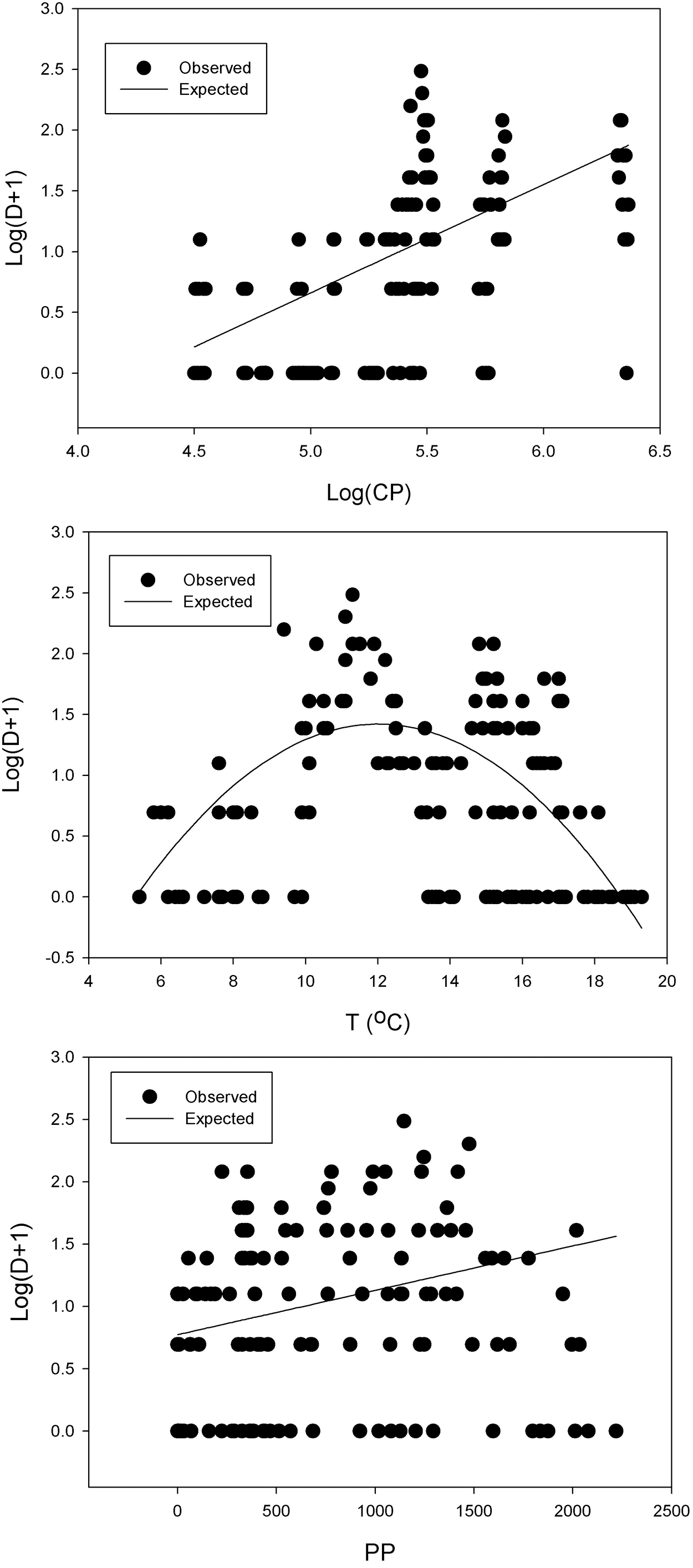
Relationship between number of logarithm of deaths owing to cystic echinococcosis [Log(D + 1)] and CP, mean environmental temperature (T) and total PP in Chile, 2001–2011. Solid lines represent the expected values from nonlinear univariate Poisson regressions for CP and temperature, and linear regression for PP. PP, precipitation.
Climatic Selected Variables to Explain Deaths of Cystic Echinococcosis by Means of Nonlinear Poisson Regression Model
Total PP, total precipitation; T, temperature.
Discussion
The climate-related variables with the most significant predictive effect on cystic echinococcosis deaths were CP, average temperature, and PP. CP size was the most significant factor in predicting cystic echinococcosis deaths, with a VIS of 100%. Dog overpopulation affects most population centers in Chile. Given the lack of effective regulations to address the issue, this uncontrolled CP creates serious public health, environmental, and safety hazards (Fuentealba 2002, Soto 2013). López et al. (2006) estimates that there is one dog for every three inhabitants in many regions, whereas a healthy ratio would be closer to 1 dog per 10 persons. Ibarra et al. (2003) reported that the total CP is ∼2.6–3.4 million dogs; although nearly 75% of dogs have an owner, nearly 90% of them roam freely in the streets. The remaining 25% of the dog population consists of stray animals with no home or caregiver (Ibarra et al. 2003, López et al. 2006).
The majority of zoonoses associated with companion animals are acquired either through the fecal–oral route or through direct contact between animals and humans. Children are at greater risk of infection than adults, because of their relatively lax hygiene habits and close contact with pets (Pacheco 2003, Jensen 2011).
A study of domestic dogs in Santiago, Chile yielded findings that reflect the magnitude of the zoonosis problem. In a sample of 972 dogs with symptoms of diarrhea, ∼70% of the animals had at least one parasite species, ∼50% of which were potentially zoonotic (Lopéz et al. 2006). Controlling transmission in dogs is crucial for interrupting the biological cycle of the Echinococcus parasite, as this animal is the primary source of human infection. Achieving this public health goal will require an effective strategy to encourage responsible pet ownership, such as community education programs designed to produce long-term results (Canals and Cattan 2006).
Various anthropogenic environmental factors contribute to the spread of zoonoses (Canals and Cattan 2006). Urbanization has been reported to be associated with the dynamics of animal populations, especially domestic animals and livestock. Urbanization is therefore likely to influence the spread of the disease, as the dog is the definitive host of this parasite. The growth of human populations contributes to the maintenance or spread of many zoonotic diseases; the greater the population size, the greater the probability of contact between the zoonotic agent and the soil, facilitating the exchange of agents, the alteration and occupation of new natural environments (Canals and Cattan 2006, Martínez et al. 2016). However, our study found a decrease in death with increasing urbanization index and an increase in deaths because of cystic echinococcosis in rural areas. This may be explained because rural dog owners tend to have more dogs per household than urban ones (Acosta-Jamett et al. 2010) and mainly because cystic echinococcosis is directly related to sheep and goats in Chile (Martínez et al. 2014, 2016, Medina et al. 2019).
The only variable that references the intermediate hosts was SC owing to cysts, but we did not find a relationship between deaths and number of SC. This may be explained because the slaughterhouses are not distributed evenly throughout the country and not all the livestock is killed in slaughterhouses in Chile. In Chile home slaughter of livestock related to dog copro-positivity to echinococcosis has been reported (Acosta-Jamett et al. 2014). This is one possible explanation, because some areas of the country have high home slaughter rates and also high disease incidence (Cortés and Valle 2010).
Average temperature had the second highest variable importance in the MARS model (69.1%), with cystic echinococcosis incidence ∼11°C. Poisson regression revealed a nonlinear parabolic form of the fitted curve and a significant relationship between temperature and deaths, agreeing with other regional studies in Chile (Medina et al. 2019). The high values close to this temperature may represent the optimal temperature for E. granulosus egg viability. Laboratory-controlled models designed to measure the effect of temperature and humidity on egg survival have shown this parasite tolerates a range between +40°C and −70°C (Sanchez et al. 2005). In this study, regions with the highest cystic echinococcosis mortality tended to show average temperatures near 11°C. The region of Aysén, for instance, has a cool oceanic climate with low temperatures, abundant PP, strong winds, and high humidity, although the relief features in this region create zones with distinct climate patterns. The western sector is made up of islands and archipelagos, and the geography of the eastern sector is dominated by the Patagonian Andes Range. The city of Coyhaique in eastern Aysén had one of the highest rates of cystic echinococcosis incidence during the 2001–2011 period. The median temperature in this city was 8°C, with a minimum of −1.4°C and a maximum of 16.9°C (DGAC 2001), well within the range of tolerance for the eggs of this parasite.
Results from the Patagonian region of Argentina also provide relevant insights on the relationship between weather and the spread of this parasite. This region has an arid climate with significant seasonal temperature shifts, characterized by warm summers and cold winters with frequent frosts. The temperature in this zone ranges from 37°C to −3°C, with a mean annual temperature of 10°C and low PP (<300 mm/year). Sánchez et al. (2005) assessed the viability and infectiousness of E. granulosus eggs in Argentine Patagonia in vivo in sheep. After 41 months of aging under the local environmental conditions, the parasites remained capable of producing infection in all the sheep challenged with the eggs. The eggs entered a semisenescent state, conserving their infectious capacity in the intermediate ovine host (Sánchez et al. 2005). Sánchez et al. (2003) also assessed the presence of intestinal parasites in canine feces collected from public plazas in Chubut, Argentina. The authors found that E. granulosus eggs persisted for over 3 years and 5 months under cool, arid environmental conditions (Sánchez et al. 2003). In Kenya, Wachira et al. (1991) studied the viability of E. granulosus eggs in semi-arid environments, finding that eggs survived a maximum 19 days in shaded soil when exposed to an average environmental temperature of 20°C and RH of 75 ± 15%.
Total PP was the third most important factor contributing to cystic echinococcosis deaths (VIS = 17.51%). Median PP in Chile for the 2001–2011 period was 21.050 mm/year, with a range from 0 to 567.5 mm (DGAC 2001). An infected definitive host passes thousands of E. granulosus eggs every 50 days that are then dispersed by various means, including rain (Wachira et al. 1991). According to Jensen, the spread of E. granulosus eggs in the Chubut province of Argentina is related to the presence of surface water, among other factors (Jensen 2011).
The factors discussed have an effect on cystic echinococcosis deaths, creating more favorable conditions for transmission and infection, but cystic echinococcosis can be treated and an increase in incidence does not necessarily result in higher mortality. However in Chile, mortality is a good proxy of incidence and thus of transmission and infection. For example, the curves of reported cases and mortality rates had similar slopes between 2001 and 2014, with a ratio of mortality/reported cases of 0.085 ± 0.015 (MINSAL 2015).
The analysis shown studied cystic echinococcosis until 2011. After this date national estimators of reported cases had a slight tendency to decrease; however, they do not show regional realities, where there is a heterogeneous geographical distribution associated with the basic economy, shown by the increase in cases southward in Chile, but also by differences in quality and access to health benefits that have not changed significantly in recent times (Reyes et al. 2019). In addition, the possibility of mobility from people prevents knowing exactly where the infections occurred.
Limitations of this study include the use of secondary data from different sources, collected for different purposes by different investigators, and different sampling methods. These differences may have biased the distribution of the data; therefore, the samples cannot be considered random. The type of information available limited the choice of statistical models, as some models require random sampling.
Conclusions
The anthropogenic environmental and weather variables with the greatest influence on human cystic echinococcosis mortality were urbanization, CP, temperature, and total PP. The CP was the factor with the greatest impact on cystic echinococcosis mortality in the study model. Therefore, public policies aimed at encouraging safe management of companion animal populations are crucial. Effective animal management strategies would offer wide-ranging public health benefits, advance the welfare of companion animals and livestock and decrease the number of human cystic echinococcosis cases.
Footnotes
Acknowledgments
The authors thank Jeannette Recabarren, Mary Gatica and Doris Perez; Meteorological Department of Chile, and Salvador Ayala for his help with the maps. The authors also thank Lafayette Eaton for review the English and helpful comments.
Author Disclosure Statement
No conflicting financial interests exist.
Funding Information
No funding was received for this article.
Supplementary Material
Supplementary Table S1
References
Supplementary Material
Please find the following supplemental material available below.
For Open Access articles published under a Creative Commons License, all supplemental material carries the same license as the article it is associated with.
For non-Open Access articles published, all supplemental material carries a non-exclusive license, and permission requests for re-use of supplemental material or any part of supplemental material shall be sent directly to the copyright owner as specified in the copyright notice associated with the article.
