




Abstract
Background:
The mosquito species Culex pipiens is a known vector of several pathogens and occurs in two distinct bioforms, pipiens and molestus. The bioform molestus thrives in urban environments where there are below-ground habitats; it can mate in confined spaces and feed on mammals as well as birds. In contrast, the bioform pipiens is found above ground, is thought to require more space for mating, and mainly feeds on birds. The pipiens bioform is present in large parts of Sweden but the molestus bioform has previously only been found in major cities.
Materials and Methods:
People experiencing mosquito nuisance in southern Sweden submitted mosquito samples as part of a citizen science project, and these samples were analyzed to determine the geographical distribution of the molestus bioform of Cx. pipiens. Mosquito specimens were identified to the species level by DNA barcoding of the cytochrome C oxidase subunit I (COI) gene, and the bioforms were determined through the CQ11 microsatellite marker.
Results:
Culex pipiens f molestus was observed to be spread across large parts of Gothenburg as well as in the suburbs. This bioform was found both in urban and rural areas at several sites across southern Sweden. In one site, hybrids between the two bioforms were found.
Conclusions:
The detection of Cx. pipiens f molestus in several rural areas was surprising, indicating that it may be more widely spread than urban areas alone, where it has been previously reported.
Introduction
Culex pipiens is a known vector for several pathogens, such as West Nile virus (WNV) and Usutu virus (USUV) (Brugman et al. 2018). The species is represented by two bioforms, Cx. pipiens f pipiens Linnaeus (L), 1758, and Cx. pipiens f molestus Forskal (F), 1775 (Diptera: Culicidae) (Harbach et al. 1985). In areas of sympatry, Cx. pipiens bioforms can interbreed to form hybrids. In northern Europe, they have separate but overlapping habitats and the hybridization rate between Cx. pipiens f pipiens and Cx. pipiens f molestus is lower than that in southern Europe where their habitats overlap more (Becker et al. 2012, Vogels et al. 2015, Brugman et al. 2018). It is of interest to distinguish Cx. pipiens f molestus from Cx. pipiens f pipiens that prefers avian hosts over mammals.
Culex pipiens is found in most parts of Sweden (Hesson et al. 2011). Culex pipiens f molestus has been found previously in Gothenburg and human biting Cx. pipiens has been reported in Stockholm in 1934, as reviewed in Lindström (2017). There are also findings of three Cx. pipiens f molestus from a farm and two wetlands outside Linköping in central south Sweden and hybrids in Linköping (Vogels et al. 2016). However, no other studies suggest that Cx. pipiens f molestus is present outside urban areas in Sweden.
To assess how widespread Cx. pipiens f molestus is in Sweden, we collected Culex mosquitoes through a citizen science outreach project from people in urban areas experiencing mosquito nuisance. Specimens were also sampled in three rural and periurban areas in the south of Sweden. We determined the specimens as Cx. pipiens using C oxidase subunit I (COI) and distinguished between the two bioforms, Cx. pipiens f pipiens and Cx. pipiens f molestus, by using the CQ11 microsatellite marker.
Materials and Methods
Mosquito samples were captured as part of a citizen science outreach project in Sweden, where people experiencing mosquito nuisance problems were encouraged to submit specimens. The information was disseminated through a press release from the National Veterinary Institute, SVA, and was picked up by several major news outlets (
In addition, mosquitoes were collected overnight in three areas in the south of Sweden using either Mosquito Magnet Patriot traps (Woodstream Corp.
DNA was extracted from two to three legs per mosquito and COI sequencing was performed as previously described (Lilja et al. 2017). The CQ11 assay was performed as described previously (Bahnck et al. 2006) to identify bioforms and hybrids but products were also purified, sent to Macrogen (Seoul, South Korea) and sequenced using the CQ11F2 primer. Sequences were compared to verify bioform classification.
Results
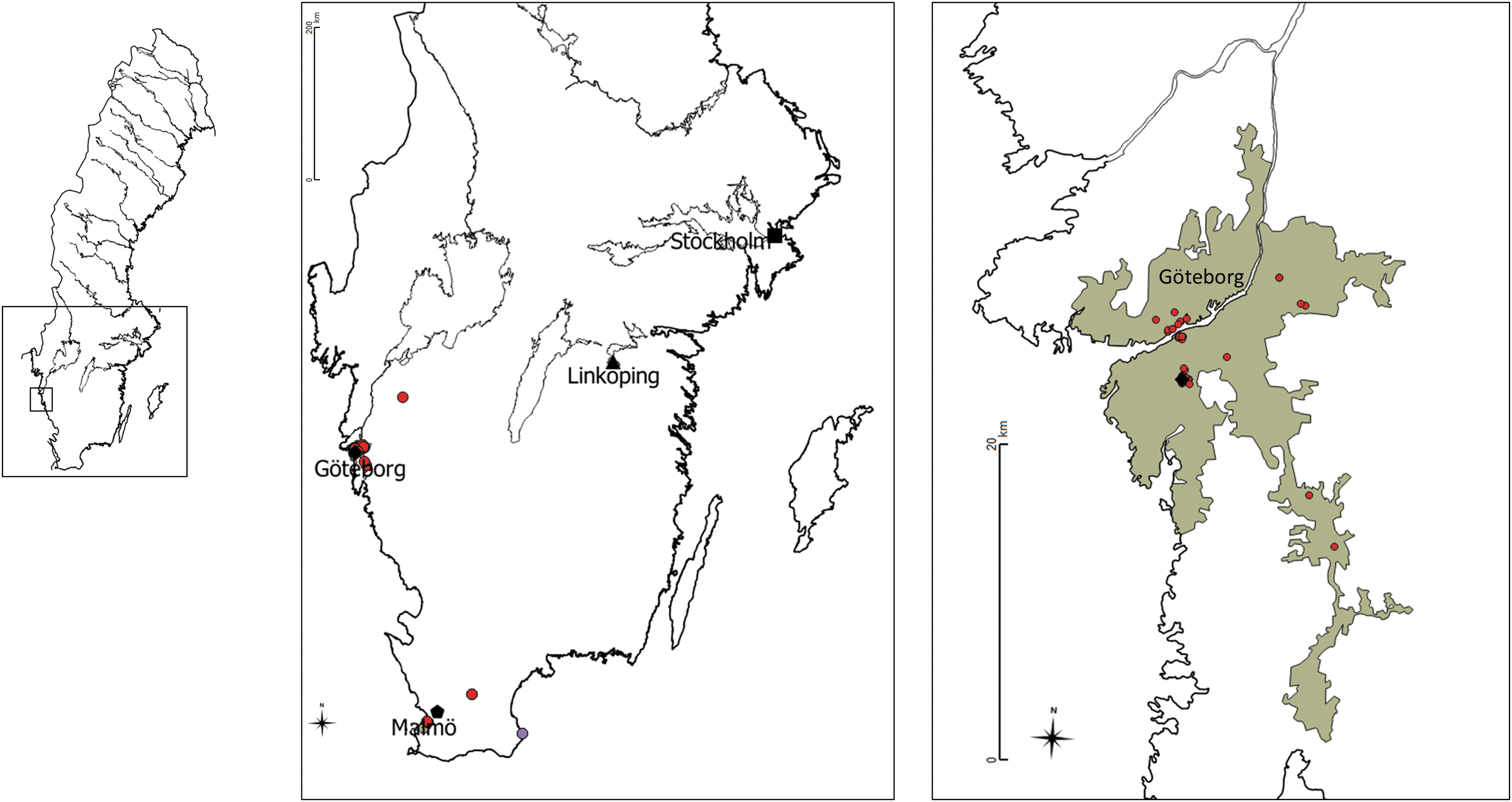
In total, there were 111 Culex mosquito specimens from southern Sweden, whereof 72 specimens were sent in by citizens and 39 were collected by research staff. Of these, 58 were defined as Cx. pipiens f molestus, 33 were Cx. pipiens f pipiens, 12 were Cx. torrentium, 1 was not a Culex mosquito (Aedes excrucians), 2 were hybrids of f pipens and f molestus, and 5 were unable to be classified due to a poor DNA quality. All Cx. pipiens f molestus mosquitoes were sent in by the public, and Cx. pipiens f pipiens and Cx. torrentium were uncommon in these samples (Supplementary Table S1). In Gothenburg (Fig. 1), Cx. pipiens f molestus was more spread throughout the city than previously reported and was also present in neighboring suburban locations. The molestus bioform was also present in the northern Malmö suburb Burlöv, and on two farms in rural locations dominated by farmland in Sollebrunn and Hörby. Culex pipiens hybrids were found in Simrishamn.
Discussion
Compared with the few previous reports of Cx. pipiens f molestus in Sweden, we have unexpectedly found specimens in several rural areas. Our study analyzed specimens sent in by people experiencing mosquito nuisance in the south of Sweden, allowing us to get samples that would be hard to obtain without citizen collaboration. Most of the Cx. pipiens f molestus specimens were collected in Gothenburg where the bioform has been recently described (Hesson et al. 2016). Although we cannot evaluate the true distribution of the molestus bioform, it is more common than previously thought. Our results indicated that the bioform may be identified as present in even more places, if investigated more closely.
In our study, we found Cx. pipiens f molestus only where people described nuisance problems indoors, and in these samples only three Cx. pipiens f pipiens were found. Although we did not have access to mosquito traps in these locations, it seems that passive surveillance using citizens who are urged to report indoor nuisance is a good method to find new populations of Cx. pipiens f molestus.
Our result contrasts with the results by Vogels et al. (2016), wherein they found Cx. pipiens f molestus in traps in rural sites and hybrids in an urban site where no nuisance problems have been reported. Further studies will be needed to more closely study the distribution of Cx. pipiens f molestus in Sweden and how this might affect future transmission of mosquito-borne viruses such as WNV and USUV that are spreading in Europe.
Conclusions
Culex pipiens f molestus was present in several urban and rural locations in southern Sweden and seemed to be associated with indoor nuisance problems.
Footnotes
Authors' Contributions
V.N.L. performed the laboratory investigation of the samples and drafted the article. D.E. collected mosquitoes, identified mosquitoes, and commented on the article. A.L. organized the mosquito collections and commented on the article. S.G.N. commented on the article. M.E. analyzed data and commented on the article. T.L. conceptualized the study, performed additional experiments, analyzed data, organized results, and finalized the article.
Acknowledgment
We thank all members of the public who collected mosquitoes for the study.
Availability of Data and Material
The data sets during and/or analyzed during this study are available from the corresponding author on reasonable request.
Author Disclosure Statement
No conflicting financial interests exist. A preliminary version of this work was posted on bioRxiv 2019-04-23 (
Funding Information
This research was cofunded by the Swedish Research Council Grant 2017-05607 and the Swedish Civil Contingencies Agency (MSB) that supported the collection and identification of mosquito samples.
Supplementary Material
Supplementary Table S1
References
Supplementary Material
Please find the following supplemental material available below.
For Open Access articles published under a Creative Commons License, all supplemental material carries the same license as the article it is associated with.
For non-Open Access articles published, all supplemental material carries a non-exclusive license, and permission requests for re-use of supplemental material or any part of supplemental material shall be sent directly to the copyright owner as specified in the copyright notice associated with the article.
