




Abstract
Background and Objectives:
Canine visceral leishmaniasis affects dogs, the main urban reservoirs, which favor the transmission and expansion of this zoonotic disease in areas with high anthropization process and human density. We investigated the occurence of Leishmania infatum based in molecular diagnosis, and phylogenetic analysis of isolates obtained from dogs in metropolitan region of São Paulo.
Methods:
A total of 201 dogs were tested by parasitological and molecular diagnosis. Phylogenetic analysis based sequences from SSUrDNA and gGAPDH genes were performed.
Results:
The parasitological diagnosis revealed 5% (10/201) of positivity, and the sequences obtained from seven isolates were clustered with L. infantum in phylogentic analysis based on SSUrDNA and gGAPDH genes. A total of 24.9% (50/201) of dogs were positive in molecular diagnosis based on cathepsin L-like marker.
Interpretation and Conclusion:
According to this study, it is necessary to implement a surveillance policy of visceral leishmaniasis, intensifying the actions of diagnosis, prevention, and control of this zoonosis.
Introduction
Visceral leishmaniasis has a wide distribution in South America where the etiological agent of the infection is the heteroxenic protozoan Leishmania infantum (Marcili et al. 2014), transmitted between mammals of different orders through the blood repast of female sand flies of different species (Maroli et al. 2013). This zoonosis is one of the most important tropical diseases among the 10 infectious diseases with the highest number of cases (Hotez et al. 2004). Between 200,000 and 400,000 new human cases are estimated to occur annually, of which 90% come from India, Bangladesh, Sudan, South Sudan, Ethiopia, and Brazil (Alvar et al. 2012). In a broader risk estimate, 1.7 billion people, or a quarter of the world's population, reside in areas with potential risk of leishmaniasis (Pigott et al. 2014).
In Brazil, visceral leishmaniasis affects 21 states, distributed in 1600 different municipalities with records of autochthonous human cases (Anversa et al. 2018). Transmission chains have historically been related to the northeast region; however, epidemiological data series have shown a disease expansion movement in the southeastern region (Reis et al. 2017), including the state of São Paulo (Bezerra et al. 2018).
The spatiotemporal expansion route in São Paulo state is associated with anthropic interventions and major infrastructure projects that have increased the disease frontier to the eastern portion of the state (endemic region) toward its metropolitan region, where the advancement of visceral leishmaniasis represents an alert, for both animal and human health (Cardim et al. 2016, Sevá et al. 2017, Oliveira et al. 2018).
Canids play a fundamental role in the transmission cycle (Deane and Deane 1954, 1955), mainly the domestic dog considered as the main reservoir host of the agent, especially in urban and periurban environments (Ashford et al. 1998). The main clinical manifestations in dogs involve anorexia, exfoliative, pustular, or ulcerative dermatological lesions, nonpruritic alopecia, bilateral blepharitis, depigmentation of the nasal region, onychogryphosis, popliteal lymphadenomegaly, ophthalmopathy, hepatomegaly, splenomegaly, and even chronic renal impairment (Ribeiro et al. 2018). However, there are dogs classified as asymptomatic, which, despite being infected, maintain a healthy appearance, constituting an additional challenge for epidemiological studies, making latent the need to employ sufficiently sensitive diagnostic methodologies to identify these carriers (Berrahal et al. 1996).
All studies on the spread of leishmaniasis in the state of São Paulo have pointed to the same path that the disease has been spreading west east. This dispersion follows a well-established pattern, for both canine and human cases, and for vectors, bordering mainly on highways, and that, in line with what happened in other states in the late 1990s, the metropolitan region will soon be an endemic area, example of what today is the whole region of the west of São Paulo (Matsumoto et al. 2013).
However, despite the sanitary importance of visceral leishmaniasis and epidemiological projections that indicate an increase in the prevalence values, there are few studies that evaluate the frequency and circulation of the disease in the metropolitan region of São Paulo, so this study aims to diagnose, isolate, and characterize L. infantum chagasi in domestic dogs of the metropolitan region of São Paulo.
Subjects and Methods
The metropolitan region of São Paulo comprises 39 municipalities. In this study, dogs in the municipalities of Barueri, Carapicuíba, Cotia, Embu das Artes, Osasco, São Bernardo do Campo, Sâo Paulo, and Vargem Grande Paulista were sampled; dogs of both genders, of different breeds and ages, residing in the area, all belonging to São Paulo. Clinical data were recorded at the time of collection, and the respective consent terms were filled in according to the Animal Use Ethics Committee (n° 09/2016 CEUA UNISA).
From each animal, a venous blood sample was collected, placed in a sterile tube containing absolute ethanol (v/v) for molecular diagnosis. Sample of the puncture popliteal lymph node content and skin samples (biopsies) collected through a 3 mm dermatological punch for parasite isolation. In addition, the skin samples were placed in vials containing PBS1X plus gentamicin, ampicillin, and amphotericin B at the time of collection until isolation process.
Isolation of Leishmania
The aspirate contents and skin biopsy were inoculated into Vacutainer tubes containing a biphasic medium consisting of 15% sheep red blood cells as the solid phase (blood agar base), overlain by liquid LIT (Liver Infusion Tryptose) medium supplemented with 20% fetal bovine serum. The culture was incubated at 28°C and grown in LIT medium for DNA preparation. The isolates were cryopreserved in liquid nitrogen in the Brazilian Trypanosomatid Collection (Coleção Brasileira de Tripanossomatídeos, CBT) in the Department of Preventive Veterinary Medicine and Animal Health, School of Veterinary Medicine, University of São Paulo, Brazil.
Molecular diagnosis and phylogenetic analysis
The DNA from Leishmania cultures and blood samples were extracted using Purelink Genomic DNA (Termofisher). DNA samples from Leishmania isolates were subjected to the conventional PCR for trypanosome barcoding (V7V8 SSUrDNA) (Maia da Silva et al. 2008) and gGAPDH gene (Hamilton et al. 2004). The Cathepsin-like PCR was used for L. infantum diagnosis (Silva et al. 2019). PCR products of the expected size were purified and sequenced in an automated sequencer (ABI Prism 310). The nucleotide sequences generated were deposited in GenBank (Table 1).
Sample and Geographic Origin of Leishmania infantum Isolates Obtained in São Paulo Metropolitan Area
CBT, Coleção Brasileira de Tripanossomatídeos.
The sequences obtained from this study were aligned with sequences previously determined and available in GenBank (Table 1) using ClustalX (Thompson et al. 1997) and were adjusted manually using GeneDoc (Nicholas et al. 1997). The phylogenetic tree was constructed using maximum parsimony, as implemented in PAUP version 4.0b10 (Swofford 2002) with 500 bootstrap replicates. The Bayesian analysis was performed using MrBayes v3.1.2 (Ronquist and Huelsenbeck 2003) with 1,000,000 replicates. The first 25% of the trees represented burn-in, and the remaining trees were used to calculate the Bayesian posterior probability.
Results
A total of 201 animals were sampled: 80 animals in Cotia, 59 in Vargem Grande Paulista, 19 in Embu das Artes, 16 in Osasco, 12 in Carapicuíba, 10 in São Paulo, and 5 in São Bernardo do Campo.
Cultures seeded with lymph node puncture material and/or skin biopsies revealed a positive frequency of 5% (10/201). Considering the municipalities sampled individually, the percentages obtained were 6.25 (5/80) for the municipality of Cotia, 10.5 (2/19) for Embu das Artes, 6.25 (1/16) for Osasco, 10 (1/10) in São Paulo, and 1.7 (1/59) in Vargem Grande Paulista, with no positive punctures found for the other territories analyzed (Fig. 1). Among these 10 positive cultures, 7 were properly isolated and cryopreserved for molecular and phylogenetic characterization (Table 1).
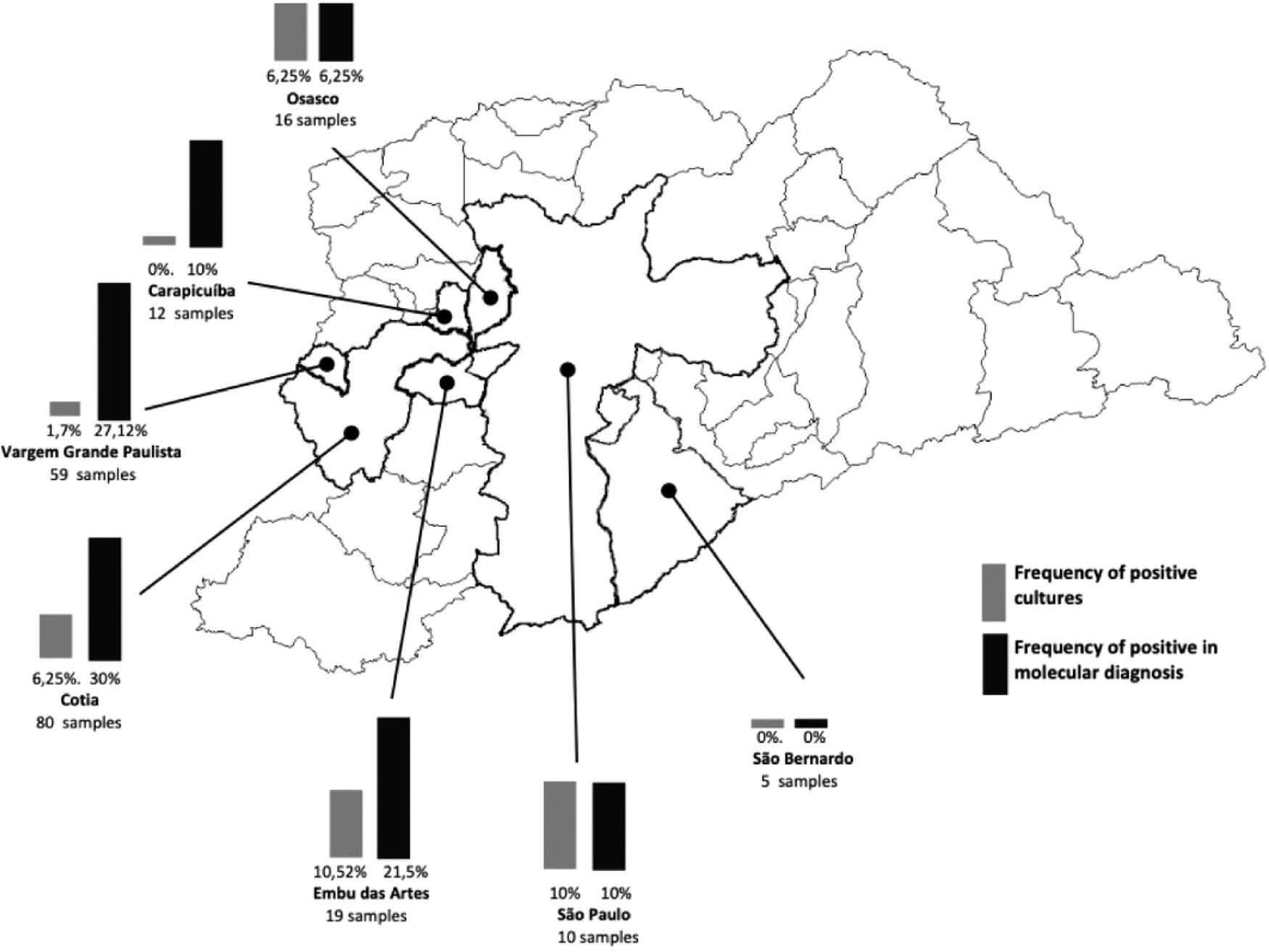
Geographical origin of dogs caught in the São Paulo metropolitan city and frequency of parasitological and molecular diagnosis.
Molecular diagnosis based on cathepsin marker L-like showed a positive percentage of 24.9 (50/201), with values of 30% (24/80), 27.1% (16/59), 21% (4/19), 33.3% (4/12), 6.25% (1/16), and 10% (1/10), for the municipalities of Cotia, Vargem Grande Paulista, Embu das Artes, Carapicuíba, Osasco, and São Paulo, respectively (Fig. 1). All positive samples in the direct parasitological diagnosis were positive in the molecular reactions for cathepsin L-like, a coincidence that confirms the specificity of the marker and helps demonstrate its validity for conducting epidemiological surveys.
Similarity analysis (Blast) of SSUrDNA and gGAPDH gene sequences obtained from the seven isolates showed 99% similarity to L. infantum (XR_001203206). The phylogenetic analysis based on concatenated sequence alignments revealed the segregation of species causing visceral leishmaniasis into three distinct groups (Fig. 2). The groups formed were as follows: I. Leishmania donovani (100% similarity and 100% bootstrap and 1.0 a posteriori probability), II. L. infantum Old World (100% similarity and 100% bootstrap and 1.0 a posteriori probability), and III. L. infantum New World (100% similarity and 100% bootstrap and 1.0 a posteriori probability).
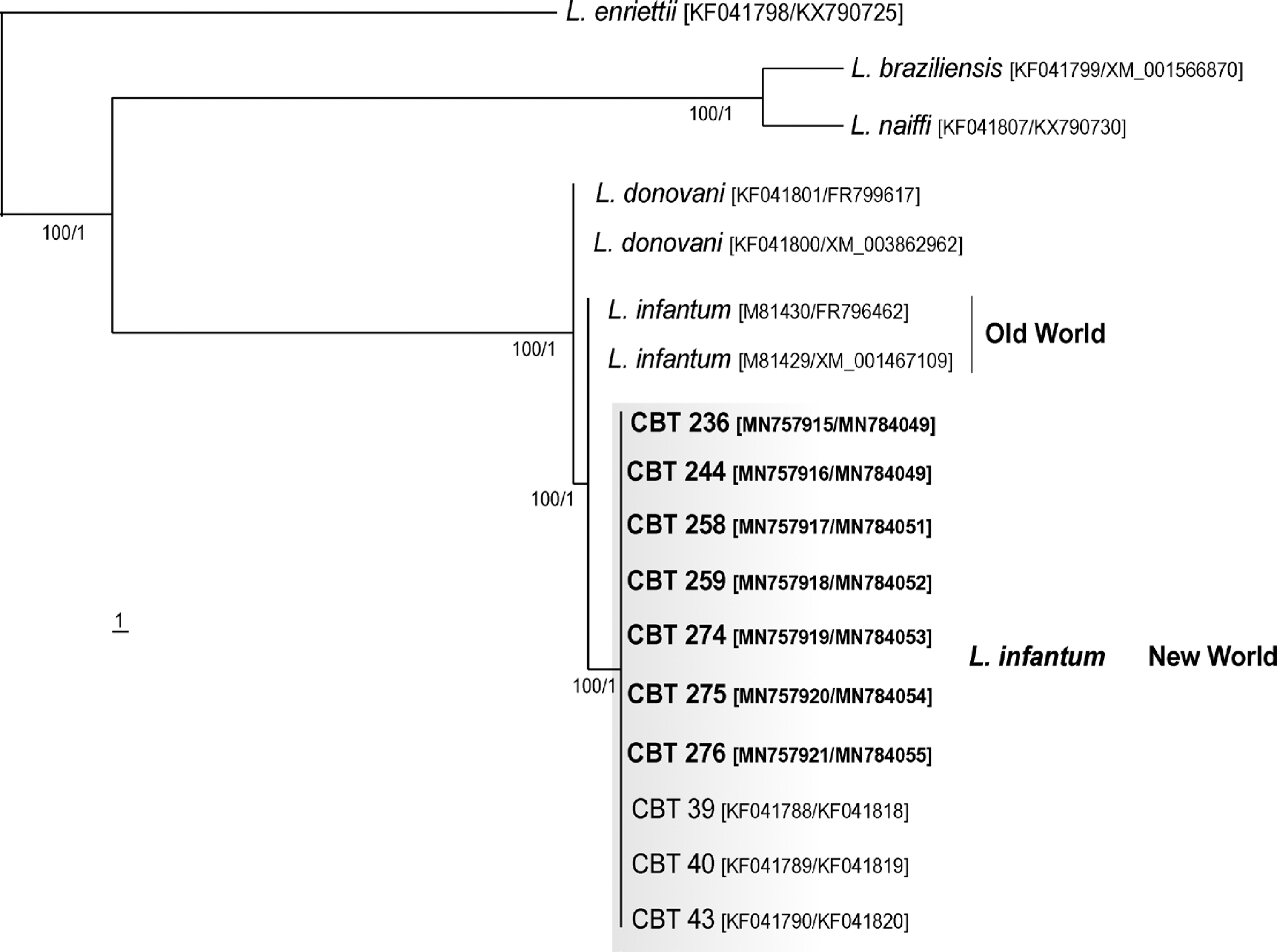
Dendrogram based on concatenated SSU rDNA and gGAPDH sequences on 17 Leishmania, which was used for maximum parsimony and Bayesian inferences. Numbers at nodes are the support values for the major branches (bootstrap/posterior probability; 500 replicates). The sequences obtained from this study are indicated in bold. CBT, Coleção Brasileira de Tripanossomatídeos.
The phylogenetic analysis did not show differences between the sequences of the several isolates obtained in the metropolitan region of São Paulo, nor were there any differences between these isolates and those from other geographical regions of Brazil, confirming the inexistence of intraspecific variability among the isolates of circulating L. infantum in the region investigated and in the country.
Discussion
Phylogenetic inferences indicated a complete identity among the isolates. When the sequences obtained from the isolates were compared with sequences from isolates from other geographical origins, the identity profile was maintained, attesting that the isolates correspond to L. infantum and confirming the absence of intraspecific variations previously observed in multimarker analyses (Marcili et al. 2014, Silva et al. 2019).
The phylogenetic groups and their respective distances reflect the differences between the species causing visceral leishmaniasis and their distribution worldwide, affirming the recent segregation between L. infantum and L. infantum chagasi during the European colonization process in America and the conserved character of their sequences (Kuhls et al. 2011, Marcili et al. 2014, Espinosa et al. 2018).
Data from the parasitological and molecular diagnosis reinforce the hypothesis of the disease's tendency to expand, in which the role of human activities in ecological dynamism has allowed the number of municipalities with pathogen circulation records to grow abruptly (Camargo-Neves et al. 2003, Cardim et al. 2013, Sevá et al. 2017).
One of the objections to the hypothesis of visceral leishmaniasis transmission in the studied region was the absence of the Lutzomya longipalpis vector. However, findings point out that the sum of the high attractiveness by the dog, the susceptibility to protozoan infection, the life expectancy of the infected insect, and especially the high population density make Pintomya fischeri a potential vector of canine transmission in situations where L. longipalpis is absent (Galvis-Ovallos et al. 2017).
Studies demonstrated incidence rates of P. fischeri ranging from medium to high values in various localities of the state of São Paulo, including the municipalities of Cotia, Embu das Artes, Osasco, Vargem Grande Paulista, and São Paulo, which accumulated the positive cases diagnosed (Shimabukuro et al. 2010).
The epidemiology of the disease demonstrates that autochthonous human cases in a territory are preceded by canine notifications (Camargo-Neves et al. 2001). Thus, this work, by providing new elements that attest and corroborate the occurrence of canine visceral leishmaniasis in the metropolitan region of São Paulo, points to the need for studies that identify new ecoepidemiological elements of the disease that investigate the possibilities of human morbidity and mortality and draw attention to the need for adoption of diagnostic methodologies of high predictive value that contribute to the prevention and control of this important zoonosis.
The city of São Paulo has legislation that regulates from the possession of dogs and cats by individuals to their commercial breeding. Among the prohibitions in the city is that it is illegal to keep >10 animals in the same residence, regardless of size or species. With these legal measures, kennels (whether legal or illegal), shelters, nongovernmental organization, and animal rescuers eventually moved their property to cities in the metropolitan region where such rules do not exist and they need not worry about legal measures, such as court restraints, fines, and other penalties provided for by law.
Although city law requires the registration of all dogs and cats living in São Paulo, enforcement of this law is not effective and/or nonexistent. Sanitary control measures related to animal traffic would be more effective, given that animal traffic is mostly conditioned by guardian traffic.
Vector control measures in different municipalities and the requirement of a health certificate are effective measures to control this zoonosis, since for the initiation of the transmission cycle in new localities, the presence of both the vector and vertebrate hosts harboring the parasite is necessary. Such measures are adopted in health programs against foot-and-mouth disease, classical swine fever, and equine infectious anemia, where for animal transport a health certificate or vaccination certificate is required, and road surveillance is effective, for diseases in that the biggest damage is purely economic and not public health.
The metropolitan region of São Paulo is considered the fourth largest in the world by number of inhabitants and, consequently, high concentration of pets and the presence of dogs diagnosed as positive demonstrate that the parasite is circulating throughout the metropolitan region of São Paulo; hence urgent measures must be taken to prevent the region from becoming endemic to visceral leishmaniasis.
Footnotes
Authors' Contributions
R.E.S. and A.M. conceived the study and designed the experiments; R.E.S., V.P.C., F.A.N.C., R.C.F.A., and J.M.F. assisted with sample collection, performed the experiments and analyzed the data; and R.E.S., R.T., and A.M. prepared the article. All authors read and approved the final version of the article.
Acknowledgment
The authors thank all dog owners who accepted to collaborate in this study.
Author Disclosure Statement
No conflicting financial interests exist.
Funding Information
This research was financially supported by Conselho Nacional de Desenvolvimento Científico e Tecnológico – CNPq [grant number 303288/2015-9 and 302145/2018-4], Fundação de Amparo a Pesquisa do Estado de São Paulo [grant number 2015/25592-3], and Coordenação de Aperfeiçoamento de Pessoal de Nível Superior (CAPES).