




Abstract
The zoonotic parasite Dirofilaria repens has spread toward north in Europe, and cases of autochthonous dirofilariosis caused by D. repens have emerged in the Baltic countries Estonia, Latvia, and Lithuania. We conducted a review on the emergence of dirofilariosis in humans and domestic dogs in these three countries in northeastern Europe. Based on the available literature and reports, the first finding in the Baltic countries was made in Latvia in 2008, followed by the first in Lithuania in 2010, and the first in Estonia in 2012. In all three countries, further findings were reported soon after the first reports. By the end of 2019, autochthonous human D. repens infections had been described from Latvia and Lithuania, and autochthonous canine D. repens infections had been described from all three Baltic countries. While no epidemiological studies estimating prevalence or incidence of the human infections have been published from the three countries, a substantial proportion of investigated dogs have tested positive for microfilariae in studies performed in Latvia and Lithuania. Dirofilariosis is an emerging zoonosis in northern Europe, and the summarized data confirm that D. repens has become established and endemic in the Baltic countries. The available data do not provide a good overview of the situation, and further epidemiological studies are needed. Awareness about the recently emerged zoonotic parasite should be increased among medical doctors, veterinarians, and the general public. Managing this zoonotic infection is a public health challenge that needs to be addressed using a One Health approach. Investigating the spread of D. repens in the Baltic countries could be useful for better preparedness for the anticipated further spread to the Nordic countries.
Introduction
Dirofilariosis, a vector-borne disease caused by nematode parasites of the genus Dirofilaria, is an emerging zoonosis in northern parts of Europe (Cielecka et al. 2012, Simón et al. 2012, Oksanen et al. 2013, Czajka et al. 2014, Friedrich et al. 2014, Tappe et al. 2014, Borkowski et al. 2015, Deksne et al. 2020). Studies from western parts of Europe have documented the spread of Dirofilaria spp. toward northeast, and studies from Russia toward northwest (Genchi et al. 2011a, Kartashev et al. 2015, Capelli et al. 2018)—that is, toward where the Baltic countries Estonia, Latvia, and Lithuania are located. Among the factors facilitating the spread are climate change and movement of pet dogs (Genchi et al. 2009, 2011b, Simón et al. 2012). Dirofilaria repens appears to be spreading faster than Dirofilaria immitis (Capelli et al. 2018).
Dirofilaria repens can cause subcutaneous nodules, which may mimic tumors and be associated with erythema, swelling, and pain (Popescu et al. 2012, Simón et al. 2012, Friedrich et al. 2014). As the infection can be subclinical, delayed diagnosis and treatment may allow unnoticed reservoir hosts that may provide microfilariae to the vectors, mosquitoes. Domestic dogs are definitive hosts for the parasite and key hosts for its epidemiology—public health risk is considered to be present in areas with infected dogs (Simón et al. 2012). Although humans are mainly considered an accidental and dead-end host, there are few reports of mature female worms and circulating microfilariae in infected individuals (Genchi et al. 2009, Simón et al. 2012, Friedrich et al. 2014).
The northern border of distribution of Dirofilaria spp. is practically not limited by the availability of vectors but rather by environmental factors allowing microfilariae to mature into infective larvae in the vectors (Genchi et al. 2011b, Sassnau and Genchi 2013, Pietikäinen et al. 2017). The northernmost European locations, where D. repens life cycle has been confirmed, are Tartumaa county in Estonia (Jokelainen et al. 2016) and the Novgorod Region in Russia (Ermakova et al. 2014).
In Finland, the first imported D. repens case in a dog was diagnosed in 2014 (Finish Food Safety Authority 2014), and the first autochthonous human case was diagnosed in southeastern Finland in 2015 (Pietikäinen et al. 2017). In Poland, the first autochthonous human case was diagnosed in 2010 (Cielecka et al. 2012). Between 1995 and 2012, altogether 236 cases of human infection by D. repens were reported from Russia (Ermakova et al. 2014).
Preparedness for emerging zoonotic parasitic vector-borne diseases, such as dirofilariosis, requires transdisciplinary thinking and awareness (Aguirre et al. 2019). Questionnaire studies carried out in the Nordic-Baltic region (Tiškina and Jokelainen 2017, Mikola et al. 2020) have indicated that there is room for improvement in awareness and knowledge about dirofilariosis across the sectors. Canine vector-borne parasites are a timely topic in the Nordic-Baltic region (Deksne et al. 2020).
This article summarizes the available publications and reports on the emergence of D. repens in humans and dogs in the Baltic countries Estonia, Latvia, and Lithuania.
Materials and Methods
Setting
The Baltic countries Estonia, Latvia, and Lithuania are EU-countries located in the northeastern part of Europe, between 53°N and 59°N (Fig. 1). They are bordered by Russia in the east, Belarus in the south, and the Baltic Sea in the north-west. The average mean air temperature is 6.0°C in Estonia (Estonian Weather Service, 2020), 6.4°C in Latvia (Latvian Environment, Geology and Meteorology Centre, 2020), and 6.5°C in Lithuania (Lithuanian Hydrometerological Service, 2020). The average annual precipitation is 672 mm in Estonia (Estonian Weather Service, 2020), 692 mm in Latvia (Latvian Environment, Geology and Meteorology Centre, 2020), and 695 mm in Lithuania (Lithuanian Hydrometerological Service, 2020).
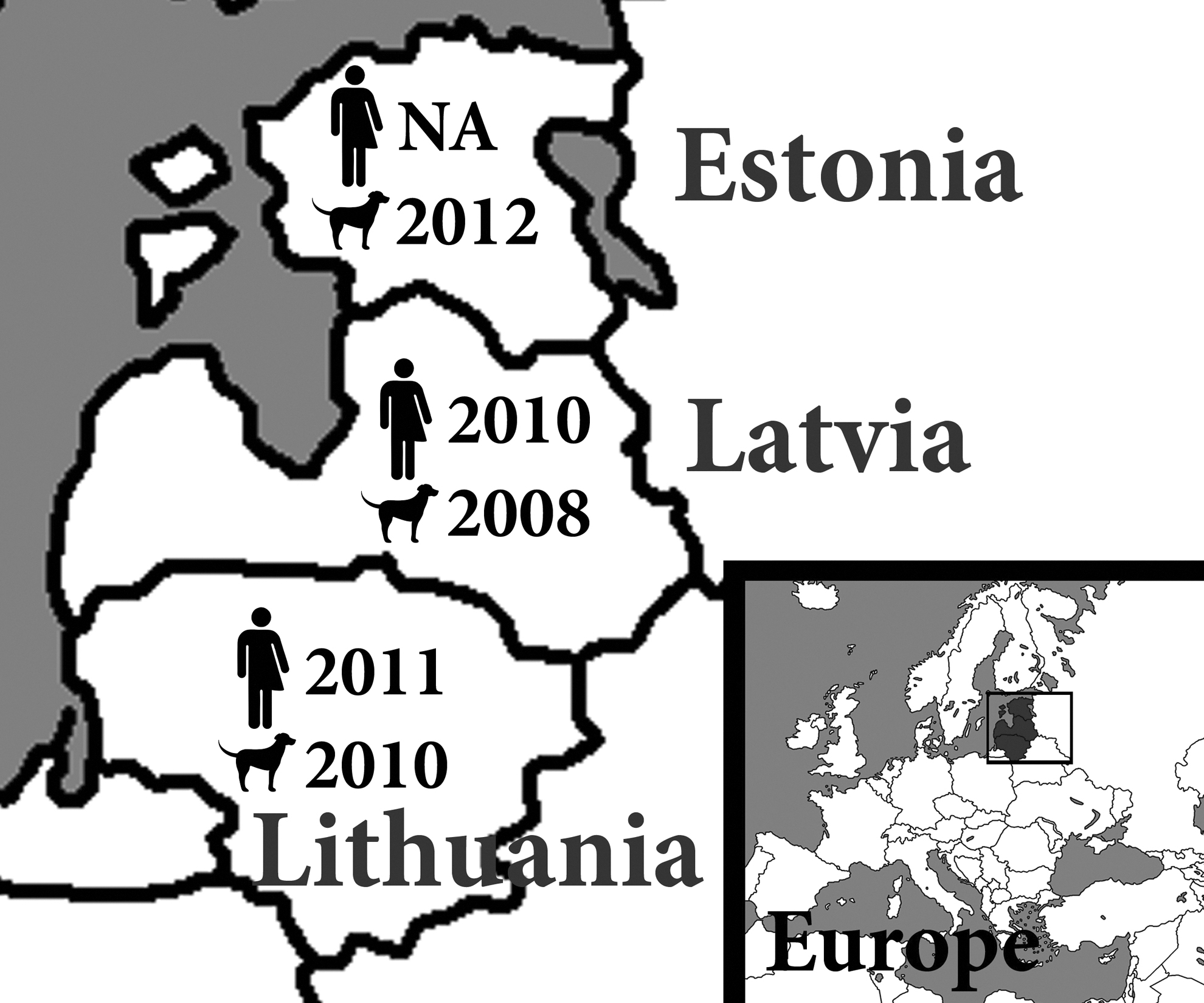
Map showing the location of Estonia, Latvia, and Lithuania, and the year of the first detected case of Dirofilaria repens in humans and in dogs in each of them.
Search strategies
This review was not a systematic review. We aimed to identify and include all records on D. repens from the three Baltic countries. We searched three electronically available databases (PubMed, Scopus, and Google Scholar) for epidemiological studies and descriptions of autochthonous, travel-related, and immigration/import-related D. repens infections in humans and domestic dogs in the three Baltic countries. We used the search words “Dirofilaria,” AND “human” OR “dog,” AND “Estonia” OR “Latvia” OR “Lithuania,” without time limitation. Articles that were not about D. repens were subsequently excluded.
The reference lists of identified articles were used for identifying further literature. Furthermore, we searched for gray literature, including articles in local languages, reports and anonymized summaries of a convenience selection of diagnostic laboratories and health care provides, conference abstracts, and theses. The last searches were performed on December 27, 2019.
Results
We identified publications about D. repens from all three Baltic countries. Based on the available literature, D. repens emerged in the three Baltic countries within a time period of few years, in 2008–2012 (Fig. 1; Jankauskaitė et al. 2010, Melbarde-Gorkusa et al. 2011, Järvis 2012, Stepanjana 2012, Jokūbauskienė et al. 2014, Jokelainen et al. 2016, Sabūnas et al. 2019). The parasite has since then established itself in all three countries. In 2016, 24% of veterinarians who worked in the Baltic countries and participated in a questionnaire study reported having seen a dog or several dogs, all without a history of travel or import, which had D. repens infection (Tiškina and Jokelainen 2017).
In Estonia, the first reported D. repens finding was from a dog, detected apparently in 2012 (Järvis 2012) and the first finding that was confirmed by molecular methods to be D. repens was made from a dog the following year 2013 (Jokelainen et al. 2016). The confirmed finding was part of a case series that reported microfilaremia in three dogs, all without history of travel or import. The case series mentioned that the three cases comprised 0.05% of all dogs admitted to the university animal hospital during the study period 2013–2014 (Jokelainen et al. 2016). All three cases were accidental findings, and the proportion should not be considered a prevalence estimate (Jokelainen et al. 2016). There have been no epidemiological studies aiming to estimate the prevalence of D. repens infection in dogs in the country. Publications on human infections were not identified from Estonia.
In Latvia, the first D. repens findings were made from dogs in the time period from 2008–2012, and some of them were confirmed using molecular methods to be D. repens (Stepanjana 2012). The first finding from a human was made in Latvia in 2010 (Melbarde-Gorkusa et al. 2011). The available estimates of proportion of dogs with microfilaremia, detected by microscopy of blood smears and reported as D. repens, range from 2.5% to 3.8%, and those detected with modified Knott test range from 6.8% to 23.5% (Stepanjana 2012, Stepanjana et al. 2012, Veškins et al. 2012, 2014, Kirjušina et al. 2015). Available annual reports reported a mean annual proportion of positives of 3.8% (median 3.8%, range, 0.9–5.3%; number of tested dogs per year 893–1719) based on microscopy of blood smears in 2008–2017 and mean annual proportion of positives of 20.7% (median 20.9%, range,13.1–29.2%; number of tested animals per year 227–440) based on modified Knott test in 2012–2017 (Institute of Food Safety, Animal Health and Environment BIOR, 2008–2017). Autochthonous D. repens infections in dogs have been reported after 2010 (Kirjušina et al. 2015). There have been at least six cases of dirofilariosis in humans in 2009–2014, diagnosed based on morphology of the parasites removed by surgery (Zinčenko et al. 2012, Kirjušina and Krūmiņa 2014, Krūmiņa et al. 2016). Moreover, further cases have been seen at Department of Oral and Maxillofacial Surgery, Riga Stradiņš University and Riga East University hospital, Riga, Latvia (unpublished data).
In Lithuania, the first D. repens finding was made from a dog in 2010 (Jankauskaitė et al. 2010, Sabūnas et al. 2019), and the first finding from a human was made in 2011 (Jokūbauskienė et al. 2014, Sabūnas et al. 2019). The estimates of proportion of dogs with microfilaremia, reported as D. repens, based on different methods (microscopy of blood smears, modified Knott test, PCR), have ranged from 0.8% to 32.0% (Jachimavičiūtė 2016, Kotryna 2017, Kraftaitė 2018, Sabūnas et al. 2019). Majority of the dogs described as having the infection had no clinical signs (Jachimavičiūtė 2016, Liutkevičiūtė 2017). None of the dogs had been imported from previously known endemic countries or had history of travel outside Lithuania (Sabūnas et al. 2019).
From 2011 to 2018, at least nine cases of human dirofilariosis were observed in Lithuania (Telksnys et al. 2015, Sabūnas et al. 2019). Moreover, further cases have been seen at Vilnius University Hospital Zalgiris Clinics, Vilnius, Lithuania (unpublished data).
Discussion
This article provides an overview of dirofilariosis caused by D. repens in humans and dogs in the Baltic countries Estonia, Latvia, and Lithuania. The review of literature shows that D. repens emerged during a relatively short time period in the three countries (Fig. 1) and is now well-established and endemic in them. The infection has been reported in canine hosts with no history of travel or import, epidemiological studies have identified a substantial proportion of positive dogs, and autochthonous human infections have also been seen. Molecular confirmation of the causative parasite species has been applied in all three countries.
It should be emphasized that the available data likely underestimate the number of cases, prevalence, and incidence. This was exemplified by the wide range of estimates for the proportion of dogs that were positive, which is partly explained by different methodologies applied, as well as by knowledge of further human cases in addition to those reported. Moreover, the number of studies conducted on the topic as well as the number of publications on the topic that are directly available to international audience is limited.
The information in the identified publications and reports was not always complete, and some references to earlier findings were inaccurate. More studies estimating the prevalence and incidence of D. repens infection in both humans, dogs, and other hosts, as well as studies on the mosquito vectors, are needed to obtain a good overview of the situation and to design and apply effective control measures.
Dirofilariosis caused by D. repens is neither a notifiable disease in humans nor in dogs in any of the three Baltic countries. Due to the unspecific clinical signs and presumed general low awareness, underdiagnosing of D. repens infections is likely. It is noteworthy that among the described cases, some human infections were diagnosed after surgery, and the diagnosis was reached in some dogs after an accidental finding at microscopy of blood smears or during surgery.
Both physicians and veterinarians should remember dirofilariosis caused by D. repens as a differential diagnosis for patients with suggestive clinical signs, who are living in or have visited the Baltic countries. In both humans and dogs the diagnosis can be relevant for avoiding unnecessarily extensive surgery and worrying. In particular, infected dogs should be diagnosed and treated without delay to stop them from contributing to the life cycle of the parasite. It is noteworthy that dogs in the Baltic countries are neither routinely regularly treated with antiparasitic drugs, which would have an effect on D. repens, nor with mosquito repellents.
Continuous professional education of health care professionals and veterinarians in the Baltic countries and neighboring regions should address dirofilariosis caused by D. repens, as it is a recently emerged disease. Recently, practical guidelines have been published for veterinarians (Federation of European Companion Animal Veterinary Association, 2018). Importantly, D. repens is zoonotic and One Health collaboration is needed for addressing it. Moreover, the general population living in the Baltic countries as well as tourists, especially those traveling with their dogs, should be informed about the new disease.
The Nordic countries and other areas where the emergence of D. repens is more recent or anticipated, but yet to be documented (Pietikäinen et al. 2017, Tiškina and Jokelainen 2017), could benefit from learning from the observations made in the Baltic countries, which this article summarized.
Conclusions
Dirofilaria repens emerged during a relatively short time period in all Baltic countries and is now well-established and endemic in them. Dirofilariosis is a zoonotic disease that requires more attention in the region. Managing this zoonotic disease and public health challenge requires a One Health approach, good communication across the sectors, and international collaboration.
Footnotes
Acknowledgment
We thank the colleagues who helped us find gray literature.
Author Disclosure Statement
P.J. has received lecture fees from educational institutes, Sympaatti, Evidensia/Vetcare, Orion Pharma Eläinlääkkeet, and Fennovet. Other authors declare that no competing financial interests exist.
Funding Information
No funding was received for this article.