




Abstract
Toxoplasma gondii, an intracellular zoonotic parasite, can infect humans and various animals worldwide. Wild rodents plan an important role as intermediate hosts of T. gondii. Some studies on T. gondii from wild rodents have been published, but the investigation data of T. gondii in wild rodents in China are limited. Therefore, brain tissue samples from 382 wild rodents in four provinces and one autonomous region of China were screened by PCR amplification of T. gondii B1 gene. Furthermore, the wild rodents were identified as five species based on their morphological characteristics, including Citellus dauricus (n = 35 from Heilongjiang), Lasiopodomys brandti (n = 81 from Inner Mongolia), Apodemus agrarius (n = 12 from Heilongjiang), Rattus norvegicus (n = 2 from Heilongjiang; n = 99 from Zhejiang; n = 54 from Shanxi), and Mus musculus (n = 99 from Guangxi). The overall prevalence of T. gondii in these wild rodents was 5.24% (20/382) in this study. At different regions, the highest prevalence of T. gondii was in Guangxi (12.12%) compared with other regions (0% in Heilongjiang; 2.47% in Inner Mongolia; 2.02% in Zhejiang; 7.41% in Shanxi). At different climates, the higher prevalence was found in temperate/mesothermal climates (7.07%) compared with continental/microthermal climates (3.26%). Also, the results showed that M. musculus had the highest prevalence of T. gondii infection (12.12%) among the rodent species sampled. Moreover, sampling year was significantly related to the prevalence of T. gondii in investigated wild rodents (p = 0.0117). This is the first report of T. gondii in wild rodents from Zhejiang, Guangxi, Shanxi, Heilongjiang provinces and Inner Mongolia autonomous region in China, providing the fundamental information for further prevention and control of toxoplasmosis in China.
Introduction
The protozoan Toxoplasma gondii leading to toxoplasmosis can infect virtually all warm-blooded animals (Dubey 2010, Gong et al. 2020, Sun et al. 2020). More than 1/3 of the world's population and 10% of population in China have been infected with T. gondii (Weiss and Dubey 2009, Zhang et al. 2018). The cat is the sole definitive host of T. gondii, excreting millions of oocysts into the environment (Dubey et al. 2016). Moreover, suitable temperatures and increased rainfall improve the survival rate of T. gondii oocyst (Tenter et al. 2000, Bastiaan et al. 2009). Humans are infected through consumption of undercooked meat from livestock or by drinking water contaminated with oocysts. In addition, congenital transmission is also the main route of human infection (Torda 2001, Dubey 2004, Zhao et al. 2011). In general, healthy individuals infected with Toxoplasma are typically asymptomatic or develop flu-like symptoms, but it can cause abortion and stillbirth during pregnancy, and even fatality in people with immunocompromise (Montoya and Liesenfeld 2004).
Wild rodents as an important intermediate host of T. gondii are a potentially important source of T. gondii infection in both domestic and wild cats (Dabritz et al. 2008). Infected rodents are also important vectors of T. gondii infection in swine and part of the transmission chain to other livestock (Hill et al. 2010). Previous studies suggested that the prevalence of toxoplasmosis in rodents was closely related to climatic and season factors and so on (Tenter et al. 2000, Bastiaan et al. 2009). Therefore, more researches are needed to understand the epidemiology of Toxoplasma in wild rodents to control the parasite's spread to humans. To date, studies on the prevalence of T. gondii in wild rodents have been reported worldwide (Ivovic et al. 2019, Krijger et al. 2019, Nazari et al. 2019). In China, data involving T. gondii in wild rodents were only recorded in Guangzhou (Yin et al. 2010), Jilin (Zhang et al. 2013, 2014), Xuzhou, Jiangsu (Yan et al. 2014), Hubei (Wang et al. 2013), Hunan (Zhang et al. 2004), and Qinghai (Zhang et al. 2013).
As T. gondii is a globally important zoonotic parasite and knowledge of rodent infection in China is limited, we investigate the prevalence and risk factors regarding T. gondii infection in wild rodents in the four provinces (Heilongjiang, Zhejiang, Shanxi, Guangxi) and one autonomous region (Inner Mongolia), which is helpful for taking measures to prevent and reduce the infection of humans and other animals.
Materials and Methods
Ethics statement
This study was approved by the Animal Ethics Committee of Heilongjiang Bayi Agricultural University (approval no. HBAUAEC2017-011). All operations were handled in strict accordance with the Good Animal Practice requirements of the Animal Ethics Procedures and Guidelines of the People's Republic of China.
Sample collection and preparation
A total of 382 wild rodents were randomly collected from five regions from 2017 to 2019, including Daqing city of Heilongjiang (n = 35, Citellus dauricus; n = 12, Apodemus agrarius; n = 2, Rattus norvegicus), XilinGol Inner Mongolia (n = 81, Lasiopodomys brandti), Jiaxing of Zhejiang (n = 99, R. norvegicus), Taigu County of Shanxi (n = 54, R. norvegicus), and Nanning of Guangxi (n = 99, Mus musculus). In our study, we determine the climate type of the sampling site used according to the Köppen–Geiger climate classification (Kottek et al. 2006). Climate of the sampling area comprised the monsoon-influenced hot-summer humid continental climate (Dwa; Heilongjiang), monsoon-influenced warm-summer humid continental climate (Dwb; Shanxi, Inner Mongolia), and humid subtropical climate (Cfa; Zhejiang, Guangxi). Finally, according to the Köppen–Geiger climate classification, the sampling sites were divided into two main climate types, continental/microthermal climates (D; Dwa, Dwb) and temperate/mesothermal climates (C; Cfa). All climate information is recorded at the sampling site. The information about wild rodents was recorded to carry out risk factor analysis, including species, sampling year, seasons, and climate. It is noteworthy the other information associated with T. gondii infection, such as sex, rainfall, and humidity, but it is difficult to estimate this information and we failed to obtain them.
The rodents came from the grasslands near rural areas, some stray rats were also found in the investigated regions. All the rats were trapped with cages and bait. More than 20 cages were randomly placed and trapping transects were used at each site to try to obtain a representative sample of local wild rodents. All of the captured animals were adult wild rodents, which were identified by morphological methods. Then, after animal euthanasia, the brain tissue was carefully removed with sterile forceps and scissors, cleaned with sterile saline, and stored in −20°C refrigerator for subsequent use.
Sequencing and statistical analysis
DNA was extracted from brain tissue (0.5–1.0 g) using the TIANamp Genomic DNA kit (Tiangen™, Beijing, China), following the manufacturer's instructions. Strict precautions were used for labware to avoid contamination of sample by exogenous DNA or amplicons. The extracted DNA sample was screened for T. gondii infection by using seminested PCR targeting the B1 gene as described elsewhere (Zhang et al. 2014, Robertson et al. 2019). The first-round direct PCR used the primer pair forward: 5′-GGAACTGCATCCGTTCATGAG-3′ and reverse: 5′-TCTTTAAAGCGTTCGTGGTC-3′. One microliter of the amplicons resulted from the first-round PCR as the target DNA, the forward primer: 5′-TGCATAGGTTGCAGTCACTG-3′, and the reverse primer from the first-round PCR. Cycling conditions for both the direct and seminested PCR were denaturation at 94°C for 5 min, followed by 35 cycles of 94°C for 1 min, 60°C for 1 min, 72°C for 2 min, and a final extension at 72°C for 5 min. Products from PCR were analyzed on prepoured 2.0% agarose gel with ethidium bromide added. Each positive DNA was sent for sequencing, which was compared against the GenBank database to identify the T. gondii B1 gene.
The variation in T. gondii prevalence of wild rodents (y) by region (x1), species (x2), sampling year (x4), seasons (x5), and climate (x6) was analyzed by chi-squared test using the SPSS for windows (Release 19.0 standard version, Chicago, IL) and SAS version 9.1 (SAS Institute Inc., USA). In the multivariable regression analysis, each factor was included in the binary logit model as an independent variable. The best model was validated by Fisher's scoring algorithm. When the p value was <0.05, the indicated difference was considered statistically significant. Odds ratios (ORs) and their 95% confidence intervals (95% CIs) were obtained to explore the strength of the association between T. gondii positivity and the risk factors considered above.
Results
Out of the 382 examined wild rodent DNA samples, twenty samples (5.24%, 95% CI: 2.99–7.48%) were positive by T. gondii B1 PCR (Table 1). Optimized by Fisher's scoring technique, the effects of multiple variables on T. gondii were evaluated by forward stepwise logistic regression analysis. In the model, one variable is considered to have effects on infection, and the equation is described as follows: y = 0.7610x1 + 1.1982. Regions had positive effects on the risk of T. gondii, for which the ORs were 2.14 (95% CI: 1.38–3.32). Among the five regions, the highest prevalence (12.12%, 95% CI: 5.58–18.66%) was in Guangxi, compared with the other regions. The odds of T. gondii infection were 6.7 times higher in wild rodents from this province (OR 6.69, 95% CI: 1.46–30.73) than in rodents from Zhejiang province (Fig. 1). The lowest prevalence of T. gondii was in autumn (July–September, 4.12%, 95% CI: 1.83–6.42%), and the highest T. gondii prevalence in winter (October–December, 10.81%, 95% CI: 0.31–21.31%). Moreover, prevalence in the temperate/mesothermal climates (7.07%, 95% CI: 3.47–10.67%) was slightly higher than that in continental/microthermal climates (3.26%, 95% CI: 0.67–5.85%).
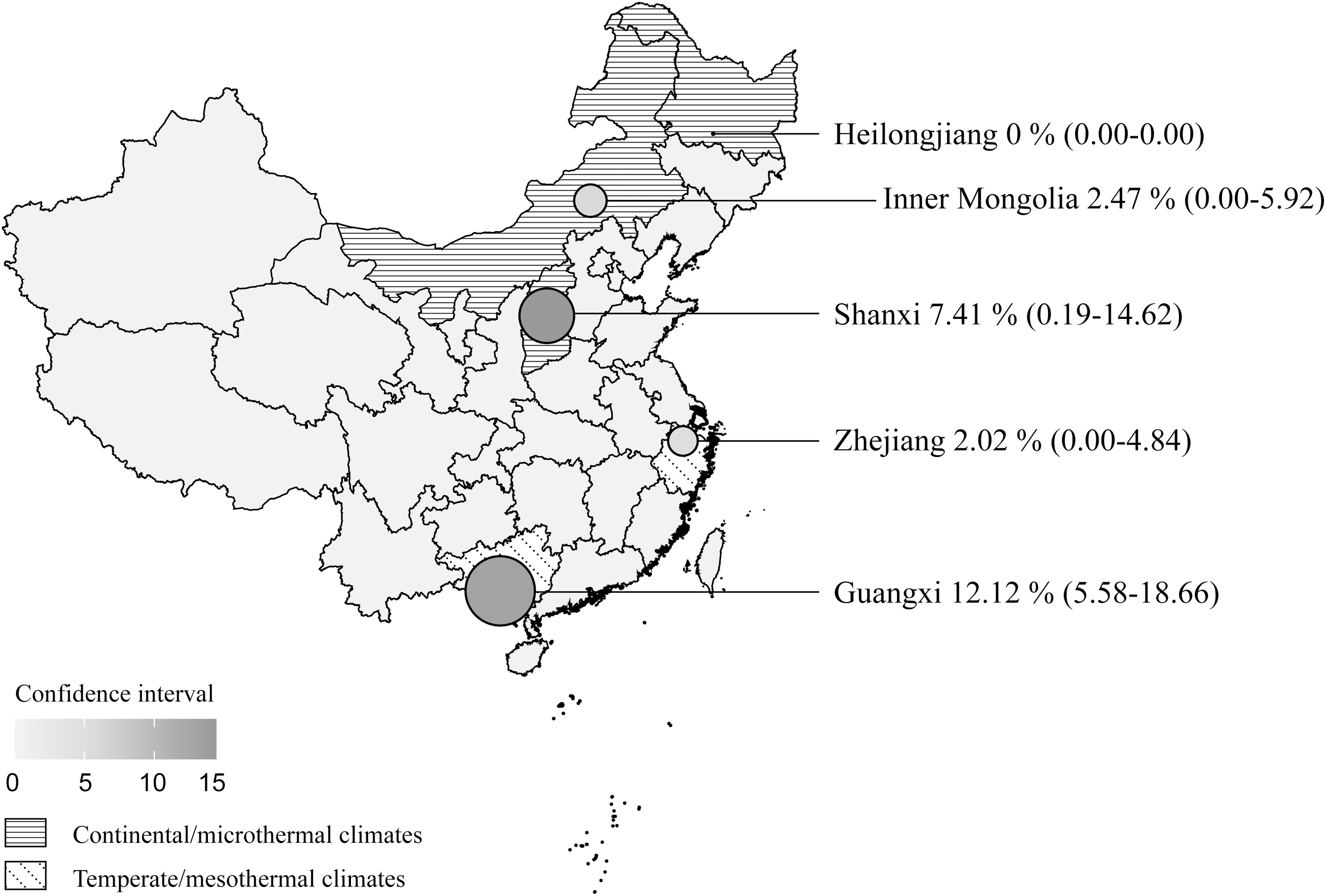
The prevalence of Toxoplasma gondii infection in wild rodents in all provinces, and division of climate. The gray gradient represents the range size of the confidence interval, and the bubble size is the prevalence of the area.
Prevalence and Risk Factors Related to Infection of Toxoplasma gondii in Wild Rodents from China
CI, confidence interval; OR, odds ratio.
In the five different species, including the C. dauricus, L. brandti, A. agrarius, R. norvegicus, and M. musculus, the highest prevalence was detected in the M. musculus (12.12%, 95% CI: 5.58–18.66%) than other types of wild rodents. Our results showed that the prevalence for sampling year gradually decreased over time, and the prevalence in 2017 was 12.12% (95% CI: 5.58–18.66%), and 3.25% (95% CI: 1.02–5.48%) in 2018, but with zero in 2019. Furthermore, the wild rodents sampled in 2017 had a more than fourfold increase risk (OR 4.10, 95% CI: 1.62–10.38), compared with the wild rodents sampled in 2018. According to our results, the difference in prevalence in the risk factors, region, species, seasons, and climate was not statistically significant, but the difference in sampling year was considered statistically significant (p = 0.0117).
Discussion
Although there are some studies on the detection of T. gondii in wild rodents in China, the prevalence of T. gondii infection in wild rodents in most areas of China is unknown in general. In this study, T. gondii was only detected in brain tissue from 20 of the 382 wild rodents, with the overall prevalence of 5.24% (95% CI: 2.99–7.48%), which was lower than that of previous studies in wild rodents that detected T. gondii by the PCR method, such as the prevalence of T. gondii infection in rodents in Yunnan Province with 6.13% (Wang et al. 2018), 12.5% in Qinghai (Zhang et al. 2013), and 53.8% in Jilin (Zhang et al. 2014). It is also lower compared with northwest Iran (7.1%) (Nazari et al. 2019), but was higher than the study from the Istria (Ivovic et al. 2019) (2.94%) and Bangladesh (3.4%) (Krijger et al. 2019). These regional differences perhaps result from multiple factors (Bastiaan et al. 2009), but these data indicated that Toxoplasma was widely distributed and had a high prevalence rate among wild rodents in China.
Differences among the regions sampled were marginally significant (p = 0.0546), with higher odds of infection in wild rodents in Guangxi than the reference region, Zhejiang. At the same time, our results showed that the prevalence was higher in the temperate/mesothermal climate group than in the continental/microthermal climate group, although the difference was not statistically significant (p = 0.1029). The harvesting site in Guangxi located in the temperate/mesothermal climate zone with warm and humid environment, characterized with high temperature and rain, provides favorable conditions for Toxoplasma oocyst sporulation and survival to promote transmission of Toxoplasma (Smith and Frenkel 1995), which has been confirmed in domestic animals (Tagwireyi et al. 2019). The sampling site in the northern region in the continental/microthermal climate zone, colder and drier than the sampling site in Guangxi, was not conducive to the survival of Toxoplasma oocysts (Bastiaan et al. 2009). There was a significant correlation between the sampling year and the infection prevalence of T. gondii in wild rodents. From the results of three consecutive years of sampling, the prevalence of T. gondii in wild rodents showed a decreasing trend per year. Even in 2019, all the samples were negative. However, the source of samples varies per year. Most of the samples collected in 2018 and 2019 were from the northern regions (Heilongjiang, Inner Mongolia, and Shanxi), except for some samples in 2017 from Guangxi Province, which perhaps lead to the prevalence rate in 2017 being significantly higher than 2018 and 2019. In addition, the differences in prevalence may also be related to host sensitivity and survival environment, which need to be further confirmed in future studies.
The results showed that there was possibly no significant correlation between T. gondii prevalence and wild rodent species (p = 0.0774), which were in accordance with previous studies performed in China (Yin et al. 2010, Yan et al. 2014). However, this may be due to the uneven distribution of species in the sampling site, with four out of five species sampled from only one region. Nonetheless, the prevalence in M. musculus infected with T. gondii was higher compared with other types of wild rodents. This was possibly because the habitat of M. musculus distribution overlaps the human habitat extensively. A study on goats (Garcia et al. 2012), which are also intermediate hosts of T. gondii, found that the incidence of goat infection was higher in some areas due to nearby human settlements perhaps or that intensive farming increased the exposure to cats and rodents. Also, rural areas tend to be denser with cats, which are used to control rodents and pests. As a result, rodents living closer to these areas may be more likely to be exposed to T. gondii. In the vicinity of developed areas, cats are often kept as companion pets, and their exposure to rodents is low, making it difficult for them to circulate infection (Dubey et al. 2020). Notably, the samples from Inner Mongolia and Guangxi were taken from grasslands near rural areas with far from developed areas but still subject to human activity, making it impossible to estimate T. gondii infection in wild rodents in truly uninhabited terrestrial environments. We also found that the samples collected in winter had the higher prevalence than other seasons (summer and autumn), because rodents want to stay warm as much as possible in winter to manage to migrate to the residential area.
Moreover, the infection of T. gondii in L. brandti was the first detection in China and even worldwide. There were no positive samples in the investigated C. dauricus and A. agrarius. Two reasons perhaps explain this result. First, it might be due to the small-size sample to effect the research findings. Second, C. dauricus and A. agrarius are less susceptible or less exposed to T. gondii, and also the fact that there were few studies published regarding C. dauricus or A. agrarius infected by T. gondii in China, while Thomasson et al. (2011) have reported that A. sylvaticus were infected with T. gondii in Britain.
In conclusion, this is the report of T. gondii in wild rodents from four provinces of China and one autonomous region. Moreover, this is also the first demonstrated existence of T. gondii in L. brandti worldwide. Wild rodents circulate including wild and residential areas, and domestic and wild felines prey on them, playing an important role in the transmission of T. gondii among humans and other animals. Consequently, we should pay more attention to the significance of infection prevalence in wild rodents and take some measures to controlling wild rodents in general for reducing T. gondii infection in cats. Contact between wild cats and the human environment, or between domestic cats and wild rodents, should be worth getting attention to avoid transmission of Toxoplasma. Considering the distribution of wild rodents, further studies about investigating the prevalence in wild animals and food animals will be necessary.
Footnotes
Author Disclosure Statement
No conflicting financial interests exist.
Funding Information
This study was supported by the National Natural Science Foundation of China (grant no. 31902238), the State Key Laboratory of Veterinary Etiological Biology, Lanzhou Veterinary Research Institute, Chinese Academy of Agricultural Sciences (grant no. SKLVEB2019KFKT012).