




Abstract
This study was conducted to assess the presence of West Nile virus (WNV) in Kosovo by serological testing of apparently healthy local horses and free-range chicken, and it attempted to detect viral nucleic acid in birds and mosquitoes. Between January 2018 and June 2019, 260 equine serum samples were collected, additionally 580 adult mosquitoes (53 pools) were grouped in for genera, including Culex spp. (226 individuals; 26 pools), Aedes spp. (136 individuals; 16 pools), Anopheles spp. (184 individuals; 7 pools), and Culiseta spp. (34 individuals; 4 pools). Fifty domestic birds and 51 wild birds were collected from different regions of Kosovo. Equine and domestic bird serum samples were tested by flavivirus IgG enzyme-linked immunosorbent assay (ELISA), while mosquitoes and bird viscera were tested for WNV RNA by RT-qPCR. All ELISA-positive results were confirmed by plaque reduction neutralization test (PRNT) and eight by virus neutralization test. WNV antibodies were present in 27 out of 260 equine sera (10.38%) and one out of 50 samples in domestic birds by ELISA and PRNT. Eight of 27 positive equine serum samples with high titer neutralized WNV, but not Usutu virus. No WNV RNA was detected in birds or mosquitoes. The occurrence of WNV antibodies in local equines from all regions of Kosovo indicates that the virus is circulating within the country. Public health authorities should therefore plan a risk assessment and disease control program.
Introduction
West Nile virus (WNV) is an arthropod-borne virus of the Flaviviridae family with worldwide distribution (Calistri et al. 2010). In Europe, there were 4700 cases of West Nile fever (WNF) reported from 2011 to 2019, with the highest incidence of 1503 cases reported in 2018 (ECDC 2019). Since 1999, WNF has caused over 37,000 reported cases in North America. WNV was initially detected in Africa and has spread to other continents (Roehrig 2013, Sule et al. 2018). The natural cycle of infection involves many species of birds and mosquitoes. Globally, WNV has been detected in more than 300 bird species, while viral nucleic acid has been detected in 75 species of mosquitoes (Medlock et al. 2005). In Europe, these are predominantly mosquitoes from the genus Culex, where Cx. pipiens is considered to be the most important vector for WNV (Vogels et al. 2017). Birds are the natural reservoir of the virus, serving as amplifying hosts, while humans and horses are considered accidental or dead-end hosts (Komar 2000). WNV infection is often asymptomatic in humans and equines, with ∼20% of human cases showing febrile syndrome, and neuroinvasive disease in <1% of patients (Campbell et al. 2002).
While up to nine genetic lineages of WNV have been identified, lineage 1 and 2 are both circulating in Europe and appear to have significant medical importance (Pachler et al. 2014). Over the past 50 years, lineage 1 was responsible for human and equine WNF in the Mediterranean basin and was introduced into North America in 1999. WNV lineage 2 was first isolated in Hungary in 2004 and has since spread to neighboring countries, causing major outbreaks in 2010 and 2011 in Greece and Italy, respectively (Magurano et al. 2012, Hernández-Triana et al. 2014). Recent studies report that lineage 2 of WNV is endemic in Europe, including Balkan countries (Papa et al. 2011, Magurano et al. 2012, Bakonyi et al. 2013). Furthermore, WNV outbreaks have caused great concern for Europe's public health authorities (ECDC 2018, Haussig et al. 2018).
In Albania, WNV antibodies in humans were first detected in Europe in 1958 (Bardos et al. 1959), while in recent years in this country, only two human cases were recorded in 2011 (ECDC 2019). Since 2008, WNV from humans, equines, birds, and mosquitoes has been detected or isolated in many European countries. In Serbia, the first outbreak of human WNF was reported in 2012 with 69 reported and 41 clinically and laboratory confirmed cases. Also, in Greece, the first large outbreak of WNF was reported in 2010 with 262 infected people, and after that, seasonal outbreaks were detected annually up to the present time. Greece, Italy, and Serbia comprise the most affected countries in Europe (Danis et al. 2011, Popovic et al. 2014, ECDC 2019).
WNF cases in Kosovo were first reported in 2012, with four patients being confirmed clinically and in the laboratory. Between 2013 and 2015, 14 infected people were identified (Dreshaj et al. 2018). The latest outbreak of WNF in Kosovo was in 2018, with 14 human cases, including three deaths (ECDC 2019).
No WNV infections have been documented in animals in Kosovo yet. Data about WNV infection in animals and mosquitoes are lacking in Kosovo. In the first study carried out in the country in 2010, 29 equine serum samples were serologically tested and no WNV antibodies were found (Berxholi et al. 2013). In the same study, antibodies were found in 22% of horses in neighboring Albania, although no antibodies were found in birds (Berxholi et al. 2013). Culex pipiens has been found to be the most widespread species of mosquitoes in Kosovo, representing around 40% of the distribution of 13 identified species in the country (Muja-Bajraktari et al. 2019).
The aim of this study was to investigate the presence of WNV in horses, mosquitoes, and birds in Kosovo.
Materials and Methods
Equine sampling
Equine sera
Two hundred sixty equine blood samples (251 horses, 7 donkeys, and 2 mules; mean age = 10.9 years, range = 1–32 years) were collected from seven regions of Kosovo between January and September 2018: Prishtina n = 32, Mitrovica n = 28, Peja n = 25, Prizren n = 47, Gjakova n = 12, Ferizaj n = 50, and Gjilan, n = 66 (Fig. 1). The samples originated from 177 different animal farms. Individual animals were sampled once and the proximity of sampling sites to wetland areas ranged between 1 and 10 km. There are 2353 equines in Kosovo (Report of Kosovo Agency of Statistics, 2017). Blood samples were collected randomly from healthy horses with no history of West Nile neuroinvasive disease, taken from jugular vein from local veterinarians. Sera were kept at −20°C until use.
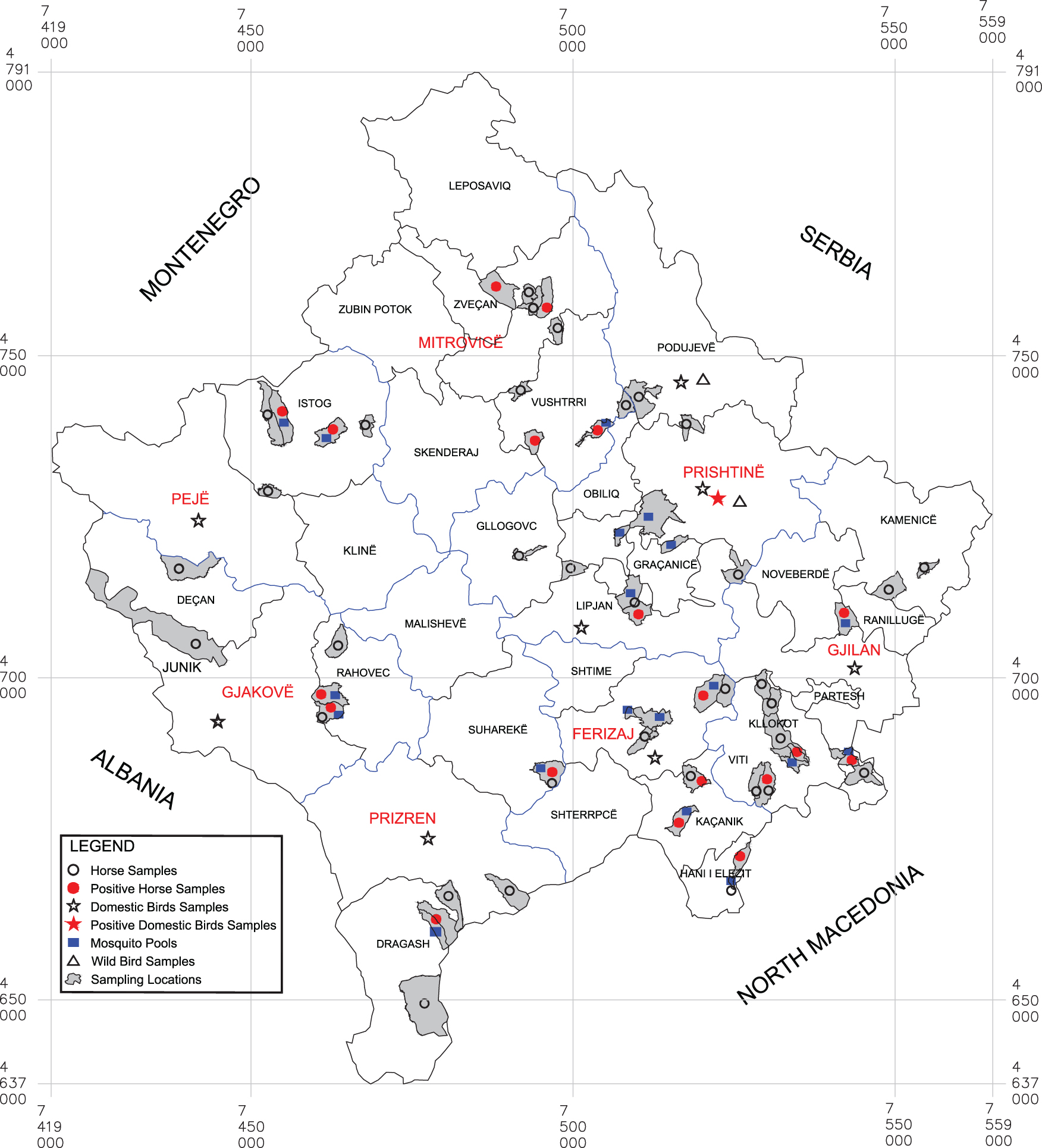
Geographical serosurveillance of equines and birds for West Nile virus in Kosovo. Color images are available online.
Bird sampling
Fifty sera of domestic birds (backyard chickens) were collected between June and October 2019. The chickens aged from 1 to 3 years were purchased from free-range farms and kept outdoors. After slaughtering, 5 mL blood was collected from each animal, while 5 g of viscera tissues from the brain, liver, heart, kidney, and lungs were pooled and stored at −80°C freezer. Blood samples (sera) were kept at −20°C until use, and they were performed only for serological testing. In addition, 51 wild bird samples from the Corvidae family were collected randomly, such as Hooded crow (Corvus corone) 2 samples, Jackdaw (Corvus monedula) 9 samples, and Raven (Corvus corax) 40 samples, as they were found dead by hunters and stored in −20°C freezer. The carcasses were collected freshly dead. Viscera from each bird (brain, liver, heart, kidney, and lungs) were pooled and stored at −80°C.
Mosquito sampling
Mosquito samples were collected in the period from June to October 2019, from the 27 farms of the equine samples, in locations where seropositive WNV cases in horses were detected. The number of sampling was once per farm. Collections were made using an Insect Monitoring Trap (“Genicco srl,” Italy) with dry ice. In total, 27 sites were selected, in which four traps were used, and they were placed overnight. Upon recovery from the traps, adult specimens were morphologically identified under binocular stereomicroscope to genus level based on main morphological characteristics using interactive identification keys for mosquitoes of the Euro-Mediterranean Region (Gunay et al. 2017). After the morphological identification of mosquitoes on the same day of collection, specimens were stored immediately at −20°C for 1 week and after that at −80°C. A total of 580 mosquitoes were collected and 5–30 individuals were pooled according to their genera and collection sites before RT-PCR screening. Pools included Culex spp. (226 individuals; 26 pools), Aedes spp. (136 individuals; 16 pools), Anopheles spp. (184 individuals; 7 pools), and Culiseta spp. (34 individuals; 4 pools). The sampling period coincided with the peak activity period for these mosquito species.
Serological testing
Enzyme-linked immunosorbent assay
Sera were tested for WNV-reactive antibodies using a commercially available enzyme-linked immunosorbent assay (ELISA)-blocking enzyme immunoassay, which allowed recognition of WNV-IgG-antibodies (INGEZIM west Nile COMPAC, Madrid, Spain). The kit is designed to detect specific antibodies for WNV. The kit is able to detect a very low titter of antibodies in sera of different infected animal species (birds, horses, humans, etc.). The INGEZIM West Nile COMPAC kit is based on the blocking enzyme immunoassay described below: The plates are coated with inactivated viral antigen. After adding the sample to the well, if it contains specific antibodies against WNV, they will bind to the antigen absorbed on plate, while if the sample does not contain specific antibodies, they will not bind to the antigen. ELISA was performed according to the manufacturer's instructions.
Plaque reduction neutralization test
All ELISA-positive serum samples were then subjected to plaque reduction neutralization test (PRNT) to confirm the presence of virus-specific antibodies. The test was performed on twofold dilutions of the serum samples (starting from 1:20 to 1:80) against a 100 pfu/100 μL diluted NY99 (lineage 1) strain of the WNV on Vero cells (ATCC CCL81). Serum samples blocking 90% of plaque occurrence were considered positive for WNV-specific antibodies.
Virus neutralization test
Eight ELISA- and PRNT-positive horse sera were then confirmed by virus neutralization test (VNT), with neutralizing antibody titers from 1:320 to 1:1280, using WNV strain NY99 and Usutu virus (USUV) strain 1477 on Vero E6 cells (Gabriel et al. 2013). Eight sera samples with high titer in ELISA and PRNT were selected for testing in VNT to exclude USUV.
RT-qPCR testing
RNA extraction from mosquito and bird organs: the mosquito pools (5–30 individuals) and 0.5 g of bird organ (0.1 g of brain, lung, heart, kidney, and lungs) were placed in a 2 mL Eppendorf tube containing three to five steel beads (7 mm; Qiagen, Hilden, Germany), frozen on liquid nitrogen and directly pulverized in a Tissue-Lyser LT (Qiagen) with a −20°C precooled rotor at 50 Hz for 2–5 min. Repeated freezing and lysis was necessary in some cases. Pulverization and homogenization of tissue samples did not occur uniformly, so freezing in liquid nitrogen and lysis in the TissueLyser had to be repeated. The samples were then resuspended in 300–500 μL phosphate-buffered saline (depending on tissue size) containing 500 IU/mL penicillin, 10% fetal calf serum, and 500 μg/mL amphotericin, and centrifuged at 2000g. Viral RNA extraction was done with QIAamp® Viral RNA Mini Kit (Qiagen) according to the manufacturer's instructions.
RT-qPCR: 25 μL of each sample extraction was tested using RealStar® WNV RT-PCR Kit 1.0 (Altona Diagnostics, Hamburg, Germany) for the detection of WNV RNA, according to the manufacturer's instructions.
Results
Of the 260 equine serum samples, 10.38% (27 out of 260) reacted in the antibody-ELISA of WNV. All 27 samples were tested with PRNT and titers ranged from 1:20 to 1:80. Samples testing positive from both the ELISA and PRNT were considered as positive for WNV-specific antibodies. Eight of 27 high titer samples, neutralized WNV, but not USUV by VNT.
The results revealed that WNV-seropositive horses are widespread in Kosovo. WNV antibodies were detected in horses from all seven regions with different seroprevalence rates. The highest rate was in Peja 20.00% (5/25), followed by Mitrovica 17.86% (5/28), Gjakove 16.67% (2/12), Ferizaj 10% (5/50), Gjilan 9.09% (6/66), Prizren 6.38% (3/47), and Prishtina 3.13% (1/32). No positive samples were detected from donkeys or mules.
One domestic bird (2%) resulted positive for WNV antibodies out of 50 chickens tested, near to Kosovo's capital city, Prishtina (Table 1).
Results for West Nile Virus in Equines, Birds, and Mosquitoes in Kosovo
VNT—8 of 27 high titer samples, neutralized WNV, but not USUV.
ELISA, enzyme-linked immunosorbent assay; PRNT, plaque reduction neutralization test; USUV, Usutu virus; VNT, virus neutralization test; WNV, West Nile virus.
The most abundant mosquito genus trapped close to WNV-positive locations for equines was Culex spp. (in 21 out of 27 locations), representing 36% of all mosquito genera identified within this study. However, no WNV-RNA was detected by WNV-specific RT-qPCR (Fig. 1).
None of the 51 wild birds or 50 domestic birds was positive for viral RNA by RT-qPCR.
Discussion
This study provides the first report of WNV seropositivity in equines and birds in Kosovo. The wide distribution of WNV antibodies in local equines from all regions of Kosovo indicates that the virus is already circulating within the country. A study in Kosovo from 2010 detected no antibody response to WNV infection in serum samples collected from 29 horses (Berxholi et al. 2013). However, this was most likely due to the small sample size.
Surveys from neighboring countries have detected the following WNV infection rates in healthy equines: Croatia 0.41% (2007), Serbia 12% (2009/10), and Albania 22% (2010) (Madić et al. 2007, Lupulović et al. 2011, Berxholi et al. 2013). In a study conducted in northern Serbia in the year 2007–2011 with 252 equine serum samples, a seropositivity rate of 28.6% was found (Medić et al. 2014).
WNV appears to have been introduced into Kosovo between 2008 and 2012, with the first reported human cases in 2012, when four patients were confirmed by laboratory tests, and no data on the history of traveling abroad have been reported (Dreshaj et al. 2018).
Kosovo's most abundant mosquito species is Culex pipiens of the 13 identified species in the country (Muja-Bajraktari et al. 2019). In our study, it was also found to be and also widely distributed (36% of sample sites), including the sample sites, in horses that tested positive for WNV antibodies. Our survey did not detect viral genomic RNA by RT-qPCR, perhaps due to the small sample size for mosquitoes and birds.
Further surveillance studies in vectors and animals are thus necessary to determine the WNV lineages that circulate among birds and mosquitoes to more thoroughly assess the risk for humans and animals.
Conclusions
This report provides the first evidence of WNV antibodies among local equines and birds in Kosovo. The most predominant mosquito genus in the country sampled near equine farms was Culex spp. The occurrence of WNV in Kosovo is a serious concern for public health authorities in planning their strategies for disease prevention and control.
Footnotes
Acknowledgments
The authors are grateful to local Kosovan Veterinarian Veton Haziri and Dr. Sabri Hacioglu from the Ankara University.
Author Disclosure Statement
No conflicting financial interests exist.
Funding Information
This work was supported by a grant from the Ministry of Education, Science and Technology of Kosovo (project no. 2-3970-2).