




Abstract

Social isolation has been implemented in many countries around the world to reduce the impact of COVID-19 during the 2020 pandemic. Although, this measure is critical in preventing the spread of the virus, the initiative has lead to rodent-human behavioral changes, resulting in health, economic and social impacts (Corburn et al., 2020; Heymann & Shindo, 2020; Battersby et al., 2008). Globally, an increase in rodent-related problems has been reported in various media outlets by experts during the pandemic. In low and middle income countries (LMIC) such as Brazil, where a large proportion of urban residents live in slum communities, with substandard water, sanitation, and hygiene coverage, social isolation seems to have provided an ecological opportunity for rodents' expansion, and any increase in the population of rodents during the social isolation could aggravate the risk of zoonoses among vulnerable residents, since rodents are reservoirs of several zoonotic diseases (Battersby 2015).
We collected data on rat sightings from consenting participants during home visits in a slum community-based longitudinal study on urban leptospirosis in Salvador, Brazil. Participants were interviewed over more than two years in three biannual follow-ups. Then, out of the 287 residents participating in the cohort during 2018–2019, 46 answered the same questionnaire through an instant messaging application three months after the commencement of social isolation (June 2020) (Fig. 1). Their responses were included in a mixed effects model to compare the number of rat sightings at different time periods. These periods were grouped as 18 months, 12 months, and 5 months before COVID-19, plus the COVID-19 sample, which was temporally equivalent to the first pre-COVID sample. Rat sightings were 123, 128, 114 (all pre-COVID), and 156, respectively. The perceived increase in the number of rats seen by residents during the social isolation, representing 1.27 (CI: 1.00–1.60) in the number of rats sightings, the most among the different time periods (before and during COVID-19) in Brazil (Fig. 1). There was, however, no difference in the proportion of people who saw rats across the periods.
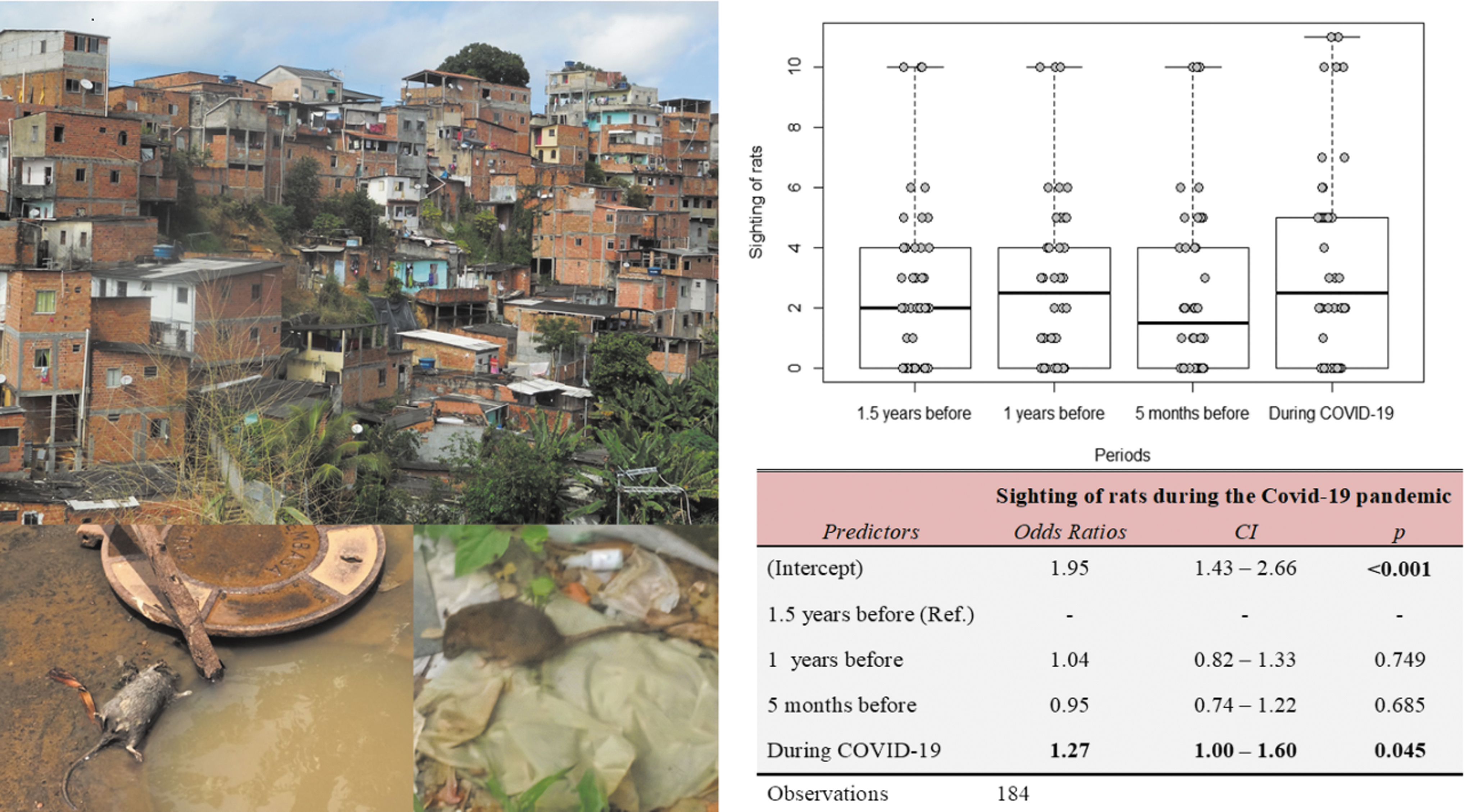
Distribution of the number of sighted rats among residents of an urban community in Brazil (Sanitary District of Pau da Lima. Salvador-Brazil) and the effect of social isolation during the COVID-19 pandemic on the sighting of rats inside urban slum spaces.
The closing of trade, reduced trash collection (that was already precarious), and an increase in the number of residents living in small spaces may all have contributed to the increase in the accumulation of garbage, a source of food for rodents. The increase in rat activity may in turn increase residents' exposure and susceptibility to diseases, for example toxoplasmosis, leptospirosis, salmonellosis, diarrhea and viruses like haemorrhagic fever with pulmonary syndrome, haemorrhagic fever with renal syndrome, lassa fever among others through elevated rodent-human contact and subsequent disease transmission. In a similar vein, social isolation is coinciding with arbovirus epidemics in the same city, suggesting environmental changes and human behavioral changes that may influence both vectors and reservoirs of disease (Ribeiro et al. 2020).
The COVID-19 pandemic has brought about changes in human behavior likewise increase in inequality and vulnerability of residents in poor urban communities. Above all, the health authorities have to target multiple efforts that go beyond control actions for the prevention of COVID-19, since these populations live in a scenario of increased exposure and risk to multiple diseases in this pandemic.