




Abstract
Chlamydia bovis is a widespread infection disease caused by the mixed infection of Chlamydia psittaci, Chlamydia pecorum, Chlamydia abortus, and Chlamydia suis in cattle. Although many studies have investigated Chlamydia infection in cattle, there is no nationwide study on the prevalence of Chlamydia infection in cattle of China. We constructed the first meta-analysis to assess the infection rate and infection risk factors of Chlamydia in cattle in China, and we searched PubMed, ScienceDirect, Chinese Web of Knowledge, Wanfang, and VIP Chinese journal database for studies reporting Chlamydia infection in cattle from April 29, 2020. We collected a total of 563 publications from 1989 to 2019, and finally, 78 studies were eligible, which included 152,364 cattle from 27 provinces across the country. We estimated the pooled prevalence of Chlamydia in cattle was 14.2% (95% confidence interval [CI]: 12.2 to 16.4). The prevalence of bovine Chlamydia in China collected before 2000 (14.8%, 95% CI: 5.6 to 27.3) showed the highest prevalence rate. The highest prevalence was found in Central China (22.6%, 95% CI: 12.8 to 34.2). The prevalence of Chlamydia spp. between abortion cattle (39.1%, 95% CI: 24.6 to 54.6) and healthy cattle (8.3%, 95% CI: 3.1 to 15.2) showed significant variation (p < 0.05). In detection methods subgroup, enzyme-linked immunosorbent assay (30.5%, 95% CI: 21.5 to 40.3) showed the highest prevalence. In the age subgroup, the prevalence rate of age >1 year (16.6%, 95% CI: 12.6 to 20.9) was higher compared with age ≤1 year (9.8%, 95% CI: 6.7 to 13.3). Yaks (17.8%, 95% CI: 13.3 to 22.8) showed the highest Chlamydia prevalence among the varieties of bovine. We also estimated the potential risk factors such as feeding model, sample classification, sampling seasons, bovine gender, parity, and quality level of included studies. Our findings suggested that Chlamydia was prevalent in cattle in China. So we should pay attention to bovine Chlamydia and take necessary measures to prevent it.
Introduction
Chlamydia is a Gram-negative pathogen (De Puysseleyr et al. 2014), that can cause a wide range of diseases in animals and humans (Reinhold et al. 2010, Rohde et al. 2010, Hulin et al. 2015). The family Chlamydiaceae currently contains the single genus Chlamydia, which includes 11 recognized species, namely Chlamydia trachomatis, Chlamydia suis, Chlamydia muridarum, Chlamydia pneumoniae, Chlamydia abortus, Chlamydia caviae, Chlamydia felis, Chlamydia pecorum, Chlamydia psittaci, Chlamydia avium, and Chlamydia gallinacea (Sachse et al. 2015).
Chlamydia is a microorganism that is different from bacteria and viruses with a unique biphasic development cycle (Yin et al. 2013). It does not have the ability to synthesize high-energy compounds ATP and GTP, and must be provided by the host cell. Chlamydia has two types of nucleic acids, which are DNA and RNA. It can parasitize in eukaryotic cells through a cell filter. People can be infected with C. pneumoniae, C. trachomatis, and C. psittaci, which can cause pneumonia, trachoma, myocarditis, and so on. Chlamydia infection in cattle is a mixed infection usually, mainly C. psittaci, C. pecorum, C. abortus, and C. suis (Reinhold et al. 2011).
Chlamydia infection in female cattle often manifests abortion, endometritis, infertility, vaginitis, and weak fetus (Cavirani et al. 2001, Jee et al. 2004, Longbottom. 2004, Kaltenboeck et al. 2005). The clinical symptoms of male cattle are epididymitis, seminal vesicle adenitis, orchiatrophy, and decrease in sperm quality (Storz et al. 1968, Amin 2003). Reproductive disorders are a very serious problem for animal husbandry worldwide (Softic et al. 2018). The research presents confirmation of the presence of DNA from various species of Chlamydiaceae in the reproductive disorders of cattle in Argentina (Rojas et al. 2018).
In Italy, the prevalence of Chlamydia in cattle with reproductive problems is significantly higher (Cavirani et al. 2001). Cattle are infected with Chlamydia due to many factors, such as management issues or various environmental factors, which may cause cattle to get sick (Anstey et al. 2019). Several risk factors have been identified in Germany, including hygiene of the milking parlor, walkways, and cows. (Kemmerling et al. 2009). Recently, Chlamydia infection in cattle has been reported in many countries such as United Kingdom, Sweden, Germany, Jordan, Ireland, Switzerland, Argentina, India, Slovak Republic and Poland, and China. This is a major issue for China and the world with Chlamydia in cattle.
Now China has become a major animal husbandry country and exports meat and dairy products to the world (Yin et al. 2013). However, the infection of cattle with Chlamydia causes huge losses to the Chinese economy (Zhao 2015). There are many reports of yak infection with Chlamydia in Qinghai Province, China (Kong et al. 2012, Li et al. 2013). In some areas of Guangxi, there are reports about Chlamydia infection in buffalo (Hu 2016).
To our knowledge, there is no research on Chinese cattle infected with Chlamydia systematic assessment until this moment. Therefore, we conducted the first meta-analysis to assess the prevalence of Chlamydia in cattle in China, and analyzed the potential risk factors (Region, Sampling years, Variety, Breeding mode, Detection method, Sample, Season, Gender, Age, Abortion, and Quality level). Our research can help prevent and control Chlamydia infection in Chinese cattle and reduce the public health hazards of Chlamydia.
Materials and Methods
Search strategy and selection criteria
We searched the PubMed, ScienceDirect, Chinese Web of Knowledge, Wanfang, and VIP Chinese journal database for studies reporting Chlamydia infection in cattle from April 29, 2020. We aimed to screen and obtain all English or Chinese articles about the prevalence of Chlamydia in cattle in China.
In the PubMed database, the Boolean operator “AND” was used to connect the theme words, and the Boolean operator “OR” was used to connect the Entry Terms. We used the MeSH word “cattle” [Mesh] and the Entry Terms “Bos indicus,” “zebu,” “zebus,” “Bos Taurus,” “Cow, Domestic,” “Cows, Domestic,” “Domestic Cow,” “Domestic Cows,” “Bos grunniens,” “Yak,” and “Yaks” constitute the retrieval formula A:
(((((((((((“Cattle”[Mesh]) OR Bos indicus) OR Zebu) OR Zebus) OR Bos taurus) OR Cow, Domestic) OR Cow, Domestics) OR Domestic Cow) OR Domestic Cows) OR Bos grunniens) OR Yak) OR Yaks
The MeSH word “Chlamydia” [Mesh] constitutes the retrieval formula B (no Entry Terms in MeSH in PubMed):
“Chlamydia” [Mesh]
The MeSH word “China” [Mesh] and “People's Republic of China,” “Mainland China,” “Manchuria,” “Manchuria,” and “Inner Mongolia” constitute the retrieval formula C:
(((((“China” [Mesh]) OR People's Republic of China) OR Mainland China) OR Manchuria) OR Sinkiang) OR Inner Mongolia
Finally, the formulae A, B, and C were connected with the Boolean Operator “AND,” and the final search formula was
(((((((((((((“Cattle”[Mesh]) OR Bos indicus) OR Zebu) OR Zebus) OR Bos taurus) OR Cow, Domestic) OR Cow, Domestics) OR Domestic Cow) OR Domestic Cows) OR Bos grunniens) OR Yak) OR Yaks))
AND (“Chlamydia”[Mesh])
AND ((((((“China”[Mesh]) OR People's Republic of China) OR Mainland China) OR Manchuria) OR Sinkiang) OR Inner Mongolia)
In the ScienceDirect database, the keywords “Chlamydia,” “Cattle,” “prevalence,” and “China” were used to search.
The search terms “cattle” (in Chinese) and “Chlamydia” (in Chinese) were used for advanced search in the three Chinese databases. All the Chinese databases used fuzzy search and synonym expansion. All the retrieved citations were imported into Endnote X9 (version 9.3.3).
To select eligible studies, first, we excluded duplicate studies and review studies (not research articles). And then we used the following criteria: (1) the objects of the research must be cattle; (2) the purpose must be to study the prevalence of Chlamydia infection in cattle in China; (3) the study must include information on the number of examined cattle and the number of Chlamydia-positive cattle; and (4) the study design must be a cross-sectional study. We excluded the studies if they did not fulfill all these criteria. Duplicate studies and review studies (not research articles) were also excluded.
Data extraction and quality assessment
The four reviewers extracted the data separately. Any disagreement is decided by the author of this article. We extracted following information from all eligible studies about first author, publication year, sampling year, geographical region and province of the study, cattle variety, sample type, whether abortion, age, gender, season, diagnostic tests, farming mode, total number of examined cattle, and the number of Chlamydia-positive cattle. The database was established by Microsoft Excel (version 16.64).
We evaluated the quality of included publications accessed according to the criteria derived from the Grading of Recommendations Assessment, Development, and Evaluation method (Speich et al. 2016, Elliott and Cheetham 2019). The quality of the publications was graded using a scoring approach. If article satisfy following items, studies were awarded one point.
Whether or not sampling was random?
Were they accurately recording the sampling time?
Were they describing the sampling method in detail?
Were they clearly introducing the detection method?
Were there were four or more potential risk factors in the studies?
Studies with a score of 0 or 1 were identified as low quality, 2 or 3 points were marked as moderate quality, and 4 or 5 points were designated as high quality.
We conducted this meta-analysis of proportions in R v4.0.0, where the “meta” package (version 4.12-0) was used to estimate models (Wang 2018). According to previous research, we chose the double-arcsine transformation method for rate conversion to make the rate conform to the normal distribution (Table 1) (Barendregt et al. 2013, Li et al. 2020). For reporting, the transformed summary proportion and its confidence interval (CI) were converted back to proportions for ease of interpretation (Wang 2018).
Normal Distribution Test for the Normal Rate and the Different Conversion of the Normal Rate
NA, missing data; NaN, meaningless number; PAS, arcsine transformation; PFT, double-arcsine transformation; PLN, logarithmic conversion; PLOGIT, logit transformation; PRAW, original rate.
High heterogeneity can be expected in the prevalence of meta-analysis. Therefore, we hypothesized that the random-effects model was used for combination of total effect quantity and subgroup analysis. We predicted the heterogeneity and quantified the variations using the I 2 and Cochrane Q statistics (expressed in χ2 and p values). The I 2 values corresponding to low, medium, and high degree of heterogeneity were 25%, 50%, and 75%, respectively. The visualized statistical results of meta-analysis were represented by forest plots. The funnel plot and Egger's test were used to detect publication bias, and sensitivity analysis was used to verify the stability of results. Subgroup analysis and single factor regression analysis were further used to analyze heterogeneity.
We conducted subgroup analysis stratified by the potential risk factors: the investigated factors included the region (northern China vs. other six regions), sampling year (2012 or later vs. 2000 or before and 2001–2011), detection method (enzyme-linked immunosorbent assay [ELISA] vs. indirect hemagglutination assay [IHA] and PCR), cattle variety (yak vs. buffalo, dairy cow, crossbreed cattle, yellow cattle, and others), farming mode (comparison of intensive farming with free range), season (spring vs. summer, autumn, and winter), gender (female vs. male), age (<1 year vs. ≥1 year), abortion (yes vs. no), and study quality (high vs. middle and low). The code of this meta-analysis in R software is present in Supplementary Table S1.
Results
Studies included
In this study, our searches identified 563 records. After removal of duplicates and initial screening, 111 studies were retained. Of these publications, 33 articles were excluded due to the following reasons: 2 were review articles, 10 used duplicate data, 14 were wrong data, 4 articles were with incomplete information, and 2 were unavailable for full articles. Finally, we used 78 studies to construct meta-analysis (Fig. 1). According to our quality criteria, 20 studies were high quality (4 or 5 points); 56 articles were moderate quality (2 or 3 points), and 2 articles were low quality (0 to 1 point) (Table 2 and Supplementary Table S3).
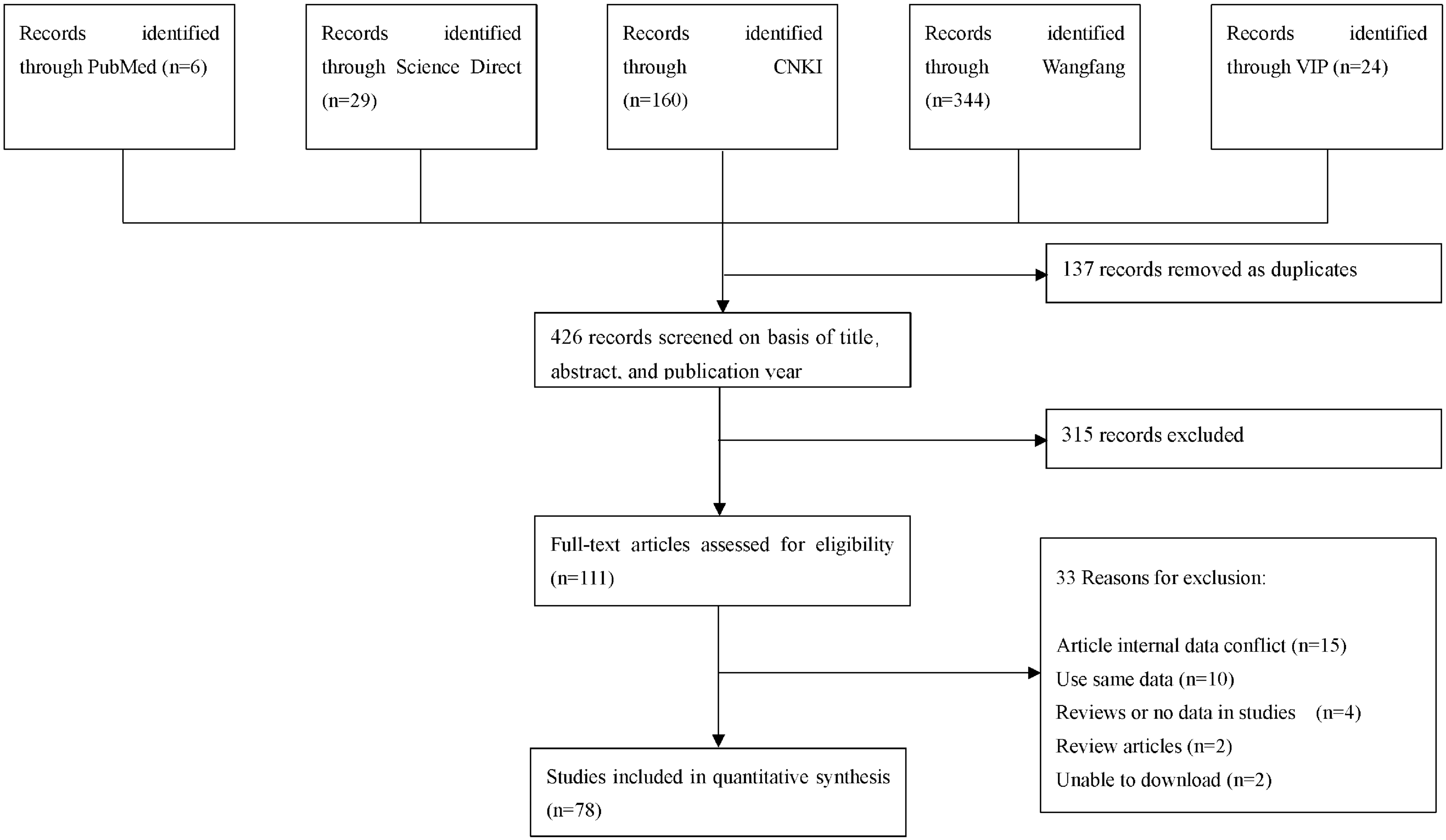
Flow diagram of eligible studies for searching and selecting.
Included Studies of Chlamydia Infection of Cattle in Mainland China
ELISA*, enzyme-linked immunosorbent assay; IHA*, indirect hemagglutination assay; PCR*, polymerase chain reaction; UN*, unclear.
We performed four positive transformations on all included article data (Table 1). According to the results, the conversion results of arcsine transformation and “PFT” may be closer to the normal distribution and PFT can stabilize the variance more effectively. Finally, we chose the combination result of “PFT” conversion for meta-analysis (Ding et al. 2017).
Publication bias
According to the strong heterogeneity (χ2 = 7675.36, I 2 = 99.0%, p = 0.00), the random-effects model should be used in this meta-analysis (Fig. 2). The funnel plot indicated that there was publication bias or heterogeneity in the study (Fig. 3). The results of Egger's test (t = 3.74, p < 0.05) (Supplementary Table S2) showed that there was existence of publication bias in the studies (Fig. 4). We did not conduct a trim and fill to test the sensitivity of our study because there was a small-study effect bias in the included studies and it would lead to the result being unstable. Sensitivity analysis showed that when a study is omitted, the results did not change, and indicated our meta-analysis is stable and reliable (Fig. 5).

Forest plot of prevalence of Chlamydia in cattle among studies conducted in China.

Funnel plot with pseudo 95% confidence interval limits for the examination of publication bias.
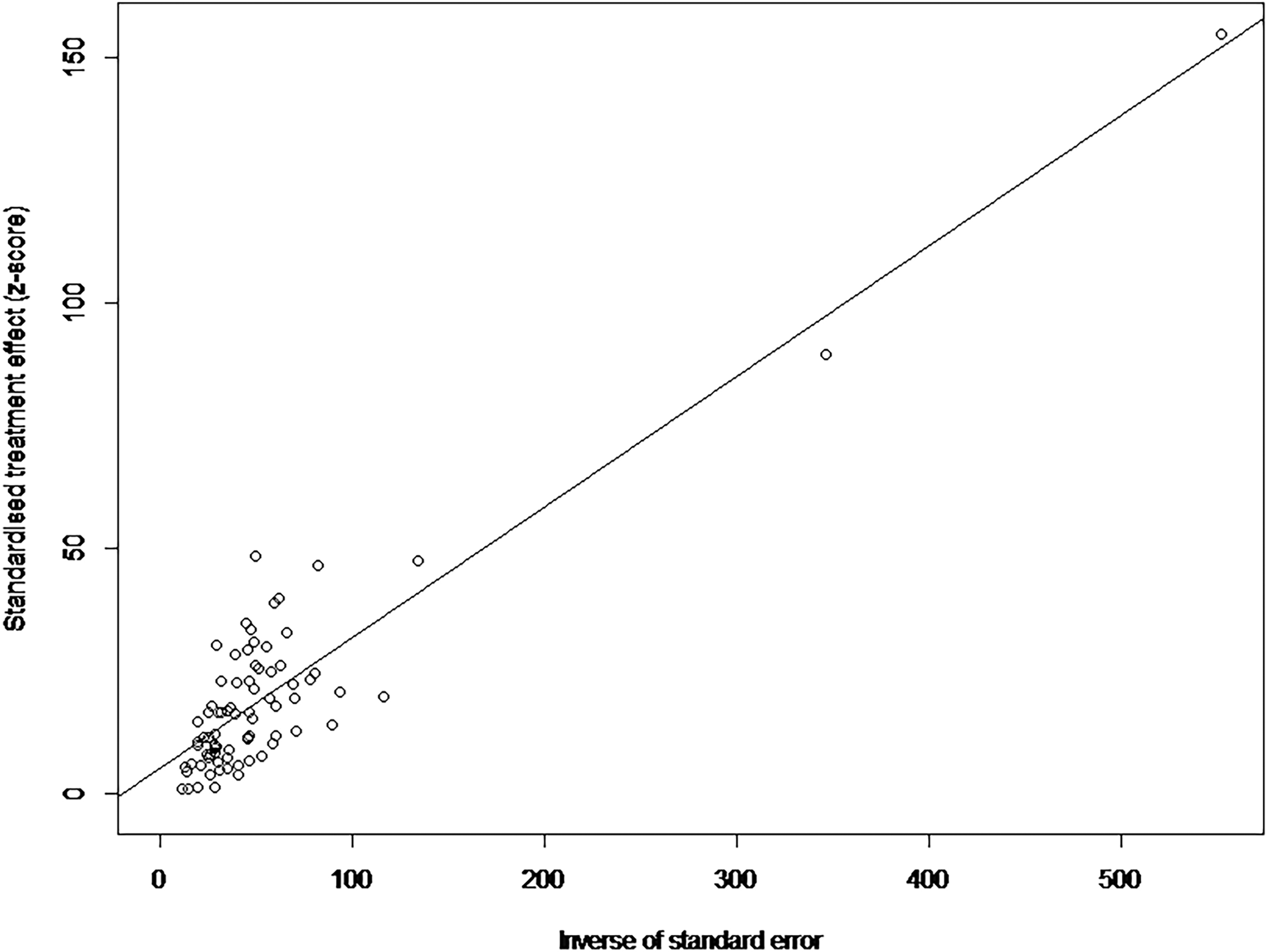
Egger's test for publication bias.
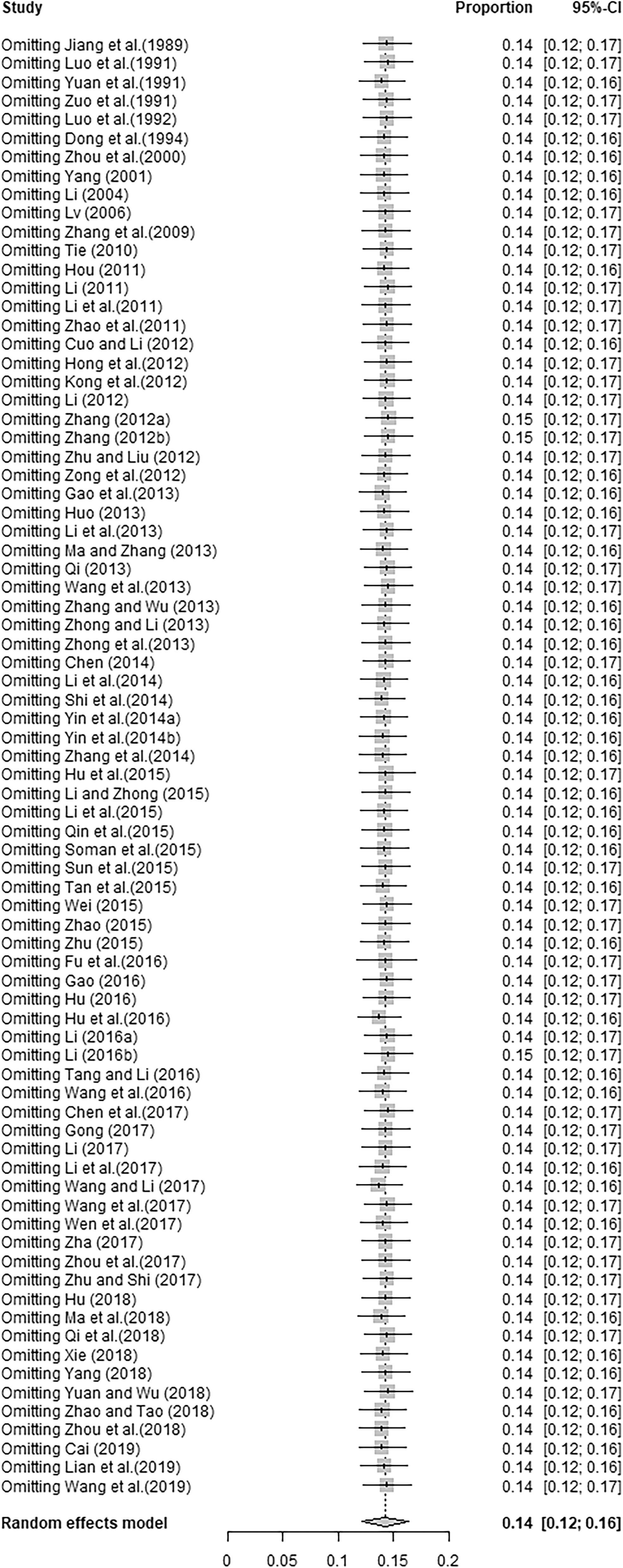
Sensitivity analysis.
Pooling estimates and potential risk factors
We conducted a survey of 152,364 cattle in 7 regions and 27 provinces in China. The results showed that the combined prevalence of Chlamydia was 14.2% (95% CI: 12.2 to 16.4; 14,671/152,364) (Fig. 2 and Table 2). In terms of geographical region, the highest prevalence of Chlamydia in Central China was 22.6% (650/3520) and the lowest in East China was 5.0% (247/2536), and the difference is statistically significant (p < 0.05). The pooled prevalence of Chlamydia in different provinces was various, the results showed that the highest, 44.2% (95% CI: 39.2 to 49.2), in Hubei province, and the lowest 0.0% (95% CI: 0.0 to 1.0) in Yunnan province and 0.0% (95% CI: 0.0 to 6.8) in Fujian province (Fig. 6 and Table 4).
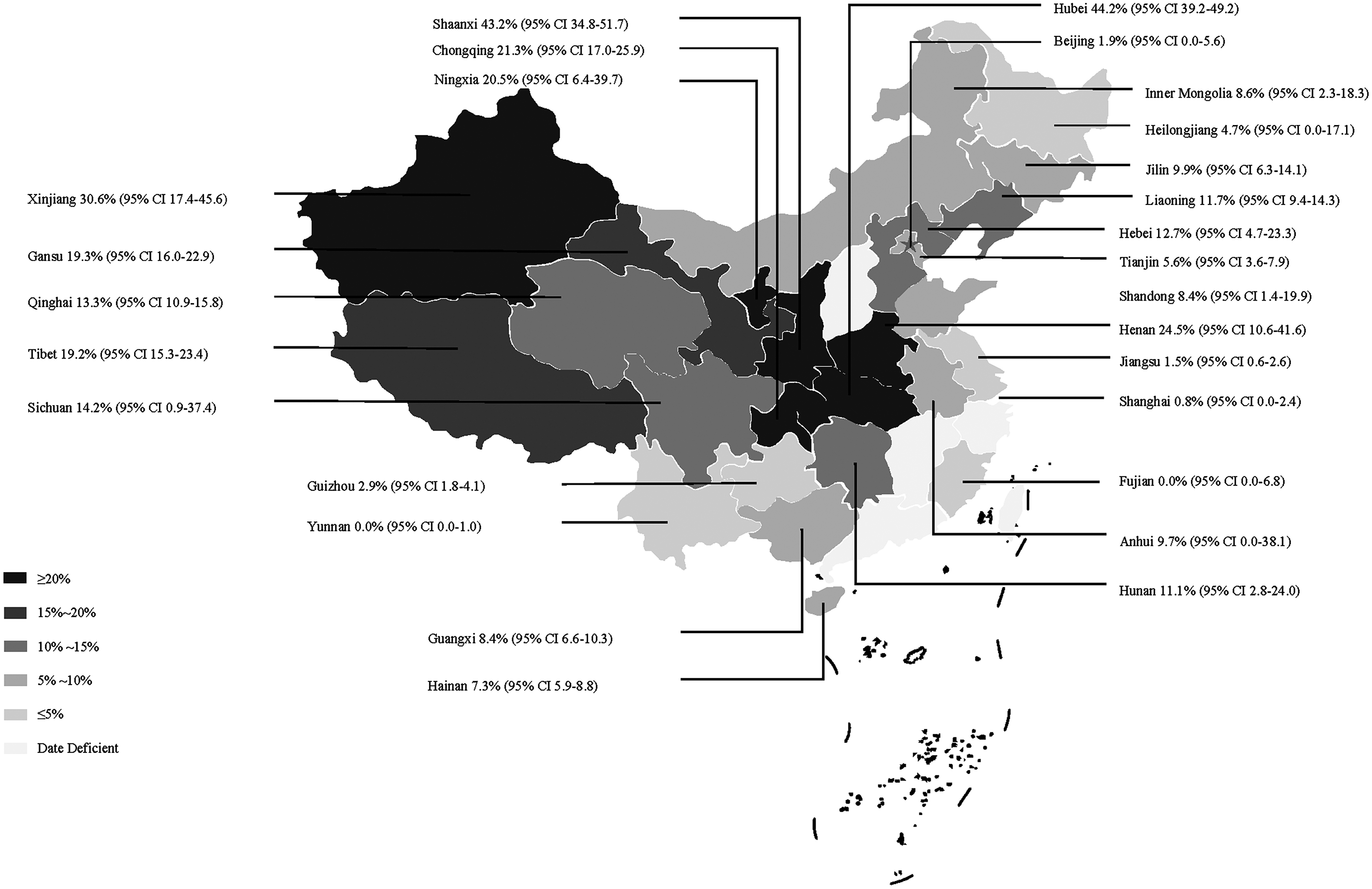
Map of Chlamydia in cattle among studies conducted in China.
The pooled Chlamydia prevalence was 14.8% (95% CI: 5.6 to 27.3, 511/3040) in cattle collected before 2000 group, 4.1% (95% CI: 2.8 to 5.7, 434/13,106) in 2001–2010 group, and 11.8% (95% CI: 10.3 to 13.5, 12,041/128,186) in cattle collected after 2011 group (Table 3). The pooled Chlamydia had the highest prevalence of 17.8% (95% CI: 13.3 to 22.8; 8449/91,929) in yak, and the lowest prevalence of 1.4% (95% CI: 0.0 to 4.4; 13/553) in others, which result in different species significant variation (p < 0.05) (Table 3). The prevalence of Chlamydia investigated by ELISA was higher (29.4%, 95% CI: 19.2 to 40.7; 951/3431) than other detection methods (Table 3). Abortion cattle (39.1%, 95% CI: 24.6 to 54.6; 779/2013) showed a higher pooled prevalence of Chlamydia than health cattle (8.3%, 95% CI: 3.1 to 15.2; 414/4342) (Table 3).
Pooled Prevalence of Chlamydia in Cattle of Mainland China
Central China: Henan, Hubei, Hunan; Eastern China: Anhui, Fujian, Jiangsu, Shandong, Shanghai,; Northeastern China: Heilongjiang, Jilin, Liaoning; Northern China: Beijing, Hebei, Inner Mongolia, Tianjin; Northwestern China: Gansu, Ningxia, Qinghai, Shaanxi, Xinjiang; Southern China: Guangxi, Hainan; Southwestern China: Chongqing, Guizhou, Sichuan, Tibet, Yunnan.
Spring: March to May; Summer: June to August; Autumn: September to November; Winter: December to February.
CI, confidence interval.
Regression analysis showed that the region, sampling time, cattle variety, detection method, physical condition, and quality score subgroup might be the main sources of heterogeneity (p < 0.05).
Discussion
At present, Chlamydia is still a serious zoonotic disease (Bandyopadhyay et al. 2009). Since the discovery of Chlamydia, its existence is reported all over the world which shows that Chlamydia has various degrees of infection worldwide (Wu 2013). It is one of the most important reasons that result in economic losses in animal husbandry (Vidal et al. 2017). Therefore, we built this first meta-analysis of bovine Chlamydia prevalence in China.
The results of this study may provide people with some measures to control the prevalence of Chlamydia in cattle, thereby reducing the economic losses of animal husbandry. In the study, a total of 152,364 cattle were tested, of which 14,671 cattle were infected with Chlamydia, from 78 articles in 1989 to 2019. The overall pooled prevalence of Chlamydia in cattle was 14.2% (95% CI: 12.2 to 16.4), which was lower than that in Australia (80%) (Jelocnik et al. 2019) and Zimbabwe (32.3%) (Ndengu et al. 2018).
According to our results, the prevalence of Chlamydia was significant differences in different region (p < 0.05). Chlamydia prevalence was higher in Hubei, Shaanxi, and Xinjiang, and lower in Fujian, Shanghai, and Yunnan (Table 4). According to our results, provinces with a high prevalence of Chlamydia are concentrated in Central China and Northwest China (Fig. 5). Central China has a monsoon climate, with heavy rainfall and high average temperatures in summer. The risk of infection is higher in humid climates (Ndengu et al. 2018).
Estimated Pooled Seroprevalence of Chlamydia by Provincial Regions in China
Both Hubei Province and Shaanxi Province have relatively developed economic conditions, and their gross domestic product has increased rapidly. The feeding mode is basically large-scale intensive management, and there may be problems such as high stocking density and lax disinfection management, which lead to the high rate of Chlamydia infection.
However, we only collected one study in each of these two provinces, which may cause errors in the results. The area of Xinjiang is too large, the temperature difference between day and night is large, and the economy is relatively underdeveloped. The herdsmen's knowledge of epidemic prevention and control is not in place, and the management is not strict, which lead to an increase in the infection rate of Chlamydia (Shi et al. 2014). Regions with high positive rates are all neighboring provinces. Therefore, in addition to climatic factors, the circulation of animals and animal products across provinces can also affect the spread of diseases.
In this study, the results showed that the positive rate of Chlamydia before 2000 was 14.8%, which decreased to 4.1% from 2001 to 2010, but after 2011, it increased to 11.8%, and there was a significant difference (p < 0.05). Although we took measures to prevent animal diseases before 2000, the epidemic prevention work was extremely difficult and the effect was not obvious, due to the inadequate conditions in all aspects, imperfect facilities, and insufficient understanding of the disease (Yin 2000). In 2001, China joined the World Trade Organization (WTO), which brought vast development space for China animal husbandry (Jiang 2011).
After joining the WTO, the animal husbandry industry has become more large scale, and has gradually strengthened the prevention and control of animal diseases. Various diseases, including Chlamydia, have been effectively controlled. Therefore, the prevalence of Chlamydia decreased during the period from 2001 to 2010. In 2012, China issued a mid-to-long-term animal disease prevention plan (2012–2020), which strengthened the prevention and control measures against animal epidemics. In this disease prevention plan, Chlamydia was not animal disease that was not controlled first and focused on prevention by the state. Consequently, farmers ignored the hazards of Chlamydia. In addition, some of the research results we collected show that after 2011, the positive rate of Chlamydia has an upward tendency year by year (Yang 2018).
With the active animal husbandry market, the circulation of livestock is becoming more and more frequent, which may be the reason that the circulation and exchange of livestock between villages and counties have led to the phenomenon of imported epidemic sources (Wei 2015). Therefore, it is necessary to continuously and effectively control the Chlamydia infection in cattle. It aims to strengthen the supervision of livestock disease control and formulate corresponding comprehensive prevention and control measures.
The Chlamydia prevalence was significantly higher in yak than in buffalo, dairy cattle, yellow cattle, and crossbreed cattle. About 90% of yaks in the world were produced from the Qinghai–Tibetan Plateau of China (Chen 2014). Yak industry is the main source of income for farmers and herdsmen in pastoral areas. Various conditions in the plateau regions are relatively poor and yak is generally grazed in the wild, so the daily disinfection management becomes more difficult (Wang 2017). In addition, the grazing lawns may also be contaminated by feces with Chlamydia. And yaks are considered the main source of meat products for native herdsmen and carnivores (Wang et al. 2012). Herdsmen eat uncooked diseased yak meat, which may be infected with Chlamydia.
The infection rate of dairy cows is second only to yak, probably because most of the cows are intensive management the density is relatively high and the sick cows are not isolated in time (Li et al. 2017, Anstey et al. 2019). Insects are vectors of disease, and buffaloes always cover their bodies with mud, which can effectively avoid insect bites, thereby reducing the infection rate of Chlamydia (Johnson 2004). Although buffalo are susceptible to most diseases, the infection effect is often not as serious as other cattle in the same ecosystem (Rajput et al. 2005). This may be the reason for the lowest positive rate of Chlamydia in buffalo. Yellow cattle have strong adaptability and disease resistance, which are not afraid of cold or hot. Crossbred cattle are bigger with more muscles and are more resistant to disease.
Therefore, the prevalence of Chlamydia in yellow cattle and crossbred cattle is relatively low. In daily feeding management, we should strictly pay attention to the sanitation and disinfection of various venues and personnel appliances. Before eating beef and milk, we should pay attention to whether it has been sterilized by high temperature to avoid human infection with Chlamydia.
Our results show that there is no significant difference in the prevalence of different feeding patterns (p = 0.720). However, some studies considered that risk behaviors should be different under different farming modes (Xie 2018). The reason for this result may be that farmers have different levels of cattle management and disease prevention measures. Grazing cattle can eat and excrete feces on the grassland, which will be polluted by feces with Chlamydia (Tang and Li 2016). Chlamydia can survive in dry feces for months (Perez-Martinez and Storz 1985). Intensive cultivation may have problems such as crowded feeding, poor environment, and unquarantined sick cattle (Jee et al. 2004, Anstey et al. 2019, Li et al. 2017). The difference between the prevalence rate and the feeding pattern need further study.
During this period, it is necessary to strengthen the management of cattle, uniformly improve the breeding environment, control the feeding density, strictly disinfect the site, and promptly eliminate Chlamydia-positive cattle herd to ensure safety and reduce economic losses.
Animal Chlamydial diseases mainly include two diagnostic methods: serology and molecular biology. The serology mainly includes indirect hemagglutination test (IHA), complement fixation test (CFT), ELISA, and micro immunofluorescence (MIF) (Zhang 2014). Among them, CFT and MIF methods have high requirements for experiments, and these are not used in the research we collected.
Our results indicate that the highest positive rate of Chlamydia detected by ELISA may be due to its higher sensitivity. In this study, Chlamydia-positive rate detected by IHA is lowest. The research results showed that the detection method heterogeneity was statistically significant (p < 0.05) (Table 3). The IHA test method for Chlamydia has been certified by the Ministry of Agriculture of China, and IHA method has high sensitivity, good specificity, and simple operation, and it is suitable for extensive serum test (Qin 2015). Moreover, the IHA method is easy to operate and can be promoted at the grassroots level, and quickly identifies positive cows (Zong et al. 2012). Therefore, we recommend using the IHA method to detect the positive rate of Chlamydia.
Chlamydial infection in cattle has been associated with reproductive disorders, including abortion (Kaltenboeck et al. 2005); thus, we analyzed the data in aborted cattle and healthy cattle. We found that the positive rate of Chlamydia in aborted cattle is nearly five times higher than that in healthy cattle. This result is consistent with other studies (Wehrend et al. 2005, Szymańska-Czerwińska et al. 2013). Chlamydia is one of the main causes of cattle abortion (Cavirani et al. 2001).
Some reports showed that a large number of Chlamydia were discharged into the environment with amniotic fluid during the period of cattle abortion or calving, which led to environmental pollution, and the other healthy cattle could be infected through the digestive tract and respiratory tract (Li 2012). One of the measures to control Chlamydia is timely quarantining of aborted cattle. However, most of the articles that we collected did not detail the health of cattle, so we have no way to know whether the diseased cattle in those studies have miscarriages or other symptoms. This may be one of the sources of heterogeneity in this study.
Chlamydia can survive up to 6 months in a low temperature and dry environment at 5–10°C, but it can only survive for 10–15 days at room temperature (Mcewen et al. 1951). We tried to determine the season as a potential risk factor, because the climate is different in different seasons, the temperature, humidity and precipitation will vary (Hu 2016). However our results are not significantly different (p = 0.304). We speculate that the season may be one of the potential risk factors affecting the change in prevalence, because warm temperature and human environment are associated with animal habitats. During spring and summer, the grass is lush, and Chlamydia is excreted into the grass with feces.
As cattle feed intake increase, the chance of infection with Chlamydia also increases (Tang and Li 2016). Abortion usually occurred in spring; the rubbish and excretion of abortion may be contacted by other healthy cattle, which increased the number of infected cattle in summer (Qin 2015). In the research we collected, most of the sampling seasons of abortion cattle were recorded in spring and summer. From our results, it can be seen that cattle infection with Chlamydia has occurred in all four seasons, and the disease should be prevented and controlled throughout the year.
In this study, the prevalence of Chlamydia under <1 year lower than ≥1 year, the difference is significant (p = 0.049). The positive rate of Chlamydia infection increases with age (Yin et al. 2014). The positive rate in calf is low and the rate in adult cattle is high; one of the reasons for this result is that the cattle live long, and the probability of being infected with Chlamydia is high (Bandyopadhyay et al. 2009). This experiment has a small sample size of cattle of known age, and the sample size is unevenly distributed. Further study the relationship between age and Chlamydia infection. We believe that the establishment of a standard for the age of cattle is conducive to a more accurate analysis of the relationship between bovine Chlamydia infection and age.
The results of this study show that the prevalence in female cattle is higher compared with male cattle, but there is no significant difference (p = 0.704). Most grazing cattle mate freely, and bulls and cows can be infected through mating. Intensively farmed cattle and bull semen can also carry Chlamydia, which can infect cows (Zhu and Shi 2017). It is recommended to strengthen the detection of sperm quality, improve the fertilization rate, and reduce disease infection. Some studies considered that gender has a significant effect on Chlamydia infection (Yin et al. 2014). The reasons for the different results need further investigation.
The results show that the test sample is not a heterogeneous source of bovine Chlamydia infection in China. Almost all the articles tested serum, and three articles detected cow vaginal secretions. One study also detected Chlamydia in the semen of the bull, but because of only this article, we did not do data analysis. The results of the study show that sick bulls can infect cows through semen (Perez-Martinez and Storz 1985). Therefore, we believe that bull semen testing is also necessary.
We tried to analyze and discuss the types of Chlamydia pathogens in cattle, but too few studies were mentioned. A study found four Chlamydia in bovine serum as C. gallinacea, C. pneumoniae, C. psittaci, and C. pecorum. The results of this research show that different regions and different breeds of cattle have different types of Chlamydia (Li 2016). In other articles, C. abortus was detected (Li et al. 2015, Qin 2015). However, no research has mentioned which Chlamydia is most harmful to cattle in China, and we should pay attention to the impact of Chlamydia pathogen types on cattle in the future.
In addition, we found that the study quality was the source of heterogeneity in this study (p = 0.025), suggesting that more risk factors should be collected as quality evaluation. We collected a total of 78 studies, of which 56 are of medium quality. We found that some studies have not specified whether random sampling may lead to heterogeneity. Therefore, it is recommended that researchers provide more detailed investigation details, which may be helpful in understanding the true infection rate of Chlamydia in cattle in China.
Our meta-analysis has several limitations. First, although different search methods and databases have been tried to collect relevant research as much as possible, qualified research may be missing. Second, although a large number of qualified studies were acquired in our system, there is not enough data for subgroup analysis on the prevalence of Chlamydia. Third, a limited number of qualifying studies had been performed in Southern China (n = 3), which may not reflect the true positive rate of the investigated regions. Fourth, failed to perform a subgroup analysis of Chlamydia bovis species. Finally, through the eligible studies, most were of moderate quality.
Conclusions
The results of our meta-analysis show that Chlamydia is a serious epidemic in cattle in China. To improve public health, proper management and monitoring measures of Chlamydia infection in cattle are necessary. The Chlamydia infection is affects by the cattle kinds, breeding mode and areas. The areas where different types of cattle are located have their own corresponding breeding methods. The testing of bull sperm quality should be strengthened, while maintaining reasonable feeding density, further strengthen intensive farming, and strengthen the environmental hygiene of the farm. This study provides epidemiological data and theoretical basis for further formulating Chlamydia prevention and control plan.
Footnotes
Acknowledgments
We thank the scientists and personnel of the College of Chinese Medicine Materials and the College of Animal Science and Technology, Jilin Agricultural University, for their collaboration.
Authors' Contributions
R.D., K.S., and N.-Q.Y. contributed to the conception and design of this analysis. T.T., Z.-Y.C., Y.Y. Y.-H.S., and J.-F.S. independently extracted and recorded data from each selected study. Q.W. and T.T. conducted the statistical analysis. Q.W. prepared the article. T.T. and J.-M.L. revised the article. All the authors reviewed and approved the final article.
Author Disclosure Statement
No conflicting financial interests exist.
Funding Information
No funding was received for this article.
Supplementary Material
Supplementary Table S1
Supplementary Table S2
Supplementary Table S3
References
Supplementary Material
Please find the following supplemental material available below.
For Open Access articles published under a Creative Commons License, all supplemental material carries the same license as the article it is associated with.
For non-Open Access articles published, all supplemental material carries a non-exclusive license, and permission requests for re-use of supplemental material or any part of supplemental material shall be sent directly to the copyright owner as specified in the copyright notice associated with the article.
