




Abstract
Cryptosporidiosis is an extensively contagious zoonotic waterborne disease caused by the genus Cryptosporidium and poses to be a danger to public health. Sheep and goats are an intermediate host of Cryptosporidium. Consequently, a first systematic review and meta-analysis are performed to assess the burden of the infection relative to the Cryptosporidium in sheep and goat flocks in China. Five databases were searched for relevant literature in accordance with the inclusion criteria until January 30, 2020. At last, a total of 33 qualified documents were included. We calculate the overall prevalence of Cryptosporidium (4.9%) in sheep and goats in China with the random-effects model. The prevalence after 2014 (4.6%) was higher than that before or in 2014 (2.8%). The pooled prevalence of Cryptosporidium in sheep and goats from Northern China (12.3%) was significantly higher (p < 0.05) than other regions. The infection rate of modified acid-fast staining (14.3%) was the highest among the detection methods. In age subgroups, the prevalence of Cryptosporidium in sheep and goats in 3 months or before was the highest (20.8%). Goats had a higher infection rate (5.9%) in species. The prevalence of large-scale farms (2.8%) was lower than free-ranging farms (4.4%). The medium quality level (6.4%) was the highest. Besides, geographical factors (such as latitude, longitude, height, precipitation, humidity, mean temperature, etc.) were further analyzed as potential risk factors of Cryptosporidium in sheep and goats. This meta-analysis indicates that the Cryptosporidium infection of Chinese sheep and goat flocks is general. Thus, it is necessary to further monitor the prevalence of Cryptosporidium, and the reasonable preventive strategy should be formulated on the basis of the geographical factors of different regions and the differences in sheep and goats' growth stages to reduce the prevalence of Cryptosporidium in sheep and goats.
Introduction
C
After they further proliferate and differentiate, Cryptosporidium chiefly parasitizing in epithelial cells from the digestive and respiratory tract of vertebrates, will cause a series of adverse symptoms. Cryptosporidiosis is generally accompanied by fever, vomiting, bellyache and diarrhea, whereas it will produce more serious diarrhea, even death in immunocompromised individuals (Wang and Yan 2008, Ryan et al. 2016). Hence, Cryptosporidium has the great risk of being a zoonotic.
Sheep and goats, as the intermediate hosts of Cryptosporidium infection, is not only infected by Cryptosporidium, but also transmit Cryptosporidium oocysts leading to symptoms that are unfavorable for growth, such as systemic fever, diarrhea, etc. (Ma 2017). Especially, lambs are infected by Cryptosporidium, resulting in retarding of growing and weight loss (Li et al. 2016a).
At present, the yield of Chinese mutton (sheep and goat) is the first in the world, and the industry of sheep has been developing rapidly (Wang 2018). According to relevant researches, with the increasing demand of meat products, the output of Chinese mutton was 4.75 million tons in 2018, which is higher by 19.05% than 2010 (Zhao 2020). However, sheep diseases have seriously restricted the development of sheep and goat husbandry, and some zoonoses from sheep and goat have severely threatened human health, including cryptosporidiosis (Zhang et al. 2017). Globally, cryptosporidiosis is extensive existence in sheep and goat (Robertson 2009). In China, the epidemiological investigation of Cryptosporidium in ovine and caprine flocks were conducted in many areas and found that sheep and goat were generally infected by Cryptosporidium (Yang 2018a).
Although, the infection of Cryptosporidium in sheep are common in China, there is no systematic study on the prevalence of Cryptosporidium in sheep and goat. Consequently, this systematic review and meta-analysis was constructed to evaluate the prevalence of Cryptosporidium infection in Chinese sheep and goat, and appraise potential risk factors, such as breeding model, age, and season.
Materials and Methods
Strategy and selection criteria
We conducted a meta-analysis according to PRISMA guidelines (Moher et al. 2010, 2015, Supplementary Table S1). Moreover, a comprehensive search of the articles in Chinese and English published online are performed . Five databases (Chongqing VIP, Wanfang, China National Knowledge Infrastructure [CNKI], PubMed, and ScienceDirect) were searched for relevant literatures published on any date up to January 30, 2020. In PubMed, the searching procedure was completed using MeSH terms alone or in composition: first of all, we searched the MeSH terms “Sheep,” “Cryptosporidium,” and “China” in MeSH. Next was to lookup the corresponding MeSH term “Sheep” using the Entry Terms “Ovis,” “Dall Sheep,” “Ovis dalli,” and “Sheep, Dall.” Then, the corresponding Entry Term “Cryptosporidiums” was found by the MeSH term “Cryptosporidium.”
In addition, we also found the corresponding Entry Terms of the MeSH term “China” that includes “People’ s Republic of China,” “Manchuria,” “Sinkiang” and “Inner Mongolia.” MeSH terms are linked by Boolean operators “AND” and the corresponding Entry Terms by “OR.” Lastly, the search logic we used was “(((((((“Sheep” [Mesh]) OR Ovis [MeSH Terms]) OR Dall Sheep [MeSH Terms]) OR Ovis dalli [MeSH Terms]) OR Sheep, Dall [MeSH Terms])) AND ((“Cryptosporidium” [Mesh]) OR Cryptosporidiums [MeSH Terms])) AND ((((((“China” [Mesh]) OR People's Republic of China [MeSH Terms]) OR Manchuria [MeSH Terms]) OR Sinkiang [MeSH Terms]) OR Inner Mongolia [MeSH Terms])” in PubMed.
In ScienceDirect, the search formula used for acquiring the related literatures was “(Sheep OR Ovis OR Dall Sheep) AND (Cryptosporidium OR Cryptosporidiums) AND China.”
The retrieval type we established was “sheep and goat” and “Cryptosporidium” in Chinese (“yang,” and “yinbaozichong”), and “prevalence or infection rate” were keywords in Chinese (“yangxinglv” or “ganranlv”) in CNKI. We used title or keywords “sheep and goat” and “Cryptosporidium” in Chinese (“yang,” and “yinbaozichong”) in the VIP Chinese Journal Databases. Concurrently, we also used title or keywords: “sheep and goat,” “Cryptosporidium” in Chinese (“yang” and yinbaozichong), and abstract: “prevalence or infection rate” in Chinese (“yangxinglv” or “ganranlv”) in WanFang Database.
In the three Chinese databases, fuzzy searches and synonym expansion were included in the complete search processes. The articles of some authors could not be download from the databases for getting additional information, and we tried to contact these authors through other channels. No attempt was made to identify the unpublished reports. The included articles were recorded by using Endnote X9 (version 3.2) software.
To select fit studies, at first, duplicate publications were excepted from this article. Second, reviews and irrelevant articles were deleted by checking titles and abstracts. Additionally, we used the following inclusion criteria: (1) the article population of interest was restricted to sheep and goats in China; (2) the researches must be to study the prevalence of Cryptosporidium infection in sheep and goats; (3) the studies must include data on the number of examined sheep or goats and the number of positive cases reported; (4) the articles were published from 2010 to 2019; and (5) the studies had to have a cross-sectional design. The articles were excluded that unfitted the abovementioned criteria.
Data extraction and study quality assessment
Two reviewers extracted and recorded data from all included studies independently. Any uncertainty between the reviewers or disagreement about the eligibility of a study was further evaluated by the author of this meta-analysis. From each study collected, we extracted the following variables: the first author's last name, publication year, the year and the season the samples were collected, types of detection methods used, geographical region of study, species, age, total number of sample sizes, the number of positive samples, the breeding model of ovine and caprine flocks, and geographic factors. The database was built in Microsoft Excel (version 16.32).
We evaluated the quality of the qualified publications on the basis of criteria derived from the Grading of Recommendations Assessment, Development, and Evaluation methods (Aguayo-Albasini et al. 2013). The quality of the publications was rated by using a scoring approach. In brief, in each of the following factors in the study literatures were awarded one point: detailed sampling method, definite detection method, random sampling, sampling time, and four or more factors.
Articles could be allocated 0–5 points in accordance with the standard: articles with 4 or 5 points that were thought to be high quality, those with total score of 2–3 points that were deemed moderate quality, and articles with scores of 0–1 point that were thought to be low quality.
Data synthesis and statistical analysis
We conducted the meta-analyses in the R software (“R core team, version 3.5.2; R: A language and environment for statistical computing,” R core team 2018) with “meta” package to analyze included literatures in this study (Li et al. 2020b). To make the rate conform (or close) to the normal distribution, four estimation methods were applied to convert the observed proportions: Raw, that is, untransformed, proportions, log transformation, logit transformation (PLOGIT), arcsine transformation, and double-arcsine transformation (Li et al. 2020b). We obtained the corresponding conversion rate of the abovementioned four methods, and then conducted a normal distribution test (Luo et al. 2013). On the basis of previous research, we chose PLOGIT for conversion (W = 0.96522, p = 0.3605) (Gong et al. 2020).
Before performing the meta-analysis, we made a basic option between fixed-effects model and random-effects model. Based on previous research and the strong heterogeneity that can be foreseen, we finally chose the random-effects model for the combination of total effect size and the analysis of subgroups. Then, according to values of the Q and the I 2 in forest plots that assess statistical heterogeneity, we choose the random-effects model to estimate the pooled prevalence and subgroup analysis.
By subgroup analysis and meta-regression analysis, factors that were the heterogeneity source of included studies were analyzed. Thus, some potential risk factors were investigated: geographical region in China (comparison of Northern China with other regions), sampling year (comparison of before 2014 and after 2014), detection methods (comparison of modified acid-fast staining with other methods), species (comparison in sheep and goat), age (comparison of 3 months or before and other age stages), breeding model (comparison between free-ranging farms and large-scale farms), season (comparison of winter with other seasons), and quality level (comparison of low and other quality levels).
We also conducted the subgroup analysis of geographical factors such as latitude (comparison of 30° to 35° and other latitude ranges), longitude (comparison of 110° to 120° and other longitude ranges), altitude (comparison of 1000–2000 meters with other altitude scopes), average annual precipitation (comparison in 400–1000 mm and the other scopes of average annual precipitation), average annual temperature (comparison in less than 10°C and the other ranges of average annual temperature), humidity (comparison in 60–70% and the other scopes of humidity), maxterms average temperature (comparison in more than 20°C and the other scopes of maxterms average temperature), lowest average temperature (comparison in 0–5°C and other scopes of lowest average temperature), and evaluation of them.
The probability of publication bias was checked by a funnel plot and an Egger's test (Wei et al. 2015). Moreover, in sensitivity analysis, one study was deleted at a time and other studies were analyzed to estimate whether our results were stable (Viechtbauer et al. 2010).
Results
Search results and included literatures
On the basis of the aforesaid search logic, a total of 1047 studies were obtained from five databases. By removing duplicates and excluding ineligible studies, we excluded 1014 articles. Finally, a total of 33 eligible articles were used in meta-analysis (Fig. 1, Table 2). In accordance with our quality criteria, 25 articles were of high quality (five or four points), 6 articles were of medium quality (three or two points), and 2 of low quality (zero or one point; Table 2 and Supplementary Table S2).
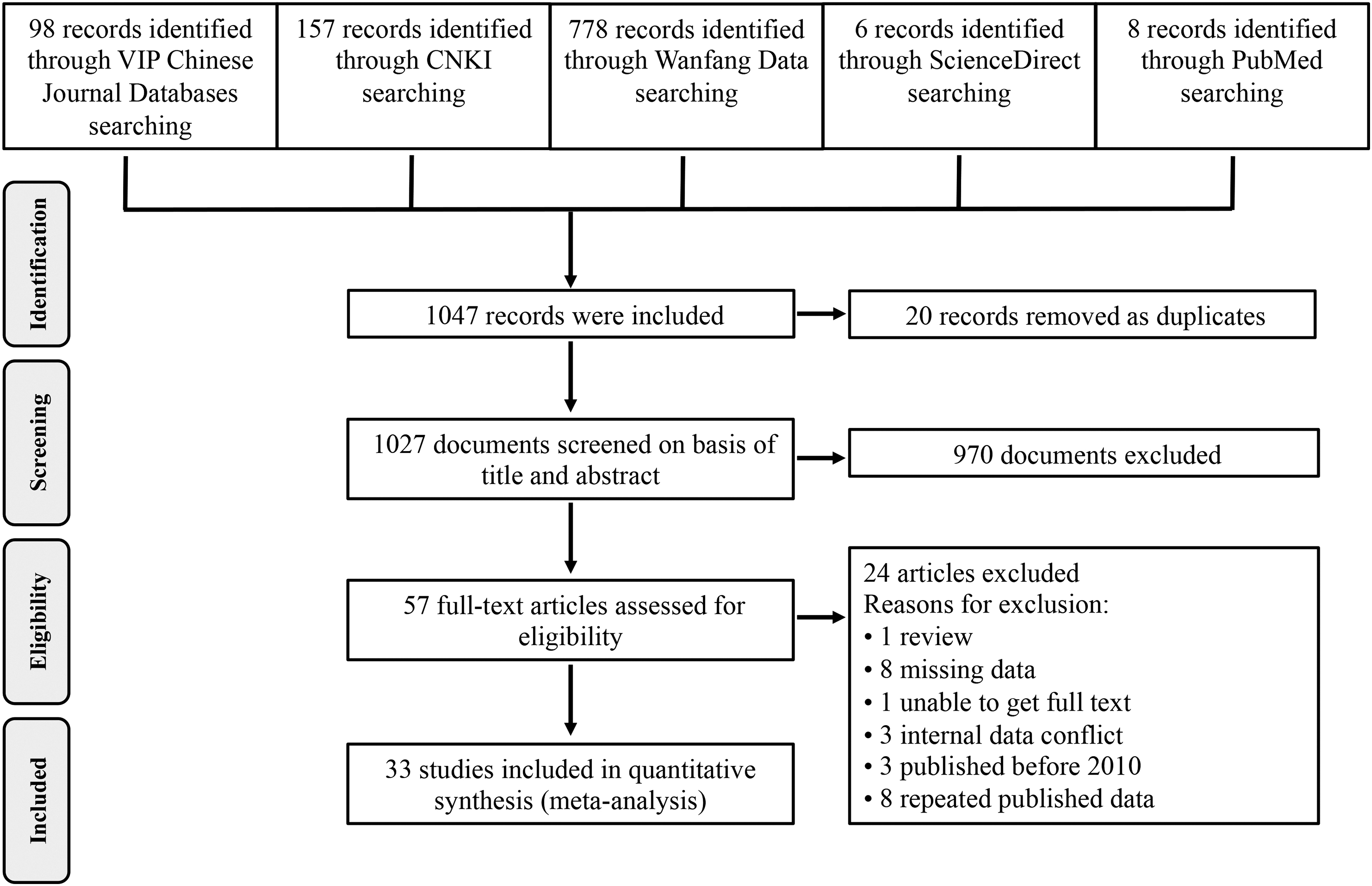
Flow diagram of eligible studies for searching and selecting.
Included Studies of Cryptosporidium spp. Infection in Sheep and Goat Flocks in China
Central China: Henan.
Eastern China: Anhui; Fujian; Jiangsu; Jiangxi; Shandong; Shanghai.
Northern China: Beijing; Inner Mongolia.
Northeastern China: Heilongjiang; Jilin; Liaoning.
Northwestern China: Gansu; Ningxia; Qinghai; Shaanxi; Xinjiang.
Southwestern China: Chongqing; Guizhou; Sichuan.
PCR, polymerase chain reaction; UN, unclear.
Pooling and heterogeneity analysis
Due to the result of PLOGIT fit the normal distribution more in four positive conversions (Liu et al. 2003), “PLOGIT” conversion is chosen for meta-analysis (Table 1). In this study, we obtained the p-values and I 2 statistics in a forest plot (χ 2 = 1121.20; p < 0.0001; I 2 = 97.5%), and assessed the heterogeneity among studies by using the random-effects model (Fig. 2, Table 2).

Random-effects meta-analysis of Cryptosporidium spp. infection in sheep and goat flocks.
Normal Distribution Test for the Normal Rate and the Different Conversion of the Normal Rate
PAS, arcsine transformation; PFT, double arcsine transformation; PLN, logarithmic conversion; PLOGIT, logit transformation; PRAW, original rate.
Publication bias and sensitivity analysis
In the included studies, we determined the publication bias by observing funnel chart and the trim and fill test, and Egger's test (t = −4.8106, p < 0.05) (Figs. 3–5). Although there was publication bias, the results were not substantially affected. Afterward, we also conducted a sensitivity analysis, the result proved that the results after excluding a single study and the previous results were approximately the same (Fig. 6). To sum up, we considered that the outcomes of our meta-analysis were dependable.
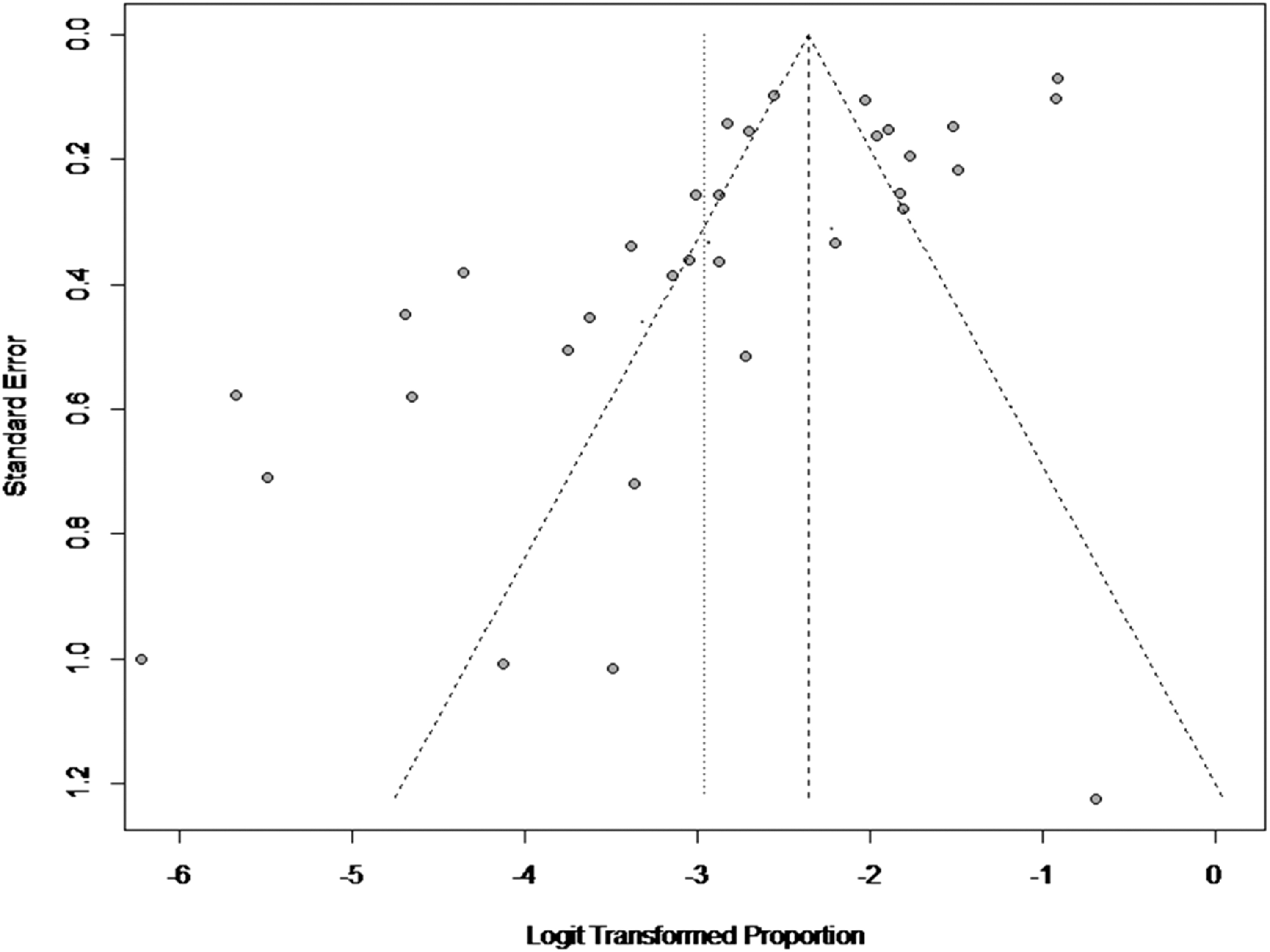
Funnel plot with pseudo 95% confidence interval limits for the examination of publication bias.
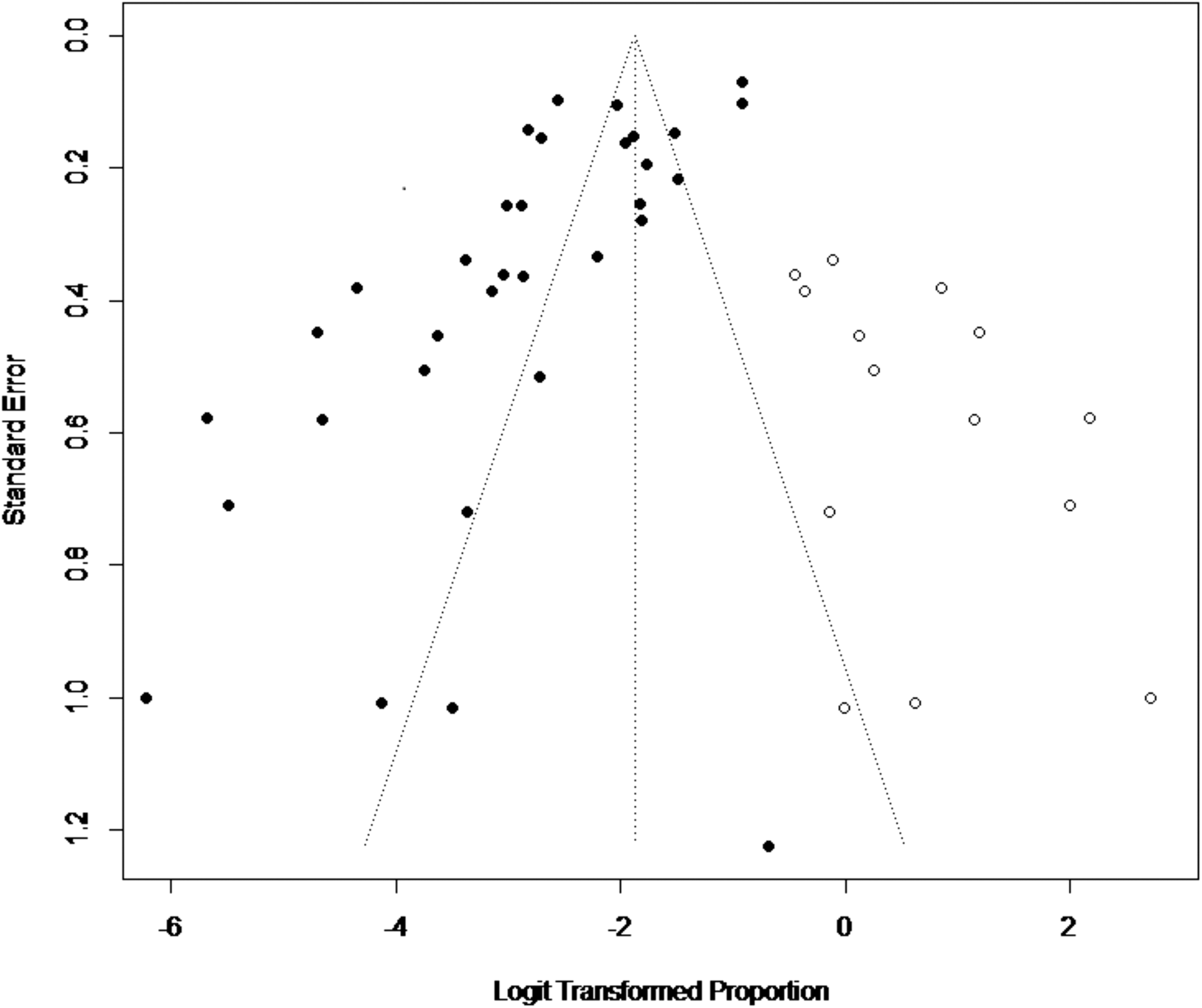
Funnel plot with trim and fill analysis of the publication bias.
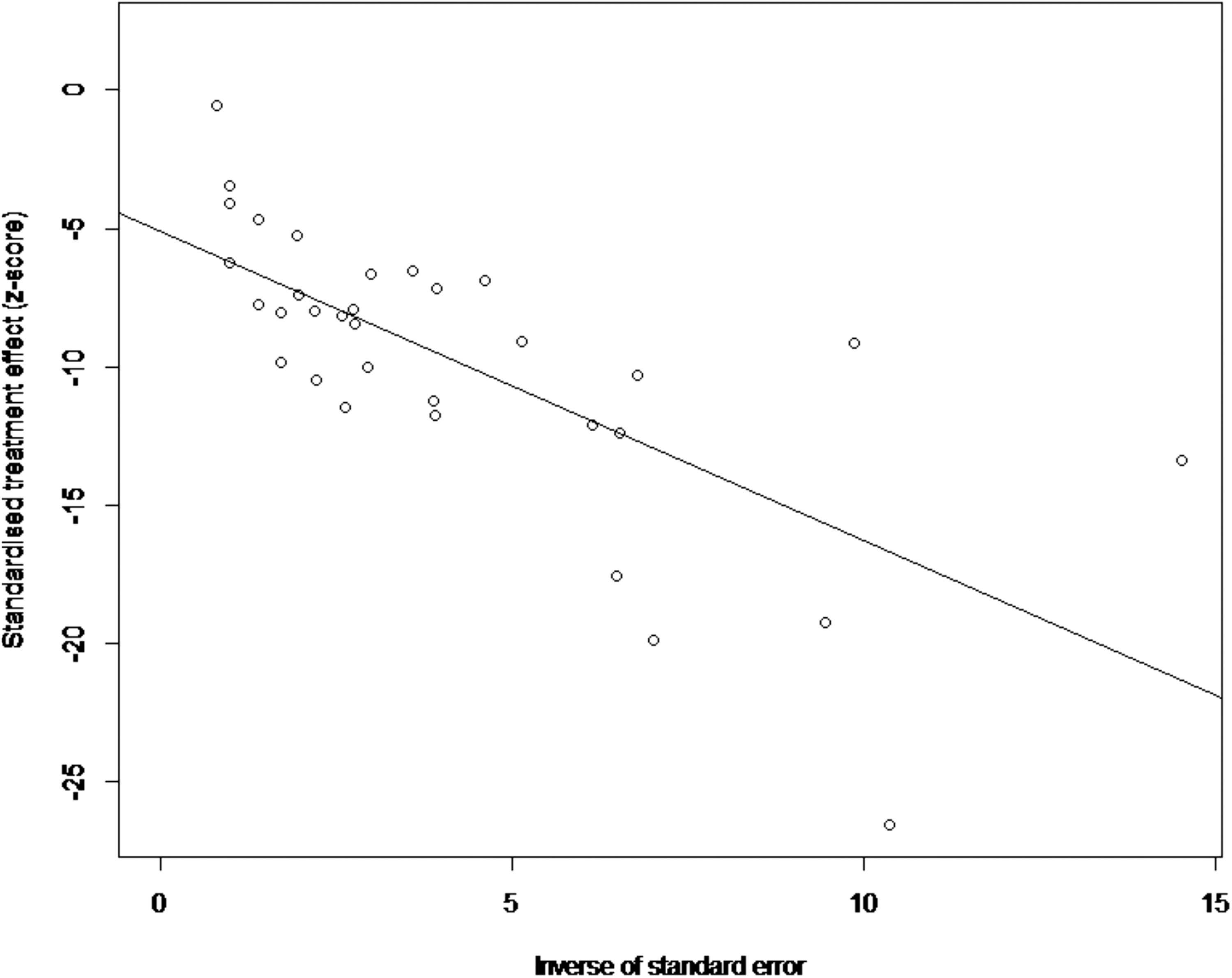
Egger's test for publication bias.

Sensitivity analysis.
Meta-analysis
In 33 included literatures, the whole pooled prevalence of Cryptosporidium infection in sheep was 4.9% (95% confidence interval [CI] 3.2–7.5; 1096/12,691). We used the random-effects model to make a univariate meta-regression analysis for each subgroup.
Among the different Chinese regions, the prevalence of Cryptosporidium in sheep and goats was 12.3% (95% CI 4.0–31.9; 89/564) in Northern China, which was the highest (Table 3), and Ningxia with the highest 35.7% (95% CI 24.9–48.2; 191/601) among provinces (Table 4, Fig. 7). The prevalence of Cryptosporidium infection in different sampling years: 4.6% (95% CI 2.6–7.8; 455/5578) after 2014 was higher.
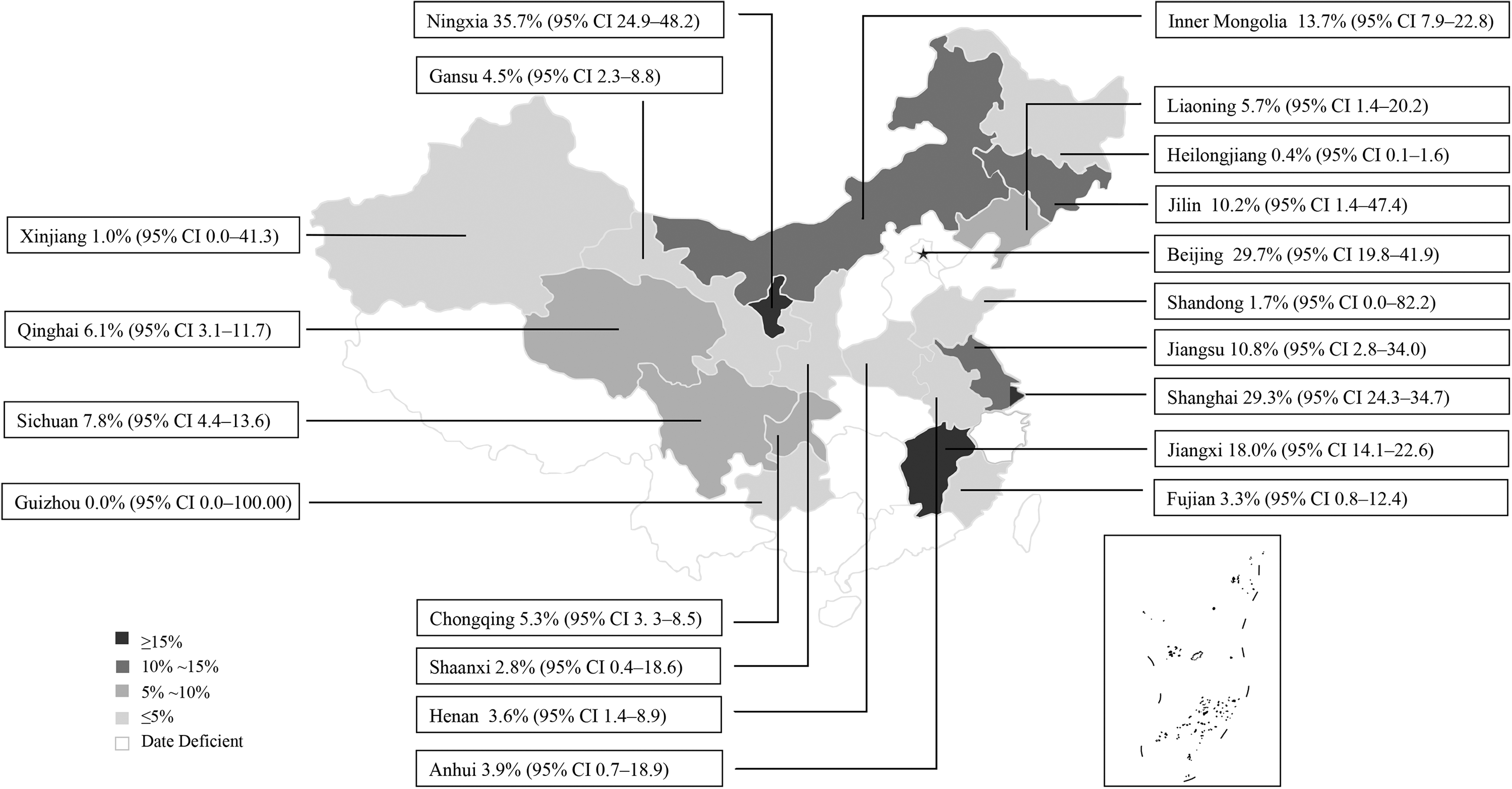
Map of Cryptosporidium in sheep and goat flocks among studies conducted in China.
Pooled Prevalence of Cryptosporidium spp. Infection in Sheep and Goat Flocks in Different Provinces
Association of Different Variates in the Seroprevalence of Cryptosporidium spp. in Sheep and Goat Flocks in China
p < 0.05 is statistically significant.
Others: serological method (ELISA); centrifugal sedimentation technique, Lugol's staining and floatation method (Suc); repeated water washing precipitation method, saturated saline floatation, floatation method (Suc), modified acid-fast staining; centrifugal sedimentation technique, modified acid-fast staining, Lugol's staining and floatation method (Suc); modified acid-fast staining and floatation method (Suc); Lugol's staining, floatation method (Suc) and microscope observation; saturated saline floatation, repeated, direct smear method, floatation method (Suc), water washing precipitation method, modified acid-fast staining; floatation method (Suc), and molecular methods (PCR); Lugol's staining, floatation method (Suc), and modified acid-fast staining.
Season: Autumn: September to November; Spring: March to May; Summer: June to August; Winter: December of this year to February of the following year.
High: 4 or 5 points; middle: 3 or 2 points; low: 1 or 0 point.
CI, confidence interval; ELISA, enzyme-linked immunosorbent assay.
Among the various detection methods, the prevalence of modified acid-fast staining of 14.3% (95% CI 9.3–21.3; 19/133) was the highest. Two species were investigated: goat 5.9% (95% CI 3.4–9.9; 387/4546) was higher in pooled prevalence. In age: the highest pooled prevalence was 3 months or before 20.8% (95% CI 14.4–29.1; 266/1083) (Table 3). In different breeding models: free-ranging farms were with higher pooled prevalence of 4.4% (95% CI 1.3–13.5; 78/1113). In varies seasons, winter had the maximum pooled prevalence of Cryptosporidium of 30.4% (95% CI 26.2–35.0; 126/414). In three quality levels, the medium quality level 6.4% (95% CI 2.5–15.6; 152/2096) was the highest.
We also analyzed the geographical subgroup factors and calculated the latitude range (35–40°; 3.5%, 95% CI 1.4–8.4); the longitude range (100–110°; 6.6%, 95% CI 3.8–11.3); altitude (1000–2000; 15.2%, 95% CI 4.2–42.4); average precipitation (>1500 mm, 9.0%, 95% CI 0.4–72.0); and average temperature (<10; 6.0%, 95% CI 3.2–11.0). In these geographic ranges, the prevalence of Cryptosporidium was significantly higher than other ranges (p < 0.05), which may be a source of heterogeneity (Table 5).
Pooled Prevalence of Cryptosporidium spp. Infection in Chinese Sheep and Goat Flocks in Geographical Factors
In accordance with the results of the univariate random-effects meta-regression, we infer that sources of heterogeneity were probable ages (p = 0.018) (Table 3), longitude (p = 0.003), height (p = 0.013), precipitation (p = 0.047), and mean temperature (p = 0.026) (Table 5).
Discussion
With the improvement of economic and Chinese living standards, people's demand for various sheep products is continuously increasing (Hou 2019, Li and Jin 2020a, Tian et al. 2020). According to the statistics of The Food and Agriculture Organization, the stock of sheep and goats in China has shown an overall upward trend from 2010 to 2018 (Food and Agriculture Organization of the United Nations 2020). However, sheep diarrhea was a significant factor affecting the development of sheep industry (Ma 2017). Especially lamb's diarrhea caused by Cryptosporidium was the most serious (Zhao 2019), and humans are easily infected by Cryptosporidium through sheep and goats (Lange et al. 2014, Al-Habsi et al. 2017).
To better understand the prevalence of Cryptosporidium in sheep and goats, this article conducted an extensive survey and summarized the infections of Cryptosporidium in sheep and goats in different Chinese regions (Table 2). As far as we know, this is the first meta-analysis of the prevalence of Cryptosporidium in sheep and goats in China.
From 2010 to 2019, the total positive rate of Cryptosporidium in Chinese sheep was 3.6%, 95% CI: 3.0–4.2; 620/6015, and goats 5.9%, 95% CI: 3.4–9.9; 387/4546. Among them, sheep and goat flocks collected before 2014 were lower than that after the 2014 group. The national correlation department had proposed diagnostic methods for cryptosporidiosis in 2014, and it was constantly revised (Xu et al. 2018).
In recent years, China encourages the sheep and goat breeding model to convert into scale. For example, the policy that promoted the structural reform of agricultural supply side was raised by the 19th session of national congress of the communist party of China in 2017, which further promoted Chinese sheep and goat breeding industry to scale development (Han et al. 2019). However, the current control methods of Cryptosporidium are insufficient to the rapid transformation of sheep breeding scale to high-density breeding (Han et al. 2019, Chong et al. 2020). This may be the reason why the infection of Cryptosporidium in sheep and goats were not effectively controlled after 2014. Hence, the management of large-scale breeding should be paid more attention, and breeding technology and the technology of disease prevention and control should be further improved (Wang 2017).
Cryptosporidium infection is mainly related to climate change and precipitation in different regions (Aparna et al. 2013). According to most studies, the seasonality of Cryptosporidium infections is uncertain. Although the analysis in this article indicates that the prevalence of winter is high, there are few articles on the relationship between seasons and Cryptosporidium infections, so the results may not be representative (Table 3). Northern China belongs to a temperate monsoon climate. The climate changes greatly throughout the four seasons, and the temperature difference between day and night is also large. Therefore, the immunity of sheep and goat may be affected by temperature changes, thereby increasing the risk of infection with Cryptosporidium (Yang 2018b).
In addition, the high infection rate of Northern China may also be borne on the transfer of sheep and goats and changing in feeding methods (Wang et al. 2020). The subgroup analysis results of province show that Ningxia has the highest infection rate of Cryptosporidium in sheep and goats (Table 4). Ningxia as a pastoral area is located in northwestern China and belongs to a continental semiarid and humid climate. It is located at 35.14–39.23°N and 104.17–107.39°E, with an average annual temperature of 5–8°C (Mou et al. 2018, Gao 2019). This is consistent with our analysis of breeding model and geographical factors: free-ranging farms with higher pooled prevalence, and the prevalence of Cryptosporidium in sheep and goats is higher in that Latitude is 35–40°, Longitude is 100–110°, and Mean temperature is <10°C (Tables 3 and 5
Although Ningxia is in an arid region with fewer precipitation days, its precipitation is increasing year by year due to the impact of global warming (Sun et al. 2019). Drought increases the runoff of unsaturated land, Cryptosporidium is more likely to survive in surface water in arid areas and may be more easily washed out of the surface by rain, thereby increasing the risk of sheep and goats contacting Cryptosporidium (Aparna et al. 2013). Although the data of Cryptosporidium infection in sheep and goats is lacking in other areas, there may be infections (Liu et al. 2020). Therefore, we suggest increasing the monitoring of Cryptosporidium in various regions and formulating effective prevention policies based on the differences in feeding management and climate in different regions.
Owing to the government support for all aspects of large-scale farms, Chinese large-scale farms had continued to improve in various aspects, including parasite control (Li 2018, Han et al. 2019). For traditional free-ranging farms, although the small breeding density can reduce the risk of infection to a certain extent, the risks of sheep and goat being infected with Cryptosporidium were increased by some disadvantages of culture, such as the standards of feeding and management were not uniform, poor culture facilities, and culture environment (Liu and Luo 2014). Therefore, the process of culture should concentrate more on the unification of feeding management, further improve the breeding environment, and raise the feeding standards.
In addition, in the use of manure/storage/treatment facilities, direct contact of the feces with superficial water is to be avoided, thus, decreasing the maximum transmission of oocysts in livestock farm, so as to prevent sheep and goat being infected with Cryptosporidium due to the unqualified basic conditions of culture (Noordeen et al. 2012).
In comparison with free-range breeding, the feed structure of large-scale breeding is more diversified, the feeding management is more unified, the feeding environment is more in line with the standard, and the risk of sheep and goats being infected with Cryptosporidium through other animals is greatly reduced (Li 2018). For example, Shandong as a major sheep and goat breeding province and an emerging agricultural area, the scale of sheep and goat farming has increased year by year (Zhang 2019), and the prevalence of Cryptosporidium in sheep and goat is lower (Table 4). Therefore, large-scale breeding should be popularized with the premise of maintaining reasonable feeding density and hygiene of the breeding environment.
When the individual age and immunologic competence are various, it was also different possibility that sheep and goats are infected by Cryptosporidium (Mammeri et al. 2019). The results of this article, consistent with most investigations, indicate that lambs 3 months old or before are more likely to be infected with Cryptosporidium. This may be related to the drinking water being contaminated with Cryptosporidium or the presence of Cryptosporidium oocysts in the environment where the lamb grows (Ma 2017). Due to the longer incubation period of Cryptosporidium in adult sheep and goats, lambs are more easily to be infected with Cryptosporidium oocysts discharged from adult sheep and goats who are without symptoms, and even lambs are infected by Cryptosporidium carried by their mothers (Jacobson et al. 2018).
In addition to the external conditions that make lambs susceptible, it is important that the lambs have poor self-immunity. Lambs who have not received colostrum and have weakened immunity due to weaning pressure are more likely to be infected with cryptosporidiosis (Wang et al. 2015a). Therefore, in the breeding stage of sheep and goats, it is necessary to strictly control the infection of Cryptosporidium in the flock, and lambs should be paid more attention, caring for them after birth and the feed management after weaning. Moreover, when lambs appear to have weight loss, fever, and diarrhea, and other symptoms suspected of being infected with Cryptosporidium, sheep and goats should be reasonably fed and grouped management to avoid further infection of Cryptosporidium in the flock (Causapé et al. 2002).
In the subgroup of species, the risk of Cryptosporidium infection in goat is estimated to be higher than sheep. The reason of this result may be related to the different susceptibility of the different hosts in the identical species of Cryptosporidium (Li et al. 2019b). The different life habit and producing area also influence the prevalence of Cryptosporidium in goat and sheep. The most breeds of goat are mainly distributed in the monsoon ecological region of eastern China, where the summer is generally hot and rainy and the winter is cold and dry. Changes in the climate may affect the immunity of goat. Most goats are produced in pastoral areas, and grazing may increase the chance of goats being exposed to Cryptosporidium in the wild (Zhang 2015). Hence, the change of the local climate and the feeding methods of grazing may increase the risk of goats being infected with Cryptosporidium.
For sheep, although the breeds of sheep are widely distributed in different areas, most of them are fed in areas with moderate or less precipitation and some areas in moderate altitude (Han 2016). This conclusion is also similar to our analysis, in that sheep and goats infected with Cryptosporidium have the lowest positive rate in areas with the altitude of <100 (1 meter) and areas with the annual precipitation of 400–1000 mm (Table 5). Although the estimated value of goat infection is higher than sheep, the result of analysis shows that there is no significant difference between goats and sheep. Consequently, whether there is a link between Cryptosporidium infections and the species of goats and sheep still needs further study.
In our research of prevalence, three detection methods are mainly used to detect Cryptosporidium. The difference comes from the sensitivity and specificity of different detection methods. The research we included mainly used three detection methods. Modified acid-fast staining and floatation method are traditional detection methods with the advantage of simple operation, but the sensitivity and specificity of them are low.
With the rapid growth of biotechnology, the diagnostic methods of Cryptosporidium were also constantly innovating. To be more convenient and more sensitive, most of the samples were diagnosed by polymerase chain reaction (PCR) in the included articles. In this study, the positive rate of modified acid-fast staining was obviously higher than PCR (Table 3). The possible reason was that samples were needed to be observed under microscope after modified acid-fast staining, and the misdiagnosis of other microorganisms might exist in this result. It is explained that this situation is not only related to the sensitivity of the microscope, but also the operating experience of the experimenter (Gerace et al. 2019, Santos et al. 2019).
Moreover, it is also necessary to indicate that there are certain shortcomings with PCR, since for example, making PCR in stool samples has the risk of false negatives due to the existence of Taq polymerase inhibitors in the samples. Likewise, if the samples do not have an abundant number of oocysts, it is also possible to obtain false negatives due to the difficulty of rupture of the oocyst to release the DNA.
Recently, Sonzogni-Desautels and her team used flow cytometry to detect Cryptosporidium. As exploratory research and scientific work, it is a successful detection method because of its advantages of high resolution and high throughput. In actual production testing, it is recommended to use flow cytometry for qualitative testing and PCR for further molecular epidemiological investigations (Sonzogni-Desautels et al. 2019).
However, this article also included some articles that did not describe the method of detection and use other methods. Because the number of studies is small or some did not specify the method of detecting Cryptosporidium, they were integrated into a group (Table 4). Most of these articles detected multiple parasites and did not analyze Cryptosporidium in detail. Therefore, further research should be carried out on Cryptosporidium in sheep and goats, and it is recommended that the method of detection should be clarified in future investigations. Furthermore, the creation and use of more sensitive, accurate, and convenient detection techniques should also be supported (Zhang et al. 2018a, Tian et al. 2019).
In this article, there are eight medium–low quality of researches, in which there is no description whether to randomly sample, the sampling time is unclear, or the sampling region is not specified. The absence of these factors may hinder the study of the relationship of the infection rate of Cryptosporidium in sheep and goats and season, and the relationship of the place of production and the prevalence of Cryptosporidium in sheep and goats. Therefore, to provide more detailed information on the epidemiology of Cryptosporidium in Chinese sheep and goats, the random sampling of samples in future research and detailed records of the sampling place and sampling time should be paid more attention.
The superiorities of this article include the large number of total sample size, the comprehensive literature search in five databases, and the strict analysis of subgroups. However, there were still some limitations in this study: first of all, although we had included 33 articles, not each article had enough subgroup data. Some subgroups had less research data, which might affect the stability of the combined results. For example, there was not data about the infection of Cryptosporidium in sheep and goat from southern China in included 33 studies. Second, the search formula we created might neglect some articles consistent with the standard. Besides, the included articles were limited to studies in English and Chinese, and some eligible studies in other languages may be excluded. Finally, the insufficient data could not analyze other potential subgroups, such as gender and Cryptosporidium species.
Conclusions
In summary, this meta-analysis illustrates that cryptosporidiosis is still widespread in Chinese sheep and goats. The change of breeding mode and the difference of geographical factors will affect the infection of Cryptosporidium, and lambs are more susceptible. Therefore, we suggest to increase the monitoring of Cryptosporidium in various regions, and formulate a reasonable prevention policy according to the differences in raising patterns and climate environment in each region. In addition, the protective measures against Cryptosporidium infections at the different growth stages of sheep and goats should be continuously improved to reduce the infections of Cryptosporidium in sheep and goats.
Footnotes
Authors' Contributions
Y.-N.C. and Q.Z. were responsible for the idea and concept of the article. B.Z. and X.-Y.Y. collected the data. Q.-L.G. analyzed the results. X.-Y.Y. and Q.-L.G. wrote the article. Q.-L.G. revised the article. All authors contributed to the article editing and approved the final article.
Author Disclosure Statement
No conflicting financial interests exist.
Funding Information
This research was supported by the National Key Research and Development Program of China (2018YFD0501600).
Supplementary Material
Supplementary Table S1
Supplementary Table S2
References
Supplementary Material
Please find the following supplemental material available below.
For Open Access articles published under a Creative Commons License, all supplemental material carries the same license as the article it is associated with.
For non-Open Access articles published, all supplemental material carries a non-exclusive license, and permission requests for re-use of supplemental material or any part of supplemental material shall be sent directly to the copyright owner as specified in the copyright notice associated with the article.
