




Abstract
Severe fever with thrombocytopenia syndrome (SFTS), caused by Dabie bandavirus, generally called SFTS virus (SFTSV), is an emerging zoonosis in East Asia. In Japan, 50–100 cases of SFTS have been reported each year since the first case was reported in 2013. SFTS is a tick-borne infectious disease, and SFTSV has been isolated from ticks in China and South Korea. Haemaphysalis longicornis and Amblyomma testudinarium are considered the primary vectors in Japan. However, the other tick species seldom feeding on humans might also play an important role in maintaining the virus in nature. In this study, we collected ticks on vegetation around the location where two SFTS patients were estimated to have been infected in Miyazaki Prefecture, Japan, isolated live SFTSV, and performed a phylogenetic analysis. A total of 257 ticks were collected, and SFTSV RNA was detected in 19.5% (9/46) of tick pools. A total of 10 infectious SFTSVs were successfully isolated from A. testudinarium, Haemaphysalis flava, Haemaphysalis formosensis, Haemaphysalis hystricis, and Haemaphysalis megaspinosa. Furthermore, the whole viral sequences isolated from ticks were highly homologous to sequences isolated from SFTS patients in the same sampling area in the past. These results suggest that SFTSVs are maintained in these tick species in the sampling area and sporadically transmitted to humans. Surveillance of SFTSV in ticks provides important information about the risk of incidental transmission to humans.
Introduction
Severe fever with thrombocytopenia syndrome (SFTS) is an emerging tick-borne zoonosis in East Asia. SFTS was first discovered in humans with acute febrile illness in rural areas of middle-eastern China in 2009 (Yu et al. 2011). After that, this disease was also confirmed in Japan, South Korea, Taiwan, Vietnam, and Myanmar (Kim et al. 2013, Takahashi et al. 2014, Tran et al. 2019, Lin et al. 2020, Win et al. 2020). Since the first case was reported in Japan in 2013, a total of 517 confirmed cases had been reported as of May 2020. This disease shows many different symptoms, most frequently involving high fever, physical exhaustion, digestive symptoms, thrombocytopenia, and leukopenia (Kato et al. 2016). The mortality rate of SFTS ranges from 5% to 27% (Choi et al. 2016, Zhan et al. 2017, Kobayashi et al. 2020). SFTS has also been confirmed in a wide range of animals, including pets, livestock, and wild animals (Chen et al. 2019). Although clinical information regarding SFTS in most animals is unclear, felines show fatal symptoms similar to those in humans (Matsuno et al. 2018, Matsuu et al. 2019, Park et al. 2019). Dabie bandavirus, generally called SFTS virus (SFTSV), is the causative agent of SFTS. SFTSV is classified into the family Phenuiviridae and genus Bandavirus and comprises three negative-sense RNA segments, namely large (L), medium (M), and small (S). SFTSV is naturally maintained among ticks and other animals and sporadically transmitted to humans by tick bites. Although this disease is thought to be a tick-borne zoonosis, the virus can be directly transmitted from infected persons and pets to humans (Gong et al. 2018, Kida et al. 2019, Yamanaka et al. 2020).
SFTSV RNA has been found in a variety of tick species (Wang et al. 2015, Yun et al. 2016, Lin et al. 2020). However, these results do not mean that all RNA-positive tick species can harbor infectious SFTSV. The South Kyushu area, including Miyazaki and Kagoshima prefectures, accounted for 23.4% (121/517) of the total SFTS cases, despite containing only 2.2% of the population. Haemaphysalis longicornis is the most likely vector transmitting SFTSV to humans, and all developmental stages can transmit SFTSV to animals by feeding (Liu et al. 2014, Luo et al. 2015). Other tick species, such as Haemaphysalis hystricis and Haemaphysalis flava, inhabit the South Kyushu area in Japan, and these tick species are considered to be the most probable vectors of Japanese spotted fever (Fujita et al. 1999, Mahara 2006). Therefore, considering these tick species to potentially harbor infectious SFTSV is important to counter the SFTS in this area.
To reveal which tick species have potential to maintain the SFTSV in nature, we collected various tick species in a location where SFTS occurred in Miyazaki Prefecture, Japan, and isolated the infectious virus. Furthermore, we performed a phylogenetic analysis to verify that the viral sequences from ticks belonged to the same lineage isolated from humans in the same area in the past. This study will contribute to the control and understanding of the emerging SFTSV.
Materials and Methods
Ethical approval
Appropriate national and institutional guidelines were followed while conducting the present study. The information of SFTS cases in humans was provided by Miyazaki Prefectural Institute for Public Health and Environment following the agreement of collaborative research.
Tick collection and homogenization
Ticks on vegetation were collected from March to April 2016 in Miyazaki Prefecture, Japan, by the flagging method. The collection site was 400 m in area and was inferred to have cases of SFTS in humans in 2013 and 2014. The species and developmental stage of collected ticks were identified morphologically by stereomicroscopy (Yamaguti et al. 1971). The collected ticks were divided into 46 pools (1–5 adult ticks per pool, 1–10 nymphal ticks per pool) based on species, developmental stage, and sampling spots. The pools were washed with 1% iodine in 70% ethanol, rewashed three times with distilled water, completely homogenized by homogenizer pestle with 500 μL of Eagle's minimal essential medium (MEM; Sigma–Aldrich, St. Louis, MO) with penicillin and streptomycin (Fujifilm Wako Pure Chemical, Osaka, Japan), and centrifuged at 400 g for 10 min at 4°C. The supernatant was collected and stored at −80°C until use.
Virus isolation
Virus isolation was conducted for all the harvested supernatants. Vero cells were adjusted to 1 × 10⁵ cells/mL and the 3 mL was seeded in a 6-well plate (Sumitomo Bakelite, Tokyo, Japan). One hundred microliters of the supernatant and 400 μL of MEM with 2% fetal bovine serum (FBS; Biowest, Nuaillé, France) were inoculated into the wells within 16 h of the seeding. After 90 min of incubation, 2.5 mL of MEM with FBS was added, and the cells were cultured at 37°C in a 5% carbon dioxide incubator. After 7–8 days, 500 μL of supernatant of the first passage was transferred to fresh Vero cells. The cells were cultured for 7–8 days, and the supernatant of the second passage was transferred to flesh Vero cells as described above. After an additional 5 days, the supernatant of the third passage was harvested. Detection of cytopathic effect (CPE) and RT-PCR were used for the confirmation of virus isolation. The Vero cells inoculated with SFTSV A17 (A17/Haemaphysalis formosensis/Miyazaki/2016) strain isolated in this study were used for immunofluorescence analysis (IFA) and transmission electron microscope (TEM). The IFA method was as described in a previous report (Takahashi et al. 2014). The rabbit anti-SFTSV recombinant nucleoprotein serum (kindly provided by Dr. Shigeru Morikawa, National Institute of Infectious Disease, Tokyo, Japan) and phycoerythrin-conjugated mouse anti-rabbit immune globulin G antibody (Santa Cruz Biotechnology, Santa Cruz, CA) were used as a primary and a secondary antibody, respectively.
For electron microscopy, the cells at 2 days postinfection were fixed with 2% paraformaldehyde and 2.5% glutaraldehyde in 0.1 M phosphate buffer (PB). The fixed cells were postfixed with 1% osmium tetroxide in 0.1 M PB for 2 h on ice and then embedded into epoxy resin. Ultrathin sections (60–80 nm in thickness) were cut and stained with 2% uranyl acetate and Reynolds' lead citrate. TEM observations were performed using HT7700 TEM (Hitachi, Tokyo, Japan).
RNA extraction and RT-PCR
Total RNA was extracted from the supernatant of tick homogenate and of cultured cells using a NucleoSpin Virus Kit (TaKaRa Bio, Kusatsu, Japan) according to the manufacturer's instructions. RNA extraction was confirmed using a NanoDrop 8000 Spectrophotometer (Thermo Fisher Scientific, Waltham, MA). The extracted RNA was assessed using OneStep RT-PCR Kit (Qiagen, Venlo, Netherlands) to detect the nucleoprotein region of the SFTSV genome. The specific primers were as follows: SFTS NP-1F: 5′-ATCGTCAAGGCATCAGGGAA-3′ and SFTSV NP-1Rd: TTCAGCCACTTCACCCGRA (Takahashi et al. 2014). The size of each PCR product was confirmed by gel electrophoresis.
Whole-genome amplification and library preparation
The amplification of whole viral genomes was performed in a reaction mixture containing 25 μL of one-step buffer, 2.0 μL of PrimeScript One Step Enzyme Mix (TaKaRa Bio), four primers at 0.4 μM (SFTS_LM_Fwd: 5′-ACGCGTGATCACACAGAGACG-3′, SFTS_LM_Rev: 5′-ACGCGTGATCACACAAAGACCG-3′, SFTS_L_Fwd: 5′-ACGCGTGATCACACAGAGACGC-3′, and SFTS_L_Rev: 5′-ACGCGTGATCACACAAAGACCGC-3′), a primer at 0.2 μM (SFTS_S_F&R: 5′-ACGCGTGATCACACAAAGAACCCC-3′), 2 μL of the extracted RNA, and enough PCR-grade water to reach a final volume of 50 μL. A step-down PCR method was used to reduce nonspecific amplification, which included an initial reverse transcription step at 50°C for 30 min, a PCR activation step at 94°C for 2 min, 5 cycles of denaturation at 98°C for 10 sec and annealing and extension at 74°C (with a 2°C decrease per 5 cycles for 6 min 30 sec), and 20 additional cycles when the annealing and extension temperature reached 68°C. Amplification of PCR products of the three segments (6368, 3378, and 1746 bp) was confirmed by gel electrophoresis. After purification of the PCR products using Agencourt AMPure XP Beads (Beckman Coulter, Brea, CA), the DNA concentration was quantified using a Qubit dsDNA HS Assay Kit (Thermo Fisher Scientific). One hundred nanograms of purified DNA was then subjected to library preparation steps using a QIAseq FX DNA Library Kit (Qiagen) per the manufacturer's instructions. Before sequencing, the concentration of the prepared library was determined using an NEBNext Library Quant Kit for Illumina (New England Biolabs, Ipswich, MA).
Next-generation sequencing and data analysis
Next-generation sequencing was performed using a MiSeq instrument (Illumina, San Diego, CA). A total of 600 μL of 10 pM pooled and bar-coded DNA libraries was loaded into a MiSeq Reagent Kit v2 (300 cycles). The sequences generated by MiSeq were analyzed using CLC Genomics Workbench 11 software (Qiagen). The sequences were then processed to remove primers and low-quality sequences and mapped to Japanese reference genomes of SFTSV strain YG1 (accession nos. AB817995, AB817997, and AB817999). The complete sequences of the SFTSV that were determined in this study (N2, 4/Amblyomma testudinarium/Miyazaki/2016; N7/H. flava/Miyazaki/2016; N10, 12, 14, A17/H. formosensis/Miyazaki/2016; N19, 21/H. hystricis/Miyazaki/2016; and N23/Haemaphysalis megaspinosa/Miyazaki/2016) were submitted to the DNA Data Bank of Japan under accession no. LC536536-65.
Phylogenetic analysis
The SFTS viral genome sequences that were obtained in this study and the available full-genome sequences that we retrieved from GenBank were aligned using ClustalW. Molecular phylogenetic trees were constructed using the neighbor-joining method with MEGA7 software (Kumar et al. 2016). Evolutionary distances were computed using Kimura's two-parameter model. A total of 1000 bootstrap replicates were used to derive the trees based on the nucleotide sequences of the genome segments.
Statistical analysis
The minimum infection rate (MIR) of SFTSV in ticks was expressed as the number of positive pools divided by the number of tested ticks and multiplied by 100. The chi-squared test and Fisher's exact test were used to compare the MIR between tick species and developmental stages, respectively. These analyses were performed using GraphPad Prism 6 Software (GraphPad Software, San Diego, CA). p Value <0.05 was considered statistically significant in this study.
Results
A total of 70 adult and 187 nymphal ticks were collected and divided into 46 pools (adults: 23 pools, nymphs: 23 pools) (Table 1). The adult ticks were morphologically identified as H. formosensis (n = 37; 11 pools), Haemaphysalis kitaokai (n = 21; 7 pools), H. flava (n = 8; 3 pools), H. hystricis (n = 2; 1 pool), and H. megaspinosa (n = 2; 1 pool). The nymphal ticks were identified as H. formosensis (n = 59; 6 pools), H. flava (n = 39; 5 pools), A. testudinarium (n = 35; 4 pools), H. longicornis (n = 30; 3 pools), H. megaspinosa (n = 15; 2 pools), and H. hystricis (n = 9; 3 pools). Nine of the 46 (19.5%, MIR = 3.5) pooled samples were RT-PCR positive for SFTSV. All the RT-PCR-positive pools were pools of nymphal ticks. SFTSV genes were detected in nymphal ticks of H. formosensis (3 pools), H. hystricis (2 pools), A. testudinarium (2 pools), H. megaspinosa (1 pool), and H. flava (1 pool). There were no significant differences in the RT-PCR-positive rate between developmental stages (Fisher's exact test; p = 0.11) or tick species (chi-squared test; p = 0.12). SFTSVs were successfully isolated from 10 of the 46 (21.7%, MIR = 3.8) pooled samples (Table 2). Clear CPE in Vero cells appeared on after 3 days postinoculation in the first to third passage, and the presence of virus in the cytoplasm was confirmed by IFA and TEM (Fig. 1). One and nine samples from which SFTSV was isolated were from pools of adult and nymphal ticks, respectively. A total of nine SFTSVs were isolated from the RT-PCR-positive pools. One SFTSV was isolated from the RT-PCR-negative pool (H. formosensis, adult). SFTSVs were isolated from a pool of adult H. formosensis (1 pool) and pools of nymphal H. formosensis (3 pools), H. hystricis (2 pools), A. testudinarium (2 pools), H. megaspinosa (1 pool), and H. flava (1 pool). There were no significant differences in the virus isolation rate between developmental stages (Fisher's exact test; p = 0.29) and tick species (chi-squared test; p = 0.17).
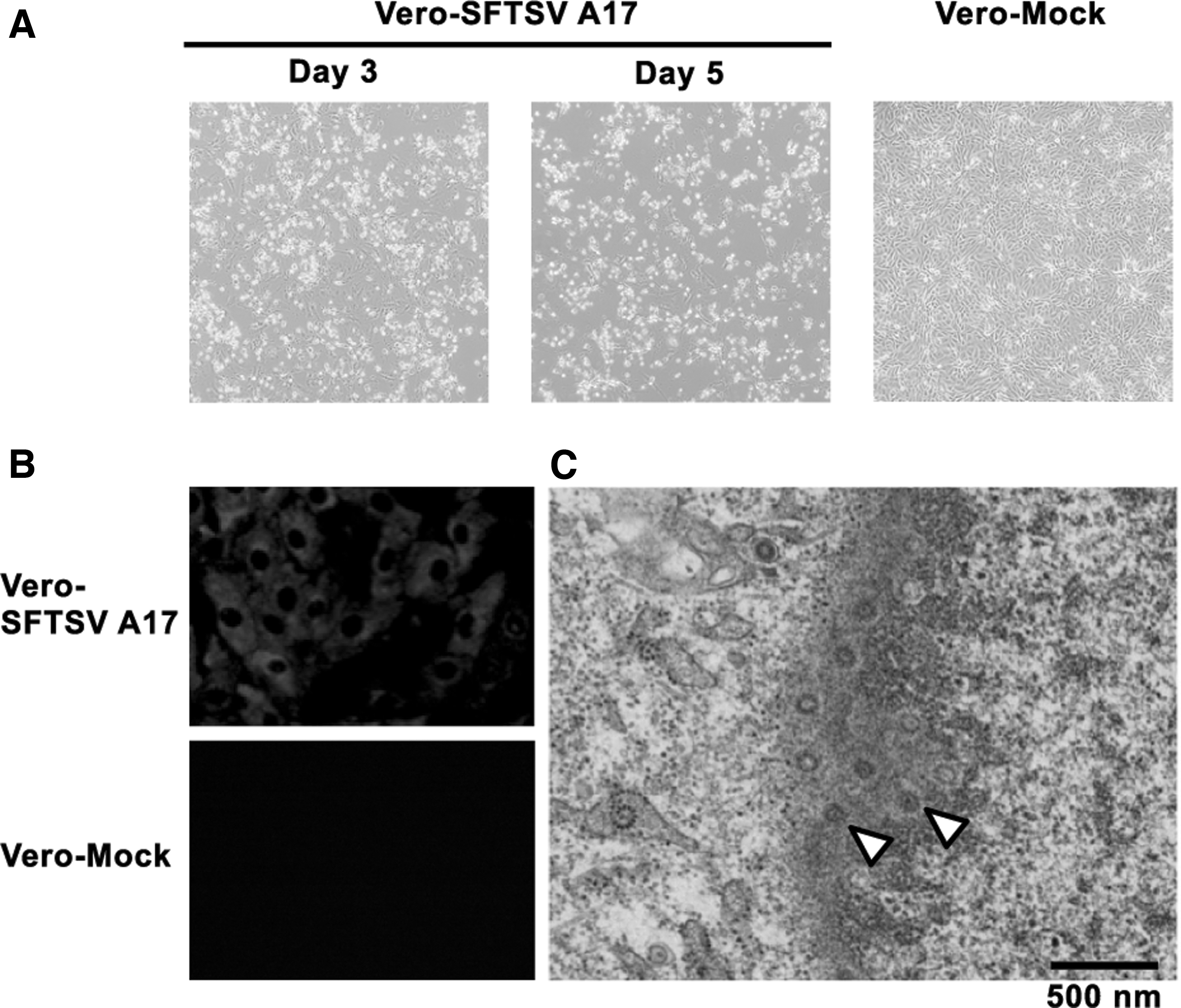
Confirmation of the isolation of SFTSV.
Prevalence of Severe Fever with Thrombocytopenia Syndrome Virus in Ticks
Virus isolation was confirmed by RT-PCR and cytopathic effect.
MIR = number of RT-PCR-positive or virus isolated pools/number of tested ticks × 100.
MIR, minimum infection rate.
Details of Tick Pools of Isolated Severe Fever with Thrombocytopenia Syndrome Virus
In this study, we used the five primers for amplification of the three whole viral segments. The S segment has 14 nucleotides of complementary conserved sequences in 5′ and 3′ terminal ends. The M and L segments have 11 and 12 nucleotides of the common conserved sequences in 5′ and 3′ terminal ends, respectively. Thus, we first designed the three primers (SFTS_LM_Fwd, SFTS_LM_Rev, and SFTS_S_F&R) containing each conserved sequence and performed RT-PCR. Although S and M segments were successfully amplificated, DNA band of the L segment was weak due to the longer nucleotide sequence than the M segment. Thus, we added two other primers adding a nucleotide specific for the L segment to 3′ end (SFTS_L_Fwd, FTS_L_Rev) to amplify the L segment. The full genome sequence was successfully deduced from all the isolated SFTSVs using the next-generation sequencing. The nucleotide sequences of the three genomic segments of all the isolated viruses showed 100% homology and were classified as belonging to the J1 lineage (Fig. 2). Although the viral sequences isolated from ticks had a 1.4–4.2% nucleotide difference compared with the sequences of the Japanese reference strain YG1, the sequences had only a 0.1–0.2% difference compared with the sequences recovered from SFTS patients (SPL124A, SPL128A) in the same area in the past (Yoshikawa et al. 2015).
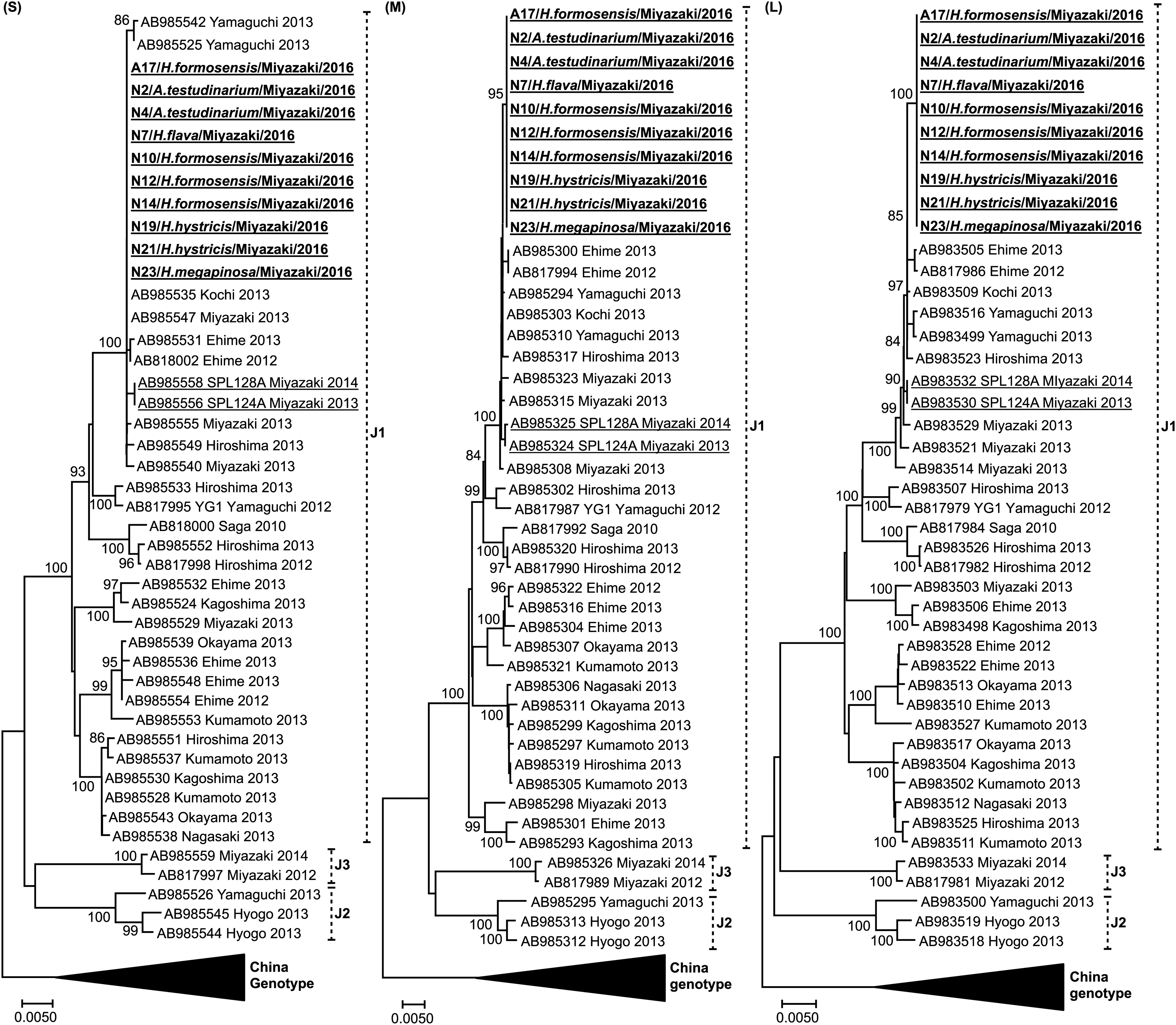
Phylogenetic analyses of the three genomic segments of the SFTSV at the nucleotide level. The analyses involved a complete nucleotide sequence of each segment. The viruses isolated from ticks in this study are boldfaced and underlined. The viruses isolated from humans in the same sampling area in the past are underlined. The dotted line indicates the classification of viral genotype. Bootstrap values >80% (1000 replicates) are shown next to the branches. The scale bars indicate the number of substitutions per site. The sequences of the SFTSV that were determined in this study were submitted to the DNA Data Bank of Japan under accession no. LC536536-65.
Discussion
This is the report of the isolation of SFTSV from various tick species in an area inferred to have two cases of SFTS in humans. Infectious virus isolation from ticks is necessary to confirm that specific tick species have the potential to maintain SFTSV in nature. We proved that A. testudinarium, H. flava, H. formosensis, H. hystricis, and H. megaspinosa harbored infectious SFTSV in this area. Furthermore, whole viral genome analysis revealed that the SFTSVs we isolated from ticks were closely related to the viral sequences obtained from SFTS patients in the same area in the past. These results indicate that some of these tick species seldom feeding on humans have the role of retaining SFTSV in nature and the other species feeding on humans have the potential to be vectors transmitting the virus.
A total of 257 ticks belonging to 2 genera and 7 species were collected in this study. H. formosensis was the most frequently collected tick, followed by H. flava, A. testudinarium, and H. longicornis. This result was similar to the result of a previous survey conducted in the same prefecture (Nakao et al. 2013). H. longicornis and A. testudinarium are considered the primary tick vectors of SFTSV transmitting to humans in Japan (Saijo 2018). However, to the best of our knowledge, SFTSV isolation directly from ticks has not been reported in Japan. In our study, SFTSVs were isolated from A. testudinarium, H. flava, H. formosensis, H. hystricis, and H. megaspinosa. H. hystricis and H. flava are well-known ticks feeding on humans and considered to be the vectors of Japanese spotted fever (Mahara 2006). Therefore, they could have the potential to transmit the SFTSV to humans in this area. However, H. formosensis and H. megaspinosa seldom feeding on humans might play important role in maintaining the virus in nature. Live SFTSV was isolated from non-blood-sucking adult and nymph ticks. This result demonstrated that SFTSV was transstadially passed from nymphs and larvae to the next developmental stages in A. testudinarium, H. flava, H. formosensis, H. hystricis, and H. megaspinosa. However, further studies are required to reveal whether specific tick species have the potential to harbor and amplify the virus. We collected ticks around the location where SFTS patients were estimated to have been infected, and the prevalence of SFTSV RNA was high (19.5%, MIR = 3.5). The positive rate in these ticks was similar to that in a previous study conducted in an area where SFTS is endemic in China (21.3%) (Tian et al. 2017). The positive rates of SFTSV RNA in ticks were extremely different among studies. A previous study conducted in an SFTS-harboring prefecture in Japan reported no SFTSV RNA in more than 2000 ticks (Hayasaka et al. 2015). We do not know how long and what probability of SFTSV-infected ticks can hold the virus, and the positive rates in ticks affect the seasonal influences or not. Therefore, the positive rate of SFTSV RNA in ticks might be markedly different among sampling locations and seasons. Miyazaki Prefecture is the most SFTS-endemic prefecture in Japan. This prefecture accounted for 13.9% (72 cases) of the total SFTS cases in Japan (517 cases) despite containing only 0.8% of the population. Yasuo and Nishiura (2019) performed a spatial epidemiological analysis in Miyazaki Prefecture and concluded that areas with a small number of farms and at midlevel altitudes may be at a high risk of infection. Surveillance of animals and ticks and the identification of SFTS hot spots might be important to control the disease.
The supernatant of the third passage in Vero cells was used for the whole-genome sequencing in this study. Some of isolated strains appeared CPE after the third passage in Vero cells. Thus, the virus might adapt to Vero cells with some nucleotide mutations. However, previous study concluded that the SFTSV isolated using Vero cells that basically retained their original nucleotide sequences and specific nucleotide mutations for adaptation to Vero cells was not observed (Yoshikawa et al. 2015). Thus, the viral passage would not affect the result of the viral sequence. The SFTSV sequences isolated in this study were highly homologous to sequences isolated from SFTS patients in the same area in the past. This result indicates that SFTSV is maintained among ticks and sporadically transmitted to humans in this area. To date, two genotypes (J1 and J3) of SFTSV have been reported in Miyazaki Prefecture (Yoshikawa et al. 2015). Most of the strains isolated in Japan were clustered into genotype J1, and the viruses isolated in this study were also classified as belonging to this genotype. A higher mortality rate was observed in SFTS patients infected with genotype J1 (also called genotype B-2) than in those infected with the Chinese genotype in South Korea (Yun et al. 2020). The higher pathogenicity of genotype J1 was also confirmed in an infection experiment using aged ferrets (Yun et al. 2020). Although further analyses are required to quantify the correlation between pathogenicity and specific genotypes, epidemiological surveys of SFTSV genotypes might be important for identifying the risk of SFTS.
Conclusions
The findings of this study indicate that some tick species, such as H. formosensis and H. megaspinosa, might maintain SFTSV in nature and other species, such as H. flava and H. hystricis, might be important vectors of SFTSV transmitting to humans in the endemic area of Miyazaki Prefecture, Japan. Surveillance of SFTSV in ticks and the identification of SFTS hot spots will provide useful information about the risk of incidental transmission to humans. Currently, there is not enough information available about this virus throughout East Asia. Therefore, further studies are required to reduce the incidence of this virus.
Footnotes
Authors' Contributions
T.O. designed and organized the study. Y.S., Y.K., S.Y., S.A., T.S., and T.O. contributed to the field sampling. Y.S., P.E.S., and T.O. performed the laboratory detection and virus isolation. H.M. performed the genome study. Y.S., H.M., and T.O. wrote the article.
Acknowledgments
The Collaborative Research Project in the Center for Animal Disease Control, University of Miyazaki, and the Special Education and Research Expenses by MEXT supported the research described in this study. The anti-SFTSV recombinant nucleoprotein serum was kindly provided by Dr. Shigeru Morikawa, National Institute of Infectious Disease, Tokyo, Japan.
Author Disclosure Statement
The authors declare that they have no conflicts of interest.
Funding Information
None of the funding sources had influence upon design or performance of experimental study, interpretation of results, or writing of the article.