




Abstract
Malaria vectors are supposedly uncommon in urban areas owing to the lack of suitable breeding sites for their development. However, the maintenance in urban areas of traditional rural practices along with humanitarian crisis can create favorable conditions for malaria transmission. This study aimed to provide relevant entomological data on the risk of malaria transmission in the city of Bouaké, after the military-political crisis from 2002 to 2011 in Côte d'Ivoire. Adults mosquitoes were collected by human landing catches in Dar Es Salam, Kennedy and N'gattakro neighborhoods. Potential breeding sites were georeferenced and mapped using a GPS. Mosquito species were identified morphologically and by molecular methods. Plasmodium infections were detected by quantitative PCR. Anopheline larvae were found in rice and vegetable crops, puddles, and footprints. A total of 939 Anopheles gambiae s.l. were caught during the surveys. The average human biting rate was 8.8 bites/person/night. The A. gambiae s.l. species were A. gambiae s.s (89.6%) and Anopheles coluzzii (10.4%). The average infectivity rate was 0.74% and the average annual entomological inoculation rate was estimated at 19 infected bites/person/year ranging from 0 in Dar Es Salam and N'gattakro to 58 in Kennedy. The risk of malaria transmission exists in Bouaké city, although Plasmodium infections are low.
Introduction
Most sub-Saharan malaria vector is supposedly uncommon in urban areas owing to the lack of suitable breeding sites for the development of malaria-carrying mosquitoes (Gardiner et al. 1984). Malaria transmission intensity has been reported to be an average eight times higher in rural areas than urban settings (Trappe et Zoulani 1987, Robert et al. 2003). However, urbanization and mass migrations of human populations from the rural countryside are increasing so rapidly than most of the African cities are struggling to cope with the pace and the extent of their urbanization. This rapid and anarchic urbanization combined with difficult socioeconomic conditions such as inadequate housing, lack of public services, and poor waste disposal and water storage can create ecological conditions for the development of malaria vectors (Oyewolea and Awololab 2006, Machault et al. 2009).
In addition, urban and peri-urban agriculture, which have helped alleviate poverty and increase food security, may have inadvertently supported the proliferation of mosquito breeding sites and often an increase of malaria incidence (Afrane et al. 2004, Klinkenberg et al. 2008). Urban malaria is becoming a serious concern as most urban residents may lack immunity against malaria and thus present a high risk of morbidity and mortality.
In Côte d'Ivoire, malaria transmission is ensured by three main vectors: Anopheles gambiae s.l., Anopheles funestus, and Anopheles nili (Assouho et al. 2019). Vector transmission has been extensively studied in the past decade and malaria was described as hyperendemic and stable all year long with seasonal upsurges (Dossou-Yovo et al. 1995, Koudou et al. 2007). Annual entomological inoculation rates (EIR) were very heterogeneous across the country, ranging between 6 and 789 Plasmodium falciparum-infected bites per person per year (ib/p/y). A recent study in some Ivorian cities showed a higher EIR in central urban areas (138.7 ib/p/y) than in coastal ones (10–62 ib/p/y) (Assouho et al. 2019).
Bouaké is the second most populous city of Côte d'Ivoire after Abidjan (the economic capital) with 542,000 inhabitants in 2014. Like many cities in sub-Saharan Africa, urban agriculture is widespread within and around the city. Previous studies in Bouaké have shown the impact of agricultural practices on the proliferation of malaria vectors (Dossou-Yovo et al. 1998b).
From 2002 to 2011, the city of Bouaké has suffered from an armed conflict and a sociopolitical crisis. This situation led to large population moves, environmental modifications, an interruption of the implementation and/or maintenance of malaria-control initiatives (Betsi et al. 2007), a creation of new breeding sites, and vectors proliferation (Adja and Yobo 2015). To better guide the National Malaria Control Program (NMCP) of Côte d'Ivoire, we sought to provide relevant entomological data on the risk of malaria transmission in the city of Bouaké.
Materials and Methods
Ethics statement
This study was carried out after its approval by the National Ethics Committee of Côte d'Ivoire (June 2014; No. 41/MSLS/CNER-dkn) and the health authorities of city of Bouaké. Community members were briefed in detail on the objectives, procedures, and potential risk harms and benefits of the study. Participation in mosquito collections was strictly voluntary and all collectors were informed of the purpose of the study and the risks involved. All collectors were placed on chemoprophylaxis during the study, in accordance with the recommendations of the NMCP of Côte d'Ivoire.
Study site
The city of Bouaké is located at the central part of Côte d'Ivoire at 7°44 north latitude and 5°41 south longitude. The climate is tropical humid with a wet season from April to October, followed by a dry season from November to March. The mean annual precipitation was 961.8 mm and the mean annual temperature was 26.4°C (SODEXAM, 2015). The vegetation is grassy and woody savannas.
This study was carried out in three neighborhoods of the city of Bouaké: Dar Es Salam, Kennedy, and N'gattakro. Dar Es Salam is a densely populated neighborhood (54,992 inhabitants) located in the northern part of the city. It is limited in the south and the north by shallows exploited for vegetable and rice cropping. N'gattakro is located in the west side of the city. This neighborhood is limited in the west, south, and east by shallows barely used for agricultural activities. Kennedy is a residential neighborhood located in the eastern outskirts of town. Unlike Dar Es Salam and N'gattakro, the swampy areas are located within and around the neighborhood and intensively used for vegetable and rice cropping (Fig. 1).
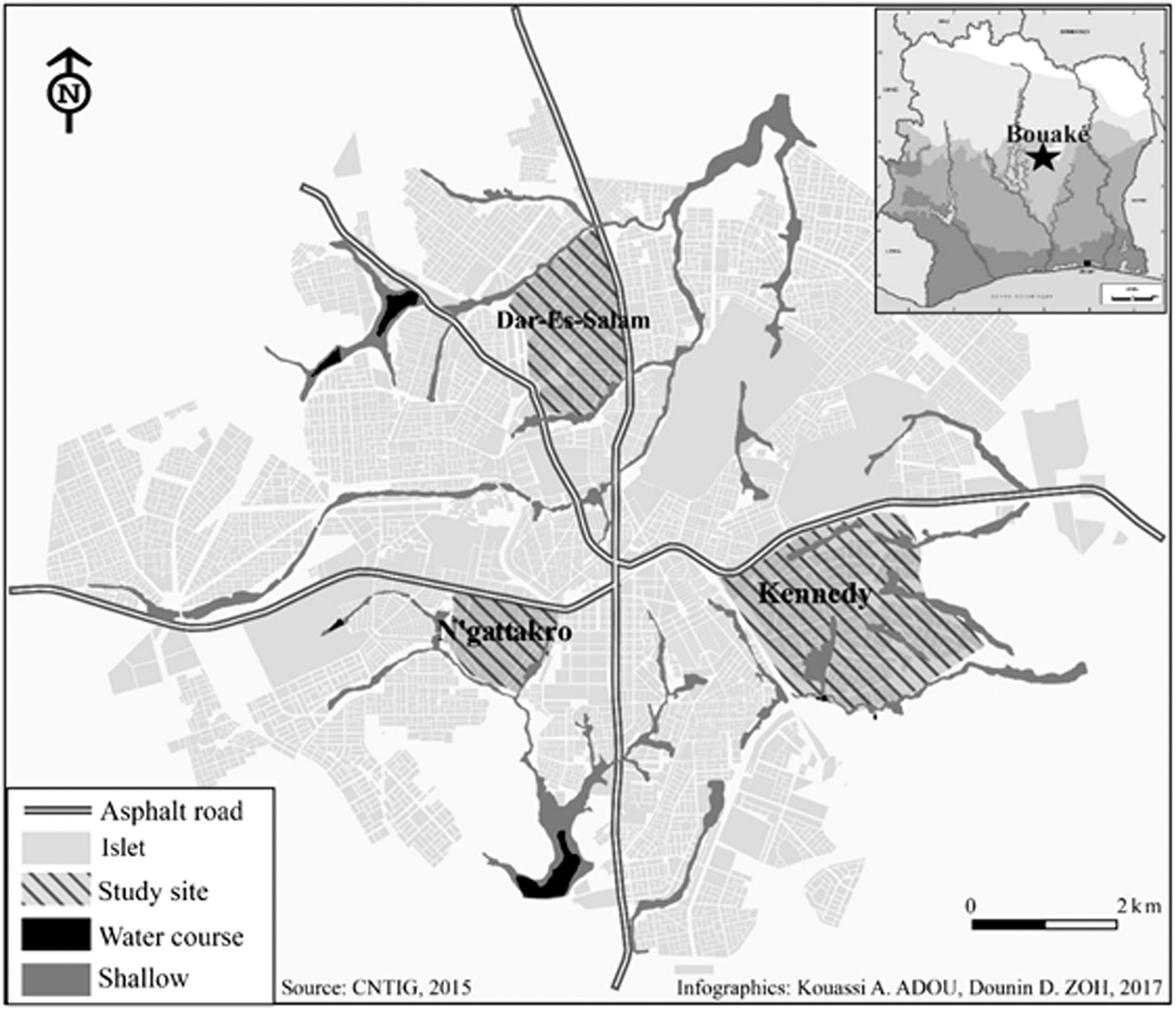
Study sites.
Adult mosquito collections and georeferencing of mosquito potential breeding sites
Adult mosquitoes were sampled from June 2014 to December 2015 using Human Landing Catches (HLC). A total of four surveys were conducted during this period: June and September 2014, corresponding to the wet season, and March and December 2015, corresponding to the dry season. In each study site, adult mosquitoes were sampled simultaneously inside and outside three households for two consecutive nights from 06:00 pm to 06:00 am. Mosquito collectors were organized in teams of two for each household. The first team worked from 06:00 pm to midnight and the second one from midnight to 06:00 am.
Larval samplings were only performed in October 2014 (wet season) in the three study sites. All water bodies likely to harbor mosquito larvae were prospected. All sampling points were georeferenced with a GPS version Garmin eTrex 20x and described to determine the distribution of mosquito breeding sites. A breeding site containing at least one mosquito larva or pupa was considered as positive. Collected mosquito larvae were reared at the insectary of the Institute Pierre Richet until adult stage.
Insectary-emerged adults and those collected by HLC were morphologically identified according to the identification keys of Gillies and Coetzee (1987). Only female malaria vectors collected by HLC were individually stored in labeled microcentrifuge tubes for further laboratory processing.
Laboratory processing
DNA from the head and thorax of each Anopheles specimen was extracted according Cornel and Collins (1996) and used for both molecular identification of A. gambiae s.l. species and determination of infection by Plasmodium species.
Molecular identification of species was performed using PCR SINE 200 amplification according to Santolamazza et al. (2008). Infection by Plasmodium was determined by real-time PCR according to Mangold et al. (2005).
Data analysis
The human biting rate (HBR) was expressed as the number of female anopheline bites per human per night. Values were averaged to calculate the HBR for the dry and the rainy season. The Plasmodium infection rate (IR) was calculated as the proportion of female anopheline found to be positive by quantitative PCR. The EIR was calculated as the product of the HBR and the IR of mosquitoes collected on humans. EIRs were calculated globally and by season (dry and rainy) for Bouaké and for each neighborhood. Data were analyzed using GraphPad Prism 5.1. Fisher tests were used to compare different proportions, and Mann–Whitney U test was used to compare HBR between dry and wet season and Kruskal–Wallis test was used to compare HBR between the three sites. All differences were considered significant at p value <0.05.
Results
Larval habitats and distribution of anopheline breeding sites
Larval collections were only performed during the wet season in October 2014. Out of 147 breeding sites prospected throughout the three sites, 22 were found positive for anophelines. All anopheline larvae were identified at adult stage as A. gambiae s.l.. These larvae were found in urban farming areas (rice and vegetable cropping), puddles, and footprints (Table 1). All these breeding sites were temporary.
Characteristics of Culicidae Breeding Sites in Study Sites
The values in parenthesis represents number of positive breeding sites;
A. gambiae s.l. larvae were mainly collected from breeding sites located at Dar Es Salam, a densely populated neighborhood. This neighborhood encountered for 63.63% (14/22) of all positive A. gambiae s.l. breeding sites identified in the study area. Larvae were collected from puddles throughout the neighborhood and from rice and vegetable cropping areas located on the outskirts of neighborhood (Fig. 2). In Kennedy, A. gambiae s.l. larvae were more concentrated and were found in puddles and rice cropping located at the center and on the northwestern outskirts of the neighborhood (Fig. 3). In N'gattakro A. gambiae s.l. larvae were only found in rice cropping areas on the outskirts of the neighborhood (Fig. 4).

Spatial distribution of potential and positive breeding sites of culicidae in Dar Es Salam.
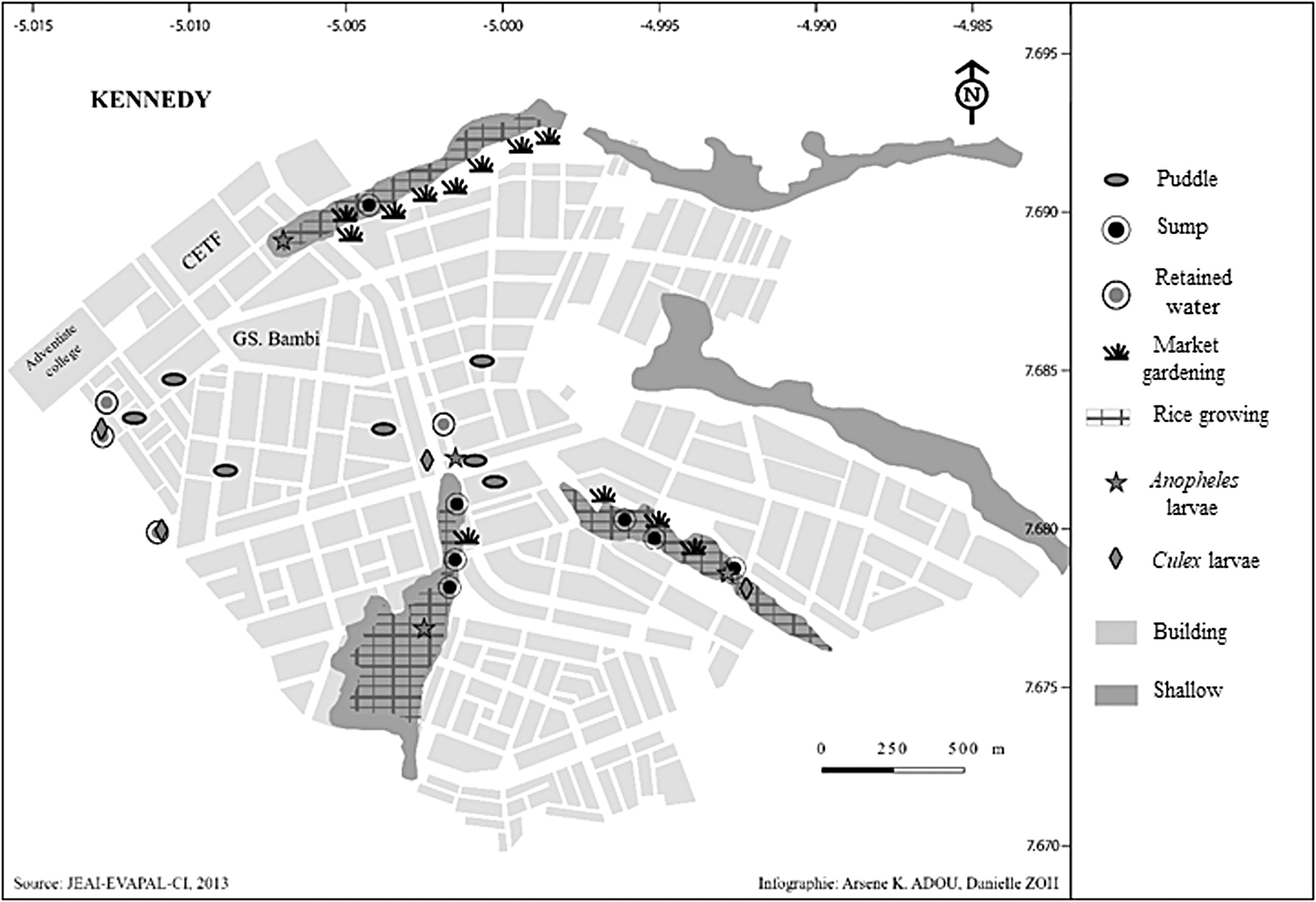
Spatial distribution of potential and positive breeding sites of culicidae in Kennedy.
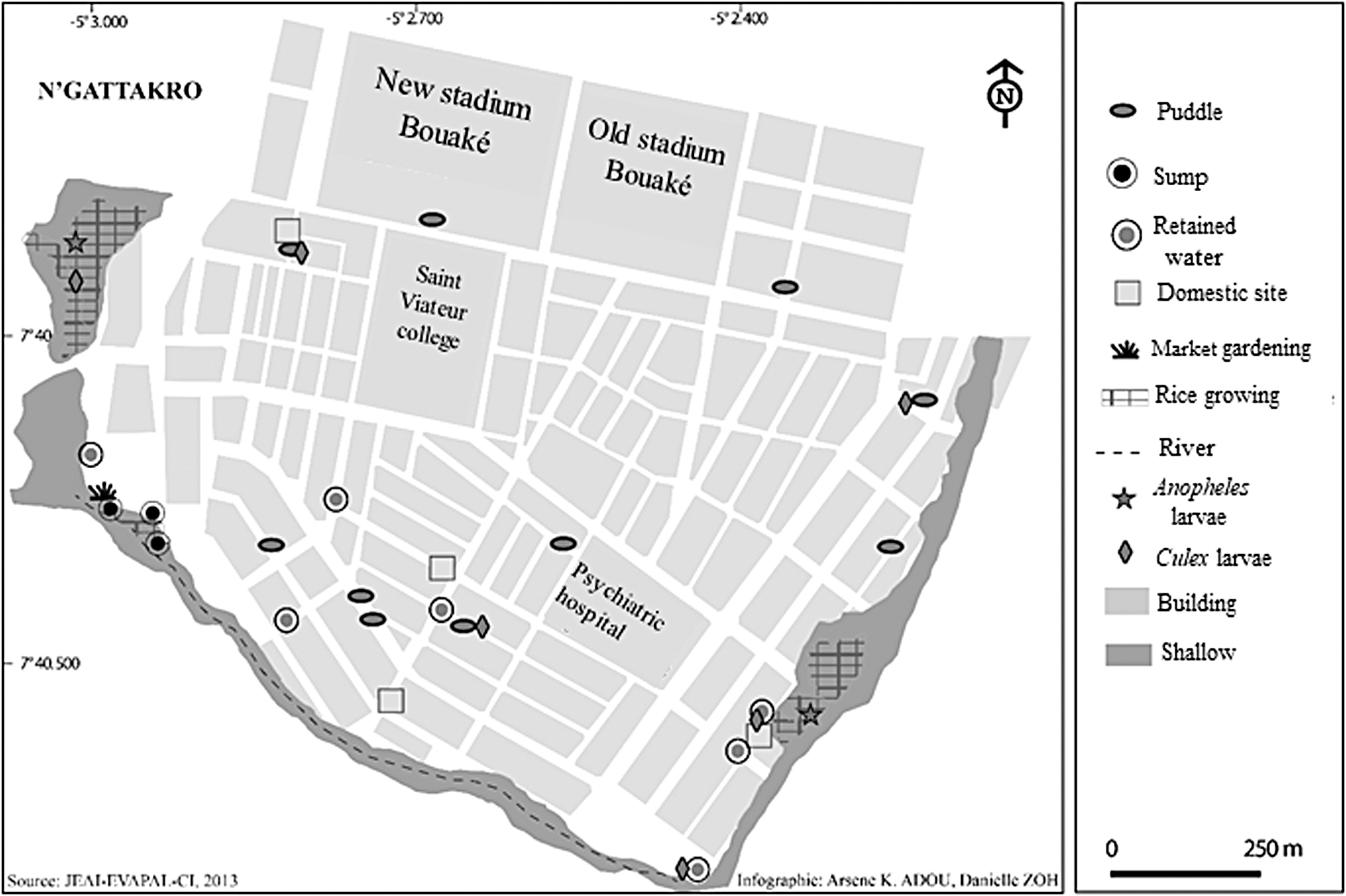
Spatial distribution of potential and positive breeding sites of culicidae in N'gattakro.
Adult mosquito collection and species composition
A total of 4204 mosquitoes were caught during 144 person-nights of collection on human bait (72 person-nights indoor and 72 person-nights outdoor) in the three neighborhoods. Overall, 970 anophelines were collected and mainly dominated by A. gambiae s.l. (96.8%, 939/970) with a few specimens of other species such as A. funestus (0.6%, 6/970), Anopheles pharoensis (1%, 10/970), Anopheles ziemanni (1.3%, 13/970), Anopheles welcomei (0.001%, 1/970), and Anopheles obscurus (0.001%, 1/970) (Table 2).
Composition of Mosquito Fauna in Three Neighborhoods
Values in bold represent the average of the data in each study site on the one hand and the total average of the data in all three sites.
Values in italics represent the total number of mosquito genus collected in each study site.
In Dar Es Salam and N'gattakro, A. gambiae s.l. only represented 2.2% (44/2006) and 16.4% (147/894) of mosquitoes collected in these neighborhoods, respectively. The genus Culex was predominant in these two neighborhoods with 96.9% (1943/2006) and 71.8% (642/894) of collected mosquitoes, respectively. Unlike Dar Es Salam and N'gattakro, A. gambiae s.l. was the dominant species collected in Kennedy with 57.4% (748/1304) of all mosquito species caught in this neighborhood. A. funestus was only caught in Kennedy and N'gattakro with three specimens in each neighborhood (Table 2).
Molecular identification of malaria vectors
All specimens caught during the wet and the dry season were identified by PCR. Among the 939 specimens tested by PCR, the A. gambiae complex population was composed of 841 A. gambiae s.s. (89.6%) and 98 Anopheles coluzzii (10.4%). This proportion of A. gambiae s.s. varied according to the study areas and was 65.9% (29/44) in Dar Es Salam, 95.1% (711/748) in Kennedy, and 68.9% (101/147) in N'gattakro (Fig. 5).

Anopheles gambiae s.s. and Anopheles coluzzii distribution in study sites.
Biting rates and biting behavior of A. gambiae s.l.
The average biting rate for A. gambiae s.l. in the city of Bouaké was 6.5 (95% CI = 4.6–8.4) bites/person/night (b/p/n). This biting rate varied between the study sites (p < 0.0001), ranging from 15.6 b/p/n (CI = 11–20.2) in Kennedy to 0.9 b/p/n (CI = 0.3–1.5) in Dar Es Salaam, and 3.1 b/p/n (CI = 1.4–4.7) in N'gattakro (Table 3). The aggressiveness of A. gambiae s.l. differed also by season. During the wet season, the average biting rate for A. gambiae s.l. was 8.8 b/p/n, with a peak of 15 b/p/n in September 2014; this fell to 3.6 b/p/n during the rainy season (December 2015). The difference in A. gambiae s.l. biting rates between neighborhoods persisted from the wet to the dry season. The average biting rate fell from 1.2 b/p/n to 0.6 b/p/n in Dar Es Salam, from 20.5 to 10.6 b/p/n in Kennedy, and from 4.7 to 1.5 b/p/n in N'gattakro. However, these differences between the wet and the dry season were not statistically significant (all p ≥ 0.05).
Biting Rate (b/p/n) of Anopheles gambiae Complex in Three Neighborhoods
Values in bold represent the average of the data in each study site on the one hand and the total average of the data in all three sites.
Values in italics represent the total number of mosquito genus collected in each study site.
m.a., biting rate; b/p/n, bite received per person per night;
Among the 939 A. gambiae s.l. caught, 537 (57.2%) were caught indoors, indicating that this species was globally more endophagic in the city of Bouaké. This was confirmed in two neighborhoods: Kennedy (58.6%, 438/748) and N'gattakro (53.1%, 78/147). On the contrary, A. gambiae s.l. seemed to be more exophagic (52.3%, 23/44) in Dar Es Salam.
Infectivity and entomological inoculation rates
Among 939 A. gambiae s.l. collected by HLC, 674 were processed by qPCR for Plasmodium detection and speciation. Among the three neighborhoods, only five A. gambiae s.l. from Kennedy, including four A. gambiae s.s. and one A. coluzzii, were found to be positive for Plasmodium infection. The average Plasmodium IR for the city of Bouaké was 0.74% (Table 4). P. falciparum and P. ovale were the two Plasmodium species identified in positive A. gambiae s.l. specimens. The infectivity rate did not vary between the wet and the dry season (p = 37.01). In Kennedy, P. falciparum and P. ovale IRs were 0.81% and 0.20%, respectively. While P. falciparum infection was recorded in both wet and dry seasons, P. ovale infections were only recorded during the dry season.
Infectivity Rate and Entomological Inoculation Rate (ib/p/n) to Plasmodium of A. gambiae s.l. in Three Neighborhoods
Values in bold represent the average of the data in each study site on the one hand and the total average of the data in all three sites.
Values in italics represent the total number of mosquito genus collected in each study site.
N, number of mosquito female tested; S, infectivity rate; ib/p/n, infectious bite received per person per night.
EIR, entomological inoculation rate.
The average EIR in Bouaké was estimated at 0.05 infectious bites/person/night (ib/p/n), or 18 infectious bites/person/year. No Plasmodium transmission was found in Dar Es Salam and N'gattakro. In Kennedy, the annual EIR was 58 ib/p/year. The annual EIRs for P. falciparum and P. oval were 47 and 11 ib/p/year, respectively. P. falciparum transmission was quite permanent in this neighborhood, while P. ovale transmission only occurred during the dry season (Table 4).
Discussion
The city of Bouaké suffered an armed conflict and a sociopolitical crisis from 2002 to 2011 that led to large population moves, environmental modifications, and an interruption of malaria control initiatives (Betsi et al. 2007). Following the crisis, the population is increasingly reinvesting in the city and resettling in formerly abandoned neighborhoods. The present study aimed to provide relevant entomological data on the risk of malaria transmission in the city of Bouaké to better guide the NMCP. Our study allowed to identify six Anopheles species among which A. gambiae s.l. and A. funestus were already incriminated in malaria transmission in Bouaké (Dossou-Yovo et al. 1998a). This diversity of Anopheles species could be explained by the presence of favorable conditions for larval development of each of these species: permanent watercourses, puddles, footprints, and exploited shallows that create a large number of suitable larval habitats. In this study, A. gambiae s.l. was the predominant species of mosquito fauna collected in Kennedy and had a higher density compared to other neighborhoods. The main reason could be linked to ecological factors owing to the presence of heavily exploited shallows for agricultural activities compared to the other neighborhoods. This gives it an environment close to the rural environment, therefore favorable to the development of A. gambiae s.l.. This may also be explained by the abandonment of this neighborhood by the population following the military-political crisis from 2002 to 2011 in Côte d'Ivoire, which led to the creation of a large number of larval habitats of this species (Adja and Yobo 2015). In addition, populations living on the outskirts of many African cities have been shown to be more exposed to malaria than those living in urban centers (Robert et al. 2003). Also, in this neighborhood, vector density was higher in September, in rainy season, and then decreased with precipitation to reach a minimum in December in the dry season. This would be explained by the abundance of breeding sites of malaria vectors during the rainy season and would decrease during the dry season. The high vectors density in the rainy season was described in several studies in tropical zones (Carnevale et al. 1985, Edillo et al. 2004).
Molecular analysis shown that A. gambiae
This study also showed that A. gambiae s.l. were caught both indoors and outdoors, suggesting that malaria transmission can occur both indoors and outdoors. However, malaria vectors were mainly endophagic in Kennedy and N'gattakro and exophagic in Dar Es Salam. This difference in biting behavior according to the neighborhood should be taken into account when implementing vector control means.
Plasmodium parasites are mainly transmitted by A. gambiae s.l. as previously reported (Dossou-Yovo et al. 1995). While P. falciparum was transmitted during both the dry and the rainy seasons, P. ovale was only transmitted during the dry season. This suggests a permanent and stable transmission of malaria in the city of Bouaké. However, this result should be taken with caution. Positive Anopheles mosquitoes were only found in Kennedy with a similar infectivity rate between both seasons. No positive mosquitoes were found in Dar Es Salam and N'gattakro. Plasmodium transmission observed in Kennedy in this study would confirm the observations of some authors who showed that populations living on the outskirts of cities are more exposed to malaria than those living in the city center (Robert et al. 2003). However, the absence of Plasmodium-infected mosquitoes in Dar Es Salam and N'gattakro does not mean there is no malaria infection in neighborhoods. A recent parasitological study in those neighborhoods showed that the prevalence of P. falciparum in children aged 0 to 14 years was ∼90% in Dar es Salam, Kennedy, and N'gattakro (Traore et al. 2018). Since malaria vectors are present in Dar Es Salam and N'gattakro with breeding sites favorable to their development, long-term mosquito sampling on a large scale could allow to better characterize malaria transmission in this urban environment.
Conclusion
The diversity of potential breeding sites in the three neighborhoods leads to a proliferation of mosquitoes dominated by Culex genus in Dar Es Salam and N'gattakro and Anopheles genus in Kennedy. In these neighborhoods, A. gambiae s.l. is the main malaria vector. This study showed that malaria transmission in the city of Bouaké is highly heterogeneous and was mainly focused in the neighborhood of Kennedy. Malaria transmission is permanent and stable with A. coluzzii and A. gambiae s.s. as the main malaria vectors. These vectors were globally endophagic. New studies, such as entomologic surveys and human surveys, are needed to better understand the factors of this heterogeneity for an efficient control of the disease.
Footnotes
Authors' Contributions
A.M.A., A.Y., and F.C. conceptualized and designed the study, A.M.A. and D.D.Z. defined the intellectual content, D.D.Z., A.B.S., D.M.S.K., and N.G.C. performed experimental study and data collection, D.D.Z., N.G.-C., and A.B.S. analyzed the data, A.M.A., A.B.S., and D.D.Z. prepared the article, A.B.S., A.Y., and F.C. edited the article, A.M.A., N.G.-C., A.Y., and F.C. revised the article. All authors read and approved the final version of the article.
Acknowledgments
We thank Aboubacar Koné, Bernard Koffi, Patrick Akoliba, and Hadji Diallo for their technical assistance during mosquito collections and field analysis, Francois Dipomin and Gyslain Aka for their assistance in statistical analysis, and Arsène Adou and Mardoché Azognigbo for generating the figures map. We are also grateful to Bouaké authorities and populations for their authorization and assistance in carrying out the study.
Author Disclosure Statement
No conflicting financial interests exist.
Funding Information
This research was supported by the “Jeune Equipe Associée à l'IRD” EVAPAL-CI project funded by IRD (Institut de recherche pour le développement, France). ZOH D. Danielle was supported by PhD fellowships provided by IRD.