




Abstract
Lyme disease, caused by Borrelia burgdorferi sensu lato (s.l.) complex, is the most common vector-borne disease in North America. This disease has a much lower incidence in western compared with eastern North America. Passive tick surveillance data submitted over 17 years from 2002 to 2018 were analyzed to determine the occurrence of tick species and the prevalence of Borrelia spp. in ticks in British Columbia (BC), Canada. The BC Centre for Disease Control Public Health Laboratory received tick submissions from physicians, veterinarians, and BC residents. Ticks were identified to species, and all ticks, except Dermacentor andersoni, were tested using generic B. burgdorferi s.l. primer sets and species-specific PCR primer sets for B. burgdorferi sensu stricto (s.s.). Tick submission data were analyzed to assess temporal and geographical trends, tick life stages, and tick species. Poisson regression was used to assess temporal trends in annual tick submissions. A total of 15,464 ticks were submitted. Among these, 0.29% (n = 10,235) of Ixodes spp. ticks and 5.3% (n = 434) of Rhipicephalus sanguineus ticks were found carrying B. burgdorferi s.s. B. burgdorferi s.s. was primarily detected in Ixodes pacificus (52%; n = 16) and Ixodes angustus ticks (19%; n = 6) retrieved from humans (n = 5) and animals (n = 26). B. burgdorferi was found in ticks submitted throughout the year. Ixodes spp. ticks were primarily submitted from the coastal regions of southwestern BC, and D. andersoni ticks were primarily submitted from southern interior BC. The number of human tick submissions increased significantly (p < 0.001) between 2013 and 2018. The annual prevalence of B. burgdorferi in ticks remained stable during the study period. These findings correspond to those observed in US Pacific Northwestern states. Passive tick surveillance is an efficient tool to monitor long-term trends in tick distribution and B. burgdorferi prevalence in a low endemicity region.
Introduction
Lyme borreliosis, or Lyme disease, is caused by spirochetes in the Borrelia burgdorferi sensu lato (s.l.) complex, which are transmitted to humans mainly by Ixodes species (spp.) ticks (Halsey et al. 2018). Lyme disease is an acute infection characterized by rash, fever, fatigue, and myalgia. If untreated, it can lead to complications affecting the nervous system, heart or joints and can be debilitating for some people (Steere 2018). In British Columbia (BC), the first reported locally acquired Lyme disease case occurred in 1988 (Banerjee 1988). The first isolation of B. burgdorferi sensu stricto (s.s.) in BC occurred in 1993 in adult Ixodes pacificus and immature Ixodes angustus ticks (Banerjee 1993). Lyme disease is endemic in BC, yet incidence remains much lower than that in eastern North America. The incidence was 0.2–0.8/100,000 between 1997 and 2008, similar to that in the western United States (Henry et al. 2011, Xu et al. 2019).
In western North America, I. pacificus is the primary vector of B. burgdorferi s.l. in humans (Eisen et al. 2018, Rose et al. 2019). Its established geographic distribution extends from Alaska, through BC in Canada to Baja California and Mexico along the Pacific coast (Durden and Keirans 1996, Hahn et al. 2020). I. pacificus ticks are distributed across southern BC, predominately in the Greater Vancouver area and on Vancouver Island and have been detected as far as north as Smithers (N54.80, W127.20) based on active surveillance (Mak et al. 2010, Morshed et al. 2015). The deer mouse, Peromyscus maniculatus, has a widespread distribution in BC and acts as a common host for larval and nymphal I. pacificus ticks. Further inland, I. pacificus ticks are uncommon and may be dispersed by birds during spring migration (Morshed et al. 1999, 2005, Scott et al. 2001). However, the Rocky Mountain wood tick, Dermacentor andersoni, is common in the southeastern area of BC. This tick is not a vector of Lyme disease (Dolan et al. 1997) but can transmit Rickettsia rickettsii and Francisella tularensis, which cause Rocky Mountain spotted fever and tularemia, respectively (Dergousoff et al. 2009).
The distribution and prevalence of tick species in Eastern and Central Canada and the eastern United States are well known. Recent studies describe the tick species distribution and B. burgdorferi prevalence in the western United States, but the same is lacking for BC (Xu et al. 2019, Dykstra et al. 2020). This study aims to understand tick distribution patterns, seasonality, and enzootic status of the Lyme disease-causing pathogen B. burgdorferi s.l. in BC and contribute to the understanding of tick distribution along the North American west coast.
Materials and Methods
Geographic area of study
BC is Canada's westernmost province, encompassing a land area of 944,735 km2 (364,800 square miles). It has a vast diversity of landscapes that include rocky coastlines, coniferous forests, lakes, mountains, grassy plains, and inland deserts (
Sampling and testing methods
The BC Centre for Disease Control (BCCDC) Public Health Laboratory (PHL) has been identifying ticks and testing for the presence of B. burgdorferi by culture and/or PCR since 1993. Ticks included in this study were obtained from passive surveillance from 2002 to 2018. When individuals or their pets were bitten by a tick, the removed tick was submitted by a physician or veterinarian to the BCCDC PHL for species identification and testing. Ticks were submitted in a plastic container along with information on the host species (human or animal), date of exposure, and geographic location of likely exposure, clinic address, or address of submitter. Tick species were first identified using stereo microscopes (SZX 10; DF Plapo; Olympus) following tick identification manuals (Furman and Loomis 1984). All tick species (n = 11,155), except D. andersoni, as it is not a B. burgdorferi s.l. vector, were tested by culture and confirmed by traditional PCR (January 2002 to May 2012), or real-time PCR (June 2012 to December 2018) to confirm the presence of B. burgdorferi s.l. and B. burgdorferi s.s.
For culture, tick gut materials were inoculated in BSK II media to recover live spirochetes. Briefly, live ticks were surface sterilized with 10% H2O2 for 10 min, followed by quick dip in 70% isopropyl alcohol, and washed thoroughly three times using sterile distilled water. The midgut was then removed and homogenized in 500 mL BSK II. Two hundred microliters of homogenized midgut materials was placed in a 2.5 mL BSK II media tube and incubated at 34°C, and the remaining 300 μL were stored for future use. Cultures were checked weekly by dark-field microscopy for motile spirochetes for up to 30 days (Barbour 1984).
For PCR, DNA was first extracted from 200 μL of homogenized midgut materials using the Qiagen DNeasy Tissue Kit (Qiagen, Ontario, Canada) following the manufacturer's instructions. From January 2002 to May 2012, a traditional PCR was used to confirm positive cultures. It targets a portion of the variable spacer region gene between two conserved structures, the 3′ end of the 5S ribosomal RNA (rRNA; rrf) and the 5′ end of the 23S rRNA (rrl) (Persing et al. 1990, Postic et al. 1998). Beginning in June 2012, real-time PCR TaqMan ABI 7500 Platform (Applied Biosystems) with TaqMan Chemistry (ABI Universal Master Mix) was used. This test was designed to target the 23S rRNA of Borrelia species (including both Lyme disease group species as well as relapsing fever group species). Any PCR-positive tick homogenate DNA was confirmed on a second PCR, which targeted the outer surface protein A gene (for B. burgdorferi s.s.) (Persing et al. 1990, Postic et al. 1994).
Statistical analyses
Descriptive analyses on tick submissions were conducted to assess the number and proportion by tick species, tick life stage, host species (human or animal), year and month of submission, location of exposure, submission or residence, and test result. Due to incomplete data on tick requisition forms, an algorithm was established to determine the most likely location of tick exposure: ticks were mapped by place of exposure, residence of submitter or of the human/animal host, or clinic that submitted the tick specimen (in this order of priority). Ticks submitted for research projects or collected by active surveillance were excluded. Host travel information was not collected; however, ticks that were recorded on the requisition forms as encountered outside BC were excluded.
Tick species were assessed by month of collection and separated into three categories: I. pacificus, D. andersoni, and all other species. The mean numbers of ticks submitted each month, by species, for all years (2002–2018) were calculated to assess seasonality by tick species. Standard deviations of the mean were calculated for both I. pacificus and D. andersoni.
Poisson regression models were used to assess the trends in the annual number of tick submissions. A change-point analysis was used to identify the year in which the number of submissions changed. The regression model tested for a significant time trend in the number of submissions during 2013–2018 separately for animal and human hosts. Overdispersion in the count data was accounted for by assuming a “quasi-Poisson” distribution, which models the variance as a linear function of the mean. A chi-squared test was used to compare the proportion (prevalence) of B. burgdorferi-positive ticks in I. pacificus and I. angustus species. Statistical significance was reported at p < 0.05.
All descriptive analyses were conducted in MS Excel (Microsoft, Corp., Redmond, WA). All statistical analyses were conducted in R Studio (R Core Team 2019), using Tidyverse programming (Wickham et al. 2019). Geographic mapping was performed using ArcGIS (Esri, Inc., Redlands, CA). For this study research ethics board review was not required, as this study was part of routine public health operations for quality improvement and program evaluation.
Results
A total of 15,453 hard (Ixodidae) ticks and 11 soft (Argasidae) ticks were submitted to the BCCDC PHL from January 2002 to December 2018. There were 12,791 (83%) adult females, 1852 (12%) adult males, 84 (0.5%) unspecified adult ticks, 625 (4%) nymphs, and 45 (0.3%) larvae. In some cases, life stage (n = 67 ticks) and sex (n = 84) could not be determined due to submissions of incomplete tick bodies. In total, 30 tick species were identified from 8 genera (Table 1).
Genus and Species of Ticks Submitted to the Public Health Laboratory in British Columbia, Canada, Through Passive Surveillance, 2002–2018
Other Ixodes species: Ixodes dammini (n = 1), Ixodes hearlei (n = 1), Ixodes hexagonus (n = 1), Ixodes jellisoni (n = 1), Ixodes kingi (n = 1), Ixodes ovatus (n = 1), Ixodes spinipalpis (n = 1), and Ixodes sculptus (n = 1).
s.l., sensu lato.
Ticks were submitted from across the province. I. pacificus and I. angustus were primarily submitted from the wet temperate regions in the southwestern mainland and Vancouver Island, whereas D. andersoni ticks were primarily submitted from the hotter and drier southeastern region. This pattern was particularly clear when examining areas with 3 or more years of consecutive tick submissions (Fig. 1).
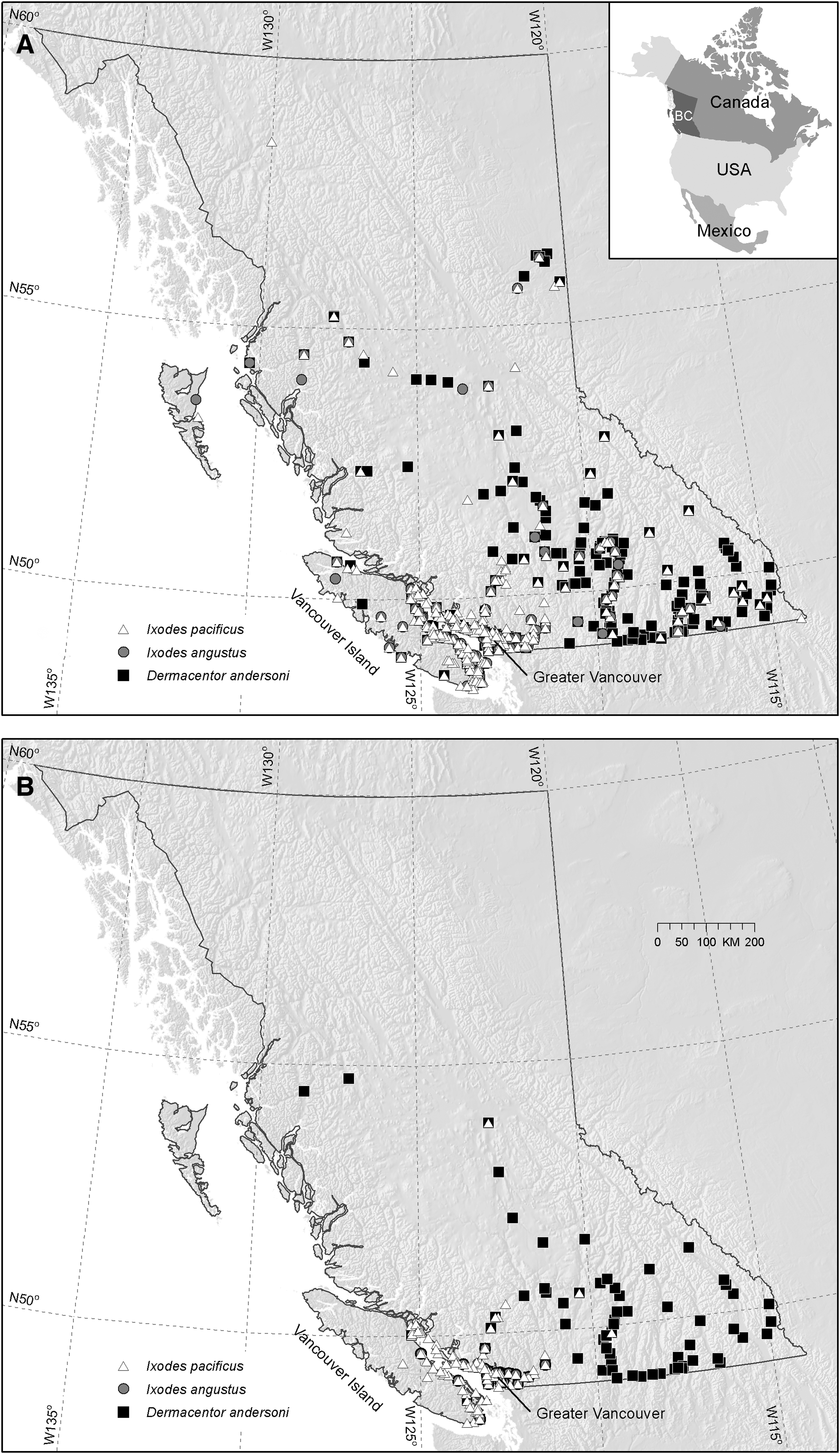
Geographic distribution of Ixodes pacificus, Ixodes angustus, and Dermacentor andersoni:
Ticks were submitted throughout the year, but with distinct seasonal patterns for various tick species and life stages. Submissions of all I. pacificus occurred throughout the year, with larger numbers submitted between February and June, peaking in April (Fig. 2). I. pacificus nymphs were submitted in small numbers between February and November (data not shown). D. andersoni had a shorter season, being submitted mainly between March and July, and peaked later (May). Submissions of other tick species were low throughout the year. The highest number of tick submissions from humans occurred in the spring (April to June), whereas ticks from animals were submitted more consistently throughout the year (data not shown).
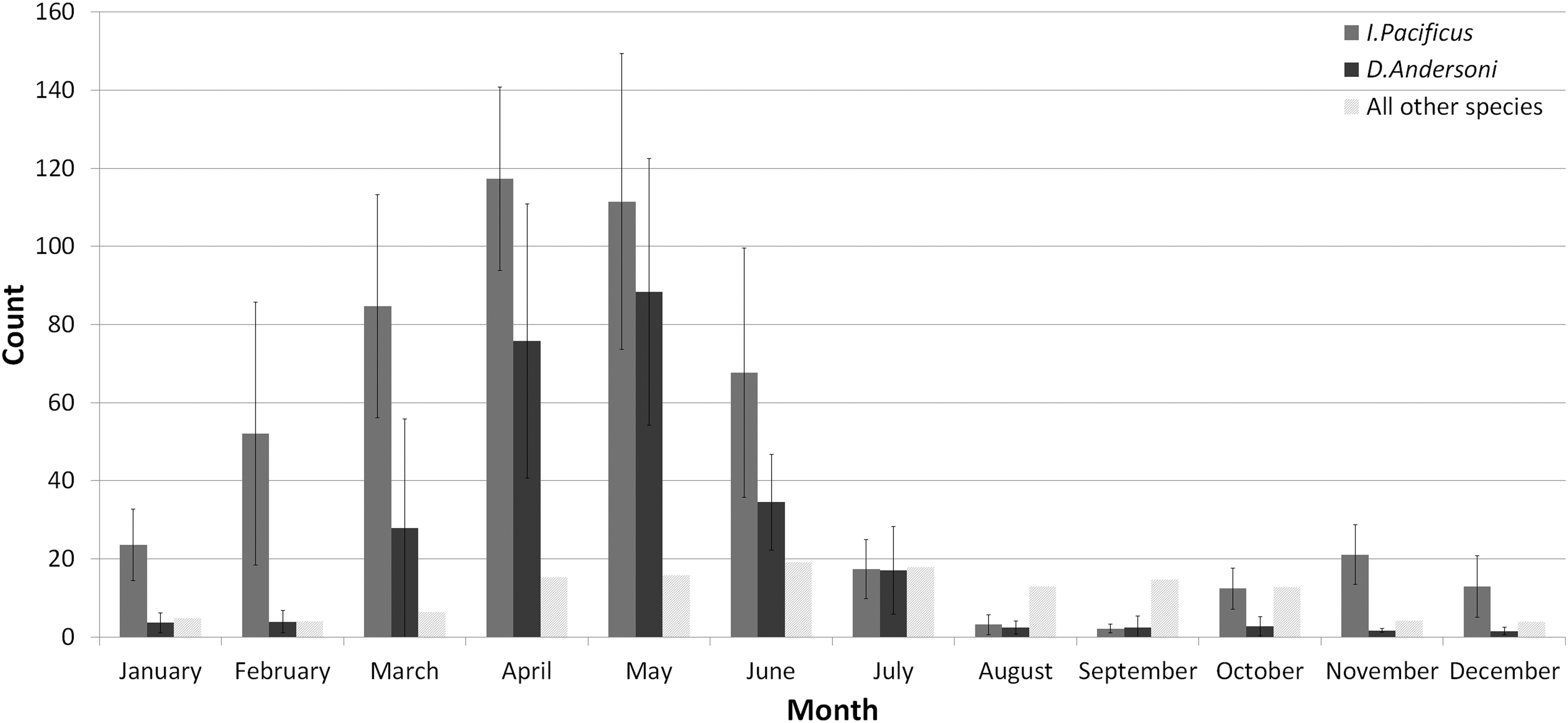
Mean and standard deviation of passive tick submissions by species and month in British Columbia, Canada, 2002–2018.
The annual number of ticks submitted varied from 687 in 2002 to 1399 in 2018, with a median of 884 (Fig. 3). The number of ticks submitted changed in 2013. Between 2013 and 2018, we found an increasing trend in submission of ticks from humans (p < 0.001) and a weakly decreasing trend in ticks submitted from animals (p = 0.065). The increase in submission of ticks from humans was observed in I. pacificus along the southwestern coast and Vancouver Island, and in D. andersoni in the southeastern region of BC (data not shown).

Passive tick submissions by human and animal hosts in British Columbia, Canada, 2002–2018.
B. burgdorferi isolates were recovered from 0.28% (n = 31) of examined ticks, of which approximately half were from I. pacificus ticks (n = 16), followed by I. angustus (n = 6), Ixodes scapularis (n = 4), and Ixodes auritulus (n = 4) (Table 2). The prevalence of B. burgdorferi ticks was higher in I. angustus in comparison to I. pacificus (0.6% vs. 0.2%, p < 0.01). Additionally, we isolated B. burgdorferi s.s. from a Rhipicephalus sanguineus s.l. tick, and two Borrelia mayonii-like strains from I. pacificus ticks (data not shown). B. burgdorferi-positive I. auritulus ticks accounted for 6% of all I. auritulus submissions. This is higher than all other tick species combined for which positive ticks accounted for <1% of submissions. B. burgdorferi was present in ticks submitted in each month of the year.
Borrelia burgdorferi Sensu Stricto-Positive Ticks by Species, British Columbia, Canada, 2002–2018
Bird (n = 4), cat (n = 3), squirrel (n = 2), unknown animal (n = 2).
Tick from dogs accounted for 48% (n = 15) of all B. burgdorferi-positive specimens, whereas 36% (n = 11) came from other animals and 16% (n = 5) from humans (Table 2). Positive ticks were found throughout BC, with 45% (n = 14) from the southwestern BC mainland and 39% (n = 12) from Vancouver Island. Positive ticks were found each year, with an annual prevalence of 0.1–0.4%. There was no apparent trend in prevalence over time. The highest percentage of positive ticks at 0.4% was recorded in 2005 (4/901).
Discussion
Passive tick surveillance over 17 years provides insights on BCs tick population, B. burgdorferi s.l. presence in ticks, as well as the risk of nonendemic tick species' introduction into the province. During this study, B. burgdorferi s.l. was detected in only 0.3% ticks, with half found in I. pacificus ticks. The number of ticks submitted increased starting in 2013, yet the proportion that tested positive for B. burgdorferi remained low and stable throughout the study period (annual prevalence range: 0.1–0.4%). These findings are similar to those found by others along the Pacific Northwest but are in contrast to the higher and increasing prevalence of I. scapularis in eastern Canada (Ogden et al. 2009, Xu et al. 2019, Dykstra et al. 2020, Hahn et al. 2020).
BC has previously been described as having the greatest diversity of tick species in Canada (Gregson 1956). In this study, we identified 29 tick species. Given the diversity of tick species and environments in BC from highly humid to arid areas, a greater diversity of B. burgdorferi s.l. is possible. We had previously reported finding two B. mayonii-like strains (Morshed et al. 2016) and Borrelia hermsii (Morshed et al. 2017). In this study, we isolated B. burgdorferi s.s. from a Rhipicephalus spp. tick. To the best of our knowledge, this is the first of such report. This could be an incidental finding where a partially fed Rhipicephalus spp. was recovered from an infected dog. Non-native tick species such as Ixodes ricinus, Dermacentor occidentalis, Amblyomma spp., and Hyalomma spp. were also found. We believe that these were likely associated with travel-related exposures.
Submissions of endemic tick species as well as positive ticks from humans and animals in BC occurred throughout the year, posing an acquisition risk for humans year-round. These findings align with western United States tick submission trends (Xu et al. 2019, Hahn et al. 2020). I. pacificus is active year-round, with adults' host-seeking from late autumn through early spring and immature life stages host-seeking from early spring through early autumn.
Our study indicates that B. burgdorferi s.s. is the most common genospecies in BC ticks, particularly in I. pacificus, with the exception of two B. mayonii findings. However, the prevalence of positive ticks remained low throughout the study period, indicating that the risk of contracting Lyme disease in BC remains low. These trends are consistent with previous studies in BC and in other parts of the Pacific Northwest (Morshed et al. 2015, MacDonald et al. 2017, Xu et al. 2019, Dykstra et al. 2020). The prevalence of 0.3% is much lower than the prevalence of B. burgdorferi in I. scapularis in eastern North America (Halsey et al. 2018). Furthermore, a vector competence study showed that I. pacificus is less effective in transmitting B. burgdorferi than I. scapularis (Couper et al. 2020).
Interestingly, in this study, the prevalence of B. burgdorferi in I. pacificus was lower than that in I. angustus and I. auritulus. I. angustus is a less competent vector than I. pacificus when studied in a mouse model (Peavey et al. 2000). I. angustus generally feeds on animals, although human Lyme disease likely transmitted by I. angustus has been recorded (Damrow et al. 1989). In our study, only 1 of the 10 positive I. angustus was submitted from a human host, suggesting that I. angustus may play less of a role in B. burgdorferi transmission in humans. I. auritulus feeds primarily on avian populations, which act as dead-end hosts, minimizing the risk of transmission to humans.
The prevalence of B. burgdorferi infection in 19 I. scapularis ticks was 1.0%. We believe that these ticks came from humans and animals that travelled outside BC. Furthermore, other tick species such as I. ricinus, D. occidentalis, Rhipicephalus spp., Amblyomma spp., and Hyalomma spp. were likely introduced into the region by human travelers or animal importations. These ticks are not believed to be endemic to the Pacific Northwest based on documented tick distribution in the Pacific Northwest, previous BC tick surveillance data, and exposure information found on tick submission requisitions (Morshed et al. 2015, Hecht et al. 2019, Dykstra et al. 2020, Francis et al. 2020).
Tick submissions increased from humans and decreased from animals between 2013 and 2018. In 2014, the PHL started charging to identify and test ticks from animals, potentially leading to decreased veterinary submissions. The reasons for the increase in human tick submissions since 2013 may be varied. In part, the increase may be due to animal ticks being submitted as human ticks to avoid the fee associated with veterinary submissions. Although there were no specific public communications or awareness-raising activities in BC, the increase in tick submissions may be related to an increase in awareness of Lyme disease due to its emergence in eastern Canada during this time period. This was noted as the reason for the recent increase in ticks submitted in Washington and Alaska (E. Dykstra, abstract;
A limitation of our study is the inability to differentiate between tick exposure location, place of residence, or clinic address. Furthermore, information on the acquisition of ticks from outside BC was not always available. Another limitation was the inability to test for other common tick-borne pathogens agents in North America, such as Anaplasma, Ehrlichia, and Babesia spp., to determine the prevalence rates of these pathogens in BC ticks. In this study, we only report on ticks collected passively when found on hosts. Although passive data cannot measure the true prevalence of B. burgdorferi infection in the BC tick population, they are a useful and efficient adjunct to active tick collection studies. Passive and active surveillance are essential tools for identifying newly established tick species and increases in range and abundance of established tick species.
This study is the first documentation of long-term passive tick surveillance in BC. The 17 years (2002–2018) of surveillance data reveal that despite an increased number of tick submissions, the prevalence of B. burgdorferi remains low and stable in Ixodes spp. populations. This study creates a baseline that can facilitate further understanding of the presence and distribution of tick-borne diseases in BC, such as Ehrlichiosis, Anaplasmosis, and Babesiosis. Continued tick surveillance is required to monitor the trends and emergence of B. burgdorferi and other tick-borne pathogens in BC.
Footnotes
Authors' Contributions
M.G.M.: conceptualization, methodology, writing—original draft. M.-K.L.: methodology, resources, investigation, writing—reviewing and editing. E.B.: formal analysis, writing—original draft, writing—reviewing and editing. S.M.: visualization, writing—reviewing and editing. E.F., E.D., and B.H.: writing—reviewing and editing. J.N.: data curation, writing—reviewing and editing. M.O.: formal analysis, writing—reviewing and editing. E.G.: writing—original draft, supervision, writing—reviewing and editing. All authors revised the article and approve the final version.
Acknowledgments
Authors would like to thank Teresa Lo, Quantine Wong and Navdeep Chahil for their help for tick identification as well as laboratory supervision. Thanks are due to the Public Health Agency of Canada for providing financial assistance for collating tick surveillance data. We also thank the BCCDC PHL parasitology and Zoonotic Diseases and Emerging Pathogens staff for their contribution to identify ticks as well as for molecular work.
Author Disclosure Statement
No competing financial interests exist.
Funding Information
Part of this study funded by the Public Health Agency of Canada and the BC Centre for Disease Control Foundation.