




Abstract
Background:
Ticks and tick-borne diseases are a major issue. These recent years, tick-borne diseases have attracted much attention because of their increasing incidence and the significant damage that they cause to livestock and human health. The objective was to identify the different species of ticks found in cattle and to determine the prevalence of Crimean-Congo hemorrhagic fever virus (CCHFV) in these different areas.
Methods:
The study was conducted in five regions of Côte d'Ivoire belonging to different geographic areas. The ticks were collected from cattle. The identification of ticks was done with a binocular microscope using the identification keys. The detection of CCHFV was done by RT-PCR using specific primers and probes.
Findings:
Of the ticks sampled, 4088 (96.9%) were adults. Of the genera Amblyomma, Hyalomma, and Rhipicephalus. The genus Rhipicephalus had the highest number with 54.3% of the collected ticks embodied in five species. It is followed by the genus Amblyomma with 43.7% and represented by only one species. The genus Hyalomma represented by seven species was obtained in a low proportion of 2.1%. The predominant species identified was Rhipicephalus (Boophilus) microplus with (48.7%), followed by the species Amblyomma variegatum (43.7%), and the other species <2%. In this study, CCHFV was detected in ticks belonging to the three genera identified. All-inclusive, 16 ticks (0.37%) out of 4219 collected from cattle tested positive for CCHFV. The species tested positive for CCHFV are A. variegatum, Hyalomma impressum, Rhipicephalus (Boophilus) geigyi, R. (B.) microplus, and Rhipicephalus sanguineus. All 16 ticks positive for CCHFV are adults and were obtained from the Korogho (11 ticks) and Bouaflé (5 ticks) regions.
Conclusion:
Three genera of ticks, Amblyomma, Hyalomma, and Rhipicephalus and 13 species infesting cattle were identified during this study. Eleven ticks were positive for CCHFV in Korhogo and five in Bouaflé. The genus mainly infested was A. Variegatum
Introduction
Crimean-Congo hemorrhagic fever virus (CCHFV) belongs to the Nairovididae and Orthonairovirus family and genus, respectively, which is an emerging tick-borne virus. It is endemic in most parts of Africa, Asia, as well as southern Europe. As a tick-borne zoonotic pathogen, CCHFV can cause severe hemorrhagic symptoms in humans with high fatality rates (5 up to 30%) (Schulz et al. 2020). Crimean-Congo hemorrhagic fever (CCHF) is the second most widely distributed arboviral disease worldwide. CCHF is transmitted to humans by bites of infected ticks from the Ixodidae family, mainly those of the Hyalomma genus, or through human contact with the blood and tissues of infected livestock (Kassiri et al. 2020). Ticks, particularly, species of the genus Hyalomma, are the main vectors and reservoir for CCHFV (Spengler and Estrada-Peña 2018). Ticks are blood-sucking arthropods that parasitize almost all vertebrates around the world. They transmit many pathogens such as viruses, bacteria, protozoa, and helminths, some of which are common to humans and animals (Boyard 2007, Aubry et Gaüzère 2016). To this end, they play a major role in human and animal epidemiology. Ticks are the most important ectoparasites in cattle. Around 80% of these animals worldwide are infested with ticks (Bowman and Nuttall 2008).
Viral infections are considered as one of the principal threats to human life and health worldwide (Al Mussaed 2018, Mohamed et al. 2018). Changes in the environment, climate, and agriculture may affect the distribution of ticks and eventually the emergence of diseases (Woolhouse and Gowtage-Sequeria 2005). CCHF has a wide geographic distribution; cases have been reported in more than 30 countries across Africa, Southeastern Europe, the Middle East, and Western Asia. In the western African countries, namely, Nigeria, Mauritania, and Senegal, serologic evidence of CCHF infections in humans and animals has been frequently documented (David-West et al. 1974, Gonzalez et al. 1990, Wilson et al. 1990). CCHFV has a wide geographic range and has been described in around 30 countries in the Middle East, Asia, Europe, and Africa, including Mali and neighboring countries.
Studies conducted in Mali have shown a high prevalence of CCHF in many regions (Zivcec et al. 2014, Kamissoko et al. 2017, Baumann et al. 2019). In Côte d'Ivoire, cattle are coming mainly from the different bordering sub-Saharan countries. To date, little is known about the prevalence of this virus in Côte d'Ivoire. The current study has been designed to deepen our understanding on the extent of the tick's involvement in the transmission of CCHF virus by assessing their geographical distribution and investigating on the presence of the CCHF virus in those ticks in large cattle breeding areas of Côte d'Ivoire.
Material and Methods
Study area
The study was conducted in five regions of Côte d'Ivoire with different geographic areas, namely, Abidjan (Latitude/Longitude: 5° 18′ 34 N/-4° 0′ 45 W, southern), economic capital of the country, Bondoukou (8° 2′ 24″ N/-2° 48′ 0″ W, north-eastern), Bouaflé (7° 10′ 0″ N/5° 49′ 60″ W, central), Korhogo (9°27′ 28″ N: 5°37′ 46″ W, northern), and Man (7° 24′ 45″ N/7° 33′ 14″ W, western) (Fig. 1). These cities are distributed in two climatic zones corresponding to two types of landscapes met namely, savannah and sparse forest in the east-northern parts (Korhogo and Bondoukou) and dense and humid forest in the southern and western parts (Abidjan, Bouaflé, and Man).

Study sites for tick collection and Crimean-Congo hemorrhagic fever virus (CCHFV) positive species across Côte d'Ivoire. Color images are available online.
The average annual temperature in our study localities varies between 25.0°C and 27°C and the average annual rainfall varies between 745.4 and 1466.4 mm. The study locations were chosen because of the strong activity of cattle breeding which causes exchanges and mixing between populations from the country with those from the border countries. Note that some of these study sites are located on the border of the country. These selection criteria were allowing the assessment of the diversity and the introduction of new tick species into the country as well as their geographical distribution.
Study design
This study was designed as a cross-sectional study carried out from December 2017 to July 2019. In each location, a census of all cattle parks was first carried out with technical support from the Ministère des Ressources Animales et Halieutiques (MIRAH). The choice of parks for the collection of ticks was made based on the following inclusion criteria: (1) the location environment (urban, periurban, or rural), (2) the number of animals in the park (at least 20 oxen) and, (3) the collaboration of the park owner. At least 12 cattle parks were used as tick collection sites in each of the five regions (Fig. 1). These parks have all been georeferenced using a GPS. Within each park, a total of 20 oxen were randomly selected, on which the ticks were collected. Note that, three ticks were taken on each ox.
The following variables were studied: geolocation characteristics (City, village, GPS code), animal and tick characteristics (sex, gender, and species), and laboratory results.
Authorization of breeders was first obtained before the collection of the ticks, the authorization of the breeders was obtained. No invasive procedures were performed as part of the data collection and ticks sampling, and no money was paid to farmers for this study.
Collection and identification of ticks
The ticks were collected from cattle of all ages and both sexes after the cattle were restrained. The ticks were taken from the entire surface of the cattle body, first targeting areas preferably ticks, namely the udders, testicles, ears, and proximities of the mucous membranes (anogenital region). The ticks were removed using foam-toothed pliers, ensuring that their integrity was preserved. They were then stored individually in the previously labeled tubes, including the name of the site and the identification numbers of the park, the ox, and the tick. All the ticks collected from the same park were gathered in bags and sent to the laboratory at the headquarters of the Ministère de la Production Animale et des Ressources Halieutiques of each study location for their identification.
This identification was made under a binocular microscope using the identification keys from Walker and Bouattour (2003), Meddour-Bouderda and Meddour (2006), and Apanaskevich and Horack (2007, 2009). Ticks were first sorted according to their development stage and then by genus and species. They were then transferred to a canister containing liquid nitrogen for storage.
CHFV detection in ticks
The ticks were crushed with 500 μL of phosphate-buffered saline buffer by an automatic grinder. The FastPrep-24™5G. After centrifugation, the supernatants were recovered in a 1.5-mL Eppendorf tube. One hundred forty microliters of supernatants were used for RNA extraction using the QIAamp Viral RNA Extraction Kit (QIAGEN, Valencia, CA), according to the manufacturer's protocol. The RNAs eluted after extraction were stored at a temperature of −80°C. Molecular detection of the virus was performed by real-time RT-PCR (One-step Applied Biosystems) using Ambion's AgPathTM One-step RT-PCR Kit. Primers and probe specific to the FHCV virus were used. These primers were for the forward primer (designated CCHF S1) TCT CAA AGA AAC ACG TGC C, the sequence of the reverse primer (designated CCHF S122) is CCT TTT TGA ACT CTT CAA ACC, and the sequence of the probe (designated CCHF probe) is FAM-ACT CAA GGKAAC ACT GTG GGC GTA AG-BHQ1 for the amplification of the S segment of CCHFV (Atkinson et al. 2012) The RT-PCR was performed in a reaction volume of 25 μL containing 1 μL of extracted RNA, 2xQuantitect Probe, nuclease-free water, primer, and probe. The following amplification program was used: 50°C for 10 min for the reverse transcription phase, 95°C for 15 min for the denaturation phase, followed by 40 cycles at 95°C for 15 s and 60°C for 1 min.
Data analysis
The data were entered using EpiData 3.1 software. Data were analyzed using EpiInfo 7.1.3.0. The qualitative and quantitative data were expressed as proportions and means, respectively. Comparison between proportions were carried out using Pearson χ2 test. The statistical significance was set at 0.05.
Results
Genera and species of ticks
In the five regions under study, 72 farms were visited. A total of 4219 ticks were sampled from 1407 cattle. Of the ticks sampled, 4088 (96.9%) were adults and 131 (3.1%) were nymphs. The identification of adult ticks revealed the presence of three distinct genera, namely, Amblyomma, Hyalomma, and Rhipicephalus. The genus Rhipicephalus had the highest number of ticks with 54.2% (2217/4088) of the ticks collected and embodied in five species, Rhipicephalus (Boophilus) annulatus (Say, 1821), Rhipicephalus (Boophilus) decoloratus, Rhipicephalus (Boophilus) geigyi, Rhipicephalus (Boophilus) microplus, and Rhipicephalus sanguineus. It is followed by the genus Amblyomma with 43.7% (1785/4088) and represented by a single species [Amblyomma variegatum].
The genus Hyalomma represented by seven species was obtained in a small proportion of 2.1% (85/4088) (Table 1). The distribution by sex in the three genera showed a high number of males in the genera Amblyomma and Hyalomma with 27.7% and 1.2%, respectively, against 16.0% and 0.9% for females. On the other hand, in the genus Rhipicephalus, more females were found compared with males (52.8% vs. 1.5%). The predominant species identified was R. (B.) microplus (48.7%), followed by A. variegatum (43.7%) and the other species were identified in small proportions (<2%) (Table 1).
Proportion of Tick Genera and Species
%, percentage of tick; n, number of tick.
Geographical distribution of ticks
Regarding the distribution of ticks by region, 13, 7, 5, and 2 species of ticks were identified in Korhogo, Bondoukou, Abidjan, Man, and Bouaflé, respectively. Overall, 16 ticks (0.4%) out of 4219 collected from 1407 cattle were tested positive for CCHFV. All of the 16 positive ticks for CCHFV were adults and were found in the regions of Korhogo (1.1% [11/1000 ticks]) and Bouaflé (0.7% [5/701 ticks]). Of all the positive ticks, 31.2% (5/16 ticks) came from Bouaflé and 68.8 (11/716 ticks) from Korogho.
Prevalence of CCHFV in ticks
The overall prevalence of CCHFV in ticks was 0.4% (16/4088) and 0.4% (12/2849) and 0.3% (4/1239), respectively, in females and males. When assessing the positive ticks according to the genus, we found positivity rate of 0.1% (6/4088), 0.02% (1/4088), and 0.2% (9/4088), respectively, in Amblyomma, Hyalomma, and Ripichephalus. By region, with regard to the prevalence of CCHFV, among the positive ticks, 75% (12/16) were females (Table 2), 1.1% (11/1000) in Korhogo, and 0.7% (5/701) in Bouaflé. In Bouaflé, among the 701 ticks collected, 86.9% (609/701) were from Rhipicephalus genus, including the five CCHFV-positive ticks identified there. In Korhogo, the 11 positive ticks belonged to five species with A. variegatum (54.5% [6/11 ticks]) as the predominant species. In this study, CCFHV was detected in ticks belonging to the three identified genera.
Prevalence of Crimea-Congo Hemorrhagic Fever Virus in Tick Species in Five Geographic Regions of Côte d'Ivoire
CCHFV, Crimean-Congo hemorrhagic fever virus.
The species tested positive for CCHFV were A. variegatum, Hyalomma impressum (Koch 1844), R. (B.) geigyi, R. (B.) microplus, and R. sanguineus, with a predominance of A. variegatum and R. (B.) microplus (Fig. 2). There was no relationship among sex of the animal, genus of the tick, and presence of the virus (p > 0.05); the presence of the virus in ticks was related to tick species and locality (p < 0.05).
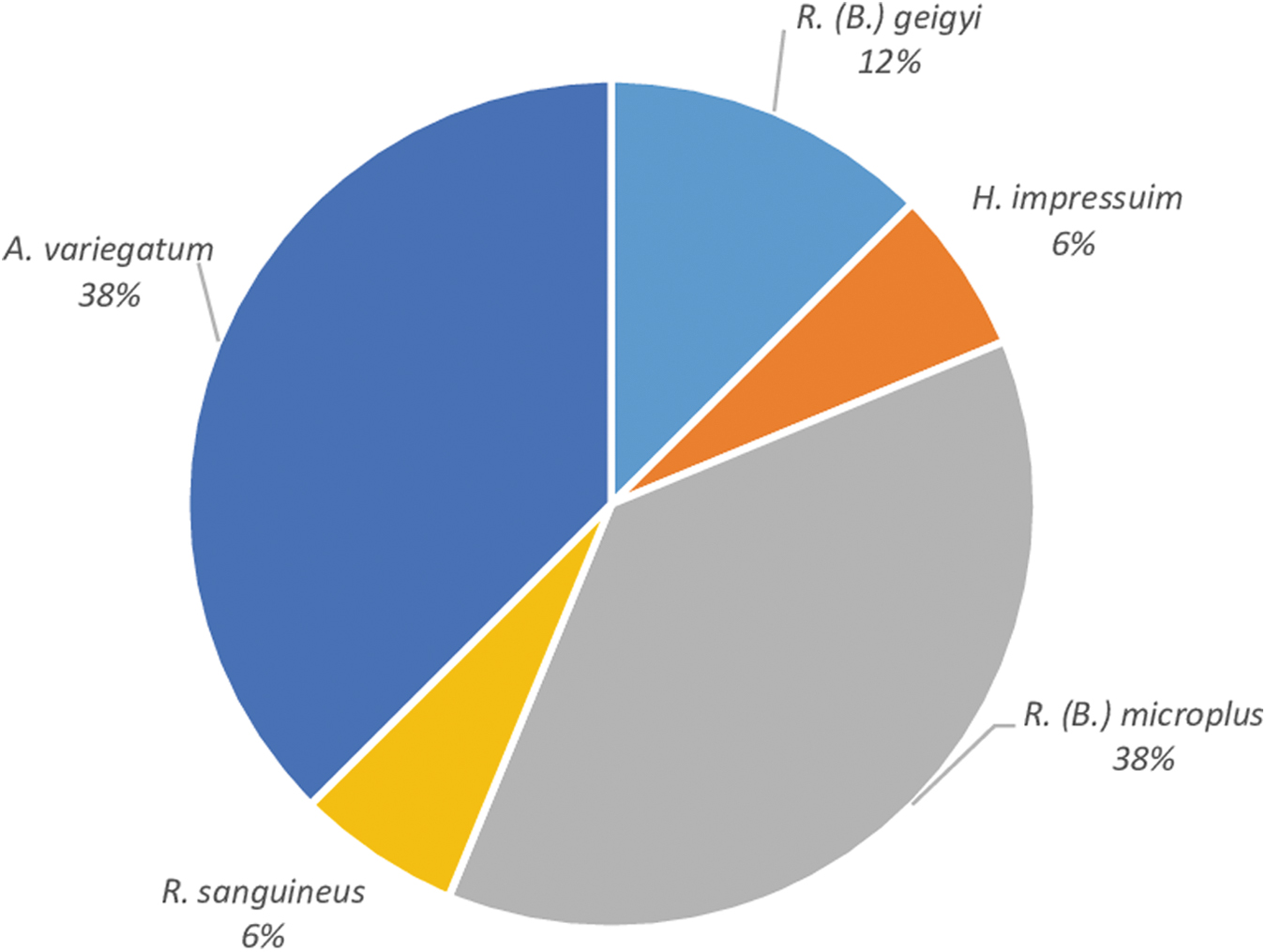
Repartition of CCHFV-positive ticks by species. Color images are available Online.
Discussion
Genera and species of ticks identified
This study on ticks in the five regions of Côte d'Ivoire showed the presence of 13 species of ticks. These species are divided into three genera, namely Amblyomma, Hyalomma, and Rhipicephalus. These genera have also been identified in previous studies (Achi et al. 2012, Toure et al. 2014).
Of the 4088 adult tick specimens collected, the genus Rhipicephalus was the most predominant among the Ixodidae infesting cattle in these different regions. At the species level, the predominant species identified was R. (B.) microplus with 48.7%, followed by A. variegatum (43.7%). Our results are consistent with those obtained by Toure et al. (2014) showing the predominance of R. (B.) microplus in these same regions.
The exotic tick R. (B.) microplus is predominant in the five regions of Ivory Coast: 48.7%. It confirms the work of Boka et al. (2017), who state that the exotic tick R. (B.) microplus was discovered in Côte d'Ivoire in 2007 and then gradually in other West African countries. This study still shows the invasive capacity of R. (B.) microplus, which is the newly introduced species in Côte d'Ivoire as shown by Madder et al. (2011) in the Azaguié region. The exotic tick R. (B.) microplus has invaded the entire Ivorian country and is now the main bovine tick (63.6% of ticks collected), followed by A. variegatum, which remains predominant in the North (Boka et al. 2017). A. variegatum was predominant in Bondoukou in the east (77.4%), followed by Korhogo in the North (69.7%) in our study.
Before the introduction of this species into Côte d'Ivoire, A. variegatum was the predominant tick species in breeding (Achi et al. 2012).
In a study in Burkina Faso, the predominant species were Hyalomma marginatum rufipes (Koch 1844) (38.6%), A. variegatum (27.7%), and Hyalomma truncatum (Koch 1844) (14.9%) (Yao et al. 2016). This discrepancy with our data could be explained by the difference in climate and vegetation between Burkina faso and Côte d'Ivoire. Among the ticks of the genus Amblyomma, only the species A. variegatum was collected. In the study conducted by Boka et al. (2017) on 23,460 ticks collected from 180 farms located throughout the country, 10 species of ticks belonging to the genus Rhipicephalus (including those of the subgenus Rhipicephalus (Boophilus), Hyalomma, and Amblyomma were identified. Ours identified 13 species.
Spatial heterogeneity in the distribution of tick species was observed. Korhogo is located in Northern Côte d'Ivoire and borders Burkina Faso. As several species have been described in Burkina Faso (Boka et al. 2017), the diversity of tick species in Korhogo could be explained. Thus, it is in the department of Korhogo that all species were found. The other species recorded small proportions compared with the two predominant species.
Our results differ from those of the work of Ladzekpo and his collaborators carried out in Ghana. Their combined results showed that the genera Amblyomma (73.66%), Rhipicephalus (15.51%), and Hyalomma (10.83%) were predominant in the study sites (Ladzekpo 2018).
Boka and his collaborators identified four species. R. (B.) microplus was the main species with 15,291 specimens, that is, 98.2% of all Rhipicephalus (Boophilus) species and 63.6% of all collected ticks. It was followed by R. (B.) annulatus (1.667%), R. (B.) geigyi (0.1%), and R. (B.) decoloratus (0.06%) (Boka et al. 2017). These results are similar to those obtained in this study where the same four species of the subgenus Rhipicephalus (Boophilus) were identified.
In Burkina Faso, four species of the genus Hyalomma were found in the study area, namely Hyalomma dromedari (Koch 1844), Hyalomma impeltatum, H. m. rufipes, and H. truncatum. In this study, we found seven species, Hyalomma anatolicum anatolicum (Koch 1844), Hyalomma detritum, H. impeltatum, H. impressium, H. m. rufipes, and H. truncatum. Three species of the subgenus Rhipicephalus (Boophilus) were collected within the framework of the study carried out in Burkina Faso. These are the invasive species R. (B.) microplus and two indigenous species R. (B.) decoloratus (Koch 1844) and R. (B.) geigyi (Yao et al. 2016). In our study work, in addition to these three species, we collected the species R. (B.) annulatus.
Prevalence of CCHFV in ticks
In Côte d'Ivoire, no human case of CCHF has been reported. Surveillance for CCHF in ticks has not yet been carried out systematically in this region of West Africa. This study was carried out to better understand the host/vector dynamics and the current epidemiological situation in cattle herds in Côte d'Ivoire.
In Mali, a country bordering Côte d'Ivoire, severe cases of CCHF have been reported in humans (Baumann et al. 2019) and the virus has been detected in ticks (Zivcec et al. 2014). CCHFV cases have also been reported in Senegal and Mauritania (Nabeth et al. 2004, Tall et al. 2009). There is no reason why the CCHFV should not be present in cattle ticks in Côte d'Ivoire.
In our study, the virus was detected in ticks with an overall prevalence of 0.4%. This prevalence is lower than in the study conducted in Mauritania, where, out of 1523 ticks collected, 39 (2.56%) tested positive for CCHFV (Schulz et al. 2020).
Our data are similar to a study conducted in Pakistan, where, among the ticks positive for hemorrhagic fever virus diseases (HFVD), 75% (15/20) were females and 25% (5/20) were males (Kasi et al. 2020).
The virus was found in Côte d'Ivoire in all three genera of ticks (Amblyomma, Hyalomma, and Rhipicephalus) in contrast to a study in southern Mali, where the virus was only isolated from Hyalomma (Zivcec et al. 2014).
In the study by Kasi et al. (2020), hard ticks, Hyalomma spp., were considered to be the main reservoir and vector of Crimean-Congo hemorrhagic fever virus (CCHFV). However, in our study, the vectors were mainly A. variegatum and R. (B.) microplus.
CCHFV genomes were most often detected in Hyalomma marginatum (30%, 6/20), followed by Hyalomma dromedarii (25%, 5/20), Hyalomma excavatum (20%, 4/20), H. anatolicum (20%, 4/20), and H. scupense (5%, 1/20) (Kasi et al. 2020). In our study, A. variegatum 38%, R. (B.) geigyi 12%, H. impressum 6%, R. sanguineus 6%, and R. (B.) microplus 38% were found to carry the virus genome.
Conclusion
Three genera of ticks, Amblyomma, Hyalomma, and Rhipicephalus, and 13 species infesting cattle were identified during this study. Amblyomma and Rhipicephalus were the predominant genera. All identified genera and species were found in Korhogo. CCHFV was detected in ticks in Bouaflé and Korhogo. Eleven ticks were positive for CCVH in Korhogo and five in Bouaflé. The genus mainly infested was Rhipicephalus.
Footnotes
Authors' Contributions
E.V.A. designed the study and had full access to the data. E.V.A., C.A.D-K., and M.K.D. undertook full responsibility for the data, accuracy of analysis, and final decision making for submission. E.V.A., and N.C-G. designed the study. C.A.D-K., and R.M.C.K.A.K. collected the data. M.K.D., E.V.A., and C.A.D-K. conducted data management. N.C-G., J.T.C., and C.A.D-K. contributed to the study concept and design. M.K.D., conducted the statistical analysis, and A.E.V. and G.N.C. contributed to statistical analysis. E.V.A., N.C-G., J.T.C., M.K.D., and C.A.D-K. drafted the article. All authors contributed to the acquisition, analysis, or interpretation of data. M.D., E.V.A., N.C-G., J.T.C., and M.K.D. critically revised the article. E.V.A. supervised the study. All authors have read and approved the article.
Acknowledgment
The authors are thankful to the Institute Pasteur of Côte d'Ivoire for the technical support of the study.
Author Disclosure Statement
No competing financial interests exist.
Funding Information
No funding was received for this work.