




Abstract
Giardia lamblia (syn Giardia duodenalis) is an important protozoan parasite that can cause enterocyte damage and loss of brush border of the epithelial cells in the intestine, resulting in shortening of microvilli and altered epithelial barrier function. Many animals have been detected as the hosts of the G. lamblia. However, the information on the epidemiology and molecular detection of G. lamblia in dairy calves and sika deer in northeastern China is limited. To investigate the prevalence and genotypes of dairy calves and sika deer in northeastern China, a total of 321 fecal samples from dairy calves in Heilongjiang Province and 818 fecal samples from sika deer in four provinces (Jilin Province, Heilongjiang Province, Liaoning Province, and Inner Mongolia Autonomous Region) in China were conducted by PCR methods, between September 2017 and April 2018. The overall prevalence of G. lamblia in dairy calves in Heilongjiang Province and sika deer in the four provinces was 4.98% (16/321) and 0.61% (5/818), respectively. In this study, the point prevalence of Giardia spp. in different factor groups was dissimilar. A total of 16 Giardia spp. positive samples in dairy calves were identified as assemblage E based on the triosephosphate isomerase (tpi), β-giardine (bg), and glutamate dehydrogenase (gdh) genes. Furthermore, two positive samples of assemblage A and three positive samples of assemblage E were identified with gdh and bg genes in the sika deer. Assemblage A was zoonotic genotype of G. lamblia, and assemblage E was identified as the predominant assemblage in dairy calves and sika deer. This study reported the prevalence and genotypes of G. lamblia in dairy calves in Heilongjiang Province and sika deer in four provinces in China. These results provided basic information to understand the epidemiology of G. lamblia in dairy calves and sika deer in China.
Introduction
Giardia spp. (G. lamblia) is a protozoan parasite that primarily parasitizes the small intestine of humans and animals, which poses a considerable threat to human and animal health globally (Stojecki et al. 2015, Dan et al. 2019, Lee et al. 2020). The infection of G. lamblia in calves usually causes clinical signs, such as abdominal cramps, diarrhea, weight loss, and malabsorption, whereas the infection is asymptomatic for some adult cattle (Hamnes et al. 2006, Uehlinger et al. 2011). The life cycle of Giardia spp. has two main stages, including proliferating trophozoite and the infectious cyst. G. lamblia can be transmitted through the fecal-oral route (Rickard et al. 1999, Li et al. 2017, Dan et al. 2019).
G. lamblia is the only causative agent of human giardiasis and was first found in human feces (Ankarklev et al. 2010, Zhang et al. 2017, Wu et al. 2020). Since then, G. lamblia has been widely reported in a variety of hosts around the world, including companion animals, livestock, birds, mussels, and wild animals (Lalle et al. 2007, Hoar et al. 2009, Torrecillas et al. 2021). Approximately 280 million people are diagnosed with Giardia spp. infection per year worldwide (Zhang et al. 2016, Kim et al. 2019), posing an important public health concerning.
Giardiasis is an intestinal parasitic disease generally occurring in areas with poor sanitation facilities and limited water treatment conditions (Inpankaew et al. 2015, Wang et al. 2019). People who drink untreated cyst-contaminated water might be infected with the G. lamblia (Gerba et al. 1997). The G. lamblia can also be spread by ingesting raw, undercooked, and cooked food that was contaminated with G. lamblia (Wang and Cui 2005, Wang et al. 2019). In addition, the G. lamblia can be transmitted from human to human in environments containing poor health facilities (Sawitri et al. 2020).
At the moment, eight genetic assemblages (A–H) have been identified. Assemblages A and B appear to be the main G. lamblia assemblages. Assemblage A infects human and primates (Naguib et al. 2018, Kiani-Salmi et al. 2019, Onder et al. 2020). Assemblage B was found in mussels and human (Naguib et al. 2018, Torrecillas et al. 2021). In particular, subtypes A1, A2, A3, A4, B1, and B4 are closely associated with human infection (Song et al. 2018). Assemblages C and D are mainly found in dogs, assemblage E in cloven hoofed animals, assemblage F in cats, assemblage G in rodents, and assemblage H in marine vertebrates (Huang et al. 2018, Kashinahanji et al. 2019, Mahmoudi et al. 2020).
Despite G. lamblia been reported in deer and calves, information regarding its prevalence and molecular characteristics is still limited, particularly in China. To investigate the prevalence and genotypes of G. lamblia in dairy calves and sika deer in northeastern China, a total of 321 feces of dairy calves were collected from Heilongjiang Province and 818 feces of sika deer were collected from four provinces (Jilin Province, Heilongjiang Province, Liaoning Province, and Inner Mongolia Autonomous Region) of China, between September 2017 and April 2018, and detected for presence of G. lamblia using PCR methods.
Materials and Methods
Study area and sample collection
The sampling sites were from Jilin Province (40°50′–46°19′ N, 12°138′–131°19′ E), Heilongjiang Province (43°26′–53°33′ N, 121°11′–135°05′ E), Liaoning Province (38°43′–43°26′ N, 118°53′–125°46′ E), and Inner Mongolia Autonomous Region (37°24′–53°33′ N, 97°12′–126°04′ E). A total of 321 fecal samples from dairy calves were collected in eight cities of Heilongjiang Province (Harbin n = 42, Tsitsihar n = 60, Mudanjiang n = 3, Daqing n = 3, Suihua n = 91, Hegang n = 9, Shuangyashan n = 50, and Heihe n = 63) (Table 1), and 818 fecal samples from sika deer were collected in Yichun city of Heilongjiang Province (n = 81), Changchun city of Jilin Province (n = 538), Shenyang city of Liaoning Province (n = 93), and Chifeng city of Inner Mongolia Autonomous Region (n = 106) (Table 2) in different seasons from 2017 to 2018, including spring (January to March), summer (April to June), autumn (July to September), and winter (October to December). A total of 321 fecal samples from dairy calves of different ages (0–3 months, n = 167; >3 months, n = 154) were collected in Heilongjiang Province, and 818 fecal samples from sika deer of different age, including preweaned sika deer (n = 31) and postweaned sika deer (n = 787), were collected in four provinces (Table 3). For the samples taken in sika deer, the preweaned sika deer was considered as young deer, and the postweaned sika deer was considered as adult. Dairy calf aged 0–3 months was considered as the preweaned, >3 months was considered as the postweaned. All the animals seemed to be healthy. In the whole operation period, the operator wore a facemask and protective suit. The fresh feces of each animal were directly collected from the rectum, and then put into sterile gloves immediately and transported back to the laboratory. Subsequently, the sex, age, and number of the samples were recorded accordingly. Finally, the fecal samples were kept at 4°C. The DNA of each sample was extracted using a stool kit (OMEGA), according to the manufacturer's instruction. The obtained DNA was dissolved in 80 μL of sterilized water, and then kept at −20°C until use.
Distribution of Giardia lamblia Genotype in Dairy Calves in Different Farms from Heilongjiang Province
Distribution of Giardia lamblia Genotype in Sika Deer in Different Farms from Four Provinces, North China
Prevalence of Giardia lamblia Infection in Dairy Calves and Sika Deer in Different Related Factors
OR (95% CI): OR is the odds ratio. OR (95% CI) is a 95% confidence interval for the OR value.
Reference: Reference range.
PCR amplification
The nested PCR amplification of triosephosphate isomerase (tpi), β-giardine (bg), and glutamate dehydrogenase (gdh) genes was performed to determine the prevalence and the assemblages of G. lamblia. The primers for PCR amplification and their annealing temperatures for the three genes are given in Table 4. PCR reaction (25 μL) composed of 1 × Ex-Taq buffer (Mg2+ free), 2 mM MgCl2, 200 μM deoxyribonucleoside triphosphate (dNTP), 0.4 μM of each primer, 0.625 U ExTaq DNA polymerase (TAKARA, Japan), and 2 μL DNA template. The cycling conditions were 5 min at 95°C, 45 s at 95°C and 45 s at 57°C, 1 min at 72°C, and a final extension for 10 min at 72°C. The secondary PCR products were electrophoresed with 2% agarose gel, and then were observed under ultraviolet light.
Primers Used for the Detection of Giardia lamblia DNA in Fecal Samples from Dairy Calves and Sika Deer
Sequencing and phylogenetic analyses
The obtained PCR products were sent to Sangon Biotech Company (Shanghai, China) for sequencing. The assemblage of G. lamblia was determined by alignment with known reference sequences available on GenBank using the BLASTn, and the software ClustalX 1.83. The phylogenetic trees were constructed using neighbor-joining (NJ) method (Kimura two-parameter model) in Mega 7.0, and bootstrapping was performed using 1000 replicates.
Statistical analysis
The variation in G. lamblia prevalence (у1) of dairy calves in different seasons (x1) and age (x2), and G. lamblia prevalence (у2) of sika deer in different provinces (x3), age (x4), and gender (x5) were analyzed by the χ 2 test using SPSS V20.0 (IBM, Chicago, IL). Each variable was included in the Binary Logit Model as an independent variable by a multivariable regression analysis. The best model was judged by Fisher's scoring algorithm. When p < 0.05, the results were considered statistically significant. Odds ratios (ORs) and their 95% confidence intervals (CIs) were estimated to explore the strength of the association between G. lamblia positivity and the tested conditions.
Data availability statement
Representative nucleotide sequences were submitted to GenBank under accession numbers: MW030506–MW030507, MW033959–MW033964 (dairy calves), and MW033965–MW033966 (sika deer) for G. lamblia.
Committee of ethics and animal welfare
This study was approved by the Animal Ethics Committee of Heilongjiang Bayi Agricultural University (registration protocol Mar 2017). The dairy calves and sika deer, which the feces were collected, were handled in accordance with good animal practices required by the Animal Ethics Procedures and Guidelines of the People's Republic of China.
Results
Point prevalence of G. lamblia
Among 321 dairy calves, 4.98% (16/321) were tested to be Giardia spp. positive in this study (Table 1). The punctual prevalence of G. lamblia in postweaned dairy calves was 5.19% (8/154, 95% CI = 1.65–8.74), and the punctual prevalence of preweaned dairy calves was 4.79% (8/167, 95% CI = 1.52–8.06). Moreover, the punctual prevalence of G. lamblia in dairy calves collected in different seasons was ranged from 1.67% (winter) to 11.22% (spring), and the difference was statistically significant (p < 0.05) (Table 3).
Among 818 sika deer, 0.61% (5/818) were tested to be Giardia spp.-positive in this study (Table 2). Of interest, all the G. lamblia-positive samples in sika deer were detected in Jilin Province. Furthermore, G. lamblia-positive samples were found in adult sika with punctual prevalence of 0.64% (5/787), whereas none were found in young sika. Moreover, only 5 (1.08%, 95% CI = 0.13–2.02) males of sika deer were detected to be G. lamblia positive (Table 2).
Phylogenetic relationship of G. lamblia assemblages
The genetic diversity of these G. lamblia-positive isolates was determined by bg, gdh, and tpi genes, respectively. Sequencing and phylogenetic analysis revealed two G. lamblia assemblages (A and E) were present in the gdh locus (Fig. 1), assemblage E was identified in the tpi locus (Fig. 2). At the bg locus, assemblages E and A were identified (Fig. 3). Only one assemblage (E = 16) was found in dairy calves and two (A = 3 and E = 3) in sika deer.

Phylogenetic analysis of the Giardia lamblia based on glutamate dehydrogenase (gdh) gene in dairy calf and sika deer. Phylogenetic analysis using the maximum-likelihood method based on the Kimura two-parameter model including bootstrap values (1000 replicates), shown next to the nodes and branch lengths scaled to the same units as those of the evolutionary distances. The trees were rooted against Giardia ardeae. G. lamblia identified in this study was marked with solid circle.

Phylogenetic analysis of the Giardia lamblia based on triosephosphate isomerase (tpi) gene in dairy calf. Phylogenetic analysis using the maximum-likelihood method based on the Kimura two-parameter model including bootstrap values (1000 replicates), shown next to the nodes and branch lengths scaled to the same units as those of the evolutionary distances. The trees were rooted against Giardia ardeae. G. lamblia identified in this study was marked with solid circle.
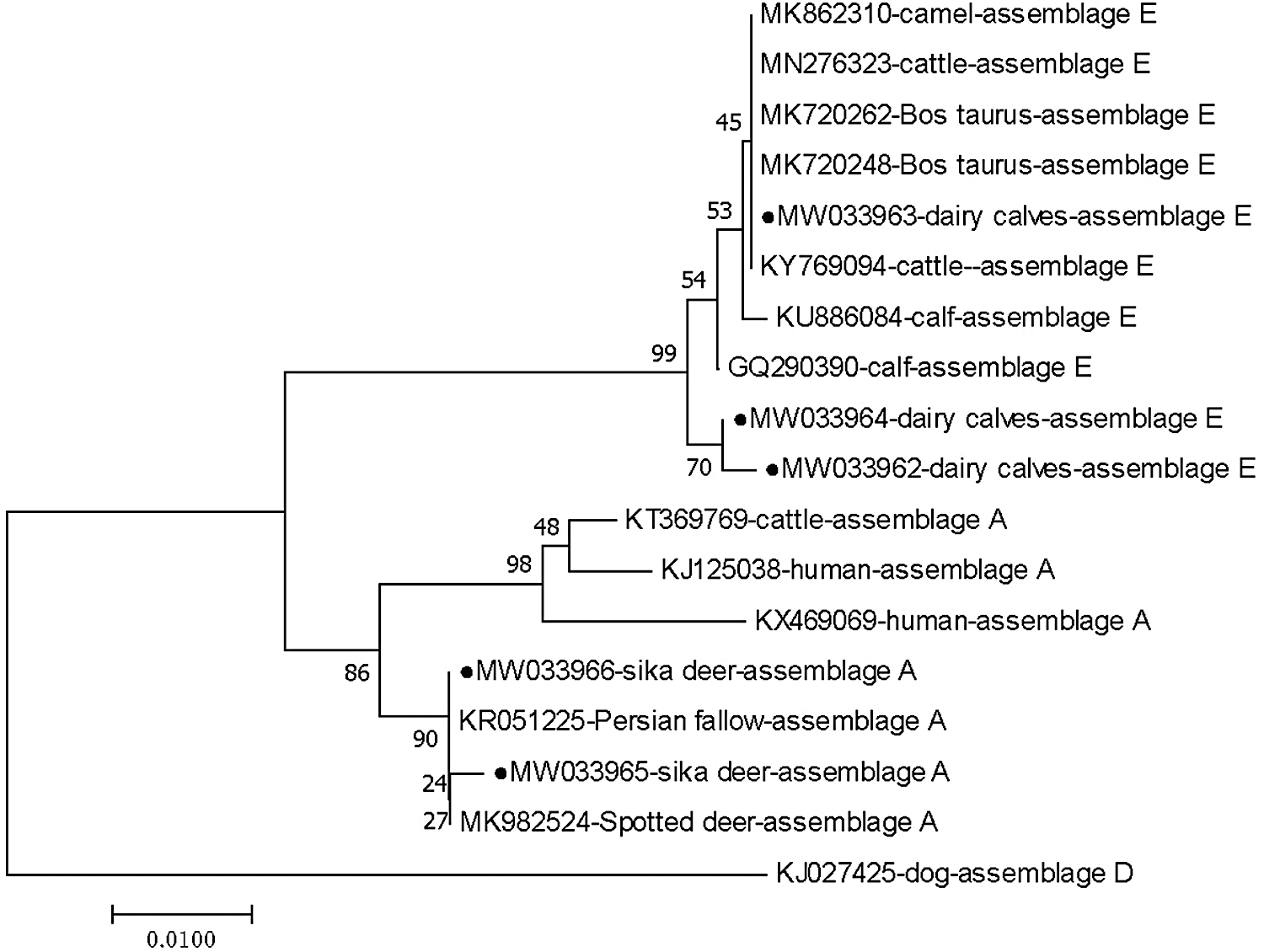
Phylogenetic analysis of Giardia lamblia based on β-giardine (bg) gene in dairy calves and sika deer. Phylogenetic analysis using the maximum-likelihood method based on the Kimura two-parameter model including bootstrap values (1000 replicates), shown next to the nodes and branch lengths scaled to the same units as those of the evolutionary distances. G. lamblia identified in this study was marked with solid circle.
In a phylogenetic analysis of the bg gene, MW033963 sequence was clustered with reference sequences of assemblage E from cattle (MN276323 and KY769094), camel (MK862310), and Bos taurus (MK720262 and MK720248). MK720248 had an identical sequence with MW033963 from B. taurus. Furthermore, the MW033965 sequence showed complete identity with KR051225 from Persian fallow (Fig. 3).
In a phylogenetic analysis of the gdh gene, MW033959 sequence was clustered with reference sequences of assemblage E from dairy cattle (KY769096, KT698971, and KF843926) and dairy calves (KY769066). MW033961 sequence was clustered with reference sequences of assemblage A from human (KY769094) (Fig. 1).
In a phylogenetic analysis of the tpi gene, MW030506 and MW030507 sequences were clustered with reference sequences of assemblage E from dairy cattle (EF654684 and KY769101) and calf (KT922259) (Fig. 2).
Discussion
In this study, the overall point prevalence of G. lamblia infection in dairy calves was 5.96%, which was lower than that found in Xinjiang Province (13.4%, 69/514) (Qi et al. 2016) and Henan Province (7.2%, 128/1777) (Wang et al. 2014). It was also lower than that found in dairy calves in Egypt (13.3%) and New Zealand (31%) (Winkworth et al. 2008, Naguib et al. 2018). There was a significant correlation of G. lamblia infection with seasons in dairy calves (p = 0.024). The prevalence of G. lamblia in dairy calves in spring (11.22%) was higher than that in winter (1.67%) (Table 3), which was consistent with the high incidence season of G. lamblia in northwestern China in spring (Zhang et al. 2016). The overall prevalence of G. lamblia infection in sika deer was 0.61%, which was lower than that found in deer in Sichuan (2.24%, 5/223) (Song et al. 2018), Jilin, and Henan Provinces (0.75%, 5/662) (Huang et al. 2018). All positive samples in this study were detected in male sika deer with the prevalence of G. lamblia infection being 1.08%. The higher prevalence of G. lamblia in male sika deer was consistent with that found in Italy (Lalle et al. 2007) and in roe deer (9.4%) in Spain (Castro-Hermida et al. 2011). The determinants of prevalence could be affected by many factors, including sample sizes, ecological conditions, timing of specimen collection, management system, and climates.
The prevalence of G. lamblia in postweaned calves (5.19%) was higher than that found in preweaned calves (4.79%), which was opposite to dairy calves in Ningxia Autonomous Region and Henan Provinces (Huang et al. 2014, Wang et al. 2014). These differences may be the result of varying environmental, geographical, or management factors.
Sequence analysis revealed that only assemblage E was detected in dairy calves. Assemblage E was also found in dairy calves in other provinces in China, for example, Sichuan and Xinjiang Provinces (Qi et al. 2016, Dan et al. 2019), which further confirmed that assemblage E was the predominance of Giardia assemblage in cattle. Previous studies showed only assemblage E was present in red deer, elk, and sika deer in Henan Province (Huang et al. 2018). Assemblage E was found in roe deer in Romania (Adriana et al. 2016), and assemblage A was found in roe deer in Spain (Castro-Hermida et al. 2011, García-Presedo et al. 2013). In addition, a report revealed that mixed genotypes (assemblages A and E) existed in Sichuan forest musk deer (Song et al. 2018). Assemblage A has been detected in humans in many countries and is an important zoonotic genotype (Wang et al. 2019). Assemblage E was also frequently found in many species of animals (Jing et al. 2019, Li et al. 2019, Peng et al. 2020). This finding suggested that the sika deer might play an important role in the transmission of G. lamblia to humans and other animals.
In the north of China, humans infected with G. lamblia usually show signs such as diarrhea, abdominal cramps, weight loss, and malabsorption, or recessive infections without obvious clinical signs. The children infected with G. lamblia also have malnutrition, malabsorption, growth retardation, and other signs (Liu et al. 2018a). At present, there is no specific drug for the treatment of giardiasis; therefore, the prevention for G. lamblia is better than cure. Strengthening the management of human and animal feces (dairy cattle and sika deer) and strictly preventing contaminated water sources can prevent the infection of G. lamblia (Liu et al. 2018b).
Conclusion
G. lamblia was widespread in dairy calves and sika deer in Northeast China. The prevalence of G. lamblia in dairy calves and sika deer was 4.98% (16/321) and 0.61% (5/818), respectively. Assemblages A and E were identified in adult sika deer in Jilin Province, whereas only assemblage E was found in dairy calves. However, there were several limitations for the conclusions in this study. First, the fecal samples of dairy calves were only collected from Heilongjiang Province, which could not represent the whole northeastern regions. Second, this study only collected feces of dairy calves and sika deer from 2017 to 2018, resulting in a limitation of time period. Third, the sample size of dairy calves and sika deer in this study was relatively small. Thus, an increase in sample size and expansion of examined regions and time period would improve the accuracy of G. lamblia prevalence in future work.
Ethical Approval
This study was approved by the Animal Ethics Committee of Heilongjiang Bayi Agricultural University. The dairy calves and sika deer, from which the feces were collected, were handled in accordance with good animal practices required by the Animal Ethics Procedures and Guidelines of the People's Republic of China.
Footnotes
Author Disclosure Statement
No conflicting financial interests exist.
Funding Information
This work was supported by funding from The National Key Research and Development Program of China (2017YFD0501300), and the Key Scientific and Technological Achievements Transformation Project of Jilin Province (20170307016NY).