




Abstract
Coxiella burnetii is an obligate intracellular zoonotic bacterium with a global distribution. This study was conducted to investigate the prevalence of C. burnetii in different animals and to assess the potential role of these species as reservoirs of infection and transmission to humans. A total of 592 blood samples (105 beef cattle, 61 dairy cattle, 110 Korean native goats, 83 Boer goats, and 233 horses) were collected in the Republic of Korea (ROK). The C. burnetii DNA was detected from blood samples using the transposon-like repetitive region (IS1111) by PCR method. The results showed that 22.7% of the Korean-native goats, 16.4% of the dairy cattle, 15.2% of the beef cattle, 6.0% of the Boer goats, and 5.2% of the horses were positive for C. burnetii. Significant differences were found between the animal species. The univariable binary logistic regression analysis revealed that the risk of contracting C. burnetii was significantly high by 5.4-fold in Korean-native goats (95% confidence interval [CI]: 2.60%−11.27%, p = 0.000), 3.6-fold in dairy cattle (95% CI: 1.48%−8.82%, p = 0.005), and 3.3-fold in beef cattle (95% CI: 1.51%−7.28%, p = 0.003) compared with horses. A phylogenetic tree based on the IS1111 gene revealed that our sequences had 92.2%−99.9% similarity and were clustered with those detected in humans, cattle, goats, dogs, rodents, and ticks. C. burnetii circulating in the ROK exhibits genetic variation. To the best of our knowledge, this is the first study to identify C. burnetii DNA in a horse in the ROK. These results suggest that cattle, goats, and horses can be potential reservoirs for C. burnetii and play an important role in the transmission of infection. Further studies should assess the pathogenicity of C. burnetii circulating in the ROK.
Introduction
C
During parturition, numerous bacteria are excreted in birth products and then, after drying, these organisms can easily be dispersed in the environment. Q fever in humans and animals occurs through inhalation of contaminated aerosols or dusts (Marrie 1990, Maurin and Raoult 1999, Schimmer et al. 2010). Of importance, C. burnetii poses a potentially significant threat to public health because the consumption of unpasteurized milk is a risk factor for human infection (Khademi et al. 2020a). Q fever in humans ranges from asymptomatic to chronic infection with life-threatening complications (Raoult et al. 2005, Landais et al. 2007, Khademi et al. 2020a).
Q fever was first described as a febrile illness in a slaughterhouse employee in Australia (Derrick 1944). Nowadays, Q fever is endemic and often recognized as an occupational disease because infection is transmitted through direct contact with infected animals or their biological products (Cabrera Orrego et al. 2020). According to a recent report from the Republic of Korea (ROK), 9.1% of slaughterhouse workers, especially those responsible for carcass evisceration, were seropositive for C. burnetii (Park et al. 2018). Livestock production is crucial to farmers' profits but confers a high risk of exposure to various diseases owing to factors such as feeding, care during birthing, and animal treatment (Cabrera Orrego et al. 2020). The livestock industry, including Korean native goats (Capra hircus coreanae), horses, and cattle, is gradually expanding in the ROK. Although C. burnetii is emerging as an important public health issue in many countries, it has been largely overlooked in the ROK. No comprehensive epidemiological studies have been conducted on Q fever in various animals in the ROK. Therefore, this study was performed to investigate the prevalence of C. burnetii in various animals and to determine the animals at potential risk of transmitting the infection to humans in the ROK.
Materials and Methods
Sampling
This study did not require the approval of the Institutional Animal Care and Use Committee (IACUC) at Kyungpook National University because the IACUC only evaluates laboratory animals kept in indoor facilities, not outdoor animals. From 2016 to 2020, a total of 592 blood samples were collected from beef cattle (n = 105), dairy cattle (n = 61), Korean native goats (n = 110), Boer goats (n = 83), and horses (n = 233) in the different regions of the ROK (Fig. 1 and Table 1). Samples were transferred to Kyungpook National University. After arrival, DNA was extracted from blood samples using the DNeasy Blood Kit (Qiagen, Inc., Valencia, CA) and frozen at −20°C until use.

Map showing the regions where each sample was collected in the Republic of Korea.
Information for Animal Species and Regions Used in This Study
Values in parentheses indicate number of positive samples.
−, No sample
PCR, sequencing, and phylogenetic tree
Coxiella burnetii was screened using the IS1111 (transposase insertion element) gene. For the primary amplification, 1F (5′-TATGTATCCACCGTAGCCAGTC-3′) and 1R (5′-CCCAACAACAACCTCCTTATTC-3′) primers were used and the amplicon size was 685 bp. The second round of PCR was performed using the following primers, 2F (5′-GAGCGA ACCATTGGTATCG-3′) and 2R (5′-CTTTAACAGCGCTTGAACGT-3′), which target a 202 bp fragment.
The amplification conditions were 93°C for 3 min, followed by 30 cycles of 93°C for 30 s, 54°C for 30 s, and 72°C for 1 min; and a final extension step at 72°C for 5 min (Parisi et al. 2006). The amplified fragment was 204 bp. In all runs, C. burnetii DNA identified in Korean water deer (Hydropotes inermis argyropus) (Shin et al. 2020) and distilled water were used as positive and negative controls, respectively. Secondary PCR products were subjected to electrophoresis in 1.5% agarose gels, visualized after staining with ethidium bromide, purified using the AccuPower PCR Purification Kit (Bioneer, Daejeon, ROK), and then used for direct sequencing (Macrogen, Daejeon, ROK). The nucleotide sequences obtained in this study were aligned with the ClustalW algorithm using the BioEdit Program. A phylogenetic tree was constructed using the maximum-likelihood method in MEGA X v. 10.0.5 (Kumar et al. 2018), with C. burnetii reference sequences obtained from the National Center for Biotechnology Information database. Bootstrap analysis using the robustness was performed with 1000 replicates.
Statistical analysis
Data analyses were performed using SPSS Statistics 25 (IBM Corp., Armonk, NY). The chi-squared (χ 2) test was used to determine any associations between the prevalence of C. burnetii and the risk of infection for animal species. The 95% confidence intervals (CI) were estimated. Univariate binary logistic regression analysis was used to evaluate the association of C. burnetii infection and species. The odds ratio (OR) and 95% CI were calculated to determine the probability of association detection. A value of p ≤ 0.05 was considered statistically significant.
Results
The prevalence of C. burnetii according to animal species is summarized in Table 2. C. burnetii infection was highest in Korean native goats (22.7%, 95% CI: 14.9%−30.6%), followed by dairy cattle (16.4%, 95% CI: 7.1%–25.7%), beef cattle (15.2%, 95% CI: 8.4%–22.1%), Boer goats (6.0%, 95% CI: 0.9%–11.1%), and horses (5.2%, 95% CI: 2.3%–8.0%). When comparing C. burnetii infection between the different animals, the prevalence of C. burnetii was significantly higher in beef cattle, dairy cattle, and Korean native goats (p = 0.000) than that in horses. The risk factors associated with C. burnetii infection in animal species were estimated using a univariable binary logistic regression analysis. The possible risk factor of C. burnetii infection in animal species is given in Table 3. Except for Boer goats, beef cattle, dairy cattle, and Korean native goats were at a higher risk of C. burnetii infection. The risk of contracting C. burnetii was significantly high by 5.4-fold in Korean native goats (95% CI: 2.60% −11.27%, p = 0.000), 3.6-fold in dairy cattle (95% CI: 1.48% −8.82%, p = 0.005), and 3.3-fold in beef cattle (95% CI: 1.51% −7.28%, p = 0.003) compared with that in horses.
Prevalence Coxiella burnetii Infection According to Animal Species
Univariate Binomial Logistic Regression Analysis for Coxiella burnetii Infection According to Animal Species
Of the 68 positive samples, 31 samples were sequenced and 24 different sequences (9 Korean native goats, 7 horses, 1 Boer goat, 3 beef cattle, and 4 dairy cattle) were included in a phylogenetic tree and then compared with previously published sequences. Our C. burnetii sequences were 92.2% −99.9% homology to each other. The phylogenetic tree based on the IS1111 gene revealed that the C. burnetii sequences obtained from beef and dairy cattle, Korean native goats, Boer goats, and horses were clustered with those from ticks, humans, rodents, dogs, goats, and cattle isolated in other countries (Fig. 2). Of interest, two sequences (Korean native goat and horse) were identical to those isolated from febrile and pneumonic patients (KP645188, JF970260, and JF968204) in Brazil, and are known as virulent strains. In addition, the sequence detected in beef cattle was clustered in the same clade with that previously reported in a severe human case (JX275488) and in aborted goats (EU000273 and KR697576). Genetic variations were found in the C. burnetii sequences identified from different animal species in the ROK.
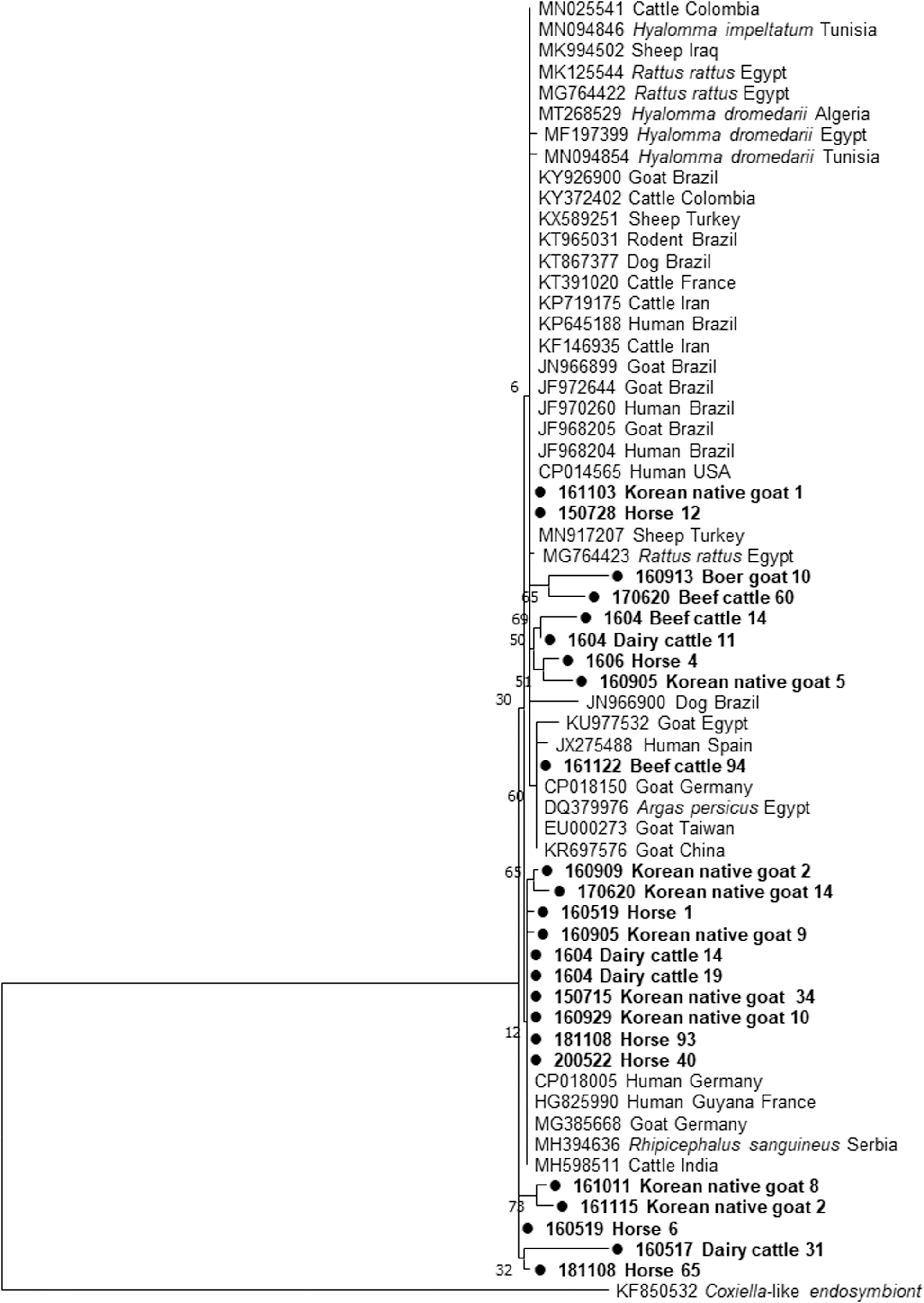
Phylogenetic analyses based on the IS1111 sequence of Coxiella burnetii identified in beef and dairy cattle, Korean native goats, Boer goats, and horses in the ROK. The tree was constructed using MEGAX software by using the maximum-likelihood method. The numbers at the nodes of the tree indicate bootstrap values as a percentage of 1000 replicates that support each phylogenetic branch. The sequences identified in this study are marked in bold type as a circle symbol.
Discussion
This study investigated the prevalence of C. burnetii in various animals to evaluate potential sources of human infection. The results demonstrated significant differences in the prevalence of C. burnetii between animal species. Among the animal species tested, C. burnetii infection was highest in Korean native goats and lowest in horses. Despite the small number of samples, our results showed that the prevalence of C. burnetii in each species was relatively high when compared with that previously reported in the ROK (Jung et al. 2014 , Seo et al. 2016, 2017, 2018). The biggest differences between the two groups may be the gene used to detect C. burnetii and the timing of sample collection; our samples are more recent, and the higher prevalence may be related to climate effects, such as an increase in the number of ticks that transmit Q fever. These results suggest that, although the detection frequency of C. burnetii varies among animal species, these animals may act as potential sources of human infection.
Coxiella burnetii infections have mainly been reported in domestic ruminants (Magouras et al. 2007 , Van den Brom et al. 2015, Barlozzari et al. 2020). Specifically, goat and sheep are known as the main sources of human infection. According to our results, the prevalence of C. burnetii in Korean native goats was significantly high (p = 0.000). Goat farming has gradually expanded in recent years, to meet an increasing demand for health supplements. As a result, meat consumption is steadily increasing. Of interest, none of the goats examined in this study exhibited clinical signs of C. burnetii infection, such as reproductive disorders, and this could be problematic for humans. At this point, it is difficult to determine the transmission route of C. burnetii infection in these goats. One possibility is that goats in the ROK are mainly raised in highlands areas and grazed on pasture. Our previous results showed that grazing represents a significant risk factor for C. burnetii infection (Hwang et al. 2020). Grazing animals have higher chance of exposure to ticks, and the high prevalence observed in this study could be a result of tick bites. Another possibility is that, unlike other livestock, goats are raised in high-density populations, so the frequency of contact between animals is relatively high. This arrangement leads to contamination of water and feed, and ingestion of contaminated water and food is the most important means of transmission of C. burnetii infection. These circumstances could explain for the high C. burnetii infection rate in Korean native goats as compared with that of other animal species. Taken together, our findings suggest that Korean native goats could be important reservoirs of C. burnetii and are high risk species for human infection. Further research should focus on identifying risk factors by analyzing the prevalence of C. burnetii in various specimens such as urine, feces, and birth products.
According to our previous results, the prevalence of C. burnetii in beef cattle was high compared with that in dairy cattle. However, in this study, dairy cattle had the second highest prevalence. Compared with the results of a previous study, these results showed that the infection rate of C. burnetii was lower in both beef and dairy cattle. The different results may be explained by the fact that all the cattle used in this study were housed indoors. This result is consistent with the results of our recent study (Hwang et al. 2020). At this point, we cannot predict the transmission route of C. burnetii infection to these cattle. This may be owing to transmission by inhalation of contaminated aerosols and dust particles in the barn environment or by contact with infected animals such as cats and rodents (Pinsky et al. 1991, Izquierdo-Rodriguez et al. 2019). In addition, it is assumed that rodents infected with C. burnetii easily enter barns and disseminate the infection to cattle through aerosol or feces. A recent study reported that rodents play a vital role in the epidemiology of C. burnetii infection in humans and animals (Abdel-Moein and Hamza 2018). Although to date, there is no clear evidence of the occurrence of C. burnetii infection in mice in the ROK, the possibility that cattle were infected via mice cannot be ruled out, given the large number of mice in the barn environment.
Rodents are known to be important reservoirs for many highly pathogenic agents capable of zoonotic transmission (Abdel-Moein and Hamza 2018). Infected animals shed bacteria in their urine, feces, and milk, indicating that these are potential sources of human infection. Although no cattle examined in this study exhibited any clinical symptoms, the detection of C. burnetii DNA in their blood indicates that these animals may be substantial sources of transmission for humans in contact with these animals. Because C. burnetii has both veterinary and public health concerns, further study is necessary to investigate the transmission route of C. burnetii infection by using various environmental materials.
The IS1111 gene has been confirmed as a rapid and reliable molecular tool for detection of C. burnetii DNA in different clinical samples and the PCR method using IS1111 is considered to be highly specific and sensitive for detecting C. burnetii (Vaidya et al. 2008). Most importantly, PCR analysis has the advantage of detecting bacteremia and ongoing infection. A previous study performed in the ROK reported the detection of Coxiella-like bacteria in horses (Seo et al. 2016). In this study, C. burnetii DNA was identified for the first time in a horse in the ROK. A recent study showed that C. burnetii infection in horses is associated with age; its prevalence increases with age, indicating that age may be an important risk factor for C. burnetii infection in horses (Khademi et al. 2020b). As the information on the ages of the horses used in this study was limited, we cannot draw an accurate conclusion about the association between C. burnetii infection and age. The epidemiology of C. burnetii infection in horses, as in other animals, should be considered along with several other risk factors such as age, sex, management, densities of animals, and contact frequency with other animals.
Serological evidence of C. burnetii infection in horses has been reported in several countries (Seo et al. 2016, Szymanska-Czerwinska et al. 2017, Desjardins et al. 2018, Khademi et al. 2020b). However, to date, the role of horses as a reservoir or shedder of C. burnetii remains unclear. Q fever outbreaks have been reported in people who touched horse and ponies, visited horse facilities, and were frequent horseback riders (Nett et al. 2012, Roest et al. 2013, Desjardins et al. 2018). Previous findings showed that horses may occasionally be sensitive to C. burnetii infection (Marenzoni et al. 2013), and pregnant mares may be at a risk of abortion during an epizootic of Q fever. In this study, the transmission route of infection in these horses was not elucidated. It can be speculated that C. burnetii infection may be owing to exposure to contaminated dust or air from the environment or direct contact with infected ticks. Although the prevalence of C. burnetii in horses was lowest among the animal species tested, the demand for horseback riding is increasing, and this result should not be overlooked. Accordingly, our results suggest that C. burnetii could be transmitted from infected horses to humans, and horses exposed to infection could serve as possible reservoirs for human infection.
The sequence analysis obtained in this study showed that genetic variation exists in C. burnetii sequences circulating in the ROK. We cannot reach a conclusion on whether this variation is owing to the animal species, timing of sample collection, or regional differences. Our results showed no significant correlations between these factors and the genetic variations. Three sequences detected in Korean native goat, horse, and beef cattle were highly related to pathogenic C. burnetii strains isolated from human patients (KP645188, JF970260, and JF968204). Although the pathogenicity of C. burnetii, which is circulating in the ROK, has not been identified in this study, our sequences showed high similarity to pathogenic C. burnetii strains detected in various samples. These findings suggest that the C. burnetii sequences detected in the ROK are probably zoonotic and pathogenic. Consequently, these results suggest that C. burnetii circulating in the ROK has important public health implications and special consideration should be paid to controlling Q fever in humans and animals.
Conclusions
This study highlights that cattle, goats, and horses may act as potential reservoirs for C. burnetii and play an important role in the transmission of infection. This study describes the first identification of C. burnetii DNA in horses in the ROK. Considering its zoonotic potential, continuous surveillance programs, and control strategies for C. burnetii are needed in humans and animals. Further studies should assess the pathogenicity of C. burnetii circulating in the ROK.
Footnotes
Author Disclosure Statement
No competing financial interests exist.
Funding Information
This research was supported by the government-wide R&D Fund for Infectious Diseases Research (HG18C0021).