




Abstract
Although the urban areas of Abidjan, Côte d'Ivoire have faced recurrent outbreaks of Aedes-borne arboviruses, the seasonal dynamics of local populations of the key vector Aedes aegypti remained still underexplored for an effective vector control. The current study thus assessed the seasonal dynamics and the spatial distribution of Ae. aegypti in three neighborhoods of Abidjan city. Aedes eggs were collected using ovitraps in three different neighborhoods (Anoumambo, Bromakoté, and Petit-Bassam) during the four climatic seasons of Abidjan. Aedes egg samples were immersed into distilled water, and emerged larvae were reared until the adult stage for species morphological identification. Spatial autocorrelation was measured with the Moran's Index, and areas with high egg abundance were identified. In total, 3837 eggs were collected providing 1882 adult mosquitoes in the 3 neighborhoods. All the specimens belonged to only one Aedes species, Ae. aegypti. The average of 15.89 eggs per ovitrap, 13.67 eggs per ovitrap, and 19.87 eggs per ovitrap were obtained in Anoumambo, Bromakoté, and Petit-Bassam, respectively, with no statistical difference between the three sites. A higher abundance of Ae. aegypti was observed during the long rainy season and the short dry season. The Moran analysis showed a clustered distribution of Ae. aegypti eggs during the long rainy season in the three sites and a random spatial distribution during the short dry season. Ovitraps with high number of eggs were aggregated in the peripheral part (near to the lagoon) of Anoumambo and Petit-Bassam in central Bromakoté and extending along the railway during the long rainy season. This study revealed a heterogeneous potential risk of transmission of arbovirus according to neighborhood. It provided data to better understand Ae. aegypti ecology to select appropriate periods and places for Aedes vector control actions and surveillance of arboviruses in Abidjan.
Introduction
A
Over 27,000 cases of arbovirus infections have been reported in West Africa since 2007 (Buchwald et al. 2020). Among these Aedes mosquito-borne viral diseases, yellow fever is endemic in 34 countries of Africa, and dengue fever could be also endemic in large areas of Africa (WHO 2015). This last disease is currently regarded as the most important Aedes mosquito-borne viral disease (Bhatt et al. 2013, Murray et al. 2013). It has long been confused with malaria due to similar symptoms and remains under-reported in Africa due to the lack of awareness among health care providers (WHO 2015).
In Côte d'Ivoire, epidemics of arbovirus, including yellow fever and dengue, have been reported since 1982 (WHO 1999, Akoua-koffi et al. 2001). Since this date, outbreaks of both diseases were recurrent, involving sylvatic vectors (such as Aedes africanus, Aedes luteocephalus, and so on) in rural areas of Côte d'Ivoire and Ae. aegypti in urban areas of Abidjan city (Akoua-koffi et al. 2001, Konan et al. 2009, 2014, Kone et al. 2013, WHO 2017).
Ae. aegypti is well-known as the main vector of arboviruses in urban areas (Dussart et al. 2012, Bhatt et al. 2013). It has been reported in urban settings of Africa such as Garoua, Cameroun (Kamgang et al. 2010) and in Ouagadougou, Burkina Faso (Ridde et al. 2016, Ouattara et al. 2019) where it is associated with the transmission of arbovirus. Ae. aegypti is predominant in the urban area of Abidjan where arbovirus infection is recurrent (Guindo-Coulibaly et al. 2010, 2019, Kone et al. 2013, Zahouli et al. 2016).
In 2008, Abidjan was confronted with an epidemic of yellow fever after that of 2001, which had led to a mass vaccination campaign (Konan et al. 2009). The circulation of the DENV-3 in Abidjan was also demonstrated during this same year (Akoua-koffi et al. 2011, WHO 2009). Again in 2019, an outbreak of dengue with 1853 cases, including 2 deaths, occurred in Abidjan city (MHPHCI 2019).
With the absence of effective prophylactic and therapeutic tools against dengue, vector control appears therefore to be the best method against this disease (Gubler 1998). Thus for effective vector control and surveillance strategies, it is essential to know the seasonal and spatial distribution of the vector in Abidjan. The objective of the present study was therefore to assess Ae. aegypti seasonal population dynamics and its spatial distribution in three neighborhoods of Abidjan.
Materials and Methods
Study area
The study was carried out in the health district of Abidjan (located between 5°00′ and 5°30°N and 3°50′ and 4°10°W) in the South of Côte d'Ivoire (Fig. 1). The district of Abidjan has a subequatorial, warm, and humid climate, with four seasons. There are two rainy seasons: the long rainy season and the short rainy season alternating with two dry seasons: the short dry season and the long dry season (Fig. 2). The monthly average precipitation was 181 mm in 2015 with 26.1 mm in the dry season and 291.6 mm in the rainy season. In 2016, it was 115.63 mm with 23.14 mm in the dry season and 181.68 mm in the rainy season. The monthly average temperature was 30°C in 2015 with 29.8°C in the dry season and 30.2°C in the rainy season. In 2016, it was 27.4°C with 27.2°C in the dry season and 27.5°C in the rainy season (Data source: SODEXAM).
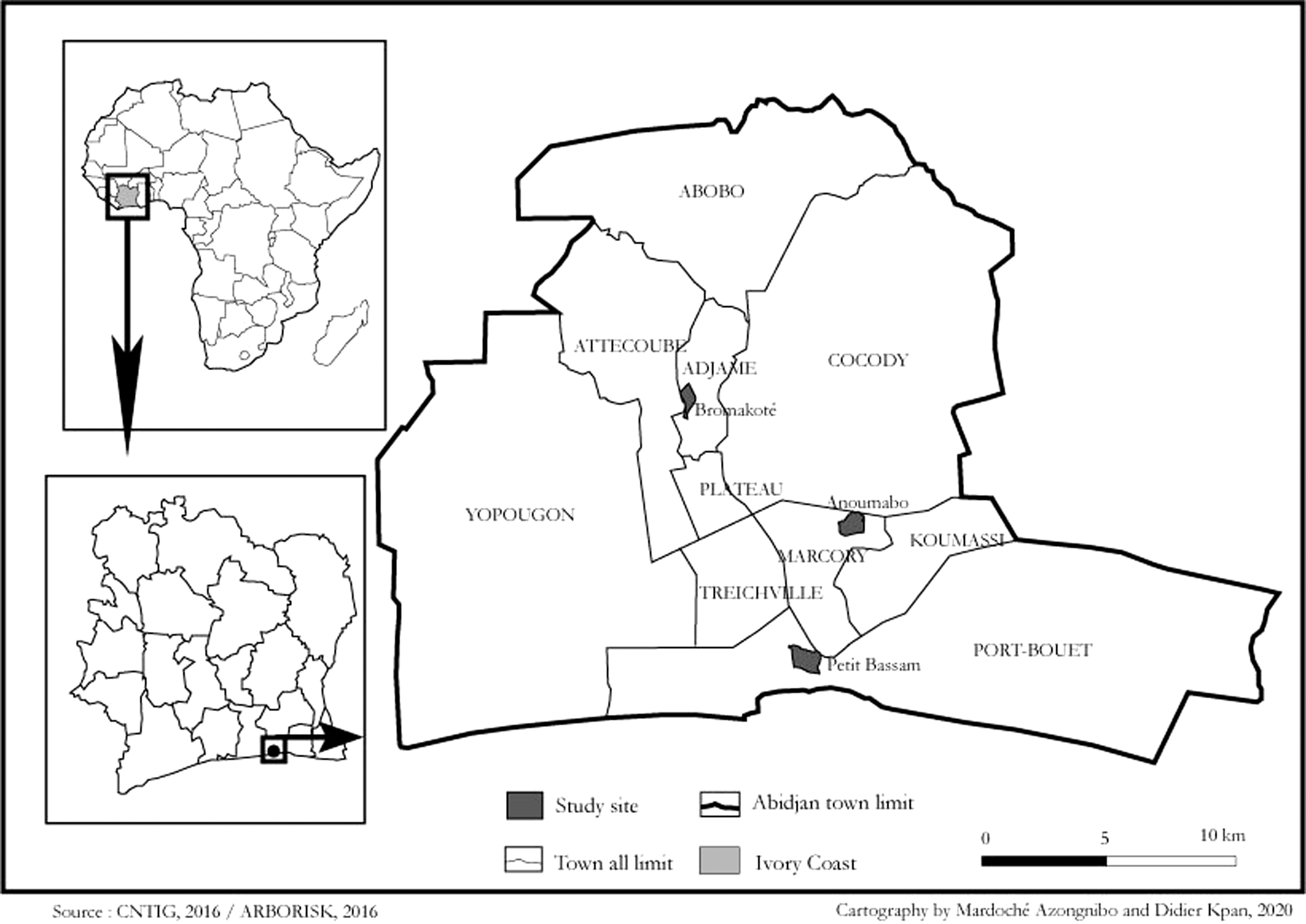
Study sites showing the three neighborhoods (in Abidjan, Côte d'Ivoire) investigated from November 2015 to August 2016.
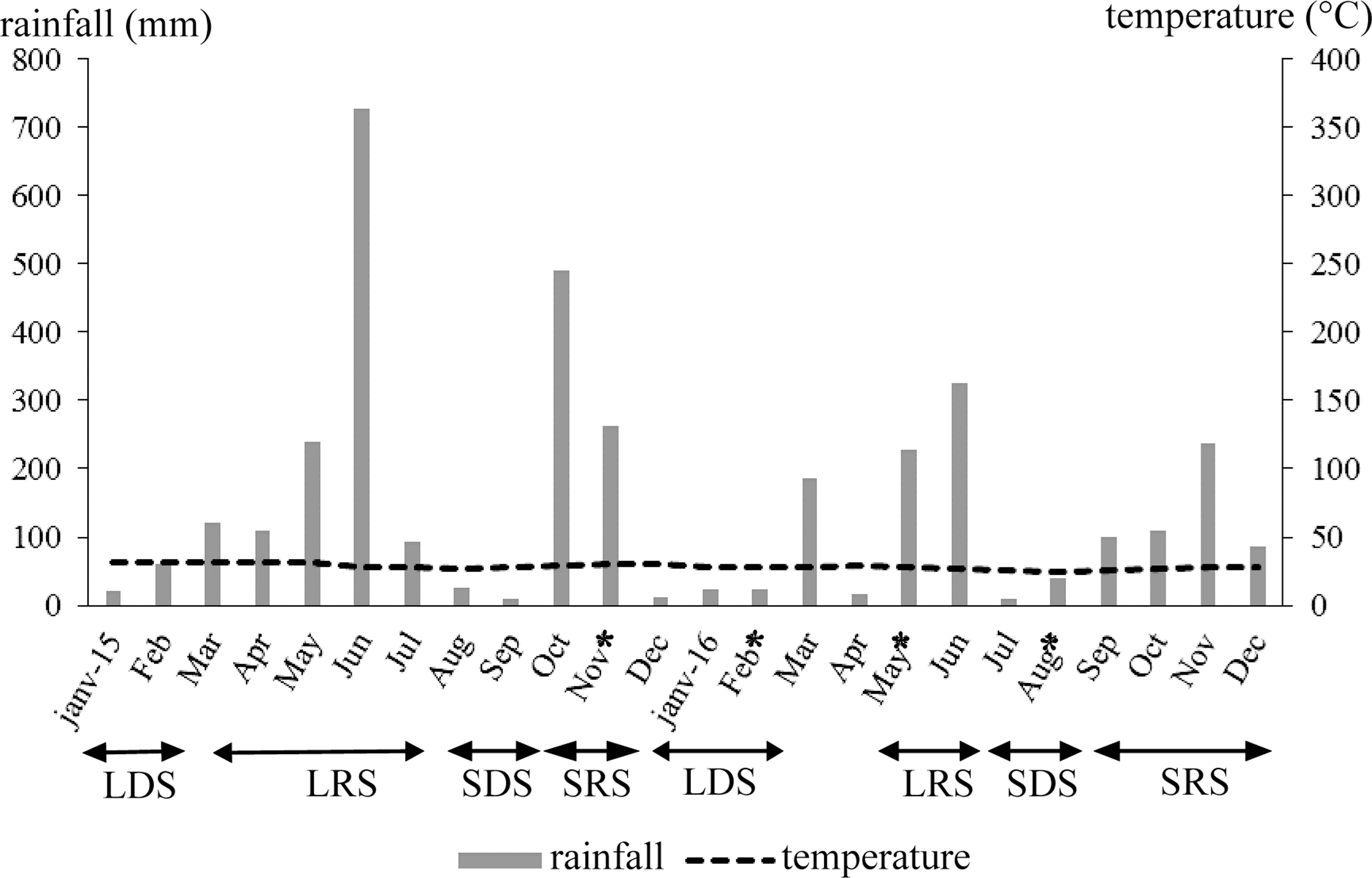
Ombrothermic diagrams of Abidjan from 2015 to 2016. *, Months of survey; LDS, long dry season; LRS, long rainy season; SDS, short dry season; SRS, short rainy season.
Three neighborhoods, namely Anoumambo (Municipality Marcory), Bromakoté (Municipality Adjamé), and Petit-Bassam (Municipality Port-Bouët), were investigated in the city of Abidjan (Fig. 1). The three neighborhoods chosen are populous areas with no real subdivision and where there are some houses made of abandoned construction equipment. Two neighborhoods (i.e., Anoumambo and Petit-Bassam) were surrounded by the lagoon but not the neighborhood of Bromakoté. Previous data from the Pasteur Institute of Côte d'Ivoire indicated the presence of a patient who had already contracted dengue only in Petit-Bassam. No cases of dengue were reported in Anoumambo and Bromakoté.
In addition, criteria that provided ideal conditions for the transport of new vector species and virus strains were also used to select these three neighborhoods (WHO 2016). The first criterion was the presence and abundance of artificial breeding sites (i.e., discarded tires and containers and so on) commonly widespread in the urban area of Abidjan (Kone et al. 2013, Zahouli et al. 2016, 2017). In Anoumambo, this criterion was combined with the presence of a precarious area (no tap water nor structure to drain rainwater away from the ground). The site is the largest neighborhood selected, with an area of 1.72 km2, a total population of 45,730 inhabitants (i.e., 26.587 inhabitants/km2) in 2014.
In the neighborhood of Bromakoté, the first criterion was combined with the presence of a railway station favorable to the transport of new species and virus strains. This neighborhood covers 0.55 km2 and displayed the highest density of population among the three neighborhoods. Its population was estimated at 45,952 inhabitants in 2014 (i.e., 83.549 inhabitants/km2).
Petit-Bassam spreads over an area of 0.86 km2 and was the less populated neighborhood with 15,217 inhabitants in 2014 (i.e., 17.694 inhabitants/km2). The criterion of the abundance of artificial breeding sites was combined with the presence of a port (favorable to the transport of new species and virus strains) to select Petit-Bassam. Vegetation (including woods, shrubs, grass) is absent in these three urbanized neighborhoods. The economic activity in the three selected neighborhoods is highly based on trading, which produces numerous artificial breeding sites for Ae. aegypti.
Study design
Four surveys were performed in each neighborhood with two surveys in the rainy season and two others in dry season. The survey was conducted in November 2015 (short rainy season) and in February 2016 (long dry season) and again performed in May 2016 (long rainy season) and in August 2016 (short dry season). Mosquito sampling was performed using the standard ovitrap method. The random selection of ovitrap position in each neighborhood was performed using QGIS software version 2.14.4. The geographic coordinates of the generated points were entered into a Global Position System version Garmin eTrex 20x. Ovitraps were placed at the same position indicated by geographic coordinates during each survey.
Twenty ovitraps were used to collect Aedes eggs in each neighborhood, in each of the four seasons. Thus a total of 80 ovitraps (20 ovitraps/survey) were used during the investigation in each study site.
Entomological sampling methods
Aedes mosquito eggs were collected using the standard WHO ovitraps. The ovitraps consisted of a 33 centiliter container painted in black with a hole in the third upper part and small supports (paddles). The paddles were immersed in the traps to serve as a substrate for egg laid by the Aedes females. The hole limited the water level in the third part of ovitraps even in the rainy season, avoiding them to be filled with water. Ovitraps were installed up to 1.5 meters above the ground in each sampling point. The paddles were left for 7 days and then removed and labeled with the identification of the collection point, the name of the district, and the collection date. Each paddle was transferred individually into a plastic bag and transported to the insectarium. Larvae present in each ovitrap were also collected in individual plastics cups labeled with ovitrap information and transported to the insectarium.
Insectarium procedures
The paddles were dried in the insectarium of the Institut Pierre Richet (IPR) of Bouake for 10 days, and all larvae collected in each ovitrap were counted and reared until the adult stage. The Aedes eggs fixed on the paddles were then counted under a stereoscopic microscope at low magnification. The total number of egg per ovitrap was estimated by addition of the number of larvae collected and the number of eggs counted in each ovitrap. The paddles were rewatered separately in cups, and yeast pellets (S.I. Lesaffre, France) were added to water to stimulate Aedes egg hatching. Larvae collected in ovitraps and larvae from the eggs hatching were fed each morning with small amounts of cat food (Casino; EMB, France) and reared up to the emergence of adults. All emerged adult mosquitoes were identified based on morphological criteria using the identification keys of Edward (1941) and Huang (2004). Mosquitoes were reared under standard insectarium conditions (27°C ± 2°C, 80% ± 10% RH, and 12:12 L:D).
Statistical analysis
Data were entered using Microsoft Office Excel 2007, cross-checked, and transferred into the software STATA.10 (Stata Corporation, College Station, TX). The Kruskal–Wallis (H) test was used to compare the egg density totals between the three neighborhoods. Within each neighborhood, this test was used to compare the egg seasonal density between the four seasons. The Mann–Whitney (U) test was used to compare the egg seasonal density two by two between the seasons in the same site. The Moran's index was used to compare the similarity between the volume of eggs in an ovitrap and the values of the neighboring ovitraps (Moran 1950). It is a spatial statistical analysis performed with ArcGIS 10.3, which verified the Ae. aegypti egg distribution according to the seasons in each neighborhood. A significance level of 5% was set for statistical testing. The maps of oviposition activity of Ae. aegypti were generated with QGIS 2.14. The study was carried out after its approval by the National Ethics Committee of Côte d'Ivoire (N° 040/MSLS/CNER-dkn).
Results
Seasonal variations of Aedes egg abundance
A total of 3837 eggs of Aedes were collected in the 3 neighborhoods; 1240, 1067, and 1530 eggs in Anoumambo, Bromakoté, and Petit-Bassam, respectively. The overall density was estimated at 16.46 (SE: 1.84) eggs per ovitrap (Table 1). The densities of 15.89 (SE: 3.54); 13.67 (SE: 2.15) to 19.87 (SE: 3.69) eggs per ovitrap were recorded in Anoumambo, Bromakoté, and Petit-Bassam, respectively. There was no statistical difference between the mean egg density recorded in the neighborhoods (H = 2.3; df = 2, p = 0.3054).
Seasonal Variation of Aedes aegypti Egg Densities in the Three Study Sites, from November 2015 to August 2016
SE, standard error.
Globally, the highest egg density was obtained in the long rainy season with an overall value of 35.83 (SE: 5.74) eggs per ovitrap (H = 232.0; df = 3, p < 0.0001), followed by the density of 14.96 (SE: 2.83) eggs per ovitrap recorded in the short dry season (H = 10.9; df = 3, p < 0.05). In each neighborhood, the comparison of the egg densities obtained in the different seasons showed heterogeneity from one site to another. In Anoumambo, the trend was the same as the global observation of seasonal variation of egg density. The highest egg density was obtained in the long rainy season with value of 36.10 (SE: 10.75) eggs per ovitrap (H = 20.4; df = 3, p < 0.0001). This density was followed by that of the short dry season where a value of 14.45 (SE: 5.78) eggs per ovitrap was recorded (H = 8.5; df = 2, p < 0.05). However, in Bromakoté, the densities recorded during the long rainy season (27.05 [SE: 5.22] eggs/ovitrap) and the short dry season (15.15 [SE: 4.14] eggs/ovitrap) were comparable (U = 1245.2, df = 1, p = 0.0765). These densities were statistically higher compared to the two other seasons in Bromakoté (p < 0.05). In Petit-Bassam, only the long rainy season displayed the highest density of egg with value of 45.35 (SE: 12.89) eggs per ovitrap (H = 14.2, df = 3, p < 0.05). The egg densities recorded during the three other seasons were comparable between them (H = 0.5, df = 2, p = 0.7915).
Composition of mosquito fauna after adult emergence
A total of 1882 adult mosquitoes were obtained after emergence. All mosquitoes belonged only to Aedes genus and only to Ae. aegypti species (Table 2). The Ae. aegypti mosquitoes were grouped into 663 (35.2%) specimens in Anoumambo, 418 (22.2%) in Bromakoté, and 801 (42.6%) in Petit-Bassam.
Aedes aegypti Adults Obtained from Eggs in the Three Study Sites from November 2015 to August 2016
%, Proportion of Aedes aegypti; LDS, long dry season; LRS, long rainy season; n, number of Aedes aegypti; SDS, short dry season; SRS, short rainy season.
Spatial analysis of the distribution of Ae. aegypti eggs
Data presented in this part concern only the seasons that were more productive (i.e., the long rainy season and the short dry season) in egg of Ae. aegypti. The maps generated showed that almost all the ovitraps were positive during the long rainy season in the three neighborhoods. Regarding the ovitraps with high number of eggs, those displayed a heterogeneous spatial distribution during the season from one neighborhood to another. In the long rainy season, the ovitraps with high number of eggs were more numerous in Anoumambo and Bromakoté but less abundant in Petit-Bassam.
The Moran's I analysis performed during this season showed a clustered distribution of Ae. aegypti egg abundance in the three neighborhoods (Moran's I = 0.23, p = 0.004). In the two neighborhoods surrounded by the lagoon (i.e., Anoumambo and Petit-Bassam), Ae. aegypti eggs were concentrated on the peripheral areas. In Anoumambo, they were clustered on the north-eastern and the south-western peripheral areas near to the lagoon, while this aggregation was more important in the north eastern (on the edge of the lagoon) of Petit-Bassam (Fig. 3A). However, in Bromakoté which is not surrounded by the lagoon, the aggregation of eggs was located in the central part and along the railway. During the short dry season, the positive ovitraps were more abundant in Anoumambo but less numerous in Bromakoté and Petit-Bassam. The Moran's I analysis performed during the short dry season showed a random spatial distribution of Ae. aegypti eggs in the three neighborhoods (Moran's I = 0.01; p = 0.766). However, the ovitraps with high number of eggs were spread throughout Anoumambo and Petit-Bassam in this season. Abundance of egg was observed in ovitraps located in southern part of Bromakoté (Fig. 3B).

Map of oviposition activity of Aedes aegypti during the LRS
Discussion
Abidjan city is confronted with yellow fever and dengue infection currently. Our study was performed in three neighborhoods of this city to assess the seasonal and spatial distribution of Ae. aegypti. In the present study, only the genus Aedes was collected in the three neighborhoods. This could be explained by the trapping method that is more adapted to that mosquito (Fay and Eliason 1966, Marques et al. 1993, Azil et al. 2010). Ae. aegypti was also the sole arbovirus vector identified in the three neighborhoods. This result corroborates previous findings that have reported a high abundance of Ae. aegypti in other neighborhoods of the urban area of Abidjan (Guindo-Coulibaly et al. 2010, Zahouli et al. 2016). The presence of the species could be due to the fact that this study was carried out in urbanized and highly anthropized environment of Abidjan. Previous studies conducted in these areas showed that Ae. aegypti represented between 98% and 100% of Aedes species (Konan et al. 2013, Zahouli et al. 2016, 2017, Guindo-Coulibaly et al. 2019), and artificial breeding sites of this species were abundant (Zahouli et al. 2017). Ae. aegypti is an anthropophilic mosquito highly associated to anthropogenic environments where this species can be found in favorable conditions created by human activities (Wilke et al. 2017). Similar results were found in Brazil. Indeed, findings from an urban area of Brazil reported that positive ovitrap indices and mean egg counts per trap were higher for Ae. aegypti than for Aedes albopictus, which is another possible vector of dengue (Serpa et al. 2013).
In the three study sites, Ae. aegypti eggs were significantly more abundant during the long rainy season as expected. Abundance of that species has usually been reported during the rainy season in literature (Konan et al. 2013, Wilke et al. 2017). The abundance of eggs observed could be due to the abundance of rainfall during this season thus increasing the oviposition activity of Ae. aegypti females (Micieli and Campos 2003). Moreover, the egg density of this species remained important during the short dry season, which was often comparable with the long rainy season such as observed in Bromakoté. That result is similar to the observations of Guindo-Coulibaly et al. (2010). The short dry season which is following the long rainy season profits from some rainfall, and flooding breeding sites favorable for egg laying and larval development. The abundance of Ae. aegypti eggs observed during both seasons which were often comparable suggests a high risk of transmission of arbovirus during these seasons. In fact in the literature, cases of dengue were reported during April, May (WHO 2009, 2017), which belong to the long rainy season, and July, August, September (Akoua-koffi et al. 2001, 2011), which belong to the short dry season. The vector activities should be focused on the long rainy season and extend the short dry season to reduce the contact between human population and vector.
A spatial heterogeneity of the distribution of Ae. aegypti egg was observed during both these seasons within each neighborhood. Almost all the ovitraps were productive during the long rainy season in Bromakoté and Petit-Bassam and during the short dry season in Anoumambo. The analysis showed that the distribution of Ae. aegypti eggs was clustered during the long rainy season in the three sites, and the generated maps showed that high productive ovitraps were distributed heterogeneously within the neighborhood. Highly productive ovitraps were aggregated on the north-east and the western peripheral parts of Anoumambo (near to the lagoon), north-eastern periphery of Petit-Bassam, and central part of Bromakoté during the wet season.
This work showed that Ae. aegypti is concentrated in different environments of the neighborhoods according to the seasons. Activities of vector control should consider this fact and detect the periods of abundance of the vector and their spatial distribution. These control activities should focus on those high potential risk areas detected and perform just before the periods of abundance to reduce the contact between the human population and vector. Outside the long rainy season, a random spatial distribution was observed within the neighborhoods in the other seasons. The random distribution of Ae. aegypti in the study sites could be explained by the ecological conditions, that is, high density of human population and the presence of breeding sites produced by trading activity (Bezerra et al. 2017). Otherwise, the areas of high concentration of eggs observed with maps suggest the existence of areas of high potential transmission of arbovirus (highly dengue) by this vector which is well-known as capable to colonize multiple man-made habitats (Bezerra et al. 2017).
Conclusion
The present study showed that Ae. aegypti was the only arbovirus vector identified in the three neighborhoods (i.e., Anoumambo, Bromakoté, and Petit-Bassam) of Abidjan, Côte d'Ivoire. In the three study sites, this vector is present throughout the year with a high density during the long rainy season and also the short dry season, which are thus periods of a greater likelihood of contact between the human population and Ae. aegypti, favoring the virus transmission. Its eggs were clustered in peripheral, western, and central areas of the neighborhoods during the long rainy season and randomly distributed during the short dry season. Effective vector control should target the long rainy season and the short dry season, focusing on peripheral and central areas of the neighborhoods. Our data revealed a heterogeneous potential risk of transmission of arbovirus according to neighborhood in Abidjan city. It showed that temporal outcomes should be associated with spatial data to prevent epidemics in the health district of Abidjan, Côte d'Ivoire.
Footnotes
Authors' Contribution
Conceptualization, A.M.A., N.G.-C., and M.D.S.K.; Methodology, M.D.S.K., A.M.A., and N.G.-C.; Software, M.D.S.K. and K.R.M.A.; Validation, A.M.A., N.G.-C., and M.D.S.K.; Formal analysis, B.Z.J.Z., M.D.S.K., K.F.A., and F.F.; Investigation, M.D.S.K., K.F.A., A.M.N.K., and D.D.Z.; Writing-Original Draft Preparation, M.D.S.K.; Writing-Review and Editing, A.M.A., N.G.-C., M.D.S.K., B.Z.J.Z., F.F., and R.F.; Supervision, A.M.A., Project Administration, A.M.A., Funding acquisition, A.M.A. All authors have read and agreed to the published version of the article.
Acknowledgments
The authors are grateful to the Institut Pierre Richet de Côte d'Ivoire for its technical assistance. The authors also extend their thanks to the health authorities, the local authorities, and the residents of the study areas and to all teams (entomological, geographical, etc.) who worked on this study.
Author Disclosure Statement
No conflicting financial interests exist.
Funding Information
This research was integrated to the multidisciplinary project Arborisk. This project provided funding for the study. The funding body did not have any role in the design, collection of data, analysis of data, interpretation of the results, and in the article preparation.