




Abstract
Background and Objectives:
Rickettsia rickettsii is a pathogen that is known to cause spotted fever, a zoonosis that is endemic in several regions of the Americas. However, no systematic review and meta-analysis has been conducted to estimate the prevalence of this rickettsial disease in the Americas. Therefore, the objective of this study was to estimate the prevalence of R. rickettsii in ticks in the Americas.
Methods:
The Preferred Reporting Items for Systematic Reviews and Meta-Analyses (PRISMA) guidelines were followed and data were retrieved from four electronic databases: MEDLINE/PubMed, SciELO, ScienceDirect, and Directory of Open Access Journals. The pooled prevalence and heterogeneity were determined using a random-effects model and using Cochran's Q test and I 2 index, respectively. Publication bias was assessed using a funnel plot and Egger's method.
Results:
The pooled prevalence of R. rickettsii in ticks was highest in Colombia (17.00%; confidence interval [95% CI]: 7.01–30.24), followed by Mexico (9.89%; 95% CI: 2.03–22.74), Panama (2.76%; 95% CI: 0.45–6.93), Brazil (2.03%; 95% CI: 0.66–4.14), and the United States (0.50%; 95% CI: 0.15–1.05). The tick species most frequently infected by R. rickettsii were Rhipicephalus sanguineus sensu lato (6.23%; 95% CI: 2.79–10.92) and Amblyomma mixtum (4.36%; 95% CI: 0.25–13.14).
Interpretation and Conclusion:
It can be suggested that studies aiming to identify the potential vectors of R. rickettsii should be conducted more intensively to better understand the epidemiology of spotted fever in the Americas.
Introduction
Spotted fever is a zoonosis caused by bacteria of the genus Rickettsia, belonging to the spotted fever group, and is transmitted by ticks. This disease was first observed in the United States at the end of the 19th century (Baltimore et al. 1991). Soon afterward, it was detected in other countries in the Americas and it is now endemic on this continent (Rozental et al. 2015, Straily et al. 2020). Spotted fever is an acute febrile disease and its main clinical manifestation is maculopapular exanthema, that is, a rash. This skin manifestation is the main finding for establishing the differential diagnosis in relation to other febrile diseases, such as dengue and leptospirosis (Couto et al. 2015, Faccini-Martínez et al. 2017).
Rickettsia rickettsii is the main etiological agent of spotted fever, and infection by this pathogen is associated with manifestations of greater severity such as hemorrhage and organic dysfunctions, which give rise to a high rate of lethality (Angerami et al. 2009). Recently, Rickettsia parkeri was considered to be an emerging pathogen and etiological agent for this rickettsiosis in the Americas. The symptoms of infection due to R. parkeri are generally milder and nonlethal. Infected patients present low fever, malaise, headache, lymphadenopathy, rash, and inoculation eschar at the site of the tick's bite (Conti-Díaz et al. 2009).
In the Americas, high rates of lethality/mortality resulting from spotted fever have been recorded in countries like Brazil, Colombia, Mexico, and Panama (Hidalgo et al. 2011, Álvarez-Hernández et al. 2017, Bermúdez and Troyo 2018, Ribeiro et al. 2020). Moreover, attention needs to be given to the possibility of increasing numbers of cases of spotted fever consequent to environmental changes caused by humans and consequent to climatic changes (Parola et al. 2008, Polo et al. 2015, Kebisek et al. 2020).
R. rickettsii is transmitted by different tick species in the Americas. In the United States, the main vectors of this bacterium are ticks of the species Dermacentor variabilis and Dermacentor andersoni (Gage et al. 1994, Kakumanu et al. 2018). However, Rhipicephalus sanguineus sensu lato (s. l.) is the vector for R. rickettsii in the southwestern region of the United States and in Mexico (Demma et al. 2005, Peniche-Lara et al. 2015). In Central America, R. sanguineus s. l. and tick species in the Amblyomma cajennense complex, such as Amblyomma mixtum, have been implicated as vectors for R. rickettsii (Nava et al. 2014, Bermúdez and Troyo 2018). In South America, ticks of the genus Amblyomma, such as A. cajennense s. l. and Amblyomma aureolatum, are considered to be vectors for R. rickettsii (Pinter and Labruna 2006, Guedes et al. 2011).
Infection by R. rickettsii is a serious public health problem in the Americas. However, no all-encompassing understanding of the severity of the problem exists yet, given that the various studies that have been conducted report differences in prevalence of this disease either between single countries or between regions of the same country. In this study, we systematically reviewed the studies in which R. rickettsii was detected in ticks through use of the PCR and conducted a meta-analysis to answer the question: What is the prevalence of infection by R. rickettsii in ticks in the Americas?
Materials and Methods
This systematic review and meta-analysis was structured in accordance with the recommendations for Preferred Reporting Items for Systematic Reviews and Meta-Analyses (PRISMA) (Supplementary Additional File S1) (Moher et al. 2009).
Search strategy and eligibility criteria
The traditional approach for formulating research questions and bibliographic searches for systematic reviews is to use the PICO structure (Population, Intervention, Comparator and Outcome). However, this approach is inappropriate for prevalence studies. In the present study, the research question was developed in accordance with the recommendations of the Joanna Briggs Institute (Munn et al. 2015) and followed the CoCoPop structure: Co (Condition) = infection by R. rickettsii; Co (Context) = countries in the Americas; Pop (Population) = ticks.
Four electronic databases were consulted between June 1 and November 15, 2020: MEDLINE/PubMed, ScienceDirect, SciELO, and Directory of Open Access Journals. For this search, combinations of the following keywords were used: “Rickettsia rickettsii” AND “Tick” OR “Vector” AND “Prevalence” OR “PCR.” There were no language restrictions.
The titles and abstracts that were found through the search were read independently by two authors of this study, to determine whether these should be included in or excluded from the meta-analysis. If the abstract was unavailable, the studies were assessed through reading their complete texts. Divergences between the evaluators were resolved through reaching a consensus. Studies were considered eligible for the meta-analysis if: (1) R. rickettsii was detected through PCR; (2) the study reported what the target population was; (3) the study clearly demonstrated the number of samples used and how many were positive; and (4) the study stated the location of the study. Studies were excluded if: (1) an egg mass or pool of ticks was used for the analysis; (2) they were experimental; and (3) they were unpublished.
Data extraction
From each eligible study, the following data were extracted: first author, year of publication, country, sample size, and number of samples positive for R. rickettsii.
Meta-analyses
Meta-analyses were conducted with support from the MedCalc® statistical software, version 19.5.2 (MedCalc Software Ltd., Ostend, Belgium). The prevalence of R. rickettsii was estimated as the number of positive individuals divided by the size of the sample, expressed as a percentage. The confidence interval (95% CI) for the prevalence was calculated for each study included. The pooled prevalence, consisting of the weighted mean prevalence, was calculated. For the meta-analysis, the random-effects model described by DerSimonian and Laird (2015) was used. The pooled effect was determined using the double arcsine transformation method. To assess heterogeneity between the studies, Cochran's Q test and the I 2 index were used. Given the low power of the Q test, statistical significance for heterogeneity was defined as a p value <0.01. The estimates for the degree of heterogeneity ascertained using I 2 were categorized as low (25%), moderate (50%), or high (75%) (Higgins et al. 2003). The effects of heterogeneity on the estimates for the prevalence of R. rickettsii were investigated through subgroup analyses using the variables of geographical region and tick species.
Publication bias
Publication bias was examined using funnel plots and its statistical significance was tested using Egger's method. In this, nonsignificant results indicated absence of publication bias (Egger et al. 1997). This study was based on public domain data, dispensing with the need for approval from a research ethics board.
Results
Results from searching for and selecting studies
A PRISMA flow diagram showing the methodology used for selecting the studies included was constructed (Fig. 1). A total of 41 studies were retrieved to investigate their eligibility, and 29 of these were included in the meta-analysis (Table 1). Data on 16,844 ticks were obtained for estimating the pooled prevalence of R. rickettsii.
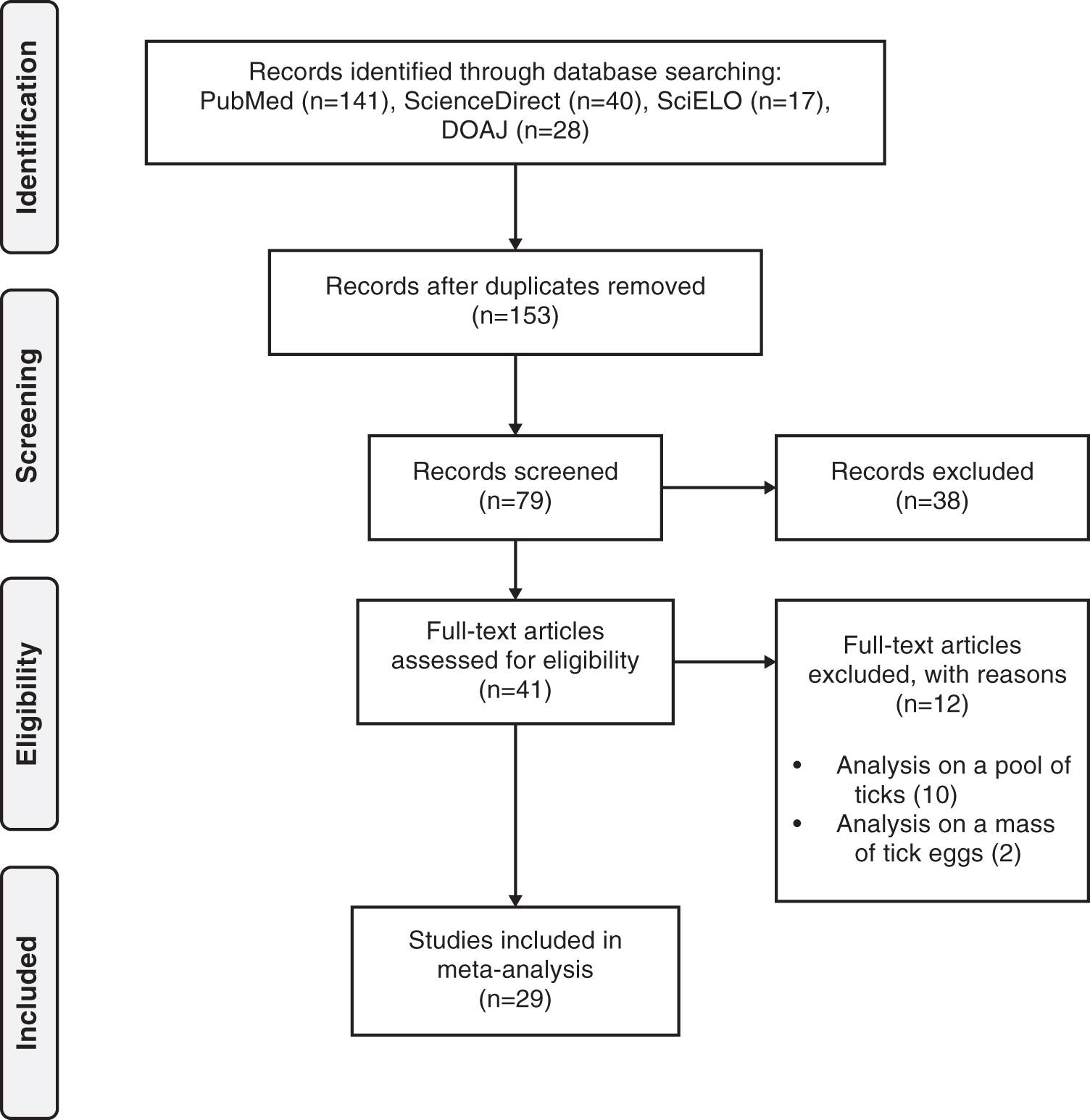
PRISMA flow diagram describing the process of selecting eligible studies, through a systematic approach, in order to assess the prevalence of R. rickettsii in ticks. DOAJ, Directory of Open Access Journals; PRISMA, Preferred Reporting Items for Systematic Reviews and Meta-Analyses.
Characteristics of the Studies Included in the Meta-analysis on the Prevalence of Rickettsia rickettsii in Ticks
CI, confidence interval; RFLP, restriction fragment length polymorphism; RLBH, reverse line blot hybridization.
Pooled prevalence of R. rickettsii
The pooled prevalence of R. rickettsii in ticks was 3.23% (95% CI: 1.97–4.78) (Fig. 2). Significant heterogeneity within this prevalence was observed (I 2 = 95.14%; p < 0.0001). The presence of publication bias among the studies included was observed through funnel plot analysis (Fig. 3) and Egger's test (p < 0.0001).

Forest plot of the pooled prevalence of R. rickettsii in ticks in the Americas.
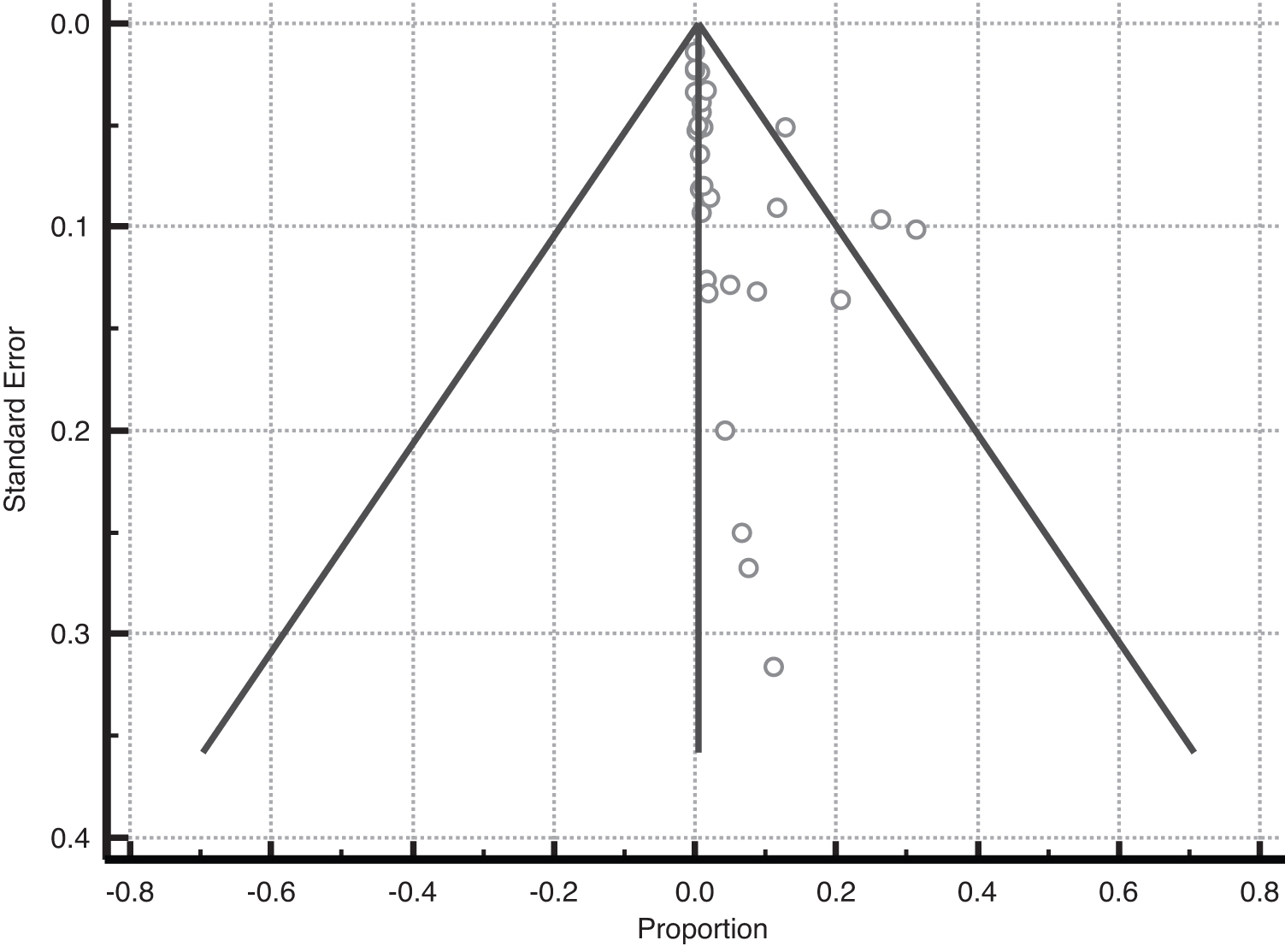
Funnel plot of the studies included for estimating the pooled prevalence of R. rickettsii in ticks.
A subgroup meta-analysis demonstrated that the prevalences of R. rickettsii in South, North, and Central America were 3.42% (95% CI: 1.41–6.29), 3.42% (95% CI: 1.57–5.95), and 2.02% (95% CI: 0.59–4.27), respectively. The countries with the highest prevalences of this pathogen in ticks were Colombia (17.00%; 95% CI: 7.01–30.24) and Mexico (9.89%; 95% CI: 2.03–22.74). Panama, Brazil, and the United States presented a prevalence of 2.76% (95% CI: 0.45–6.93), 2.03% (95% CI: 0.66–4.14), and 0.50% (95% CI: 0.15–1.05), respectively (Table 2).
Pooled Prevalence of Rickettsia rickettsii According to Region of the Americas and Tick Species
The highest prevalence rates for R. rickettsii were observed in ticks of the species R. sanguineus s. l. (6.23%; 95% CI: 2.79–10.92) and A. mixtum (4.36%; 95% CI: 0.25–13.14) (Table 2).
Discussion
The results from this meta-analysis study provide information about the prevalence of R. rickettsii in ticks in different countries in the Americas. Data from each of these countries were pooled and analyzed with the aim of compiling relevant information for public health decision makers in each region.
Colombia presented high pooled prevalence of R. rickettsii in ticks (17%). In this country, the disease emerged between 1934 and 1936 in the municipality of Tobia, Cundinamarca (Patiño et al. 1937), and then remained silent until 2003, when it reemerged in the same region, with two fatal cases (Hidalgo et al. 2007a). Subsequently, outbreaks with fatal cases were recorded in Antioquia and Córdoba (Hidalgo et al. 2007b, Pacheco et al. 2008). Currently, spotted fever is a neglected disease in Colombia, without epidemiological surveillance. For this reason, in many cases, no differential diagnosis between this illness and other febrile diseases is made (Quintero et al. 2017). Data from two studies showed that R. rickettsii had been identified in Amblyomma patinoi and A. mixtum in this region (Faccini-Martínez et al. 2015, Rivera-Páez et al. 2018). These ticks have been found in the central part of Colombia, in Antioquia and Cundinamarca (Faccini-Martínez et al. 2015, Rivera-Páez et al. 2016, Quintero et al. 2021). However, information on these and other species that are vectors for R. rickettsii in Colombia remains scarce. Through conducting tick surveillance studies and including spotted fever in the group of diseases for which notification is mandatory, comprehension of the epidemiology of spotted fever in Colombia can be improved.
From the meta-analysis, the highest pooled prevalence of R. rickettsii was observed in ticks of the species R. sanguineus s. l., and Mexico was the country with the highest prevalence rate in these ticks (Eremeeva et al. 2011, Peniche-Lara et al. 2015). This explains the high pooled prevalence of R. rickettsii that was observed in that country (9.89%). In Mexico, spotted fever emerged in the 1940s, and R. sanguineus s. l. was considered to be the main vector for R. rickettsii at that time. Then, after decades of quiescence, the disease reemerged at the beginning of the 21st century, especially in the states of Sonora and Baja California, with epidemiological characteristics similar to what had been observed in 1940 (Álvarez-Hernández et al. 2017). R. sanguineus s. l. is the tick that most infests dogs: almost all of its stages can parasitize these animals and transmit R. rickettsii. Infested dogs can transport R. sanguineus s. l. into human homes or the areas surrounding them, where this tick can bite humans and transmit R. rickettsii to them (Bermúdez and Troyo 2018). In Sonora, outbreaks of spotted fever have occurred mainly in urban areas with large populations of stray or unleashed dogs. Risk factors such as contact with ticks and contact with dogs have been correlated with most of the cases reported (Álvarez-López et al. 2021).
R. sanguineus s. l. is present in other regions of the Americas but its participation in transmission of R. rickettsii to humans has still not been definitively proven in these areas. Brazilian researchers have reported occurrences of human parasitism by R. sanguineus s. l. and high prevalence of R. rickettsii in this tick species. This indicates that there is a potential risk of transmission of R. rickettsii to humans through the tick R. sanguineus s. l. These researchers suggested that public health care services and other researchers should pay careful attention to this possibility (Pacheco et al. 2011, Silva et al. 2017, Reck et al. 2018).
A meta-analysis on three studies demonstrated that A. mixtum is one of the tick species with highest pooled prevalence of R. rickettsii (4.36%). A. mixtum was identified over a region extending from Texas (United States) to western Ecuador and Colombia (Nava et al. 2014, Rivera-Páez et al. 2016). This tick has mainly been found in rural areas, parasitizing horses, cattle and humans (Bermúdez et al. 2016, Troyo et al. 2016, Rivera-Páez et al. 2018). Intensification of tick surveillance and evaluation of the role of A. mixtum in transmission of R. rickettsii are recommendable, for better understanding of the epidemiology of spotted fever in the areas where this tick is present.
The results from the present study demonstrated that A. aureolatum and D. variabilis presented low pooled prevalence of R. rickettsii (<1%). It is known that R. rickettsii can cause pathogenic effects in several tick species. In A. aureolatum and D. variabilis, R. rickettsii can be lethal and can reduce the fertility of adult females (Burgdorfer and Brinton 1975, Labruna et al. 2011, Schumacher et al. 2016). Moreover, Harris et al. (2017) observed that females of D. variabilis that had been infected with R. rickettsii were incapable of transovarian transmission of this pathogen. In relation to R. sanguineus s. l., there is evidence that the deleterious effects of R. rickettsii may be less in this species. Piranda et al. (2011) observed that R. rickettsii did not cause any lethal effect in these ticks and that infected females were capable of transmitting this bacterium to 40% of their progeny. This variation in the pathogenic effects of R. rickettsii may explain the differences in tick infection rates that were observed in this meta-analysis.
Another possibility to be investigated is whether coinfection by other species of Rickettsia might impede transovarian transmission of R. rickettsii and limit its propagation in the population of these ticks. One study demonstrated that D. variabilis was incapable of maintaining two different species of Rickettsia through transovarian transmission (Macaluso et al. 2002). New studies need to be conducted to better understand the interactions between R. rickettsii and other rickettsial species in situations of coinfection caused by ticks that are vectors of spotted fever.
Despite the low pooled prevalence of R. rickettsii in ticks in the Americas (3.23%), countries like the United States, Brazil, and Mexico have been recording cases of spotted fever every year recently (Kebisek et al. 2020, Ribeiro et al. 2020, Álvarez-López et al. 2021). Nonetheless, it needs to be borne in mind that the serological tests that are routinely used for diagnosing spotted fever do not have the capacity to differentiate between species of Rickettsia. Thus, it is likely that some cases that were previously diagnosed as spotted fever due to R. rickettsii may have been caused by other rickettsial species such as R. parkeri and R. amblyommatis (Parola et al. 2013, Karpathy et al. 2016, Paixão Sevá et al. 2019). Therefore, there is a need to reassess the techniques and strategies used in surveillance for spotted fever, to determine the real distribution of the different forms of rickettsiosis that occur in the countries of the Americas.
This study provides perspective regarding the prevalence of R. rickettsii and points out the direction that future studies should take, but it has some limitations. There was a high degree of heterogeneity among the eligible studies and, for this reason, a random-effects model and subgroup analysis were chosen for estimating the prevalence of R. rickettsii. This high heterogeneity may have been due to variations between: (1) geographical regions; (2) tick species; and (3) sample sizes. Studies with smaller samples tend to generate prevalence rates that are higher than what is expected. This may explain the publication bias that was observed in the present review, given that studies with smaller samples tend to report larger effect sizes and, therefore, have a higher chance of being selected for publication (Turner et al. 2013, Llau et al. 2019).
Conclusions
In the present study, Colombia had the highest prevalence of R. rickettsii in ticks. In that country, spotted fever is a neglected disease without epidemiological surveillance. Therefore, implementation of surveillance actions is recommended, to identify the potential vectors of R. rickettsii and enable better comprehension of the epidemiology of spotted fever in that region. R. sanguineus s. l. was the vector with highest prevalence of R. rickettsii and its role in transmission of this pathogen needs to be investigated by public health professionals, given that this tick is frequently found in urban settings because of the close relationship between dogs and humans.
Footnotes
Authors' Contributions
C.M.R. conducted the systematic review and meta-analysis; P.A.S.B. helped C.M.R. in reading the eligible studies. Both the authors took part in elaborating the text.
Author Disclosure Statement
No conflicting financial interests exist.
Funding Information
There was no financial support.
Supplementary Material
Supplementary Additional File S1
References
Supplementary Material
Please find the following supplemental material available below.
For Open Access articles published under a Creative Commons License, all supplemental material carries the same license as the article it is associated with.
For non-Open Access articles published, all supplemental material carries a non-exclusive license, and permission requests for re-use of supplemental material or any part of supplemental material shall be sent directly to the copyright owner as specified in the copyright notice associated with the article.
