




Abstract
Vector-borne diseases (VBDs) are continuing to emerge globally, requiring new surveillance systems to follow increasing VBD risk for human populations. Sentinel surveillance is an approach that allows tracking of disease risk through time using limited resources. However, there is no consensus on how best to design a sentinel surveillance network in the context of VBDs. We conducted a scoping review to compare VBD sentinel surveillance systems worldwide with the aim of identifying key design features associated with effective networks. Overall, VBD surveillance networks were used most commonly for malaria, West Nile virus, and lymphatic filariasis. A total of 45 criteria for the selection of sentinel unit location were identified. Risk-based criteria were the most often used, and logistic regression showed that using risk-based criteria dependent on host animals is particularly correlated with surveillance system sensitivity (p < 0.018). We identify tools that could prove valuable for sentinel surveillance network design, including a standardized approach for evaluating surveillance systems and a tool to prioritize criteria for selecting optimal geographic locations for spatial sentinel units.
Introduction
In the last few decades, we have witnessed an expansion in the geographic distribution of many arthropod vectors of human disease, such as mosquitoes, biting flies, and ticks. Driving forces in vector range expansion include anthropogenic factors, such as urbanization and globalization, and climate change, which result in new environments becoming suitable for the survival of vectors (Maynard et al. 2017, Ogden 2017, Kraemer et al. 2019). With expanding vector ranges, the emergence of vector-borne diseases (VBDs), diseases transmitted by hematophagous arthropods, is becoming a growing public health problem. VBDs now account for an estimated 17% of the worldwide infectious disease burden and cause more than 700,000 deaths annually (Semenza and Suk 2018, Barker and Reisen 2019).
In many cases, VBD emergence requires public health authorities to develop new approaches to track VBD risk within their administrative boundaries. Public health surveillance is defined as the continuous and systematic collection of data to guide public health practice and interventions (WHOa 2020). In the surveillance of VBDs, additional complexities must be considered—their distribution in space is dependent on vector ecology and reservoir host ecology, and human exposure to vectors. This creates specific challenges for VBD surveillance: (1) as vector habitat range increases, public health authorities must survey an increasing geographic area with finite resources, (2) the presence of vectors and pathogens in the environment is often the target of surveillance since it is prerequisite to the emergence of human cases, and (3) the spread of vectors and pathogens in space can be difficult to predict due to heterogeneity of habitat suitability and patchy introduction of the vector associated with stochastic events or host movement patterns.
Sentinel surveillance offers the opportunity to overcome some of these ecological and logistical challenges. Sentinel surveillance involves the selection of a subgroup of the population to be measured repeatedly to provide a time series of surveillance data. As it uses a targeted sample, costs are limited. Despite a restricted sample size, sentinels have been shown to permit the surveillance of the presence or absence of the vector and/or the pathogen in previous research, for instance as seen in sentinel chicken programs for the prompt detection of West Nile virus circulation, to name a single example (Yukich et al. 2014, Bahuon et al. 2016, Petrić et al. 2016).
Although sentinel surveillance offers the possibility of establishing a cost-effective surveillance system for VBDs, its major limitation is the spatial interpolation of surveillance findings outside the sentinel units (Girond et al. 2017). Thus, to optimize the use of data obtained from the surveillance system, sentinel units must be carefully selected according to the aims of the surveillance program, taking into consideration the type of sentinel, its geographical location, sampling design, and laboratory methods used. Sentinel units, which form individual parts of the sentinel surveillance network, refer to the geographical unit where a sentinel (hospital, clinic, laboratory, sentinel surveillance site) or a group of sentinel individuals (animals, mosquito traps) are located. In this article, we use the term “sentinel unit location” to designate the selected geographic location of a sentinel unit. Animals (individuals or herds) are frequently used as sentinel units (Halliday et al. 2007), and a review of the use of sentinel herds for the surveillance of VBDs showed that sentinel unit location was a key factor determining the efficacy of the surveillance network (Racloz et al. 2006).
Evaluation of surveillance systems is crucial to assess the efficacy and functionality of the network (U.S. Department of Health and Human Services 2006). With this information, public health authorities can evaluate the benefits and challenges of using certain surveillance structure before establishing a new network. The Centers for Disease Control and Prevention (CDC) has built a framework for surveillance network evaluation based on nine key characteristics (hereafter referred to as performance parameters). These performance parameters represent characteristics that a network should have to favor efficient and effective public health surveillance: simplicity, flexibility, data quality, acceptability, sensitivity, predictive value positive, representativeness, timeliness, and stability (German et al. 2001). Sentinel unit location will influence many of these parameters. Selecting appropriate locations for the surveillance units has the potential to favor the detection of disease occurrence (sensitivity), at an early stage in disease emergence (timeliness), and in a manner to capture the risk to human populations (representativeness).
To our knowledge, sentinel surveillance networks for VBDs have not been globally inventoried, as reviews have focused on specific types of sentinel units that for example, sentinel herds (Racloz et al. 2006), or on VBDs in specific settings for example, urban environment (Eder et al. 2018). Thus, a comprehensive review assessing the structure and performance of VBD sentinel surveillance networks worldwide could provide valuable insight into which criteria to consider when designing new surveillance networks of this kind. To respond to this knowledge gap, we carried out a scoping review to characterize the main features of past and existing surveillance networks. By extracting selection criteria involved in determining the spatial distribution of sentinel units, we were able to further describe the rationale underlying the spatial design of these networks. Lastly, by correlating the use of given selection criteria with the performance of the sentinel surveillance network, we aimed to examine whether certain criteria were more likely to result in the implementation of successful surveillance networks.
Methods
Search strategy
A systematic search was conducted in Ovid MEDLINE, Embase, CABAbstracts and Global Health and in the gray literature up to November 29, 2019. The search strategy, including searching terms related to sentinel surveillance and VBDs, terms for VBDs of major public health concern as determined by the WHO (WHOb), are detailed in the Supplementary Data. The search strategy was first validated by a public health librarian from the Public Health Association of Canada (PHAC). The second validation involved using a snowball strategy (manually screening references of relevant articles) and by crosschecking for the presence of 10 references provided by an expert in the field. Any references not found during these two validation steps and which met our inclusion criteria were added to the list.
Study selection
Titles and abstracts drawn from the literature search were screened for relevance independently by two reviewers, to determine whether the articles met each one the following inclusion criteria: (1) surveillance of a VBD, including vector, animal, human, or environmental surveillance; (2) involved a network of at least two sentinel units, whereby a unit is an entity in a predetermined, fixed location; and (3) written in English, French, or Spanish. Articles which did not contain primary data were excluded. Any disagreements were settled by reaching consensus after further discussion. During the screening step, the information was evaluated for relevance by using a standardized tool implemented in DistillerSR (Evidence Partners, ON). The screening tool was validated by pretesting 10 preselected scientific articles by three individual reviewers with agreements ≥85%. General study characteristics were also extracted, such as type of study and year of publication (Supplementary Data).
Data extraction: description of sentinel surveillance networks for VBDs
Articles which met the inclusion criteria in the relevance screening were brought forward to the data extraction step, consisting of a second standardized data extraction (DE) tool (Supplementary Data). The DE tool was validated by three individual reviewers with agreements ≥85% on closed-ended questions from three preselected articles using the tool.
The DE tool contained three parts. The first involved extracting criteria, which were used in the selection of the sentinel unit location. Articles which did not report this information were excluded. In the second part, general characteristics of the sentinel network where clarified, such as VBD investigated, vectors responsible for the disease, methods used for data collection, and type of data collected. Lastly, a global evaluation of the sentinel network was completed, following CDC framework, to gain an overall impression of the value of the surveillance network.
Evaluation of sentinel surveillance networks and their construction
Based on CDC guidelines, proxies for each performance parameters were developed, and associated questions were included in the data extraction form (Supplementary Data). This allowed reviewers to evaluate the performance parameters of the surveillance in a categorical fashion (i.e., whether or not the sentinel network met the performance parameter proxies, or if it was unknown from reading the article).
The next step was to examine whether certain sentinel unit selection criteria influenced the success of the surveillance system. As aforementioned, sentinel location was deemed to directly impact three of the surveillance network performance parameters: sensitivity, representativeness, and timeliness. However, timeliness was excluded from this analysis because in most articles it was not possible to evaluate whether the surveillance network had met this performance parameter.
Thus, surveillance network sensitivity and representativeness were independently inserted as response variables in logistic regressions using the criteria used for sentinel unit selection as fixed effects. These models were run using the glm function within the R environment (R Core Team 2020, Venables and Ripley 2002). Articles whose sensitivity or representativeness could not be evaluated by reviewers were excluded from these models. Fixed effects included only selection criteria that were used in ≥10 articles, which resulted in the exclusion of 28 criteria from the models. Collinearity between variables was excluded using Variation Inflation Factor as calculated with the vif function (Fox and Weisberg 2019) in R. An Akaike Information Criterion (AIC) backward stepwise approach was used to identify the best fitting model. Finally, the fit of the models was evaluated using standard regression diagnostics methods, including Pearson's and deviance residuals, Cook's distances and Pearson's chi-squared test. No use of human or animal subjects, no need for ethics approval within the methods.
Results
Search outcome
Our search strategy yielded a total of 7309 articles, from the 4 databases and the gray literature searched. A total of 4674 duplicates were removed, and 3 articles were added after crosschecking references during the search strategy validation steps. A total of 2638 articles progressed to the title and abstract screening step.
During title and abstract screening, 1006 articles were not based on surveillance of VBD, and 861 did not focus on sentinel networks and were thus excluded. Seventy other articles were excluded as they were in a language other than English, French, or Spanish (47 Chinese; 3 Croatian; 3 German; 3 Italian; 1 Korean; 10 Portuguese; 2 Serbian; and 1 Turkish) and 64 articles were excluded as they did not present primary data. One article was both written in another language and did not contain primary data. This resulted in a total of 638 articles which progressed to the data extraction step (Fig. 1).
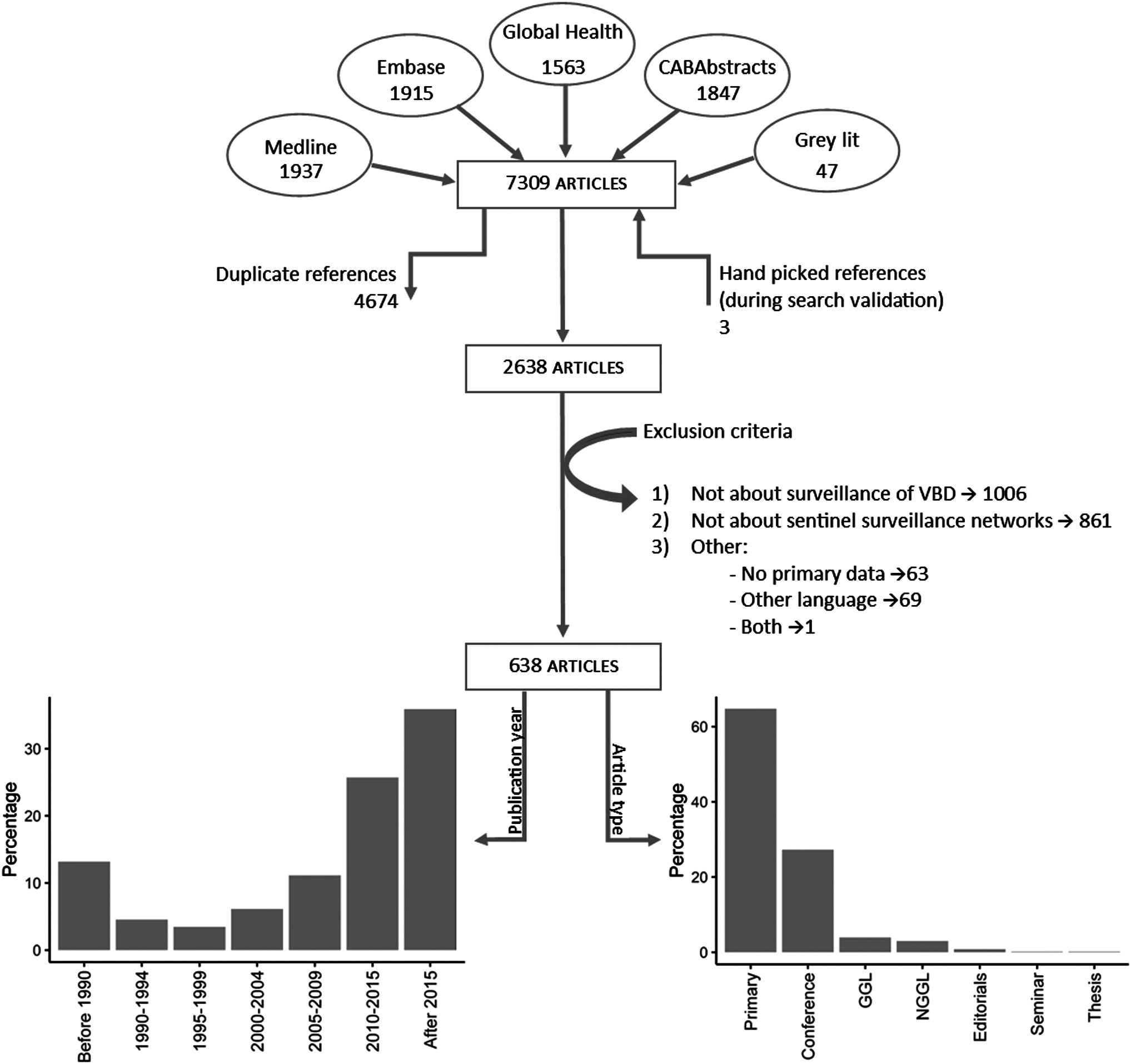
Search outcome from a scoping review aimed at investigating sentinel surveillance networks for vector-borne diseases, performed between September and November 2019. The search outcome is reported based on PRISMA guidelines. GGL, governmental gray literature; NGGL, nongovernmental gray literature.
Description of included articles
A total of 246 articles were eliminated either because they did not mention selection criteria used for sentinel site location (n = 186), or because the full text could not be found (n = 60). Thus, of the articles (n = 638), which passed the title and article screening step, 206 (32.2%) passed the full data extraction step. From here on, only the articles that were retained through the data extraction step will be described.
The 206 articles retained were carried out in Africa (n = 88, 42.7%), Asia (n = 32, 15.5%), North America (n = 27, 13.1%), Western Europe (n = 18, 8.7%), Australia (n = 14, 6.8%), Central or South America (n = 13, 6.3%), Oceania (n = 8, 3.9%), and Eastern Europe (n = 7, 3.4%). One study had sites both in Australia and Oceania. They presented results from sentinel networks operating at local (n = 33, 16.0%), regional (n = 73, 35.4%), national (n = 94, 45.6%), or less commonly multinational (n = 6, 2.9%) scale.
The principal VBDs monitored by sentinel networks included malaria (n = 68, 33.0%), West Nile virus (n = 32, 15.5%), lymphatic filariasis (n = 22, 10.7%), and schistosomiasis (n = 19, 9.2%) (Table 1). A total of 24 different viruses, 9 parasites and 3 bacteria were surveying across the articles.
List of Vector-Borne Diseases Investigated Within the Articles Included in the Scoping Review, Including Type of Arthropod Vector, Type of Pathogen, and Number of Articles Which Studied Each of These Diseases
NA, not applicable.
Sentinel surveillance networks in the articles were largely active (n = 181, 87.9%) and less commonly passive (n = 14, 6.8%). Some articles (n = 11, 5.3%), used both active and passive surveillance within the sentinel network.
Description of the sentinel networks
Surveillance networks described in the articles operated for <1 to >20 years and comprised between 2 and >50 sentinel units (Table 2).
Number of Sentinel Surveillance Units in Networks Described in Articles Considered in the Scoping Review, According to the Duration of the Surveillance Network Operation
The sentinel units in the networks were villages (n = 46, 22.3%), clinics (n = 42, 20.4%), sites in an urban setting (n = 1, 8.3%), sites in the countryside (n = 16, 7.8%), farms (n = 11, 5.3%), schools (n = 9, 4.4%), sites in the suburbs (n = 7, 3.4%), sites in the forest (n = 4, 1.9%), health zones (n = 4, 1.9%), houses (n = 2, 1.0%), and laboratories (n = 1, 0.5%), zoos (n = 1, 0.5%), or kennels (n = 1, 0.5%). However, 68 articles (33.0%) did not explicitly state or describe their sentinel site settings.
When animals were used within the network, and placed within the sentinel units, the most common animals used were chickens (n = 32, 15.5%), bovine (n = 22, 10.7%), wild birds (n = 10, 4.9%), sheep (n = 7, 3.4%), dogs (n = 6, 2.9%), goat (n = 4, 1.9%), horse (n = 4, 1.9%), hamsters (n = 3, 1.5%), mice (n = 3, 1.5%), rodents (n = 3), livestock (n = 2, 1.0%), pigs (n = 2, 1.0%), deer (n = 1, 0.5%), donkeys (n = 1, 0.5%), and zoo animals (n = 1, 0.5%). A total of 132 articles (64.1%) did not use any animals as sentinels.
Aim of articles on sentinel networks
The broad aims of the articles are included following disease trends (n = 128, 62.1%), testing intervention methods (n = 72, 35.0%), profiling risk factors (n = 32, 15.0%), acting as an Early Warning System (EWS) (n = 15, 7.3%), and evaluating the surveillance network (n = 10, 4.9%).
Disease detection methods used
A total of 49 different sampling and laboratory methods were identified in the articles (Table 3) allowing the collection of various types of data (Fig. 2).
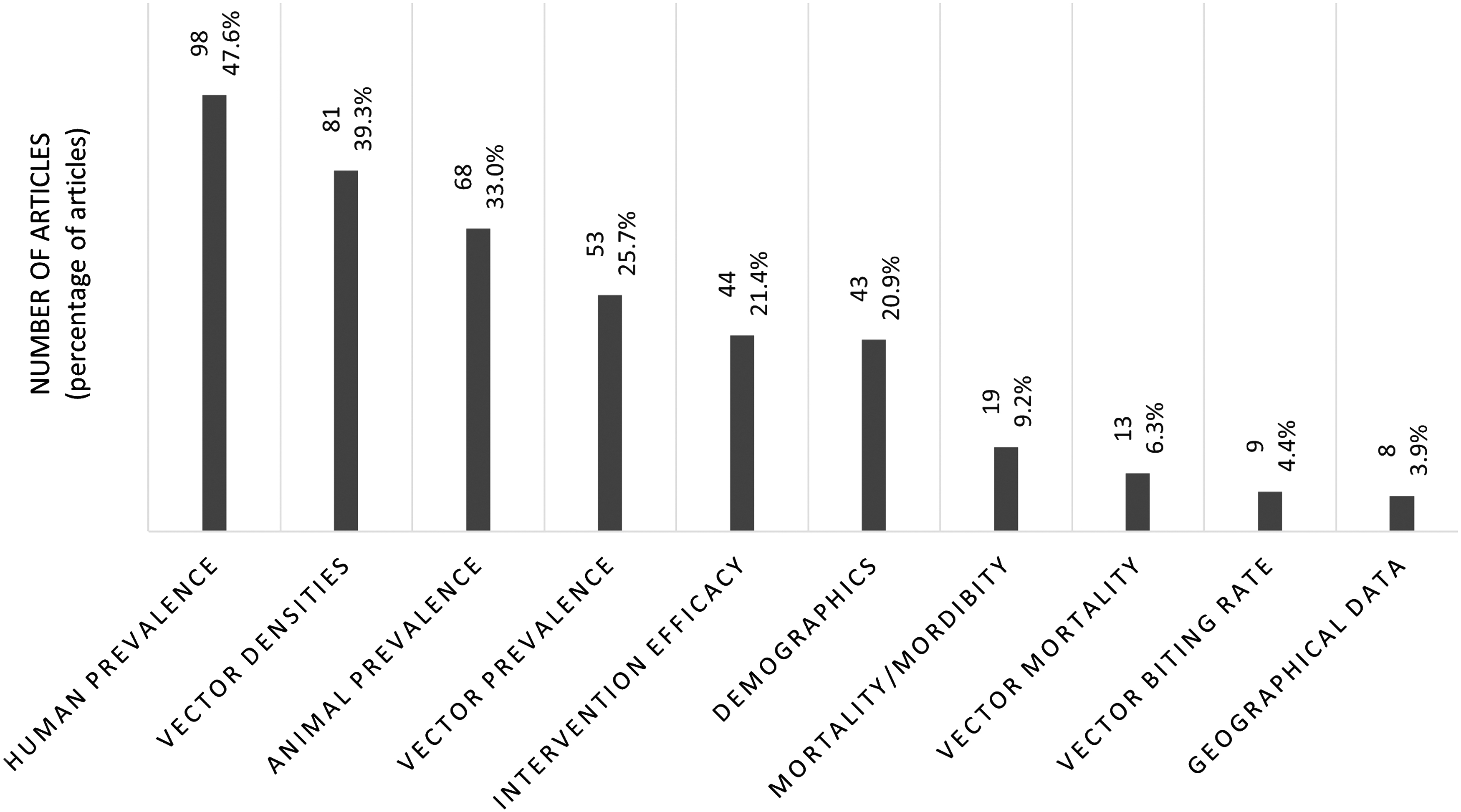
Data reported to be collected through the sentinel networks described in the articles retained in our scoping review. Articles could have more than one type of data collected. This included prevalence of pathogen/disease in humans (human prevalence), vector densities, prevalence of pathogen/disease in animals (animal prevalence), prevalence of pathogen in vectors (vector prevalence), intervention or treatment efficiency (intervention efficacy), demographic data (demographics), mortality/mortality data for humans (mortality/morbidity), mortality data for vectors (vector mortality), vector biting rate, and geographical data.
Data Collection and Laboratory Analysis Methods Used for Disease Detection in Sentinel Surveillance Systems Described in the Articles Retained in Our Scoping Review
AGID, agar gel immunodiffusion; CBC, complete blood count; CSF, cerebrospinal fluid; ELISA, enzyme-linked immunosorbent assay; FTS, Alere Filariasis Test Strip; HOLA, hot oligonucleotide ligation assay; ICT, immunochromatographic card test; PRNT90, plaque reduction neutralization tests; RDTs, rapid diagnostic tests; RFLP, restriction fragment length polymorphism; SNT, serum neutralization tests.
Selection criteria for sentinel unit locations
A total of 45 criteria involved in the selection of sentinel locations were identified during the data extraction step (Table 4). These criteria were grouped into 6 broad categories: Risk, Environment, Population, Delimitation, Past information, and Logistics.
Criteria Used to Select Sentinel Unit Locations in Sentinel Surveillance Networks for Vector-Borne Disease, as Extracted from the Articles Included in Our Scoping Review
The criteria are classified into broad categories: Risk, Environment, Population, Distribution, Past information, and Logistics.
SUL, sentinel unit location; VBD, vector-borne disease.
The Risk category includes criteria which evaluate the presence or absence of an indicator of risk within the selected sentinel units (e.g., presence of vectors, host animals or human cases). The Environment category takes into consideration the natural features of the study zone, such as habitat suitability for vectors or host animals, based on ecological, meteorological, or geographical data. The Population category is directly related to the human population of the study zone, either for demographic data, presence of human activity, or population dynamics. The Distribution category refers to criteria guiding the spatial distribution of sentinel units across the study area. The Past Information category incorporates previous knowledge, from former articles or surveillance programs, which supported the selection of sentinel unit locations. Finally, the Logistics category groups criteria, which were used to maximize feasibility of the sentinel surveillance network, including access or diffusion of results. On average, articles used 2.4 criteria to determine sentinel unit locations.
The most common categories of criteria used to determine sentinel unit locations were Risk, Past information, and Environment, with a total of 122 (59.2%), 79 (38.3%), and 74 (35.9%) articles using criteria from those categories, respectively. The Distribution, Logistics, and Population categories were less commonly used, with a total of 51 (24.82%), 43 (20.9%), and 30 (14.6%) articles reporting using these criteria, respectively.
Evaluation of the sentinel surveillance networks
Of the 206 articles, a vast majority of sentinel networks were reported to be useful (n = 200, 97.1%) by the authors. Furthermore, acceptability of the sentinel network was high (n = 191, 92.7%), with good sensitivity (n = 187, 90.8%), and representativeness (n = 157, 76.2%). Meanwhile, a large proportion of the articles had an obvious degree of complexity (n = 105, 51.0%). Overall, data quality was high, with 99 articles (48.1%) reporting less than 10% of data missing.
Some of the evaluation parameters showed a higher degree of uncertainty. Overall, 182 (88.3%), 181 (87.9%), and 175 (85.0%) of the articles did not provide enough information to objectively assess stability, timeliness, and flexibility, respectively.
Best fitting models, as determined by backward stepwise model selection using AIC, are shown in Table 5. Minimal AIC were 132.6 and 232.3 for the sensitivity and representativeness regressions, respectively. Logistic regressions showed that choosing sites used in previous studies, based on population numbers or using a risk measure of host animals were strongly significantly associated with sensitive surveillance systems. Meanwhile, the use of logistical constraints, population numbers, use of sites from previous studies or past surveillance initiatives, sites with previous public health intervention, and variation in ecology were criteria significantly associated with representative surveillance systems.
Logistic Models Investigating the Effects of Using Specific Sentinel Site Selection Criteria on Surveillance Network Sensitivity and Representativeness
Sensitivity, as defined by the CDC, refers to the ability of the network to monitor changes in prevalence in number of cases, vector density, or pathogen over time; the reference level for the analyses was “ nonsensitive.” Representativeness refers to the ability of the network to accurately describes the occurrence of a health-related event over time and its distribution in the population by place and person; the reference level for the analyses was “not representative.” Selection criteria, which were used in >5% of articles (or in over 10 articles) were included in the models. CDC, Centers for Disease Control and Prevention.
Discussion
VBDs are rapidly emerging worldwide, a phenomenon precipitated by climate change (Campbell-Lendrum et al. 2015, Semenza and Suk 2018, Rocklöv and Dubrow 2020). As the ecological ranges of vectors expand, public health authorities see the need to survey large geographical areas to detect changes in the distribution of vectors and associated changes in the spatial distribution of VBD risk. Sentinel surveillance provides an attractive surveillance method by limiting costs and offering targeted insight into the disease cycle through time. Our scoping review offers a portrait of how sentinel surveillance networks for VBDs are designed, including the type of sentinels used, the number of sentinel units, and the disease detection methods used. Furthermore, we have summarized key criteria used for the selection of sentinel unit location in the context of VBDs and provided a rudimentary evaluation of these networks.
The four VBDs most frequently targeted by sentinel surveillance systems in the reviewed literature were malaria, West Nile virus, lymphatic filariasis, and schistosomiasis. Overall, mosquito-borne diseases accounted for two thirds (67%) of retained articles, possibly reflecting global concern that by 2050 half of the world's population could be exposed to disease-spreading mosquitoes, such as Aedes spp., due to their expanding habitat range (Kraemer et al. 2019). Malaria represents a major global health burden, accounting for ∼435,000 deaths annually (WHO 2020) and it was therefore not surprising that one third (33%) of retained articles focused on this parasite. However, despite dengue showing the greatest increase in global incidence in the last 50 years, with a 30-fold rise, none of the articles included in our review targeted this disease (WHO 2014). Meanwhile, sentinel surveillance has been shown to be effective in monitoring transmission for other diseases spread by Aedes aegypti, such as Zika and chikungunya (Barrera et al. 2019). As collection methods and laboratory techniques are often similar for analysis of pathogens transmitted by a specific vector species, we suggest that existing sentinel networks could increase their impact by diversifying surveillance targets to include a larger breadth of neglected tropical diseases in regions where they are emerging or endemic.
Mosquito trapping, blood sampling, or symptom surveillance/questionnaires in humans, followed by blood sampling in animals were the most commonly used data collection methods. As for laboratory methods, Enzyme-Linked Immunosorbent Assay (ELISA) and PCR tests were most often employed. These relatively simple methods require limited training and resources (in comparison to more extensive methods such as rodent capture, physical examinations, and specialized laboratory tests) and may therefore have logistical advantages over more complex or expensive techniques in terms of network feasibility and sustainability.
A total of 45 selection criteria were identified from the different articles retained in our scoping review, reflecting the large variety of criteria considered by public health authorities when designing surveillance networks. This list of criteria provides a starting point for researchers and public health authorities seeking to identify selection criteria that will help design a sentinel network capable of fulfilling their surveillance objectives. Overall, an average of 2.4 criteria were used in the articles examined in this review, suggests that, in practical terms, working with a limited number of criteria may be sufficient to achieve satisfactory sentinel unit selection.
Risk-based criteria were the most frequently used for sentinel unit selection. Risk measures included incidence of human cases of VBD, presence of host animals, variation of risk between sentinel site locations, presence or abundance of the primary vector, or lastly, some unspecified measure of risk of disease. As sentinel surveillance targets a limited subset of the population, using risk criteria to orientate the location of sentinel units should allow for more sensitive data collection. Logistic regression analysis showed that using a selection criterion based on risk as measured by host animals is significantly correlated with sensitive surveillance systems (p = 0.018). This supports the use of sentinel animals as a sensitive initial indicator of risk (Herrer 1982, Julian et al. 2002, Kwan et al. 2010, Achazi et al. 2011, Petrović et al. 2018), with the caveat that care must be taken to select an epidemiologically appropriate sentinel animal for the disease being studied (Halliday et al. 2007).
Environment was the second most frequent category of criteria used in selection of sentinel unit locations—particularly geographical features. Variation in ecology (without explicit detail into which features were taken into consideration) were correlated with a more representative surveillance system (p = 0.009). None of the environmental criteria was correlated with sensitive surveillance systems. Despite this finding, we argue the importance of considering environment and landscape features in the selection of a sentinel unit, as VBDs are known to be sensitive to environmental changes, including ecological, landscape, and geographical characteristics (Campbell-Lendrum et al. 2015, Lowe 2018). However, choosing sentinel unit locations based solely on environment may hinder representativeness if anthropogenically driven factors, such as human movement, urbanization, and poverty, are not taken into consideration (Ali et al. 2017). Environmental criteria nonetheless play an increasingly important role in the era of climate change, and so we suggest that careful selection of sentinel unit locations based on both ecological and geographical criteria will help insure sensitivity and long-term relevance of the surveillance system, especially in the context of disease emergence.
Many surveillance networks used past information to select sentinel unit locations, taking advantage of sites used during previous surveillance initiatives (34 networks) or research projects (21 networks). These selection criteria are likely to lead to a longer time series and reduce resources required to establish new sentinel locations. Furthermore, surveillance systems that used past study sites (including past surveillance sites, or sites which have been previously targeted for public health interventions) as a selection criterion were significantly more representative (p < 0.001). Considering this information, we suggest that using existing sites established in previous initiatives and converting these to sentinel unit locations may be advantageous, provided that the previous study's objectives and data collection methods are compatible with those of the new surveillance network. Meanwhile, surveillance networks which evaluate intervention methods represent a special subgroup; in this case it is also important to determine if sentinel unit locations are to be places in areas with or without application of the targeted public health interventions.
Researchers should evaluate the added value of considering the geographic distribution of their sites—administrative boundaries may have a slightly negative impact on sensitivity of the sentinel surveillance network (p = 0.059), but could ensure equity in resource allocation across a territory. This could be overcome by selecting an even distribution of sites within the study zone or random distribution of sites which do not appear to have a negative impact.
Taking into consideration population-based criteria, such as population numbers, for selection of sentinel unit location, was associated with increased representativeness and sensitivity of the surveillance network (p = 0.032; p = 0.007). This is unsurprising since representativeness describes the accurate representation of the disease distribution in the population by place and person. Thus, targeting the right population, or maximizing the population reached by the sentinel units can provide a better portrait of the disease situation.
Finally, logistical criteria (for instance, taking into consideration travel distance and access to sentinel sites) was associated with representativeness of the surveillance network (p = 0.039). This suggests that sound strategic planning of sentinel unit locations, taking into account logistical constraints and aiming for voluntary participation, is more likely to result in effective and feasible data collection, resulting in a better understanding of the disease and its repercussions on human populations.
One limit of this scoping review is that the literature search targeted VBDs, which can be transmitted to humans. However, articles that reported on VBDs solely impacting animal health were not excluded, as they are still considered of public health importance, and can impact human populations indirectly. These diseases, such as bluetongue, are nevertheless under-represented in our results. Although many of the criteria identified will be broadly applicable to any type of sentinel network targeting VBDs, specific additional criterial may be important to consider when building sentinel surveillance networks for VBDs affecting principally animal populations, or even plants (Huang et al. 2020).
Our logistic regressions provided insight into ways of prioritizing criteria selection to optimize sentinel surveillance network performance. However, these regressions should mainly be used as a guide for performance of the selection criteria, as several limitations of this approach are important to note. First, lack of sensitivity or representativeness may not necessarily be due to sentinel unit location, but due to the surveillance methods used (e.g., failing to use an appropriate species as sentinel animals) (Crans 1986). Next, due to the complex nature of evaluating surveillance networks and the limited information available in the articles, we used simplified proxies to determine whether a particular surveillance network successfully met the CDC system attributes (German et al. 2001). However, there was still a high volume of missing information, where the reviewers were unable to determine whether the parameter was fulfilled.
Our results from the descriptive analyses of evaluation parameters and the performance score highlight an important gap in thorough reporting of surveillance functionality in publications. In addition, in articles where the aim was specifically to evaluate the surveillance system, the evaluation usually focused on a single key aspect of the overall performance of the network, such as sensitivity, representativeness, timeliness, or stability (Crans 1986, Koukounari et al. 2011, Pultorak et al. 2011, Yukich et al. 2014, Bleyenheuft et al. 2015, Healy et al. 2015, Petrović et al. 2018, Sanou et al. 2018, Wahnich et al. 2018). The need for a comprehensive approach to evaluate surveillance systems, which should be complete, flexible, and operational has been identified in the past (Calba et al. 2015). We add to this conclusion that clear and concise reporting of surveillance network evaluations should be incorporated into this approach. This would allow researchers and public health authorities implementing new surveillance networks or adding new sentinel unit locations to their network to assess potential benefits and challenges associated with different surveillance network designs.
Conclusion
Our scoping review characterized different elements required for the construction of a sentinel surveillance network for VBDs. Findings from the literature can act as a reflection exercise for those wishing to establish a new sentinel surveillance system. We have identified tools that could prove valuable for such aims, including a standardized and comprehensive approach to evaluating surveillance systems and a tool to prioritize criteria that will aid in spatial design of an effective surveillance network. In particular, given the high number of criteria and the particularities of individual VBDs, the development of an algorithm which could be applied by researchers or public health authorities to prioritize criteria to meet surveillance objectives would be a useful future development in this area.
Footnotes
Acknowledgments
The authors would like to extend their thanks to the Public Health Library of Public Health Agency of Canada and Katherine Merucci for their support in conducting their literature search.
Authors' Contributions
C.G., P.L., and C.B. conceptualized the project. C.G., C.B., P.B., and M.M. designed the scoping review. P.L. and C.S. contributed to this design. P.L. and C.B. supervised the project. C.G., C.S., and C.-A.V. collected the data by acting as reviewers for the scoping review. C.G. wrote the article, and results were analyzed with the support of C.S., P.B., M.M., C.B., C.S., and P.L. and commented on the article, and all coauthors reviewed the final draft.
Author Disclosure Statement
No conflicting financial interests exist.
Funding Information
This research was funded by the Canadian Lyme Disease Research Network (CLyDRN) and the Faculty of Veterinary Medicine, Université de Montréal.
Supplementary Material
Supplementary Data
References
Supplementary Material
Please find the following supplemental material available below.
For Open Access articles published under a Creative Commons License, all supplemental material carries the same license as the article it is associated with.
For non-Open Access articles published, all supplemental material carries a non-exclusive license, and permission requests for re-use of supplemental material or any part of supplemental material shall be sent directly to the copyright owner as specified in the copyright notice associated with the article.
