




Abstract
Background:
A wide range of insect-specific viruses (ISVs) have been reported worldwide. There are no studies from India that have reported ISVs. The current study describes the identification of Phasi Charoen-like virus (PCLV) from Aedes aegypti mosquito-pools from six districts of Karnataka state, India.
Materials and Methods:
During the Chikungunya virus (CHIKV) outbreak in the Bangalore Urban district in 2019, using conventional PCR, it was found that both human and mosquito samples were positive for CHIKV. For retrieve the complete genome sequence, mosquito samples were subjected to next generation sequencing (NGS) analysis and PCLV was also found. During 2019, as part of a vector-borne disease surveillance, we received 50 mosquito pool samples from 6 districts of the state, all of them were subjected to NGS to identify PCLV.
Results:
The A. aegypti mosquito-pools samples were subjected to the NGS platform that led to identification of an ISV, PCLV. PCLV was identified in 26 A. aegypti mosquito-pools collected from 6 districts. We also found mixed infection of PCLV with the Dengue virus (DENV; genotypes 1 and 3) and CHIKV from five pools. The nucleotide identity for the L gene of Indian PCLV sequences ranged between 97.1% and 98.3% in comparison with the Thailand sequences.
Conclusions:
To the best of our knowledge, this is the first report of PCLV dual infection with DENV and CHIKV in India. The present study confirms the presence of PCLV in A. aegypti mosquitoes from Karnataka state. The study adds India in the global geographical distribution of PCLV.
Introduction
Arthropod-borne viruses, mainly transmitted by mosquitoes, ticks, and midges, have become a significant public health concern as they cause significant mortality and morbidity among both humans and animals. Application of next-generation sequencing (NGS) technology and bioinformatic tools led to the finding that mosquitoes are naturally infected with a wide range of viruses (Iwashita et al. 2018). Over the past 15 years, many novel insect-specific viruses (ISVs) were discovered and reported from different parts of the world (Junglen et al. 2009, Quan et al. 2009, Yamao et al. 2009, Marklewitz et al. 2013, Vasilakis et al. 2013, Auguste et al. 2014, Chandler et al. 2014, Hobson-Peters et al. 2016). ISVs come under virus families traditionally associated with human arboviral pathogens, which include the Bunyavirales order and families such as Flaviviridae, Togaviridae, Reoviridae, Rhabdoviridae, and Phenuiviridae (Bolling et al. 2015, Nouri et al. 2018, Öhlund et al. 2019). India is one of the mega biodiversity countries in the world with a wide range of arthropod species that have evidenced multiple arthropod vector-borne diseases. To date, ISVs have not been identified or reported from any part of India. This study describes the accidental identification of an ISV in Aedes aegypti pools from six districts of Karnataka state, India.
During an outbreak in June 2019, in Mantapa village in Bangalore district, we found that both human and mosquito samples were positive for Chikungunya virus (CHIKV) by conventional PCR. We wanted to confirm the presence of CHIKV in both human and mosquito samples, so we subjected both samples to NGS analysis. During NGS, we accidentally found the Phasi Charoen-like virus (PCLV) in a mosquito sample. This had given us clue to screen for PCLV in all mosquito-pools samples collected during that period.
Materials and Methods
As a part of the vector-borne disease surveillance, mosquito samples from 50 pools were collected between June and August 2019 from Bangalore Urban, Bangalore Rural, Chikkaballapura, Kolar, Tumkur, and Ramanagara districts of Karnataka state. The state entomologist collected mosquito pool samples from suspect houses and the exterior of their house structure manually, using a mechanical aspirator. Inside the home, total catch was done using 2% pyrethrum extract spray. The state entomologist had identified and separated the different mosquito-pools species-wise and gender-wise. A. aegypti was identified using a hand lens or stereomicroscope based on its appearance, having a narrow and typically black body, unique patterns of light and dark scales on the abdomen and thorax, and alternating light and dark bands on the legs. A sample consisting of 10 to 20 mosquitoes was collected in a tube, where male and female mosquitoes were separated. Then, live mosquitoes were transported in test tubes plugged with cotton (soaked with glucose water) at ambient temperature within 2–4 h of collection.
Mosquitoes were frozen in liquid nitrogen and crushed with the help of a mortar and pestle. This was followed by homogenization in lysis buffer with proteinase K solution by pipetting. RNA extraction from mosquitoes was performed using the QIAamp® Viral RNA Mini Kit (Qiagen, Hilden, Germany) with minor modifications (homogenized sample was passed twice in the extraction column). RNA was eluted in 50 μL of nuclease-free water. These were tested for Dengue virus (DENV) and CHIKV by RT-PCR. The actin-1 primer (Staley et al. 2010) was used as an internal control to test the quality of RNA from mosquito pool samples. The degenerate PCR primers (ChikF: forward primer 5′-CAACTTGCCCAGCTGATCTC-3′ and ChikR: reverse primer 5′-GGATGGCAAG ACTCCACTCT-3′) for CHIKV were designed based on the E gene segment from GenBank (accession no. AF369024) with support of an earlier report (Parida et al. 2007). RT-PCR for the primer pairs of DENV was carried out using standard primer pairs (Menting et al. 2011): DENVF: forward primer 5′-GGTTAGAGGAGACCCCTCCC-3′ and DENVR: reverse primer 5′-GAGACAGCAGGATCTCTGGTCT-3′. PCR conditions are maintained as per the following steps: a reverse transcription step at 50°C for 30 min, followed by 95°C for 15 min for predenaturation, and a 40-cycle repeat of denaturation at 95°C for 30 s, annealing at 55°C for 30 s, and an extension at 72°C for 30 s. The PCR fragment is separated with the agarose gel electrophoresis method and final stain visualized by the gel documentation system (Bio-Rad) to determine the band size.
To get the complete viral genome sequence from the mosquito samples, they were referred to the Indian Council of Medical Research-National Institute of Virology, Pune, for NGS analysis. Ribosomal depletion was carried out to remove host ribosomal RNA from the extracted RNA using the NEBNext® rRNA Depletion Kit (New England Biolabs). RNA libraries were prepared from the samples received using the method described in earlier published literature (Yadav et al. 2019). These RNA libraries were quantified and loaded on the MiniSeq Illumina machine (Qiagen). The paired-end reads generated from the files were analyzed using the CLC Genomics Workbench, version 11.0. Reference-based mapping, as well as de novo assemblies, was performed to identify the agents present in the samples. A maximum likelihood tree was generated with a general time-reversible model and bootstrap replication of 1000 cycles using MEGA software, version 7.0 (Pennsylvania State University). Furthermore, percent nucleotide identity (PNI) was also retrieved using MEGA software.
Results
Of 50 A. aegypti mosquito pool samples subjected to the NGS platform, 26 revealed the presence of ISV. Analysis of the generated contigs led to identification of the Phasi Chareon-like virus (PCLV), an ISV in A. aegypti (Table 1).
Summary of the Chikungunya and Dengue Virus RT-PCR Tests from Mosquito Pools and Identified Virus using the Next-Generation Sequencing Analysis During Year 2019
Partial sequence, hence not retrieved and submitted to GenBank.
NA, not available; CHIKV, Chikungunya virus; DENV, Dengue virus; NGS, next-generation sequencing; PCLV, Phasi Charoen-like virus.
NGS analysis of 50 mosquito-pools samples reports that CHIKV and PCLV were present together in 2 pools, Dengue serotype 1 and PCLV were present together in two pools, and Dengue serotype 3 and PCLV were present together in one pool. PCLV alone was identified in 21 pools. Twenty-four pools reported no viral RNA through NGS analysis. For details, refer Table 1.
Chikkaballapura districts reported 11 mosquito pools positive for PCLV, of them, 3 pools had Dengue and PCLV together and 1 pool had CHIKV and PCLV together. The Kolar district reported four mosquito pools positive for PCLV, of them, one pool had CHIKV and PCLV together. The Ramanagara district reported PCLV from four mosquito pools, Tumkur district reported three pools positive for PCLV, and Bangalore Urban and Rural districts reported PCLV from two mosquito pools each. Refer Table 1 and Fig. 1 for more information.
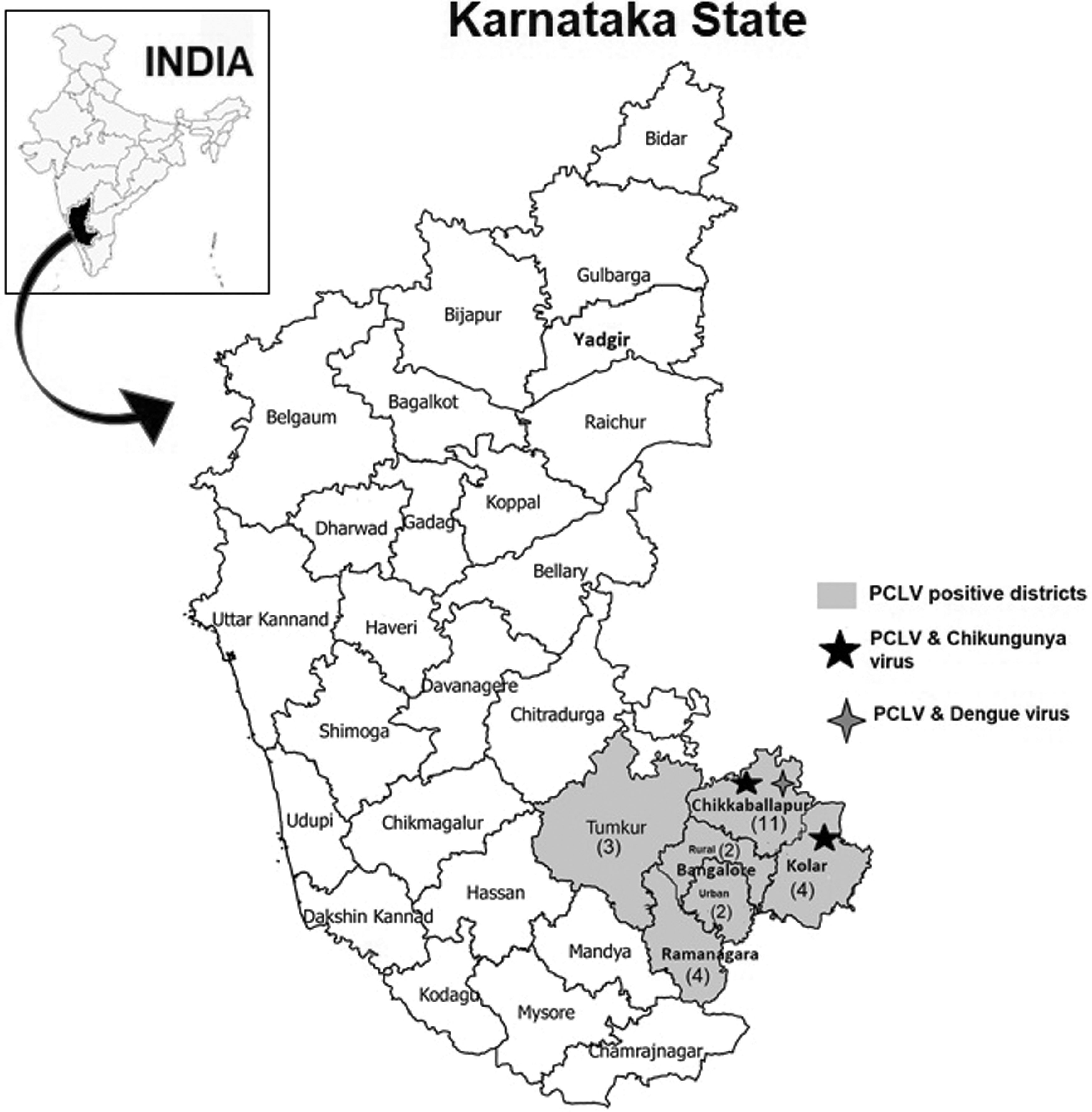
Karnataka state map showing mosquito pools positive for PCLV. The numbers in brackets indicate the number of mosquito pools found positive in each district. PCLV, Phasi Charoen-Like Virus.
Reference-based assembly was performed to retrieve the complete genome of the PCLV, DENV, and CHIKV. The percentages of relevant reads mapped and the genome retrieved are given in Table 2. Phylogenetic analysis was performed for Phasi Charoen-Like Virus (PCLV) (L, M, and S segments), DENV, and CHIKV using the reference sequences downloaded from GenBank. It was observed that the CHIKV retrieved from the current study clustered with the South/Eastern/Central African genotype of the CHIKV (Fig. 2B). It shared a PNI of 98.9% with the Indian CHIKV sequence (accession no. KX619422). The three DENV sequences clustered in two different groups, identifying two sequences to be of the DENV-1 genotype and one as DENV-3 (Fig. 2A). The DENV-1 sequences shared a PNI of ∼98.5% with the DENV-1 sequence of Singapore (accession no. MF033253). Figure 3A–C depicts the phylogenetic tree for the L, M, and S segments of the PCLV, respectively. It is observed that all these segments are clustered with the PCLV of the Thailand strain. The nucleotide identity for the PCLV L gene ranged between 97.1% and 98.3%, while for the M gene and S gene, it ranged between 96.4–97.8% and 95.3–97.3%, respectively. PNI values for the different segments of PCLVs retrieved during the study for the Thailand PCLV strain (accession no. KX619422) are given in Table 3.

Phylogenetic tree of DENV and CHIKV sequences retrieved from the study. The tree was built with the maximum likelihood method algorithm and sequences of our study, which was designated by the accession number (GenBank) reference sequences and our findings of sequences for
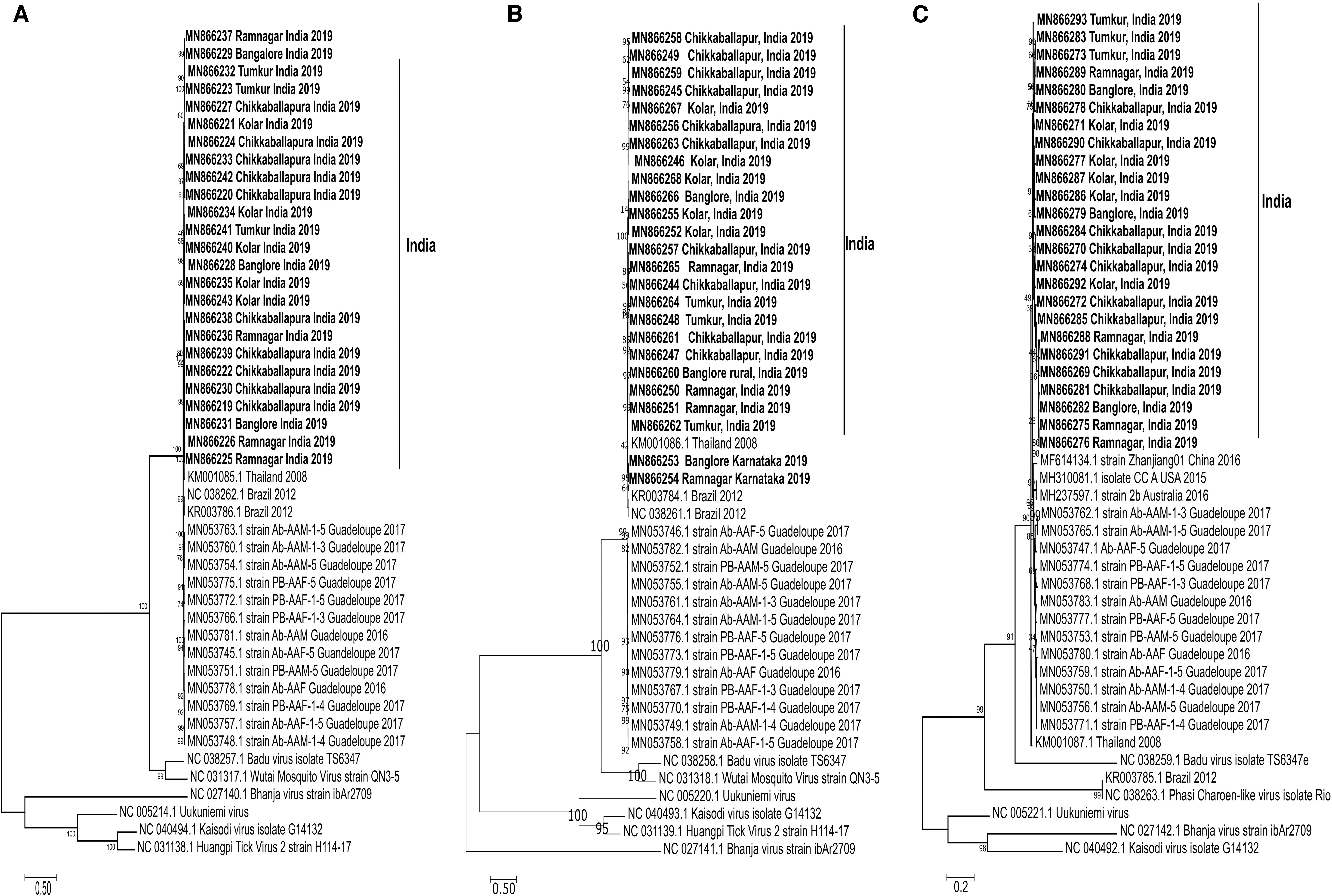
Phylogenetic tree of PCLV segments retrieved from the study. The tree was built with the maximum likelihood method algorithm and sequences of our study, which was designated by the accession number (GenBank) reference sequences and our findings of sequences for
The Percentage of Relevant Reads and the Genome Retrieved for Different Segments of the Phasi Charoen-Like Virus with Respect to the Phasi Charoen-Like Virus from Thailand
Percent Nucleotide Identity of the Indian Phasi Charoen-Like Virus with Respect to the L, M, and S Segments of the Phasi Charoen-Like Virus from Thailand, 2008
Discussion
Karnataka state is a biodiversity hotspot, with a high prevalence of various mosquito species. Vector-borne diseases such as Dengue and Chikungunya are reported every year in this state (Yergolkar et al. 2006, Lakshmi et al. 2008). During June to August 2019, mosquito pool samples were collected from six southern districts of Karnataka state as part of the surveillance. After conventional PCR detection of CHIKV and DENV in mosquito samples, we subjected the same samples to complete genome sequence analysis for identifying CHIKV and DENV; interestingly, we identified PCLV.
For decades, insect-specific bunyaviruses have been gaining attention in various parts of the globe with increased newer virus detection among mosquito species. Among Aedes species, new ISVs identified were the Cumuto and Wallerfield viruses from Trinidad; Dezidougou, Jonchet, Ferak, and Cavally viruses from Côte d'Ivoire; Badu virus from Australia; Guapiacu virus from Brazil; Phasi Charoen virus; and PCLV from Thailand (Junglen et al. 2009, Yamao et al. 2009, Vasilakis et al. 2013, Auguste et al. 2014, Chandler et al. 2014, Marklewitz et al. 2015, Hobson-Peters et al. 2016, de Oliveira Ribeiro et al. 2021).
Accidental identification of the PCLV suggests the potential of unidentified viruses in Karnataka state, India. Studies have reported high prevalence of ISVs in Aedes species, such as the novel flavivirus in the Caribbean and PCLV in Grenada, suggesting the presence of high diversity of unknown viruses in mosquito species (Jeffries et al. 2020, Ramos-Nino et al. 2020). Several studies have reported that insect-specific bunyaviruses such as PCLV have been identified in Aedes mosquito species (Schultz et al. 2018, Shi et al. 2019, Ramos-Nino et al. 2020). In vitro studies have shown PCLV growth in Aedes cell lines (Aa23 cells) (Schultz et al. 2018). Studies from mosquito surveillance and in vitro studies have reported that PCLV and arbovirus together can infect Aedes species (Schultz et al. 2018, Shi et al. 2019, Ramos-Nino et al. 2020). In the present study, all PCLVs were identified from Aedes mosquito pools.
Mosquito pools from Kolar and Chikkaballapura districts have reported both PCLV and CHIKV, and pools from the Chikkaballapura district also reported PCLV and Dengue together. A study on mosquito surveillance from Brazil reported that the Aedes mosquito pool was positive for PCLV and CHIKV (Cunha et al. 2020). In vitro studies with Aedes (Aa23) cell lines have reported dual infection of PCLV and DENV (Schultz et al. 2018). There are several laboratory studies related to newly identified ISV interaction with arboviruses in mosquitoes, trying to understand dual-host tropism (Kenney et al. 2014, Goenaga et al. 2015, Nasar et al. 2015, Jeffries et al. 2020). However, it is not understood whether the newly identified ISVs in mosquito species are hidden arboviruses that may gain potential or lose the ability to infect vertebrate hosts (Calisher and Higgs 2018, Jeffries et al. 2020). The evolutionary relationship between ISVs and arboviruses is not quite understood. The present study findings broaden our understanding of the diversity and geographical distribution of PCLVs and their associations with DENV and CHIKV in Aedes mosquito species in our country.
Conclusions
This study reports first-time identification of PCLV in India as well as PCLV cocirculation with DENV and CHIKV in Aedes mosquitoes. Detailed exploration of the presence of ISVs in other parts of the state and country is crucial to know the distribution patterns, differences in genetic sequences, and their ancestral origins. Further in vitro studies on wild Aedes mosquitoes are needed to assess the impact of PCLV on the mosquito life cycle and vector competency.
Footnotes
Acknowledgments
The authors gratefully acknowledge the epidemiologist and entomologist from the Directorate of Health and Family Welfare Services, Bangalore, Karnataka state for their support in the collection of the mosquito-pools. The authors would also like to acknowledge Ms. Rutuja Kharde for the technical help provided for sequence submission. Authors are thankful to Dr. Atanu Basu, Scientist ‘G’ and Head of the Department, Electron Micropsy, and Dr. Alagarasu, Scientist “D,” Dengue Department, ICMR-National Institute of Virology Pune for providing critical comments on the manuscript.
Authors' Contributions
A.M., P.D.Y., and D.P.S. conceived, planned, and designed the study; A.M., D.A.N., P.D.Y., M.R., S.P., T.M., S.M., M.M.J., and P.O.P. were involved in collecting information, summarizing data, and writing the draft; A.M., P.D.Y., S.M., M.M.J., and D.P.S. were involved in critical analysis and correction of the draft; and A.M., D.A.N., P.D.Y., M.R., S.P., T.M., S.M., D.P.S., M.M.J., and P.O.P prepared the final draft. All authors approved the final draft of the manuscript.
Author Disclosure Statement
No conflicting financial interests exist.
Funding Information
Financial support was provided by intramural funding from the Indian Council of Medical Research-National Institute of Virology, Pune, India. The idea and concept are the sole responsibility of the authors and do not represent the views of the funding agency.