




Abstract
Brucellosis remains an important zoonosis in various parts of the world. In Greece, brucellosis is endemic in sheep and goats. Since 1998, animal control measures include vaccination of sheep and goats older than 3 months of age in the mainland (vaccination zone) and slaughtering of infected livestock on the islands (eradication zone). We retrieved data from the mandatory notification system for 2005–2020 to describe the epidemiology in humans and assess current public health measures. Overall, 1786 notifications and an additional 111 cases related to an outbreak in 2008 (eradication zone) were recorded. The mean annual notification rate was 0.9/100,000 population (standard deviation [SD]: 0.35). A substantial mean annual decline in notification rate was reported in 2019 and 2020. A statistically significant decreasing trend of brucellosis notification rate was observed over the whole 16-year period (p < 0.001). The mean annual notification rate was significantly higher in the vaccination zone (1.2/100,000) (SD: 036) compared with the eradication zone (0.2/100,000) (SD: 0.14) (p < 0.001).
Seventy percent of cases was male (n = 1175) and the highest mean notification rate was recorded in the 45–64 age group (1.3/100,000). The majority of cases (71%) reported animal contact and almost half of the cases (49%) were stockbreeders by occupation. Consumption of unpasteurized dairy products, mainly of their own production, was reported by 57% of cases; for 115 (6.5%) cases, animal exposure or consumption of unpasteurized dairy products were not recorded. Despite animal control measures, brucellosis remains endemic in Greece with cases in the vaccination zone, as well as the eradication zone. We recommend re-evaluation and strengthening of animal control programs and training of people working in stock breeding regarding disease transmission in co-operation with local farmers' associations.
Introduction
Brucellosis, also known as “Mediterranean fever” or “Malta fever” is a zoonotic disease caused by Brucella bacteria (WHO 2006). Brucella is a small Gram-negative coccobacillus that belongs to the alpha proteobacteria. Although previous knowledge referred to six Brucella species of which four could induce infection in humans, recent knowledge demonstrates that the ecology of the bacterium has been extended substantially and more than six novel species have been characterized as human pathogens (Pappas 2014). The classical strains include B. melitensis, B. abortus, B. suis, B. ovis, B. neotomae, and B.canis according to their primary host species (Solera et al. 2018). Key reservoirs are the ruminants and especially the major food-producing animals, such as cattle, sheep, goats, and pigs (Young 1995).
Transmission of the infection to humans occurs through direct contact with infected animals, infection from a contaminated environment, and consumption of contaminated animal products.
The most typical route of infection from Brucella species is direct contact with the placenta, fetus, fetal fluids, and vaginal discharges or byproducts of infected animals (e.g., milk, meat, cheese) through ingestion, mucous membranes, broken skin, and in rare cases intact skin (Corbel 1997, Zheludkov et al. 2010, Thakur et al. 2012, Dadar et al. 2019). Other routes of transmission in the literature include blood transfusion, tissue transplantation, sexual intercourse, and breastfeeding (Tuon et al. 2017).
Brucellosis may present with persistent intermittent or remittent fever accompanied by sweating, anorexia, fatigue, weight loss, headache, arthralgia, and generalized aching. The incubation period is usually 2–4 weeks but can range between 5 days and 6 months. In general, brucellosis may affect all organ systems but osteoarticular and reproductive system involvement are the most common complications (CDC 2012). Due to the prolonged incubation period and the unspecific nature of the clinical presentation, diagnosis requires either isolation of the pathogen or detection of a Brucella-specific antibody response (Yagupsky et al. 2020).
Brucellosis is a worldwide distributed zoonosis of major public health concern and every year more than 500,000 brucellosis cases are reported globally (Corbel 2006). In general, developed countries present a lower disease notification rate than low- and —middle-income countries, but even in high-income countries, brucellosis may be a public health problem targeted to specific subgroups, such as migrants (Young 1995). In EU/EEA, the annual total number of reported cases ranged between 358 and 1349 and notification rate between 0.08 and 0.2/100,000 population for the 2005–2020 period. Among European countries, Greece, Italy, and Spain report the highest numbers of confirmed cases (EFSA 2007, ECDC 2014, 2019).
In Greece, since 1975, vaccination and eradication control programs in young goats and sheep are implemented to decrease the incidence of brucellosis in animals and humans (Ministry of Rural Development and Food, 2014). In the context of these programs, the country has been partitioned into an eradication and a vaccination zone. In the vaccination zone, female animals are vaccinated at the age of 3–6 months. In the eradication zone, male and female animals over the age of 6 months must be blood sampled and serologically tested. Animals tested positive are slaughtered.
The objectives of this study were to (1) summarize the available surveillance data for brucellosis in Greece for the period from 2005 to 2020, to better understand their epidemiology, and how the disease has evolved throughout this 16-year period, (2) assess the risk of exposure for sporadic cases, and (3) assess the public health impact of brucellosis animal control programs in the country.
Materials and Methods
Brucellosis data for the period 2005–2020 were included in this study.
Brucellosis is a mandatory notifiable disease in Greece. Thus, physicians, and in public and private sector, report newly diagnosed brucellosis cases to the Directorate of Epidemiological Surveillance for Infectious diseases of the National Public Health Organization (central level). The notification is case based and cases are reported through a structured notification form. Cases in the Greek Mandatory Notification System are classified as confirmed and probable based on the EU Case Definition (European Commission 2018).
A confirmed case is any person meeting the clinical and the laboratory criteria. Clinical criteria include at least one of the following symptoms: fever, sweating, chills, arthralgia, weakness, depression, headache, and anorexia.
Laboratory investigation techniques used for case classification are: a) isolation of human pathogenic Brucella spp. from a clinical specimen; (b) human pathogenic Brucella specific antibody response (Standard Agglutination Test, Complement Fixation, enzyme-linked immunosorbent assay [ELISA]); (c) detection of human pathogenic Brucella spp. nucleic acid in a clinical specimen.
A probable case is any person that meets the clinical criteria with at least one of the following epidemiological links: (1) exposure to contaminated food; (2) exposure to products from a contaminated animal, such as milk or milk products; (3) animal to human transmission of contaminated secretions of organs for example, vaginal discharge, placenta; or (4) exposure to a common source with a confirmed case.
Collected information includes demographic characteristics of cases, such as age, sex and ethnicity, possible exposures, including epidemiological link with a confirmed case, occupation, consumption of unpasteurized dairy products, clinical manifestations, and severity (hospitalization, outcome), and laboratory findings. Case-specific data are recorded into a centralized database at the National Public Health Organization.
For the purposes of the study, data were extracted from the database for the years 2005–2020. This time period was selected because the brucellosis surveillance system in the country substantially changed in 2004. Population data were obtained by the Hellenic Statistical Authority (ELSTAT) (Hellenic Statistical Authority 2004). The proportion of confirmed and probable cases was calculated.
Only confirmed cases were further analyzed. Probable cases and cases without information for classification were excluded from the analysis, as well as cases recorded in 2008, during a brucellosis outbreak on an island, located in the eradication zone. The outbreak-related cases were excluded as the aim of this article was to describe sporadic cases. Overall, 111 outbreak-related cases were recorded and the conducted 1:1 case–control study showed that consumption of locally produced raw cheese was associated with the occurrence of Brucella melitensis infection (odds ratio: 15.1, 95% confidence interval: 6.56–34.7) (Karagiannis et al. 2012).
The mean monthly notification rate and the mean annual notification rate per region (NUTS 2 level) of confirmed brucellosis cases were calculated. Mean annual notification rates were plotted on a map using the European Center for Disease Prevention and Control Map Maker Tool (EMMa).
The mean annual notification rate by age group (<5, 5–14, 15–24, 25–44, 45–64, ≥65 years of age), sex, ethnicity, laboratory findings, occupation of risk, and consumption of unpasteurized dairy products were calculated. Monthly counts of cases were regressed against time from January 2005 (month 1) to December 2020 (month 240) using a negative binomial regression model, to assess the temporal trend of brucellosis in the population. A negative binomial regression model was also fitted for assessing seasonal variation.
Statistical analysis was conducted using Stata 16 statistical software.
Results
For the 2005–2020 period, the brucellosis database contained a total of 2351 records, of which 247 (10.5%) were probable cases, 111 (4.7%) belonged to the outbreak identified in 2008, and 207 (8.8%) could not be accurately classified due to inadequate information. The remaining 1786 (76.0%) confirmed cases were included in the analysis.
The median annual number of the 1786 confirmed brucellosis cases was 111 (range: 28–189). The highest notification rate was reported in 2008 (1.7/100,000) even after the exclusion of outbreak cases in Thasos (Fig. 2). After 2018, the notification rate of the disease substantially decreased. In 2019 and 2020, 65 and 30 cases were recorded, respectively.
Time trend analysis showed a statistically significant decline of mean annual notification rate from 2005 to 2020 (p < 0.001).
The highest number of cases was recorded between April and June, and the lowest in autumn (Fig. 3). A two-period seasonal variation was also observed in time trend analysis (p < 0.001).
Brucellosis cases were recorded in all regions of Greece. There was a statistically significant difference in notification rate between vaccination and eradication zone (1.2 and 0.2 cases per 100,000 population, respectively) (p < 0.001).
Thessaly reported the highest mean notification rate (3.2/100,000) followed by West Greece (2.5/100,000) (Fig. 1).

Mean annual brucellosis notification rate (cases per 100,000 population) by region, Greece, 2005–2020.

Annual confirmed brucellosis notification rate/100,000 population, Greece, 2005–2020.
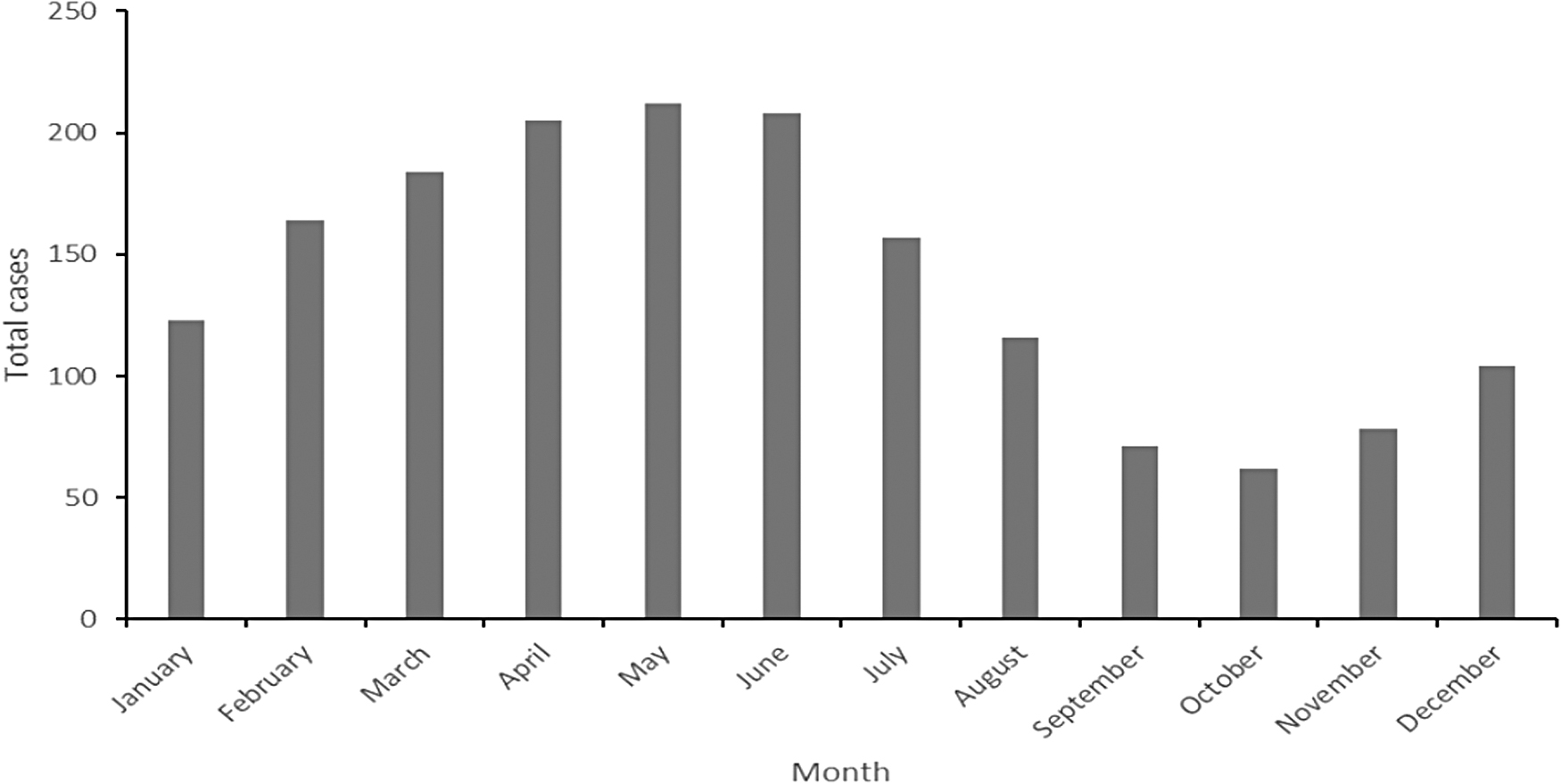
Total number of brucellosis cases by month of recording, Greece, 2005–2020.
Demographic characteristics of cases are summarized in Table 1.
Total Number of Confirmed Brucellosis Cases, Proportion, and Mean Notification Rate/100,000 of Brucellosis by Demographic Characteristics, Greece, 2005–2020
SD, standard deviation.
The median age of brucellosis cases was 44 years of age (range: 0–95) and although brucellosis cases were recorded in all age groups, most of the cases were reported among the 25–44 and the 45–64-year age groups. Mean notification rate was more than twice as high for males compared with females (1.6 vs. 0.7; p value <0.001) and most cases were Greek citizens (85.9%). The high percentage of males was a consistent finding in all age groups, ranging from 61% in the age group 65 years or more to 75% in the age groups 15–24 and 25–44.
For the majority of cases, (52%) Wright, Wright–Coombs, ELISA, Rose Bengal, and Immunofluorescence were used as laboratory testing methods followed by a combination of culture with serological tests (42.2%). Isolation of Βrucella spp. from clinical specimen was used as a single diagnostic method only in 5.6% of the cases. Brucella melitensis was the most identified Brucella species (46% out of the 567 for which information was available). Overall, most cases (71.2%) reported coming into contact with farm animals, either because of their occupation or because of ownership of domestic farm animals and 56% of the cases reported consumption of unpasteurized dairy products (p < 0.001). Brucellosis cases with an epidemiological link to another confirmed case accounted for 20.4% of the total cases (sharing a common exposure) (Table 2).
Total Number and Proportion of Confirmed Brucellosis Cases by Occupation, Consumption of Dairy Products, Exposure to Animals, Greece, 2005–2020
For several cases more than one possible exposure was identified.
Although recording of disease severity is beyond the objectives of the surveillance system, several complications of the disease were recorded. Bone and joint involvement were recorded in 14.2% of the cases but other signs, such as enlargement of liver, spleen, and lymph node were recorded as well (14.5% of the cases). Most of the cases were hospitalized (76%) at the time of notification and two deaths were recorded.
Overall, for 115 confirmed brucellosis cases there was no record of possible exposures. Descriptive analysis showed that most of the cases were 25–44 years old (32.2%) and geographically scattered (Table 3). The median annual number of cases with no recorded possible exposure was 8 (range 1–15) for the 2005–2020 period.
Total Number of Confirmed Brucellosis Cases with No Recorded Possible Exposures Factor by Gender, Age Group, and Region, Greece, 2005–2020
Discussion
Brucellosis remains a rare but severe disease in the EU/EEA countries. In Greece, although the Ministry of Rural Development and Food conducts an annual vaccination program in the mainland and an eradication program in sheep and goats on the islands, human cases continue to be recorded through the national mandatory notification system.
Greece consistently reports the highest notification rate of brucellosis among the other European countries. The high notification rate in 2008 was probably related to the recorded outbreak the same year, as well as to the sensitization efforts made for increasing awareness among physicians regarding the disease and the importance of notification.
The sharp decrease in the notification rate observed in 2019 and 2020 is not easy to interpret as control and eradication programs did not substantially change during the same period. This decrease might reflect an actual decline in occurrence of cases, however, for 2020 the coronavirus disease 2019 (COVID-19) pandemic has probably contributed to the decreased number of recorded cases due to reduced willingness of cases to visit health care services, reduced laboratory testing, or notification to the national mandatory reporting system. In 2019 and 2020, a similar decrease in cases was observed for the other mandatory notifiable diseases in the country (unpublished data).
The highest notification rates were recorded in the vaccination zone, especially in Thessaly and Western Greece. This could be due to the number of sheep and goats and family livestock breeding in these regions or due to increased awareness of diagnosis and notification of brucellosis among health care workers. Based on the available data from the National Statistical Authority, in 2016, the highest number of sheep and goats in the mainland was recorded in Western Greece (n = 1,920,799) and Thessaly (n = 1,611,196) (Hellenic Statistical Authority 2009).
Apart from the consistently high notification rate of brucellosis in the mainland, the occurrence of cases in the eradication zone is also of concern. Therefore, surveillance and awareness are very important for the whole country.
Ideally, testing of all animals over the age of 6 months and slaughtering of positive ones in the eradication zone would lead to zero cases of the disease, given that the trade of animals is “closed” that is, no importation of animals from other regions or other countries is permitted. However, the brucellosis outbreak in 2008 after several years of zero notification rate in the island, showed that the importation of infected ruminants in a restricted area may result in high risk for infection in the human population.
Thus, proper monitoring of animal trade by the relevant veterinary authorities even in the absence of brucellosis cases in an area is necessary for the long-term success of the eradication program.
Brucellosis has a specific seasonality with most cases having onset of symptoms between March and June. Considering the incubation period of the disease, seasonality coincides with the peak period of abortions and parturitions among farm animals. In addition, a massive number of sheep and goat are slaughtered every year before the Orthodox Easter Season usually from March to April. Results of our analysis highlight the importance of early vaccination of sheep and goats.
The most important factors for brucellosis transmission are exposure to infected animals and consumption of unpasteurized dairy products. Brucellosis remains an occupational disease in the country. These findings are in accordance with the literature regarding the epidemiology of the disease in other endemic countries (Meky et al. 2007, Zhong et al. 2013, Nematollahi et al. 2017).
Special consideration is needed for the 115 cases with no recorded possible exposure. Although brucellosis transmission is mainly related to direct or indirect contact with animals and animal products, less frequent modes of transmission, such as blood transfusion cannot be excluded (WHO 2006). Another possible explanation for these cases could be missing information, lack of further investigation, or refusal of cases to provide information on the possible mode of transmission.
Finally, bone and joint involvement are considered very common complications of brucellosis but according to the analysis of our data, other signs such as enlargement of liver, spleen, and lymph node are common as well. Even though one of the most common symptoms recorded in men is geniture complications, such as orchitis and epididymitis, these complications were not recorded possibly due to a lack of information regarding the long-term outcome of the disease as cases are not followed up by the surveillance system in Greece (Young 1995).
Most recorded cases were hospitalized. This might be due to the increased laboratory testing of severe cases or the higher notification rate of hospitalized cases compared with outpatients, most diagnosed at private laboratories, and remain unreported.
The analysis of surveillance data showed that brucellosis remains a public health problem in Greece and provided evidence that can be used for prioritization of future public health actions. On the other hand, the completeness and validity of surveillance data are not always optimal. An evaluation of the brucellosis surveillance system in 2015–2018 estimated that Brucella spp. isolation capacity was completely absent in 27.7% of the Greek hospitals and that underreporting of cases was 28.9% ranging annually from 24.1% to 35.0% (Dougas et al. 2019). Also, the estimation of the risk of each one of the possible exposures is not possible using the available data, as we lack a comparative group.
Conclusion
Brucellosis remains a zoonotic disease of public health concern in Greece. Although continuous targeted efforts of controlling the disease in animals are conducted by the relevant authorities of the Ministry of Agriculture and Food, cases of brucellosis continue to occur. This indicates that these efforts are not enough and that current programs need to be re-evaluated and redesigned. As brucellosis remains an occupational disease, public health measures should include training of the population involved in farming and food industry about the disease, highlighting the importance of using protection measures particularly during the high seasons of lambing and slaughtering during spring and early summer, and the risks from consumption of unpasteurized products.
Finally, increasing awareness among clinicians regarding the diagnosis and notification of the disease is important to have a better understanding about the endemicity level in the country and the effectiveness of public health measures. The performance of an analytical epidemiological study can lead at the identification of factors independently associated with the disease occurrence.
Ethics Approval Statement
The article was approved by the Ethics Committee and the Management Board of the National Public Health Organization in the 26th meeting on April 16, 2021.
Footnotes
Authors' Contributions
C.K.: principal investigator; K.M.: study design, methodology, and supervision; G.D., K.M., and R.V: study design support for statistics and data analysis; F.K.: supervision.
Author Disclosure Statement
No competing financial interests exist.
Funding Information
No funding was received for this article.