




Abstract
Background and Objectives:
Species of Leishmania genus are intracellular parasites responsible for severe zoonotic diseases worldwide, such as leishmaniasis. In Brazil, the most important species is Leishmania infantum. In the northern region, the state of Pará is notable, with a high number of cases reported in recent years. The second largest number of cases of human visceral leishmaniasis in the region in recent years has been reported in the city of Marabá (Pará state). We investigated the prevalence of L. infantum in domestic dogs from Marabá in Amazon region in Brazil.
Materials and Methods:
A total of 400 blood samples were tested using the dual-path platform chromatographic immunoassay (DPP® CVL—Bio-Manguinhos), and molecular diagnosis based in cathepsin L-like gene, which has better specificity and sensitivity than other similar tests.
Results:
The prevalence of L. infantum was 75.5% (302/400) in the serological test, and 59.25% (237/400) in molecular diagnosis, and 45.5% (182/400) in both tests.
Interpretation and Conclusion:
The results confirmed that the parasite L. infantum was prevalent in the dog population of the studied region and adoption of appropriate public policies are urgently needed.
Introduction
Visceral leishmaniasis (VL) in the Americas is caused by the protozoan Leishmania infantum (Marcili et al. 2014, Silva et al. 2019). Dogs (Canis familiaris) are among the main vertebrate hosts of this pathogen in urban environments (Gontijo and Melo 2004, Figueiredo et al. 2012). This disease is a major public health concern because of its expansion, urbanization (Cardim et al. 2016), and the severity of its different clinical forms; it is a zoonotic parasitosis classified by the World Health Organization (WHO) as one of the most important neglected tropical diseases (WHO 2020a).
Brazil contributes 97% of the cases reported to the WHO in the American continent (PAHO 2020); moreover, the transmission of VL has been reported in all Brazilian states (BRASIL 2020). In 2018, Brazil reported 3466 new cases of VL (PAHO 2020).
In 2019, the Pan American Health Organization (PAHO) proposed a composite indicator to identify areas most affected by leishmaniasis (PAHO 2019). This indicator is based on the average number of cases and incidence over the last 3 years. According to this indicator, the states with the highest number of priority municipalities for VL were Minas Gerais, Maranhão, Pará, and Tocantins (PAHO 2020).
The state of Pará had 4362 confirmed cases of VL between 2014 and 2018, reporting the most cases in the northern region of the country (PAHO 2019). In the municipality of Marabá, between 2016 and 2019, 454 cases of human VL were reported (SINAN 2021), representing ∼16% of the cases that occurred in the whole state and 5% of the cases that occurred in Brazil in the same period.
VL is considered endemic in Marabá city because the prevalence of this disease is 5.23 cases per 100,000 inhabitants, which is markedly above the threshold stipulated by the WHO for VL in human population; therefore, it is necessary to monitor the prevalence of this zoonosis in dogs from municipality as a control measure to VL transmission (Dantas et al. 2019, Henriques 2019).
Although diagnostic studies of VL have been conducted in dogs and humans, to the best of our knowledge, no studies to date have investigated the prevalence of canine VL in the municipality of Marabá.
Materials and Methods
Geographical area, study population, and sample collection
This study was conducted in the municipality of Marabá, located in the southeastern region of the state of Pará in northern Brazil. The municipality is located in the Legal Amazon region, which has a forest area of 647,810 km2 protected by reserves. Despite this, in Pará state, the rates of deforestation and anthropization of preserved forests are among the highest in the country (Alencar et al. 2016, Mengatto Junior et al. 2017).
The municipality of Marabá is divided into 12 districts, 11 in rural area, and only one in urban area. The dogs were sampled in six administrative centers in urban district: Marabá Pioneira, Velha Marabá, Cidade Nova, Nova Marabá, São Félix, and Morada Nova (Fig. 1).
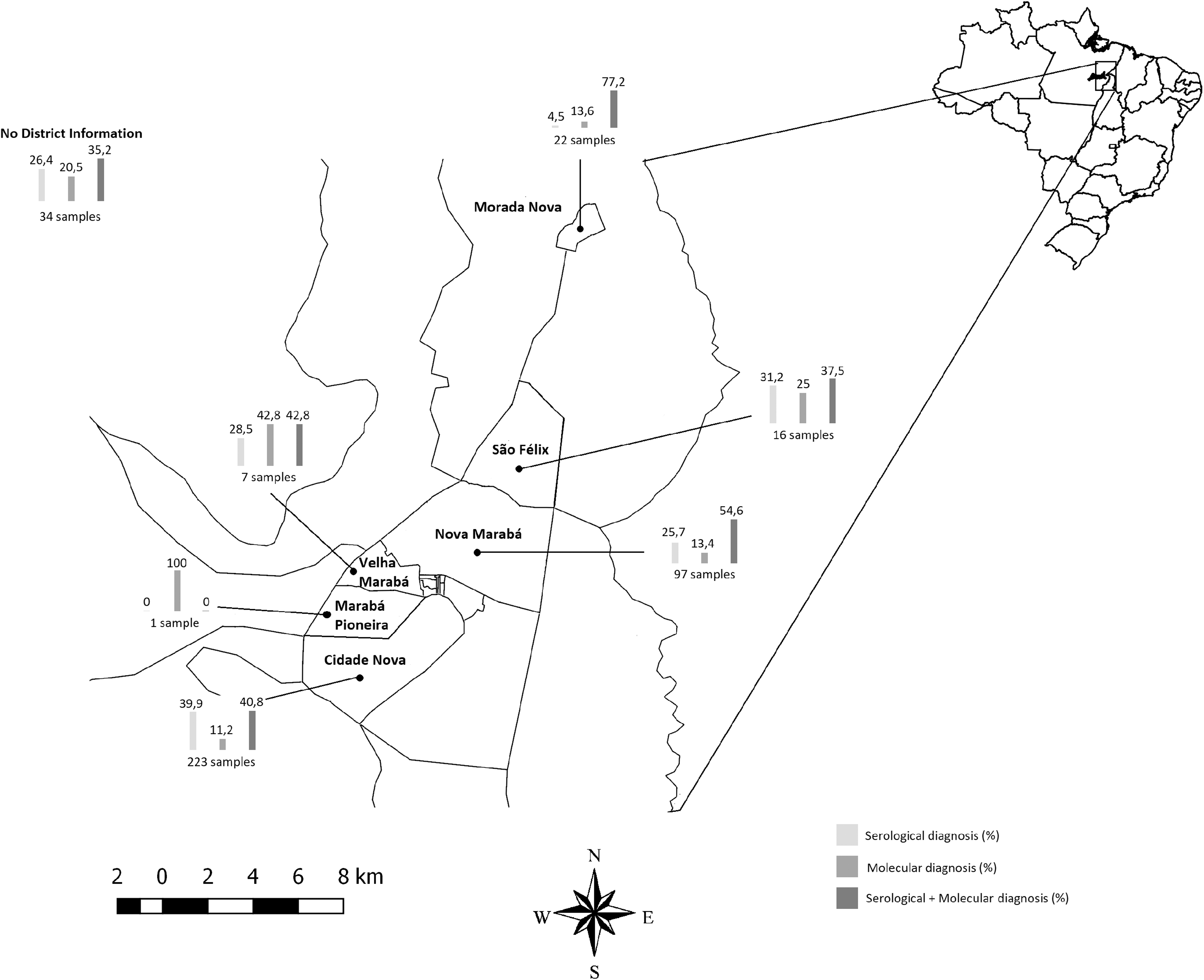
Geographical origin of dogs caught in the Marabá municipality and prevalence of serological and molecular diagnosis to Leishmania infantum.
Blood samples were collected from 400 dogs of both sexes attended in zoonosis control center of the municipality. The dogs were from all five districts of the municipality under study. The district of origin of most dogs could be determined, as given in Table 1. The number of dogs was statistically determined by sample size calculation for prevalence in Marabá municipality, considering a total canine population of 25,000 and an expected frequency of VL of 50% with a 95% CI (Thrusfield 2007). The dogs were randomly selected regardless of sex, race, or age.
Positivity of Dogs Sampled by District and Diagnostic Methods in Different Administrative Centers in Marabá Municipality
N, number of animals; DPP, immunochromatographic test; PCR, molecular test using a cathepsin L-like gene.
Cohen kappa = 0.29 (classified as weak).
AC, administrative center.
Peripheral whole blood and serum samples were collected from dogs during 2018. After collection, whole blood was aliquoted into microtubes and preserved in absolute alcohol (v/v). The serum sample was separated by centrifugation, stored in microtubes, and frozen at −20°C.
Serological screening
Serological screening was performed using immunochromatographic assay, using the DPP© Rapid Diagnostic Kit for Canine Leishmaniosis (Biomanguinhos/Fiocruz), according to the manufacturer's instructions.
DNA extraction and molecular diagnosis
For DNA extraction, the commercial PureLink Genomic DNA Mini Kit (Invitrogen) was used according to the manufacturer's instructions. For the specific molecular diagnosis of L. infantum, conventional PCR was performed using the cathepsin L-like gene (Silva et al. 2019).
Statistical analysis
We used the kappa index for agreement testing between the serological and molecular results. The values of the κ coefficients were interpreted according to Landis and Koch: 1.00–0.81: excellent, 0.80–0.61: good, 0.60–0.41: moderate, 0.40–0.21: weak and 0.20–0.00: negligible agreement.
Results
Overall, 75.5% (302/400) of the samples were positive for anti-Leishmania antibodies, as determined using immunochromatography assay, whereas 59.3% (237/400) of the samples were positive for the pathogen in the PCR analysis (molecular test). Both serological and molecular tests were positive for 45.5% (182/400) of the samples (Table 1).
The highest positivity (77.2%) in both tests was in the administrative center of Morada Nova, followed by Nova Marabá (54.6%) and Cidade Nova (40.8%). However, the number of samples is not equal in all administrative centers (Table 1 and Fig. 1).
Discussion
The first cases of leishmaniasis in Brazil were reported in the state of Pará (Benchimol et al. 2019). The WHO classifies areas endemic for this disease as places where the number of cases is >5.23 per 100,000 inhabitants; in the state of Pará, this number is markedly high, reaching 14.2 per 100,000 inhabitants in 2019 (42/283,542) (WHO 2020b).
Considering the relationship between the number of human and canine cases, the positivity rate determined in this study, wherein 75.5% of the dogs showed anti-Leishmania antibodies and 59.3% showed the presence of genetic material from the parasite, is along expected lines, because the state of Pará is the second Brazilian state in number of human cases of VL (BRASIL 2021).
During the period 2007–2017, 191 cases of VL were reported in humans, and 42.93% of the cases were concentrated in 2016 (SINAN 2021). We can infer that leishmaniasis has spread in regions with an alarming speed. Furthermore, Lutzomyia longipalpis is widely distributed in Pará state (Vilela et al. 2014).
Serological tests usually have specificity ranging from 77% to 90%, sensitivity 87% to 93% (Lopes et al. 2017, Travi et al. 2018) while in molecular, even with the variations resulting from the molecular targets used, present higher values (specificity = 95–100; sensitivity = 89–100) (Travi et al. 2018, Lima et al. 2019, Silva et al. 2019). Positivity in serological tests may result from cross-reactions with other pathogens, such as Trypanosoma caninum (Alves et al. 2012) and Babesia sp. (Laurenti et al. 2014), and leishmania vaccines (Marcondes et al. 2013, Solano-Gallego et al. 2017).
However, in the Amazon region, where dermatotropic leishmaniases cause visceral symptoms in dogs (Basano et al. 2016) and the prevalence of cutaneous and mucocutaneous leishmaniases in humans is very high (Lima et al. 2017), the possibility that other trypanosomatid species are the cause of the high serological positivity cannot be excluded, although the molecular test used has high specificity and sensitivity for L. infantum (Brilhante et al. 2019, Silva et al. 2019, Azevedo and Marcili 2020, Santos et al. 2020).
Among the districts sampled in the study, Marabá Pioneira, Velha Marabá, Morada Nova, and São Félix had the highest rates of positivity in the different tests (Table 1). The districts of São Félix and Morada Nova are located in the northern part of the municipality, toward the northern side of the Tocantins River; these districts are prone to flooding and characterized by the presence of precarious settlements (irregular occupations) and environmentally protected areas and recently deforested (Fig. 1) (PARÁ 2018).
The entire city is within the Amazon biome and surrounded by forest reserves, which have experienced gradual deforestation over the years because of anthropogenic activities (Castello and Macedo 2016). In the latest bulletin released by the Project for Monitoring Deforestation in the Legal Amazon by Satellite (Prodes), the deforested area in the city of Marabá has increased by 544.3 km2 in the last 10 years, whereas the deforested area in the entire state of Pará has increased by 1147 km2 (PRODES 2020).
It is known that deforestation within the Amazon rainforest increases the incidence of zoonoses (vector-borne diseases). In the case of leishmaniasis, for every 1% of forest area destroyed, cases of visceral and tegumentary Leishmaniasis, increase by 8.05% and 9.26%, respectively (Saccaro et al. 2015).
In addition to the relationship between leishmaniasis and deforestation, anthropogenic activities have been reported as major reasons for the increase in the incidence of diseases. The migration of vertebrate hosts and vectors to new areas provides the intake of new transmission cycles of L. infantum. Expansion of the means of transport, such as highways and railways, is one such reason (Cardim, et al. 2016, Matsumoto et al. 2019, Rancam et al. 2020). The city of Marabá has the most number of highways (five of which are federal), railways, and waterways. Their construction started in the 1990s because of the growth of mining, and it has continued to date owing to the rising need for transporting livestock. In addition, Marabá has as its main economic activities agriculture, livestock, and extractivism (Lobato e Emmi 2014, Silva et al. 2018).
The state of Pará still faces major social, environmental, and educational problems. Moreover, it is considered by the United Nations Development Program as the second worst performing region in Brazil in terms of public education. In addition to planning and appropriate public policies, infrastructure investments are required. Therefore, it can be concluded that adverse socio-environmental conditions contribute toward the increase in the incidence of several tropical and neglected diseases, such as VL.
Conclusion
The prevalence of L. infantum was 75.5% (302/400) in the serological test and 59.25% (237/400) in molecular diagnosis. The results confirmed that the parasite L. infantum was prevalent in the dog population of the studied region and adoption of appropriate public policies.
Bioethics and Biosecurity Committee Approval
This work was approved by the research ethics committee on the use of animals at the Universidade Santo Amaro (Authorization No. 08/2019).
Footnotes
Acknowledgment
The authors thank all dog owners that consented to participate in this study.
Authors' Contributions
C.C. and A.M. conceived the study and designed the experiments; R.E.S., R.C.F.A., A.C.F.C., I.P.P., B.F.A., G.S.N.C., and V.C.O., assisted with sample collection, performed the experiments, and analyzed the data; C.C., R.C.F.A., and A.M. prepared the article. All authors read and approved the final version of the article.
Author Disclosure Statement
No conflicting financial interests exist.
Funding Information
This research was financially supported by Conselho Nacional de Desenvolvimento Científico e Tecnológico—CNPq (Grant Nos. 303288/2015-9 and 302145/2018-4), Fundação de Amparo à Pesquisa do Estado de São Paulo (Grant No. 2015/25592-3), and Coordenação de Aperfeiçoamento de Pessoal de Nível Superior financial code 001.