




Abstract
The blow fly, Lucilia sericata (Meigen) (Diptera: Culicidae) is a primary facultative ectoparasite controlled by insecticides that have environmental and safety concerns; therefore, its natural and safe control is crucial. L. sericata eggs were subjected to 400 μL of 5% of 24 materials of plant-borne origin. The number of hatched and unhatched eggs were counted 24 h postexposure. Stopmyasis® expressed the highest ovicidal effect, followed by cedarwood, orange, and tea tree oils. The mean ovicidal results were 46.09–95.24% grouped as Class A, which provided the lowest hatchability rates. Even though benzoin, vanillin, citronella, and camphor oils grouped as Class B provided moderate ovicidal effects (33.69–43.92%), their efficacy differed significantly from those of the treatments in Classes A and C containing the control group and vetiver, eucalyptus, Olbas®, neem, sunflower, oil blends, patchouli, frankincense, p-menthane-3,8 diol (PMD), lavender, peppermint, cinnamon, calry sag, myrtle, and silicone oil. According to our knowledge, most (19 out of 24) applied materials were used as ovicides against L. serricata for the first time, except orange, eucalyptus, patchouli, cinnamon oils, and six of them were applied as ovicides against pests for the first time. Stopmyasis containing Géraniol and PMD is the drug of choice as an ecofriendly product to prevent blow fly strikes through correct diagnosis and prompt treatment preventing a disastrous and destructive course of the disease and improving quality of life.
Introduction
Myiasis-producing flies induce worldwide problems (Rose and Wall 2011, Ramadan et al. 2013). The common blow fly, Lucilia sericata (Meigen), Diptera: Calliphoridae, is frequently found in synanthropic and natural ecosystems and is a common cause of human and animal myiasis mainly in bedridden human patients and domestic sheep (Yaghoubi et al. 2005, Rose and Wall 2011). Females lay eggs in neglected wounds where the feeding larvae could rapidly initiate cutaneous lesions, further oviposition, debilitation, and even death. This condition demonstrates human and animal welfare concerns (Rose and Wall 2011). Myiasis kills millions of heads of sheep a year in wool-producing countries (Sandeman et al. 2014).
The prophylaxis against fly strike depends mainly upon synthetic insecticides such as organophosphates and insect growth regulators (Baker et al. 2014, Sandeman et al. 2014) and there is an urgent priority for natural alternatives because of the rising concerns about animal welfare, development of pest resistance, and health and environmental hazards (Khater 2012a). Botanicals are useful parasiticides (Khater and Shalaby 2008, Seddiek et al. 2011, 2013, 2014, Khater 2014, Khater et al. 2020).
Essential oils (EOs) of aromatic plants have been known since Imhotep and the Egyptian pyramids for their medicinal and insecticidal properties (Khater 2017). Botanicals including EOs regain their attraction as natural products, which effectively kill and/or repel arthropod pests (Khater and Khater 2009, Khater 2012, Khater et al. 2014, Murugan et al. 2015, Roni et al. 2015, Govindarajan et al. 2016a, 2016b, Khater and Geden 2019). Since the EOs have low toxicity to mammals and high biodegradability, they are very promising substances for the formulation of low-toxic eco-friendly pest control products (Khater 2013).
Larvae are the most damaging stages throughout the life cycle of the pest; therefore, most of the literature has focused on their control. The eggs are left unaccounted for as they are not the nuisance stage of the pest. However, eggs have developed highly complex structures to protect the developing embryo from water loss, environmental extremes, and predation. Hence, eggs are their most difficult life stage to be controlled, which hatch soon and infest the wound. The ovicidal effect of EOs against L. sericata was studied by Shen et al. (2007).
Consequently, the objective of this study was aimed at prevention rather than control through targeting the egg stage to prevent larval hatching and damage caused by them and reduce the overall fly population. Affordable materials as Stopmyasis®, p-menthane-3,8 diol (PMD), vanillin, sunflower, silicone oil, 16 EOs, and three oil blends (OBs) were evaluated to determine their ovicidal effects and the hatchability rates of treated L. sericata eggs. Similar to the study conducted by Roni et al. (2015), most of the applied materials in our study were tested for the first time against eggs of L. sericata.
Materials and Methods
The materials, their aroma characters, and novelty use were provided (Table 1) including Stopmyasis (SL, Rambla Guipúzcoa, 8 Sobreático 1a, 08018 Barcelona, Spain), a pour-on oily liquid product (Géraniol + PMD); PMD extracted from lemon-scented gum), vanillin and silicone oil (Sigma-Aldrich, Ltd., Dorset, UK); EOs (Naturally thinking Pure Spa Aromatherapy™, Surrey, UK) and Sigma-Aldrich, Ltd.; sunflower oil (Co-op Loved by Us™, UK), a nonvolatile vegetable oil; Olbas® (Boots UK Limited, UK) active substances (w/w) included cajuput oil 18.5%, clove oil 0.1%, eucalyptus oil 35.45%, juniper berry oil 2.7%, levomenthol 4.1%, methyl salicylate 3.7%, mint oil, and partly dementholised 35.45%; plus, two handmade OBs: OB1 (2 mL of each EO, vetiver, cinnamon, lavender oils, plus 4 mL of sunflower oil (1.5:1) and OB2 (as OB1 but without sunflower oil). Polysorbate 20 (Tween 20®; Alfa Aesar Ltd, Lancashire, UK) was diluted in distilled water 5% (v:v) and used as a diluent and for treatment of the control group.
The Applied Oils, Oil Blends, and Products and Their Novelty Use as Ovicides Against Lucilia serricata
Potency class: The applied materials were classified according to their potency into three classes, that is, A, B, and C. Class A included the most effective materials.
Blending node = blending nodes were added only for each EO.
N.Ls, a material applied as ovicide against L. serricata for the first time; N.Ovi, a material applied as ovicide against pests for the first time; OB, oil blend; PMD, p-menthane-3,8-diol.
Insect rearing
Adults of L. sericata were reared at the School of Biological Sciences, Bristol University, United Kingdom, fed solid sugar and water ad libitum, and allowed to oviposit on pig liver where larvae were reared on. Rearing as well as experiments described later were carried out at 25°C, 65% R.H., with 18:6 h (L:D) photoperiod (Khater and Geden 2018).
Ovicidal effect
Freshly laid eggs within 1–4 h (mean number/replicate was 36.94 ± 4.11) of L. sericata were subjected to contact/fumigation treatments through a filter paper (Whatman number 142.5 mm in diameter) treated with 400 μL of 5% of each material and 400 μL of the Tween 20 to the control group. The filter papers were placed at the bottom of small petri dishes (5 cm in diameter). Three replicates were used for each material. After 24 h, petri dishes were frozen to kill any hatched larvae. The number of unhatched eggs was counted under a stereoscope in accordance with the methodology described by Khater and Geden (2019).
Hatchability of treated eggs
The number of hatched larvae recovered from treated eggs in the previous experiment was counted 24 h postexposure to the applied materials.
Statistical analysis
The biological data were subjected to one-way analysis of variance by Duncan's multiple range test (Duncan 1955) using the computer program PASW Statistics 2009 (SPSS version 18).
Results
Potency class: The applied materials were classified according to their potency into three classes, that is, A, B, and C. Class A included the most effective materials. Stopmyasis expressed the highest ovicidal effect followed by cedarwood, orange oils, and tea tree oils (95.24%, 52.97%, 49.12%, and 46.09%, respectively) and grouped as Class A. Benzoin, vanillin, citronella, and camphor oils, referred to as Class B, provided moderate ovicidal effects (33.69–43.92%), and their efficacy was significantly different (p ≤ 0.05) than those of the other treatments in Class C containing the rest of treatments and the control group (Fig. 1). No significant difference (p ≤ 0.05) between treatments in Class C was recorded.
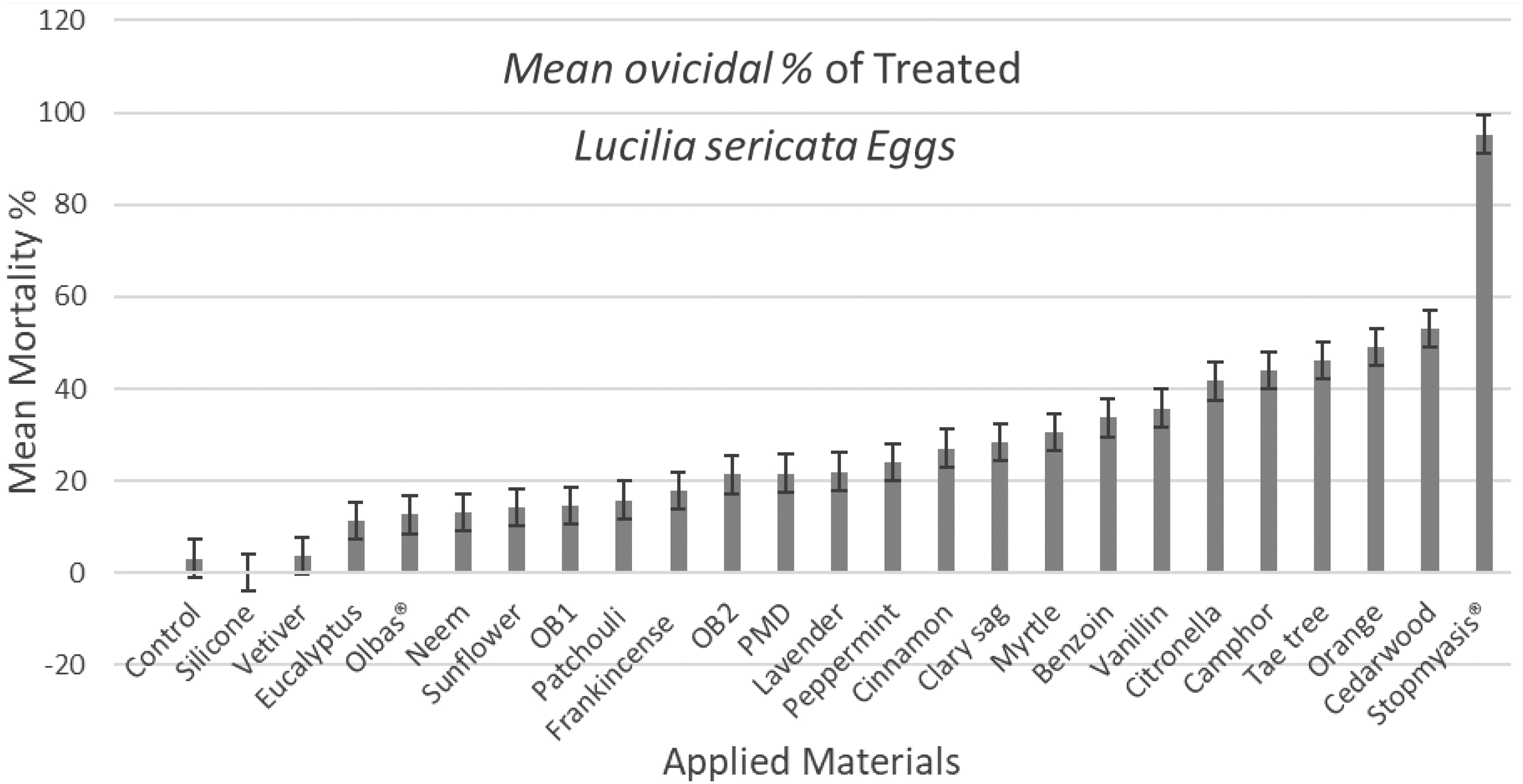
Mean ovicidal percentage of treated Lucilia sericata eggs. OB, oil blend; PMD, p-menthane-3,8-diol.
Class A materials provided the lowest hatchability of 4.76–53.91%, which were significantly (p ≤ 0.05) different than those in Classes B and C. The hatchability rates varied from 69.48% to 96.25% after treatment with materials of Class C, which were not significantly (p ≤ 0.05) different than those of the control group (96.83%) (Fig. 2).

The hatchability rate of treated Lucilia sericata eggs.
Discussion
Botanicals as EOs are promising eco-friendly biocides and repellents. Our previous study focused on prevention, rather than treating feeding larvae of L. sericata by controlling the adult fly and its behavior using EOs (Khater and Geden 2018). To date, however, the ovicidal effect of EOs had been tested only twice against the eggs of L. sericata (Shen et al. 2007, Bedini et al. 2019), and this study was designed to fill in the gap by targeting the egg stage as the neglected and resistant part of its life cycle.
To our knowledge, this study is the first one to assess the potential ovicidal efficacy of 19 applied materials against L. sericata some of which also provided ovicidal effect against pests for the first time.
Two handmade OBs were tested as OB1 (vetiver, cinnamon, lavender oils plus sunflower oils) and OB2 (similar to OB1 without sunflower oil). Another commercial OB was used: Olbas, which we could not evaluate its active ingredient individually.
According to aromatherapy (Lawless 2013, Worwood 2016), materials in Class A are mainly citrus and/or herbal besides being top and/or middle blending nodes except for cedarwood (woody and base note), whereas the other scents and blending nodes (Table 1) were not or less effective.
Our data indicated that the individual ovicidal effect of PMD was low and citronella oil was moderate; but when both materials were formulated into Stopmyasis composed of PMD and Geraniol, a monoterpenoid and alcohol and the primary component of citronella oil, provided the best ovicidal effect (95.24%). This finding may be because of the enhanced formulation of the product that preserves its efficacy.
According to the manufacturer, Stopmyasis® is applied to the skin to repel flies for a long period and prevent myiasis and has been approved for organic use with no withdrawal in meat and milk. This information and our finding support the manufacturer's efficacy of Stopmyasis as it controlled myiasis during the risk period for two consecutive years and three summer applications on ewes reared on grazing areas that created an absence of myiasis. Thus, to our knowledge, our study is the first one to test the efficacy of Stopmyasis.
Despite the perfect mix of the oil bend forming Olbas oil, its ovicidal effect is low. In contrast to the low ovicidal effect caused by lavender oil, it also as well as Clinopodium nubigenum oil provided contact and/or fumigation ovicidal effects against L. sericata (Bedini et al. 2019). Similar to our finding, lavender, patchouli, peppermint, and mandarin orange were less effective as ovicides against L. sericata, but Cinnamomum cassia, Eugenia caryophyllata, Origanum creticum, Acorus gramineus, Illicium verum, and Eucalyptus globulus were more effective (Shen et al. 2007). Different results may be attributed to the chemical composition of the applied materials, insect strain, locality, and/or the method of application.
Some EOs provided ovicidal efficacy against the other myiasis-producing flies and insects of medical and veterinary importance. For example, tea tree oil provided high ovicidal effect in this study. Similarly, a formulation containing 1% total toxic organics caused 100% mortality of L. cuprina eggs (Callander and James 2012). In agreement with our results, garlic, Allium sativum was the most effective oil providing a complete inhibition of hatching of eggs of Calliphora vomitoria L. (Bedini et al. 2020).
Orange oil, Class A and citronella, Class B oil acted as ovicides in this study. A similar effect was recorded against Musca domestica L., whereas eucalyptus and peppermint oils, Class C were not efficient ovicides in this study, but they effectively killed eggs of house flies in another study conducted by Sinthusiri and Soonwera (2014). Our data indicated that camphor and peppermint oils had moderate and low ovicidal effect, but they showed good ovicidal and pediculicidal effects against Haematopinus tuberculatus, and repelled flies infesting buffaloes in another study by Khater et al. (2009).
Six applied oils, including vetiver, cinnamon, lavender, and OBs, were extensively tested with the same concentration, 5%, in our previous study against the same British strain of immature and adult L. sericata and M. domestica using different bioassays (Khater et al. 2018, Khater and Geden 2018, 2019) referring to them as “The six oils or 6 EOs.” Our data revealed the ovicidal efficacy of six EOs, which was not significantly different from that of the control group. In contrast, the six EOs previously had promising ovicidal effects against M. domestica (Khater and Geden 2019).
Because of the gap and less information in the literature, we discuss the efficacy of the applied oils against the other developmental stages of L. sericata and some other closely related species. The six EOs controlled L. sericata as oviposition deterrents, repellents, adulticides, and larvicides (Khater and Khater 2009, Khater et al. 2011, 2018) and provided promising control of house fly larvae (Khater and Geden 2019). In contrast to the ovicidal effects revealed in this study, vetiver oil was the most larval repellent of M. domestica followed by lavender, vanillin, and sunflower oils (Khater and Geden 2019). Similar to the ovicidal effect observed in this study, the six EOs did not repel adult M. domestica; however, significant repellent effects were observed for vanillin, PMD, and neem oil. In addition to their observed ovicidal effects in this study, the six EOs were also found to be efficient adulticides (Khater and Geden 2019).
Botanicals, mainly EOs, were found to control other species of myiasis-producing flies as topical and fumigant toxicants, oviposition deterrents (Bedini et al. 2020), and larvicides (Khater 2013, 2014). Phytochemicals cause little or no threat to the environment or human health and no adverse effects have been observed on either animals or human operators after their exposure to botanicals (Khater et al. 2009, 2013, Seddiek et al. 2011, 2013, 2014, Khater 2014). Silicone oil is used as a lubricant and in medicine and surgery products (Martín-Gil et al. 1997). It was surprising that it induced 100% hatching of treated eggs, which is much better but not significantly (p ≤ 0.05) different from that of the control group. In contrast, in another study by Holzer (2003), it killed the bedbug, Cimex lectularius L. and was recommended to be used to improve the formulation as low surface tension lubricant insecticide for human use.
Conclusion
Prompt diagnoses and treatment of infested wounds are needed to stop maggots from further oviposition, tissue invasion, and destruction. Consequently, this study highlighted some novel plant-borne ovicides against L. sericata. According to our knowledge, 19 out of 24 applied materials were used as ovicides against L. serricata for the first time except for lavender, orange, eucalyptus, patchouli, and cinnamon oils.
This is the first study that revealed the highest ovicidal effect of Stopmyasis followed by cedarwood, orange oils, and tea tree oils. We propose that proper formulations would greatly improve the promising oils in this study, similar to that provided by Stopmyasis. We also believe that the six EOs could be used to treat wounds as a prophylactic measure, since they have been found to provide oviposition deterrence, larvicidal, and adulticidal effects (Khater et al. 2018, Khater and Geden 2019).
The EOs could be used for wound healing because of their control of L. sericata and their anti-inflammatory and antimicrobial actions (Khater 2013, Bedini et al. 2020) to prevent myiasis and further oviposition, and broaden the very narrow spectrum of eco-friendly alternative options to synthetic pesticides and surgical procedures used for controlling fly strike.
Footnotes
Acknowledgments
We are grateful to The School of Biological Sciences at Bristol University, England, where this study was conducted. We also thank Prof. Dr. Azza A. Moustafa, Research Institute of Medical Entomology, Egypt for her valuable support and advice.
Authors' Contributions
Conceptualization by H.F.K. and M.M.B., methodology by H.F.K., software and data collection by A.S., validation by H.F.K., M.M.B., N.A., S.A.K., and Z.H., analysis by H.F.K. and N.A., writing, review and editing by H.F.K. and M.D., and visualization by Z.H., N.A., and M.D. All authors read and approved the final version of this article.
Author Disclosure Statement
No conflicting financial interests exist.
Funding Information
This study was funded by the Newton-Mosharafa Travel grant from the British Embassy and Council in Egypt.