




Abstract
Background:
Klebsiella pneumoniae has been associated with both nosocomial and community-acquired infections with mounting public health concern throughout the world. The purpose of this study was to investigate the burden of virulent extended-spectrum β-lactamase (ESBL)-producing K. pneumoniae among diarrheic horses or those with respiratory illness to underscore the public health implication of such strains.
Materials and Methods:
Rectal and nasal swabs were gathered from 100 diseased horses (50 diarrheic and 50 with respiratory illness). The collected swabs were processed for isolation of ESBL-producing K. pneumoniae using a selective medium followed by phenotypic and molecular identification of the isolates. All ESBL-producing K. pneumoniae strains were investigated for six virulence genes (type 3 fimbrial adhesin [mrkD], enterobactin [entB], regulator of mucoid phenotype A [rmpA], Klebsiella ferric iron uptake [kfu], mucoviscosity-associated gene A [magA], and type 2 capsular polysaccharide [K2]).
Results:
Of the 100 examined animals, ESBL-producing K. pneumoniae was recovered from 13 (13%), with isolation rates in horses suffering from diarrhea and respiratory illness being 20% and 6%, respectively. Among the obtained isolates, bla TEM and bla SHV were found in all strains (100%) followed by bla CTX-M in 92.3%, while none of the isolates had bla OXA. In addition, 13 ESBL-producing K. pneumoniae strains exhibited a multidrug resistance (MDR) pattern. Regarding the occurrence of virulence genes among the isolates, mrkD (100%) and entB (100%) were the most predominant virulence genes followed by rmpA (76.9%) and kfu (46.2%). On the contrary, magA and K2 were negative in all ESBL-producing strains. Furthermore, this work provides four K. pneumoniae mrkD partial sequences that displayed high genetic relatedness with those obtained from human to clarify the public health burden of such isolates.
Conclusion:
The occurrence of virulent ESBL-producing K. pneumoniae among diseased horses highlights the potential role of this animal in the epidemiology of such virulent and antimicrobial-resistant strains, which may have great public health threat.
Introduction
K
Seriously, K. pneumoniae accounts for around one-third of all the Gram-negative infections being responsible for a wide range of life-threatening illnesses such as bloodstream infections, meningitis, pneumonia, urinary tract infections (UTI), peritonitis, and pyogenic liver abscess (Patel et al. 2013, Lin et al. 2015, Cristea et al. 2017, Juan et al. 2020, Du et al. 2021). Since the emergence of extended spectrum β-lactamase (ESBL)-producing K. pneumoniae, during the 1990–2000s, this opportunistic pathogen has become one of the most common ESBL-producing bacteria implicated in nosocomial epidemics (Navon-Venezia et al. 2017). The upsurge resistance shown by ESBL producers toward several antibiotic classes resulting in multidrug resistance (MDR) poses a public health risk due to the limiting of therapeutic options (Pitout and Laupland 2008).
Without a doubt, K. pneumoniae is of great public health concern not only due to the advent of multidrug-resistant strains, but also because it has several virulence traits (Ballén et al. 2021). The production of ESBLs along with a variety of virulence attributes may work in a harmonious tone leading to treatment failure (Gharrah et al. 2017).
Clearly, K. pneumoniae has a diverse set of virulence factors that confer its pathogenicity causing multiple clinical conditions (Huynh et al. 2017). For instance, type 1 fimbriae adhere to human mucosal surfaces and fimbriae of type 3 play a crucial role in biofilm formation (Paczosa and Mecsas 2016). In addition, there are four iron-absorbing molecules (siderophores) in K. pneumoniae: enterobactin (entB), yersiniabactin, salmochelin, and aerobactin that scavenge essential iron for survival (Wang et al. 2020). Moreover, K-capsular antigens and lipopolysaccharides (LPS) are considered major virulence effectors as well (Hu et al. 2021).
Notably, the human–animal interface prompts the cross-species transmission of K. pneumoniae where the pathogen's zoonotic potential had been documented (Marques et al. 2019, Zhang et al. 2019a, Hu et al. 2021). Livestock, companion, and wild animals have been found to be infected with K. pneumoniae (Wareth and Neubauer 2021). The possibility of cross-host transfer may be shown by evidence of sharing genomes of K. pneumoniae isolates particularly multidrug-resistant strains between various animal species and human. Since animals can act as a reservoir of K. pneumoniae to human being and vice versa, K. pneumoniae is a high-risk zoonotic agent (Yang et al. 2019).
Today, companion animals are an important part of human lifestyle with a variety of social and emotional effects on human psychology. Concerning horses, ESBL-producing K. pneumoniae had been reported (Ewers et al. 2014, Shnaiderman-Torban et al. 2020, Sukmawinata et al. 2020). There has been a worldwide alarm regarding the multidrug-resistant K. pneumoniae in horses (Trigo da Roza et al. 2019, Sukmawinata et al. 2020), while the prevalence of virulence genes related to the pathogenicity of K. pneumoniae isolates was largely neglected in equines. Therefore, this study was conducted to give special focus on the prevalence of virulent ESBL-producing K. pneumoniae isolated from ill horses to highlight its public health implication.
Materials and Methods
Collection of samples
A total of 100 diseased horses from equine farms located in the Giza Governorate, Egypt, were enrolled in this study. Fifty rectal swabs and 50 nasal swabs were obtained from adult horses suffering from diarrhea and respiratory illness, respectively, during the period from August 2020 to March 2021. The collected swabs were placed in the Cary–Blair transport medium and transported to the laboratory in an icebox with minimum delay for further processing.
Isolation and identification of ESBL-producing K. pneumoniae
The nasal and rectal swabs were directly streaked on MacConkey agar supplemented with cefotaxime (2 mg/L) and incubated at 37°C for 24 h (Luvsansharav et al. 2012). The suspected single colony (large, mucoid, and pink in color) was subcultured on eosin methylene blue (EMB) agar to obtain pure colonies (mucoid and pink to purple in color with a dark center). Following that, the isolates were identified using Gram staining and conventional biochemical tests, as well as the RapID ONE system (Remel), and then, isolates were stored at −20°C till further DNA extraction.
Molecular confirmation of K. pneumoniae strains
Bacterial DNA was extracted from presumptive K. pneumoniae isolates using the boiling method (Ragheb et al. 2020) and then kept at −20°C for further PCR amplification. To confirm that all strains were Klebsiella, extracted DNAs were amplified for the Klebsiella gyrA (DNA gyrase subunit A) gene, as previously described by Ebomah and Okoh (2020). Afterward, a K. pneumoniae species-specific primer targeting the 16S–23S ITS gene (Turton et al. 2010) was amplified in all strains.
Phenotypic identification of ESBL-producing K. pneumoniae isolates
ESBL production was determined in 13 K. pneumoniae isolates by a double disc test using both cefotaxime and ceftazidime alone, as well as cefotaxime and ceftazidime with clavulanic acid according to the guidelines of CLSI (2018).
Antibiotic susceptibility testing of ESBL-producing K. pneumoniae strains
Thirteen ESBL-producing K. pneumoniae isolates were tested for sensitivity toward 22 antimicrobial agents according to the recommendations of CLSI (2018). The following antibiotics were used: ampicillin, amoxicillin–clavulanate, cefazolin, cefepime, cefoxitin, cefotaxime, ceftriaxone, ceftazidime, cefpodoxime, aztreonam, gentamicin, azithromycin, tetracycline, doxycycline, ciprofloxacin, norfloxacin, trimethoprim–sulfamethoxazole, chloramphenicol, fosfomycin, nitrofurantoin, imipenem, and meropenem. The findings were evaluated according to the standards of CLSI (2018), which defined multidrug-resistant bacteria as those that are resistant to at least one agent in three or more antimicrobial classes (Magiorakos et al. 2012).
Molecular detection of ESBL-encoding genes
Multiplex PCR was performed to screen K. pneumoniae isolates for β-lactamase-encoding genes (bla TEM, bla CTX-M, bla SHV, and bla OXA), as previously described by Fang et al. (2008).
Molecular detection of virulence genes among ESBL-producing K. pneumoniae isolates
Extracted DNA from ESBL-producing K. pneumoniae strains was enrolled in multiplex PCR targeting the following virulence genes: type 3 fimbrial adhesin (mrkD), enterobactin (entB), regulator of mucoid phenotype A (rmpA), mucoviscosity-associated gene A (magA), Klebsiella ferric iron uptake (kfu), and type 2 capsular polysaccharide (K2). All primers were synthesized by Metabion and according to Albasha et al. (2020). The final volume of PCR mixture was 20 μL, which included 0.5 μL for each primer (10 pmol/μL), 10 μL of Cosmo PCR red master mix (Willowfor, UK), 3 μL of DNA template, and completed to a final volume with nuclease-free water.
The amplification conditions were as follows. Initial denaturation at 95°C for 5 min followed by 30 cycles of denaturation, annealing, and extension at 94°C for 30 s, 60°C for 45 s, and 72°C for 60 s, respectively, and then, final elongation at 72°C for 10 min. The PCR amplicons were separated in agarose gel electrophoresis and photodocumented using an ultraviolet transilluminator (Fig. 1).
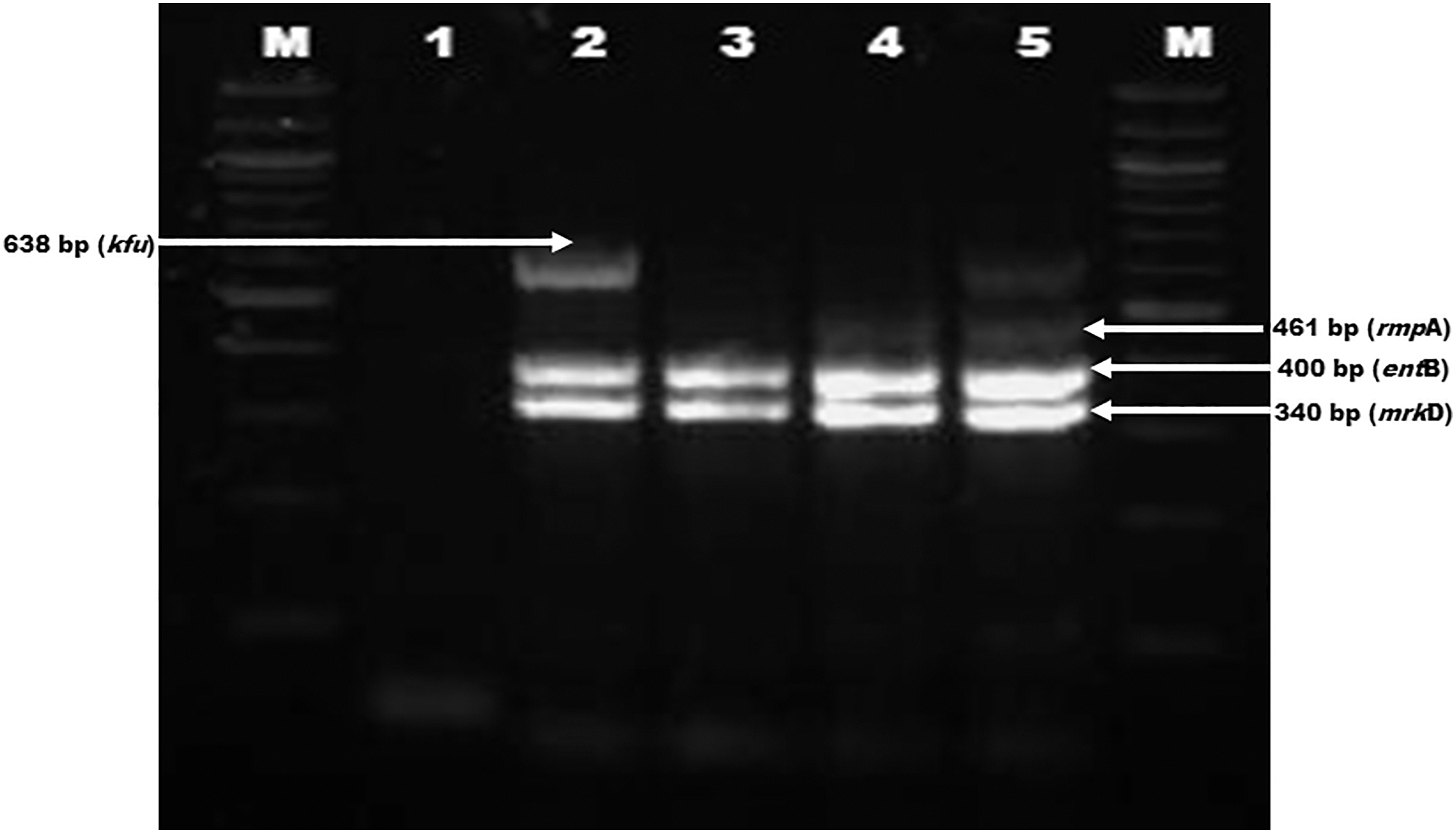
Molecular detection of virulence genes in ESBL-producing Klebsiella pneumoniae strains isolated from diseased horses. Lane M: DNA ladder (100 bp); lane 1: negative control; lanes 2, 3, 4, and 5: positive isolates showing specific bands. ESBL, extended-spectrum β-lactamase.
Partial DNA sequencing of K. pneumoniae mrkD gene
The ABI 3500 Genetic Analyzer (Applied Biosystems) was used to perform partial sequencing of purified PCR products of mrkD gene of four K. pneumoniae strains, two strains recovered from diarrheic horses and the others from horses with respiratory illness using the Big Dye Terminator V3.1 kit.
Nucleotide sequence accession numbers
The four partial sequences of the K. pneumoniae mrkD gene were deposited in GenBank under the following accession numbers: OK574337, OK636201, OK636202, and OK636203.
Basic local alignment search tool (BLAST) analysis of the obtained sequences
The retrieved K. pneumoniae mrkD partial sequences from diseased horses were blasted on the NCBI website (
Phylogenetic analysis
The obtained sequences in this study were aligned against K. pneumoniae strains from animals and humans available in GenBank using Clustal W multiple alignments via BioEdit software version 7.0.9, and the evolutionary history of our strains was shown using the neighbor-joining phylogenetic analysis via MEGA 7 software, in which the bootstrap consensus tree with 500 replicates was retrieved (Fig. 2).
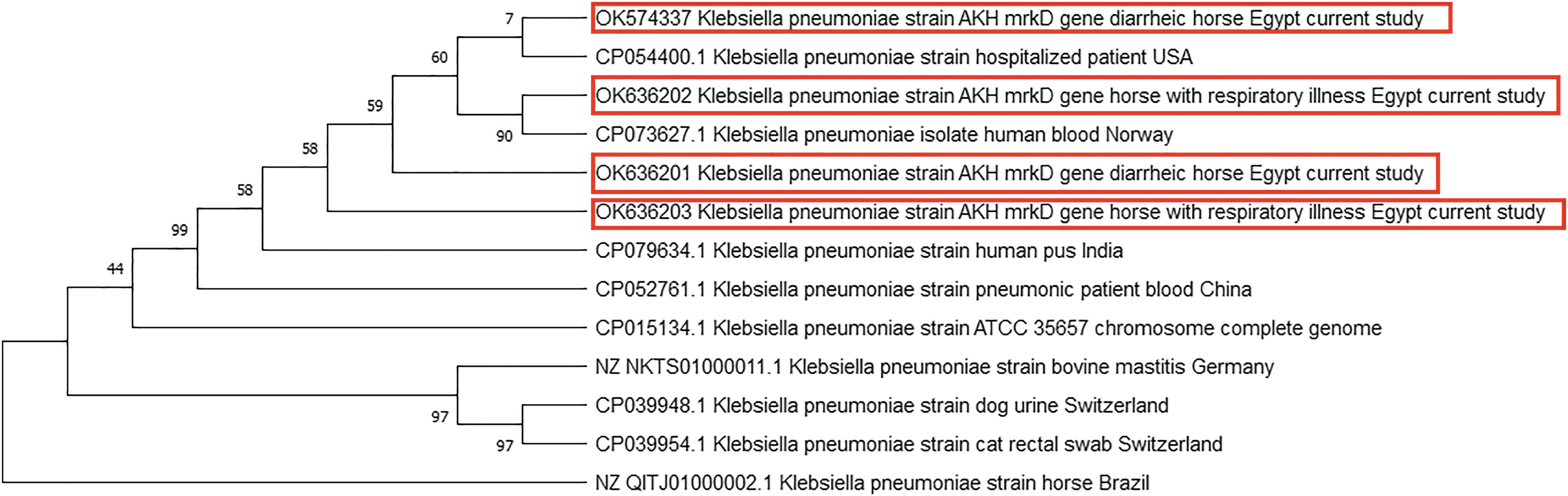
Phylogenetic tree was constructed via neighbor-joining method using MEGA 7 software to exhibit the genetic relationship between Klebsiella pneumoniae mrkD partial sequences obtained in the present study and K. pneumoniae strains retrieved from GenBank databases. mrkD, type 3 fimbrial adhesin. Red boxes in Figure 2 to mark the obtained sequences in this study. Color images are available online.
Statistical analysis
The 95% confidence interval (CI) of an overall prevalence value was calculated by the modified Wald method via the GraphPad QuickCalc online tool for determining the CI of a proportion.
Results
Overall, 13 (13%; 95% CI 7.62–21.12) out of 100 investigated diseased horses had ESBL-producing K. pneumoniae with the following prevalence rates among horses suffering from diarrhea and respiratory illness 20% (10/50) and 6% (3/50), respectively (Table 1). All the K. pneumoniae strains exhibited an ESBL phenotype when the zone diameter for either antimicrobial agent (cefotaxime and ceftazidime) tested in combination with clavulanate increased by more than 5 mm comparing with the zone diameter of the agent when tested alone. In terms of β-lactamase-encoding genes, bla TEM and bla SHV were detected in all isolates recovered from diarrheic and respiratory illness cases (13/13; 100%) followed by bla CTX-M (12/13; 92.3%), while none of the isolates harbored bla OXA, as indicated in Table 2.
Prevalence of Extended-Spectrum β-Lactamase-Producing Klebsiella pneumoniae Among Diseased Horses
Detection of β-Lactamase-Encoding Genes Among Extended-Spectrum β-Lactamase-Producing Klebsiella pneumoniae Isolates
The antimicrobial susceptibility testing of ESBL-producing K. pneumoniae isolates revealed that all of them were multidrug resistant (Table 3). One hundred percent of isolates were resistant to ampicillin, cefazolin, and cefepime, followed by 92.3% resistance toward ceftriaxone, azithromycin, tetracycline, and trimethoprim–sulfamethoxazole. Ceftazidime, cefotaxime, doxycycline, and ciprofloxacin resistance was reported in 84.6%, 76.9%, 61.5%, and 53.8% of isolates, respectively. As well as 46.2% of strains were resistant to cefoxitin, norfloxacin, and chloramphenicol, and 30.8% resistance was observed for cefpodoxime and gentamicin, whereas 23.1% of isolates exhibited resistance to fosfomycin.
Antibiotic Susceptibility Pattern of Extended-Spectrum β-Lactamase-Producing Klebsiella pneumoniae Isolates
I, intermediate; R, resistant; S, susceptible.
On the contrary, all isolates were susceptible to amoxicillin–clavulanate, aztreonam, nitrofurantoin, imipenem, and meropenem. Regarding the virulence genes, the most predominant ones found in ESBL-producing K. pneumoniae isolates were mrkD (100%) and entB (100%) followed by rmpA (76.9%) and kfu (46.2%), whereas K2 and magA were negative in all strains (Table 4). The distribution of virulence genes in isolates recovered from diarrheic horses was 100%, 100%, 70%, and 50% for mrkD, entB, rmpA, and kfu, respectively, while those recovered from horses with respiratory illness possessed mrkD, entB, rmpA, and kfu with prevalence rates of 100%, 100%, 100%, and 33.3%, respectively (Table 4).
Detection of Virulence Genes Among Extended-Spectrum β-Lactamase-Producing Klebsiella pneumoniae Isolates
entB, enterobactin; K2, type 2 capsular polysaccharide; kfu, Klebsiella ferric iron uptake; magA, mucoviscosity-associated gene A; mrkD, type 3 fimbrial adhesin; rmpA, regulator of mucoid phenotype A.
The proportion of similarity between K. pneumoniae mrkD partial sequences recovered from diseased horses in this study and the most similar K. pneumoniae strains based on BLAST analysis are exhibited in Table 5. It was obvious that human K. pneumoniae strains were the most similar ones to the obtained sequences in this study, with an identity percentage of 99.61–100% highlighting the public health threat of such sequences. Likewise, the phylogenetic analysis displayed the genetic relatedness between four K. pneumoniae mrkD gene sequences retrieved from diarrheic and respiratory illness horse cases and human K. pneumoniae strains available on GenBank (Fig. 2).
The BLAST Analysis of Obtained Klebsiella pneumoniae mrkD Partial Sequences in This Study
Discussion
Enterobacteriaceae is the most common cause of nosocomial infections, with K. pneumoniae being the second-most important pathogen after Escherichia coli (Singh et al. 2016) due to the occurrence of multidrug-resistant strains, as well as its ability to produce an abundance of virulence factors (Kumar et al. 2011, Hu et al. 2021). As such, the zoonotic potential of K. pneumoniae has become a major public health concern in the recent years (Hu et al. 2021). In the present study, ESBL-producing K. pneumoniae was found in 13% of sick horses with 20% (10/50) of diarrheic horses being positive and 6% (3/50) of horses with respiratory illness carried ESBL-producing strains.
In other studies, the prevalence rates of ESBL-producing K. pneumoniae in clinically ill horses were 3.1% (Ewers et al. 2014) and 13% (Shnaiderman-Torban et al. 2020). The high shedding rate of ESBL-producing K. pneumoniae (13%) in the current study might be due to the uptake of plasmids or resistance genes as well as an increased susceptibility of horses to clinical diseases by such strains. It was noted that the fecal burden of such strains was higher than that in nasal swabs, suggesting that diarrheic horses are more likely to be a source of ESBL-producing K. pneumoniae infection for human beings. Concerning ESBL-encoding genes, all K. pneumoniae isolates recovered from diarrheic and respiratory illness cases carried bla TEM (100%) and bla SHV (100%) followed by bla CTX-M in 12 (92.3%) isolates, whereas none of them had bla OXA.
The incidence of ESBL-producing K. pneumoniae has consistently grown (Navon-Venezia et al. 2017), with TEM and SHV being the most prominent enzymes, while CTX-M type showed climbing prevalence in the last few years (Gharrah et al. 2017). These findings indicate that diseased horses may play a potential role in the transmission of such strains to human beings (Schmiedel et al. 2014). Importantly, all ESBL-producing K. pneumoniae isolates were multidrug resistant, which might be attributed to that ESBL genes are encoded on plasmids that may cocarry additional antimicrobial resistances resulting in MDR with limited treatment choices (Liu et al. 2016). Furthermore, there was a high resistance rate to third- and fourth-generation cephalosporins, as well as 53.8% and 46.2% of isolates were resistant to ciprofloxacin and norfloxacin (fluoroquinolones), respectively.
These results represent a serious issue because such medications are commonly prescriped in equine medicine (Shnaiderman-Torban et al. 2020), and so, prudent use of antibiotics in equines is mandatory to decrease shedding of MDR strains, which has an impact on human health.
Noteworthy, the existence of ESBL-encoding genes coupled with virulence genes among the obtained K. pneumoniae strains was the most significant finding in this study to point out the public health burden of such isolates. In this work, rmpA was detected in 76.9% of the isolates (diarrheic and respiratory illness cases:70% and 100%, respectively). RmpA had been reported in patients with bacteremia (Yu et al. 2006). There is a significant correlation between rmpA and hypervirulence as well as abscess formation (Yu et al. 2006, Lee et al. 2017). For the kfu gene, 46.2% of strains were positive (diarrheic cases [50%] and respiratory illness cases [33.3%]). kfu facilitates ferric iron absorption and is associated with the virulent hypermucoviscosity phenotype (Shon et al. 2013). In addition, it was detected in nosocomial and bloodstream infections (Albasha et al. 2020, Du et al. 2021).
On the contrary, 13 ESBL-producing K. pneumoniae strains isolated from ill horses tested negative for magA, which might be attributed to that magA is principally associated with K. pneumoniae liver abscess (Fang et al. 2004) and is seldom seen in other K. pneumoniae-related diseases (Yu et al. 2006). Also, none of these isolates possessed the capsular serotype gene K2, suggesting that they may have capsular (K) serotypes other than K2 (Albasha et al. 2020).
Interestingly, all ESBL-producing strains isolated from diarrheic and respiratory illness cases carried the mrkD (100%) and entB (100%) genes, which are also among the most prominent virulence genes implicated in serious human clinical conditions such as pyogenic liver abscess (Zhang et al. 2019b), bloodstream infections (Du et al. 2021), UTI (Eghbalpoor et al. 2019), meningitis (Li et al. 2021), and K. pneumoniae-induced ventilator-associated pneumonia (Yan et al. 2016).
EntB is one of siderophores, which uptakes iron from host plasma and aids in invasion of deeper tissues (Hu et al. 2021). MrkD encodes type 3 fimbriae that play an important role in biofilm formation (Johnson et al. 2011), which enables K. pneumoniae to adhere and proliferate on indwelling catheters and other medical equipment, allowing it to persist in hospitals and cause serious nosocomial infections (Paczosa and Mecsas 2016), as well as it helps in colonization of respiratory, gastrointestinal, and urinary tract epithelia (Wang et al. 2020).
Based on the predominance of mrkD gene among the obtained isolates coupled with its incrimination in biofilm formation, partial sequencing of mrkD gene of four K. pneumoniae isolates (two from diarrheic horses and two from respiratory illness cases) was carried out. The BLAST analysis of four obtained horse K. pneumoniae sequences clarified that they were highly similar to human K. pneumoniae isolates from different countries. K. pneumoniae strain from a diarrheic horse (OK574337) exhibited 99.61% identity with human strains from China and Italy, and also another isolate from diarrheic horse (OK636201) revealed 100% similarity to human isolates from China, Germany, and India.
While for strains retrieved from horses with respiratory illness, the OK636202 sequence displayed 100% identity with human strains in Germany, Italy, and China, whereas the OK636203 sequence showed 100% similarity to K. pneumoniae isolates obtained from human in China and Mexico. As a result, the BLAST analysis points out the public health burden of such horse strains. In the meantime, the phylogenetic tree demonstrated the evolutionary history of such K. pneumoniae mrkD partial sequences.
There were two clusters: the first one included four sequences retrieved from diseased horses and human K. pneumoniae isolates with special concern for the OK574337 sequence from a diarrheic horse, which was enclosed in the same clade with K. pneumoniae strain from a hospitalized patient in the United States, and there is another clade that comprised a strain obtained from human blood, in Norway, and OK636202 sequence from a horse with respiratory illness. In addition, OK636201 and OK636203 sequences from horses suffering from diarrhea and respiratory illness, respectively, showed a high close relationship with human strains reported in India and China. This clarified the genetic relatedness between horse strains and those of humans, which reflects the zoonotic risk of such pathogenic K. pneumoniae isolates during frequent and intimate contact with horses.
On the contrary, the second cluster encompassed K. pneumoniae isolates obtained from bovine mastitis, dog, and cat, while the horse strain recorded in Brazil was considered outgroup.
Conclusion
In the current study, all ESBL-producing K. pneumoniae isolates recovered from diseased horses harbor several virulence genes, implying that horses may be a potential reservoir of virulent antimicrobial-resistant K. pneumoniae strains for human beings. Accordingly, implementation of antibiotic stewardship strategies coupled with active surveillance system in veterinary medicine under the umbrella of One Health approach is crucial to combat the public health threat of such strains. In the future, further work will be conducted to better understand the genetic variation of isolates by calculating nucleotide diversity, polymorphic level (haplotype diversity-[Hd]), number of variable sites, and the average number of nucleotide differences (K) of the isolates.
Ethical Statement
All the procedures in this study were accepted by the Ethics Committee of Faculty of Veterinary Medicine, Cairo University, Egypt (Vet CU12/10/2021/379).
Footnotes
Authors' Contributions
A.S. and K.A.A.-M.: Idea, study design, and supervising the work. H.M.Z.: Sample collection, bacteriological isolation, identification, and molecular techniques. All authors have been included in writing the article.
Author Disclosure Statement
No competing financial interests exist.
Funding Information
No funding was received for this study.