




Abstract
Background:
Flaviviruses are agents with high zoonotic potential of importance to human health. They are transmitted by mosquitoes of the Culicidae family, and birds act as host–amplifiers. Birds, mammals, and humans are susceptible hosts to infection.
Methods:
In this study, West Nile virus (WNV), flavivirus, infection was studied in 37 serum samples from 22 hens on Easter Island, Chile.
Results:
WNV was detected by ELISA (ID Screen® West Nile Competition Multi-Species). We report absence of antibodies to WNV, and to related viruses of the Japanese Encephalitis Virus serocomplex, and, therefore, absence of infection across the sample.
Conclusion:
This is the first evaluation of its type carried out in Chile, and represents a positive result for public health at Easter Island.
Introduction
Flaviviruses, such as West Nile virus (WNV), are infectious agents transmitted by hematophagous arthropods, mainly mosquitoes of the family Culicidae (Espinal et al, 2019). Birds act as host–amplifiers, facilitating the continuity of the viral biological cycle (Colpitts et al, 2012). Flavivirus-susceptible hosts include birds and some mammals, including humans (Csank et al, 2018). On Easter Island (Rapa Nui), ∼40 species of birds have been identified, including migratory, coastal, and introduced birds, the most common of which are domestic chickens (Gallus gallus domesticus). These can be found in homes, but also in feral populations in some parts of the island (Yankovic, 2020).
The absence of clinical signs of WNV infection and disease processes has been described for these populations, however, seroconversion may occur and they may become sentinels (Amdouni et al, 2020; Assaid et al, 2021). Autochthonous cases of some flaviviruses such as zika (2014) and dengue (from 2002 to date) have been reported on the island (Quarterly Epidemiological Bulletin, 2019). Chile is currently described as free of WNV circulation (Laboratory and Surveillance Bulletin, 2012). The virus is of public health concern worldwide due to potentially severe neurological symptoms that may even lead to death (Li et al, 2021).
The aim of this study was to determine exposure to WNV, flavivirus, of domestic birds on Rapa Nui by evaluating serum from birds sampled across the island.
Methods
The study was carried out in Hanga Roa, Rapa Nui (Easter Island), a volcanic island with a subtropical climate, located in the middle of the Pacific Ocean and belonging to the region of Valparaíso, Chile.
The bird captures were made in December 2019 and January 2020, through simple random sampling of free birds and in closed sectors. A protocol was used considering animal welfare and biosafety, approved by the ethics committee of the University of Valparaíso.
A total of 37 blood samples were taken from the brachial/ulnar vein (alar vein) using 23 or 25 g hypodermic needles and 1 or 3 mL syringes, depending on the size of the bird. The sample was immediately transferred to a red top blood collection tube. The samples were transferred at 4°C to the Rapa Nui Agricultural and Livestock Service laboratory, where the sera were separated and stored at −18°C until processed.
Analysis
The analysis was performed in the virology section of the clinical laboratory of the University of Valparaíso. ELISA (ID Screen® West Nile Competition Multi-species) was used to identify the presence of antibodies against WNV, Japanese Encephalitis Virus (JEV), and tick-borne encephalitis virus (TBEV). The research was checked and approved by the bioethics committee of the Valparaíso University No: CEC185-18.
Results
Sampling was carried out and covered a large part of the urban area of the island, Hanga Roa sector, Rapa Nui. A total of 153 houses were visited and 37 birds (Gallus gallus domesticus) were captured, obtaining 37 blood samples (Fig. 1). Analysis of the biological samples revealed absence of antibodies to WNV, JEV, and related viruses, and TBEV.
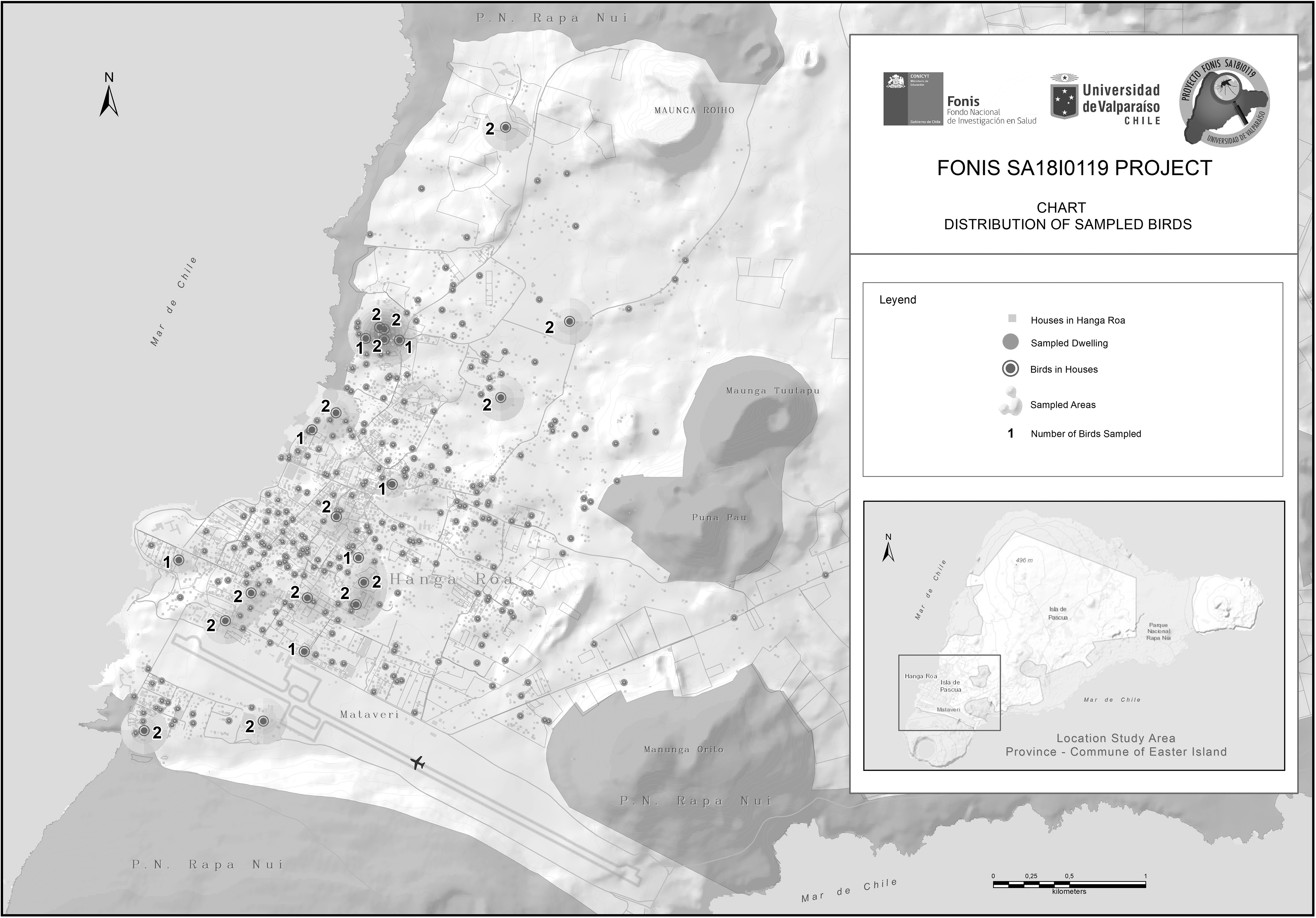
Map of the distribution of birds, according to the houses sampled in Rapa Nui island, region of Valparaíso, Chile.
Discussion
In Rapa Nui, cases of autochthonous outbreaks of some flaviviruses such as Zika and dengue have been described. However, in 2015, a study carried out in Rapa Nui identified two insect-specific flaviviruses (Collao et al, 2015). Birds are known to play an essential role in the WNV life cycle; migratory birds are hosts and amplifiers, whereas domestic birds act as sentinels.
The probability of finding seropositive birds is proportional to the number of birds sampled, an aspect to consider in future study.
This is the first study carried out on Rapa Nui birds, and given that the island presents factors such as the presence of the vector, susceptible hosts, the arrival of migratory birds, the high frequency of tourists, the illegal entry of birds, and favorable environmental conditions for the spread of WNV, it is necessary to carry out integrated surveillance, studying the human–animal–environment interface to jointly assess the dangers in health of emerging zoonoses.
Conclusions
This is the first investigation of this type carried out in Chile, leaving as a precedent that the samples analyzed are free of WNV, flavivirus, circulation, an informative result for local public health agencies. It is recommended to continue with studies in migratory birds, horses, and mosquitoes to prevent and control a possible health emergency with these flaviviruses.
Footnotes
Author Disclosure Statement
The authors declare that the research was conducted in the absence of any commercial or financial relationships that could be construed as a potential conflict of interest.
Funding Information
This research was funded by the National Fund for Health Research and Development FONIS SA 18I0119.