




Abstract
Jingmen tick virus (JMTV) is a tick-borne segmented positive-sense ssRNA virus that can cause human disease. This virus has been confirmed to be widespread, having a wide host range. In human it can cause fever, headache, lymphadenopathy, and asthenia. Therefore, JMTV poses a threat to public health. In this study, we collected 478 ticks from imported cattle on three quarantine farms near the Yunnan border to detect medically significant tick-borne viruses. Our findings show that JMTV was the only detected virus, with an incidence rate of 56.67%. Phylogenetic analysis showed that our JMTV is more closely related to previously reported JMTV strains from Yunnan Province and neighboring Laos, implying that the tick-borne virus was most likely imported from Laos. In conclusion, we identified and characterized a novel JMTV strain in tick (Rhipicephalus microplus) from Yunnan imported cattle, emphasizing the importance of arbovirus quarantine of livestock imports.
Ticks transmit a wide variety of pathogens, particularly viruses with significant public health concerns. It is estimated that these viruses spend >95% of their life cycle within the tick vector before infecting humans and animals (Madison-Antenucci et al., 2020). Jingmen tick virus (JMTV) was first detected in a tick in Hubei Province, China (Qin et al., 2014) and later confirmed to be globally distributed (Guo et al., 2020). Jingmen tick virus is a single-stranded positive-strand RNA virus, belongs to the Flaviviridae family, whose genome consists of four gene segments (S1, S2, S3, and S4). S1 and S3 encode nonstructural (NS) proteins 1 (NSP1) and NSP2. The S3 segment encodes an envelope protein (VP1). The S4 segment encodes a capsid protein (VP2) and a membrane protein (VP3).
Since its discovery in 2010 in the tick Rhipicephalus microplus in China, JMTV has been detected in ticks isolated from mosquitoes, cattle, sheep, rodents, and primates. Recently, it has been proposed that JMTV can infect humans and cause febrile illness, providing evidence that JMTV is a zoonotic virus with severe global public health concern (Emmerich et al., 2018; Jia et al., 2019). Therefore, it is more important to reveal the diversity and distribution of JMTV in nature.
In recent years, live cattle have been imported to fill the gap in beef consumption and to control China's rapidly rising beef prices. These animals are quarantined and sold until the quarantine period ends at Yunnan ports. However, there are some ticks carrying zoonotic viruses that tend to go unnoticed. A total of 478 morphologically identified R. microplus ticks were collected from three quarantine farms located in Xishuangbanna Dai Autonomous Prefecture, Yunnan, China, from 2019 to 2020. Of the total, 120 ticks (40 per cattle farm) were randomly selected for the detection of medically important tick-borne viruses.
Tick whole bodies were individually homogenized in liquid nitrogen, 200 μL were taken out for RNA extraction. Six tick-borne viruses were detected by PCR using previously reported methods, such as JMTV (Xu et al., 2020), Alongshan virus (Wang et al., 2019), Tick-borne encephalitis virus (Potkonjak et al., 2017), Crimean-Congo hemorrhagic fever virus (Koehler et al., 2018), Severe fever with thrombocytopenia syndrome virus (Liu et al., 2016), and Colorado tick fever virus (Williamson et al., 2019). Methods for amplification of our established JMTV whole genome are available on request.
The sequencing (Tsingke Biological Co. Ltd.) was used for confirmation of virus infection and further phylogenetic analysis. A total of 68 ticks (56.7%) were found to be JMTV-positive. Except for JMTV, no other viruses were detected in this study. The detection rate of JMTV in R. microplus ticks was slightly different among the three farms. In farm 1 detected rate was 95% (38/40), in farm 2 the rate was 35% (14/40), and in farm 3 it was 40% (16/40), respectively.
To further describe the genetic characteristics of these strains, three positive ticks were randomly chosen from each cattle farm for sequencing of the four-segment genome, followed by comparative and phylogenetic analyses. The JMTV sequences obtained in this study show high similarity with previously reported Yunnan tick virus 4 (YNTV4) and Mogiana tick virus (MGTV) isolates from the same province and other regions of China, with nucleotide identities of 91.48–96.55% and 89.83–96.55%, and relatively low identity of 72.7–82.6% with strains reported in the Republic of Trinidad and Tobago. Analyzed sequences showed a high degree a conservation, with differences observed mainly in the SAM binding site.
The phylogenetic tree of jmtv was constructed using the phylogenetic and taxonomic analysis software Mega-X. In this study, four phylogenetic trees were established by using the representative strains retrieved from NCBI GenBank database and the strains detected in this study. Virus sequence information is described in Supplementary Table S1. Two major phylogenetic groups were observed in the four phylogenetic trees. The first group comprised JMTV strains from Asia, Africa, and South America, whereas the second group contained viral strains from Europe, particularly the Republic of Trinidad and Tobago, the French Antilles, and Kosovo. The first group formed three evolutionary branches: Clade I comprises JMTV from China, Japan, and Laos; Clade II has only one JMTV from a red colobus monkey in Uganda; and Clade III consists of JMTV from Brazil and Guinea.
Jingmen tick virus from the same farm clustered together with high sequence homology. Notably, all JMTV strains detected in the study are shown in Clade I, and the JMTVs from three herds were clustered in S1, S3, and S4 trees. Jingmen tick virus collected from first and second cattle farms clustered together with previously detected viruses in China (provinces of Yunnan, Guizhou, and Hubei), whereas third farm JMTV strains were more closely related to viruses previously reported in Yunnan, Laos, and Japan. The strains YNTV4 and MGTV from Yunnan were grouped into two distinct sublineages (Clade I of the S2 tree) (Fig. 1).
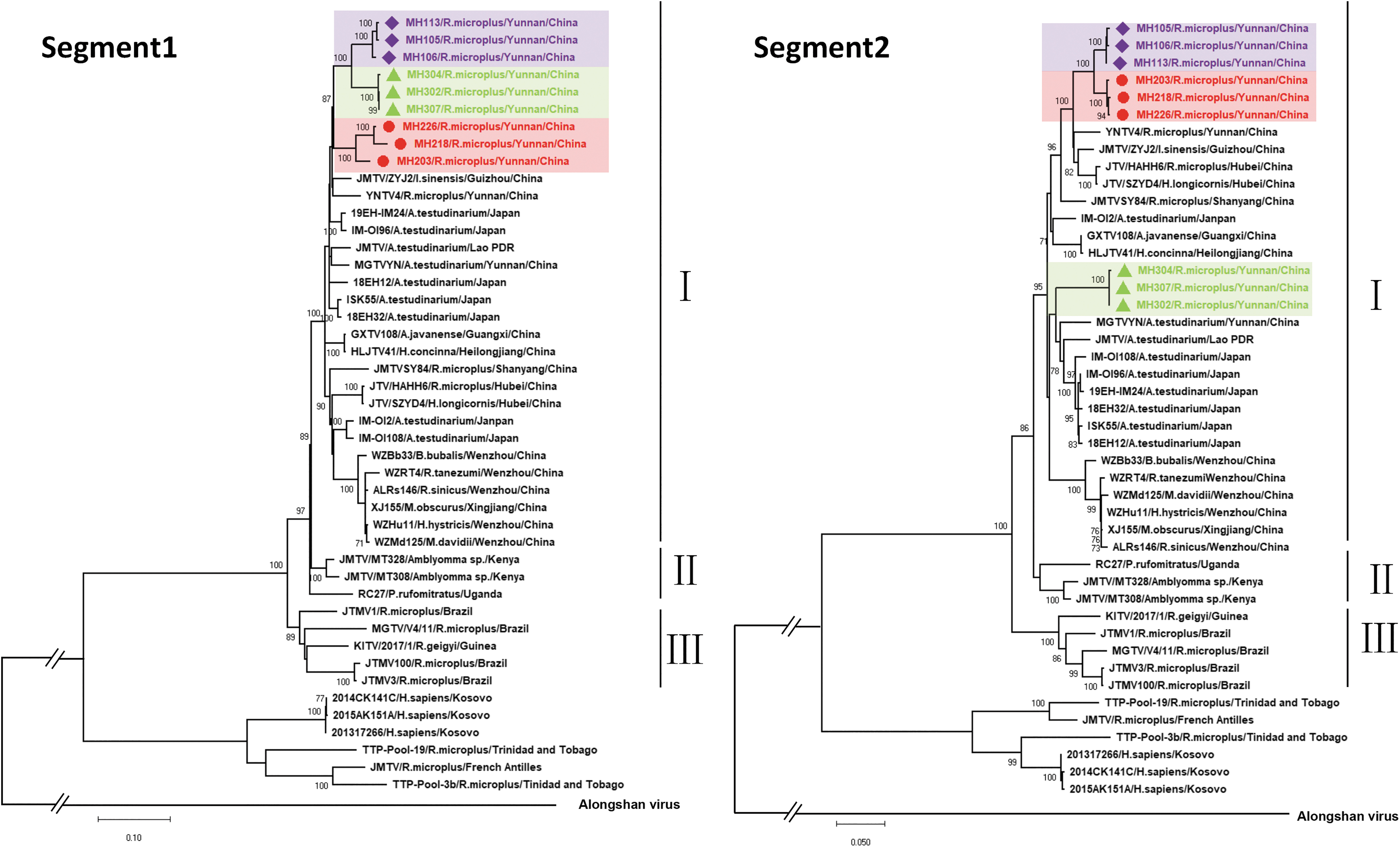
Phylogenetic analysis of nucleotide sequences from four segments of JMTV. The maximum likelihood method and substitution model GTR were used to construct the phylogenetic trees with MEGA X. Branch support was evaluated by 1000 bootstrap iterations. The viruses found in this study were marked with purple diamonds (cattle farm 1), red circles (cattle farm 2), and green triangles (cattle farm 3) according to the geographical locations where they were found. Greater than 70% of bootstrap support values are displayed on the associated node. JMTV, Jingmen tick virus.

Livestock movements play an important role in the transmission of infectious disease. Arthropods, such as tick vectors carried by vertebrate hosts, are often neglected during livestock quarantine. Six medically important tick-borne viruses have been detected in ticks collected from three quarantine farms located at the Yunnan border. Jingmen tick virus was the only positive arbovirus, which was first reported to be prevalent in central China and later confirmed to be globally distributed (Guo et al., 2020; Qin et al., 2014). Yunnan province, a traffic hub and the gateway to the west, southeast, and south of Asia, has been confirmed to have multiple infectious diseases circulating (Wang et al., 2018) and novel genotypes and recombination occurring frequently (Xuan et al., 2018).
Jingmen tick virus was also detected in the ticks prevalent in Yunnan Province using next-generation sequencing by Shi et al. (2021) and Xu et al. (2020). In this study, we reported tick borne JMTV from imported live cattle with a 56.67% prevalence rate. Unfortunately, serum from cattle possibly infected with JMTV was not collected and used for further research. However, this does not prevent us from concluding that strengthening the quarantine policy for imported livestock and agricultural products is necessary.
Tick-borne viruses are an important group of arboviruses, some of which can cause severe human diseases. Only a few studies reported the prevalence of the tick-borne virus in Yunnan province, southeast China. Jingmen tick virus was detected in Amblyomma testudinarium ticks collected from the remote village of Khammouane Province, Laos (Temmam et al., 2019). Phylogenetic analysis of four segments found in this study shows that our strains were more closely related to JMTV collected from Yunnan, Laos, and Japan. The genetic similarity of the virus strains, cattle origin, and Yunnan's geographical location suggest that the strains detected in this study were likely imported from Laos (Guo et al., 2020).
The sequential positive detection of JMTV, YNTV4, and MGTV detected in this study, strongly suggests that JMTV is widely distributed in Yunnan Province. Meanwhile, JMTV should be considered in the diagnostic of patients with a history of tick bites presenting with febrile illness. Jingmen tick virus has been detected in febrile patients in several previous studies, and the virus has been detected in mammalian worms in cattle, bats, monkeys, mice, and so on. However, the virus's transmission pattern and pathogenetic mechanisms in mammals and humans remain unclear, mainly due to scarce data, thus warranting further study.
In summary, JMTV detected in ticks from Yunnan imported cattle were closely related to strains previously reported in Laos and Yunnan. Our findings suggesting that the Laos JMTV strains were introduced into Yunnan Province by importing cattle carrying infected ticks. These results call for enhanced surveillance of arboviruses in the Yunnan border region.
Data Availability Statement
The data presented in this study are openly available in the NCBI database by Accession Nos. OP616978 and OP617013.
Footnotes
Author Disclosure Statement
No conflicting financial interests exist.
Funding Information
This study was supported by the National Natural Science Foundation of China (Grant No. 81860592), Yunnan Key R&D Program (Grant No. 202103AQ100001), Yunnan Major Scientific and Technological Projects (Grant No. 202202AG050013), Yunnan Province Basic Research Program Projects (Grant No. 202101AS070028), and Active Monitoring and Early Warning of Major Terrestrial Wildlife Diseases in Yunnan Province and Construction of Primary Laboratory (Grant No. 2022GF218Y-04).
Supplementary Material
Supplementary Table S1
References
Supplementary Material
Please find the following supplemental material available below.
For Open Access articles published under a Creative Commons License, all supplemental material carries the same license as the article it is associated with.
For non-Open Access articles published, all supplemental material carries a non-exclusive license, and permission requests for re-use of supplemental material or any part of supplemental material shall be sent directly to the copyright owner as specified in the copyright notice associated with the article.
