




Abstract
Background:
A total of 79 cases of dengue fever were reported in Jining County in 2017, which is currently the northernmost focal point of local cases of dengue fever diagnosed in China. This study aimed to evaluate the density of mosquito vectors before and after the outbreak of dengue fever and provide novel reference data for the prevention and control of the disease.
Methods:
The light traps were set to collect mosquitoes in 2017 and 2018 to assess adult mosquito density and species composition. We used the human-baited double net trap to determine the biting rate. In addition, the Breteau index (BI) was calculated to evaluate the density of Aedes albopictus in Jining, Shandong Province. The annual average densities of Ae. albopictus in 2017 and 2018 were 0.046 and 0.066 f/t/h, respectively.
Results:
The average biting rate was 0.69 f/m/h in 2018. There was no significant difference found in Ae. albopictus density and biting rate in the various months. The average BI of Jining was 38.67 and 11.17, respectively. There was a statistically significant difference observed in the BI between 2017 and 2018 (Kruskal–Wallis test, χ2 = 16.926, df = 1, p < 0.001).
Conclusion:
BI can serve as an important indicator to determine the spread of dengue fever. The findings indicted that the growing density of adult Aedes mosquitoes should be focused on, with biting rates being a potential indicator of future outbreaks. Overall, the various control measures that were implemented were effective and should be introduced in other high-risk areas.
Introduction
A
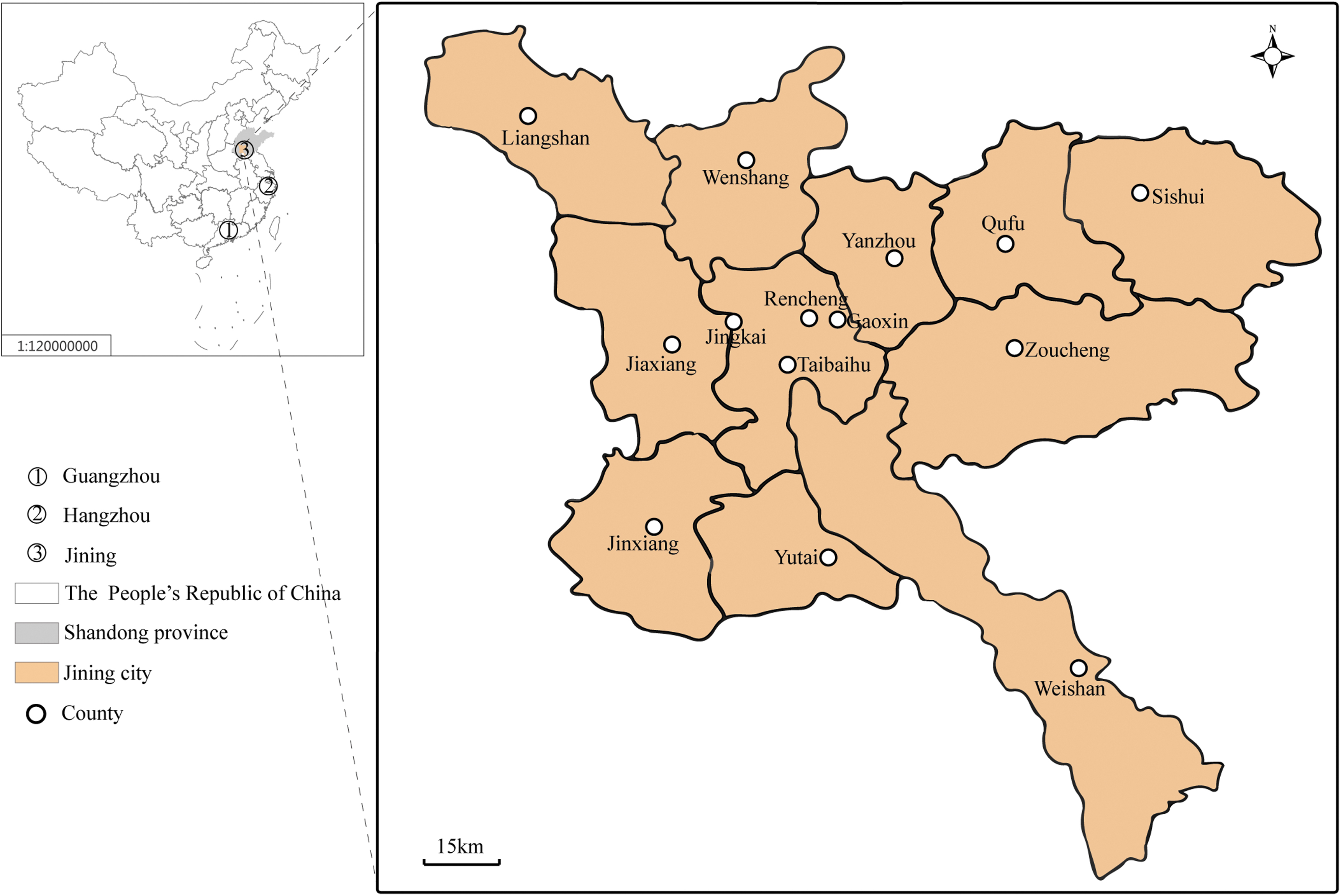
Map of mosquito sample sites in Jining, China.
The dengue fever epidemic has a tendency to spread northwards in China (Liu, 2019), and the population at risk of disease has expanded significantly since 2014. In 2017, an outbreak of local dengue fever occurred in Jiaxiang County, Jining City, Shandong Province, which is the northernmost area in China, and resulted in a local epidemic (Liu et al., 2020). In addition, with rapidly increasing globalization, urbanization and international mobility, a greater number of new cases are expected in the future in this region.
Mosquito surveillance forms the main basis of the planning and evaluation of vector-control strategies. Long-term ambulatory monitoring can evaluate the prevention as well as control measures and establish an early warning system. Therefore, it is crucial to conduct research related to the species composition and density of Ae. albopictus. Both larvae and adult have been included for mosquito monitoring. Light traps have been used to investigate the composition as well as the density of the mosquito species, and the human-baited double net traps (HDN) have been employed to monitor mosquitoes when dengue outbreaks occur.
The Breteau index (BI) can serve as an important indicator to determine the spread of dengue fever and is the most widely adopted index for larval Aedes monitoring and predicting the outbreaks. The Chinese Center for Disease Control and Prevention (CCDC) has indicated that HDN method value <2 and a BI <5 (Liu et al., 2018) can be perceived as the threshold for controlling the spread of dengue. Consequently, this survey was conducted to evaluate the density of mosquito vectors before and after the outbreak of dengue fever, and thereby provides novel reference data for both the prevention as well as control of the disease.
Methods
Study areas
According to the CCDC's Aedes monitoring division standard (Liu et al., 2018), Shandong Province belongs to a class III area. The recently reported imported cases of dengue fever and Aedes distribution have indicated the risk of dengue fever outbreaks in the area. Moreover, in 2017, 6 different counties in Jining (Rencheng, Yanzhou, Sihui, Liangshan, Zoucheng, and Jiaxiang) were routinely monitored, whereas in 2018, all 14 counties in Jining (Rencheng, Yanzhou, Sihui, Liangshan, Zoucheng, Jiaxiang, Gaoxin, Taibaihu, Jingkai, Qufu, Weishan, Jinxiang, Yutai, and Wenshang) were included for the study (34°59′82″N–35°80′81″N, 116°11′48″E–117°36′19″E).
The weather in Jining City is warm, with 60–70% of precipitation, which is mainly concentrated in June-August. The territory is rich in different rivers, consists of mainly plains, and is suitable for planting wheat, rice, corn, and other crops. The area has large airports and is characterized by frequent movement of people. The period from June to August is the busy season for farming, when both the young and middle-aged laborers return home to farm, thus increasing the possibility of dengue fever transmission. The map of the study area was created using Adobe illustrator CS6 (Adobe Systems Incorporated, San Jose, California, United States of America; Fig. 1).
According to the dengue fever surveillance guidelines of China, class I areas are provinces where dengue fever outbreaks have frequently occurred in recent years, such as Guangdong, Guangxi, Yunnan, Zhejiang, and Fujian. Class II areas include provinces that have had significant number of local cases of dengue fever in recent years, and includes Shanghai, Chongqing, Jiangsu, Anhui, Jiangxi, Henan, Hubei, Hunan, Sichuan, and Guizhou, whereas class III areas have had imported cases reported in recent years, and these include Beijing, Hebei, Shanxi, Tianjing, Shandong, Shanxi, and Liaoning.
Light traps
According to the guidelines of the Chinese vector monitoring program (Wu et al., 2015), we selected to hang lights in the residential areas, parks, hospitals, livestock sheds, and few other places away from interfering light sources, as well as shelter, and one mosquito trap lamp was placed in each monitoring habitat. The light source of a mosquito trap was at a height of 1.5 m from the ground. The power supply was turned on 1 h before sunset and the mosquito traps were turned on to trap mosquitoes for 12 h until about 1 h after sunrise the following day.
Every 12 h was considered one trapping period. The samples were obtained twice a month from March to November between 2017 and 2018 and the interval between trap days was at least 10 days. Ninety-eight light traps (Lucky Star Environmental Protection Technology Co., Ltd., Wuhan, China) were placed every month in 2017 and 60 light traps were placed every month in 2018. The captured mosquitoes were treated with chloroform and later identified based on their morphology (Chaiphongpachara, 2018; Vargas et al., 2013). The density was then estimated as the quantity of adult female mosquitoes per trap per hour (f/t/h).
Human-baited double net trapping
The HDN is primarily composed of the inner net and the outer net. The inner net is 1.5 m high, the outer net is 30–40 cm raised off the ground, and the distance between the two nets is ∼30–40 cm. Briefly, a person sits in the enclosed area of the inner net, exposing both the legs, and then the collector collects mosquitoes on the net with an electric mosquito-suction device between the two nets.
The HDN method has been improved substantially on the basis of the human-baited method, as the baiter is separated from the mosquito by the bed-net, so the risk of infection of the surveillance personnel is significantly reduced (Gao et al., 2018). All the 14 subordinate counties of Jining city were surveyed (Rencheng 8, Yanzhou 12, Sihui 4, Liangshan 4, Zoucheng 16, Jiaxiang 18, Gaoxin 4, Taibaihu 2, Jingkai 4, Qufu 12, Weishan 12, Jinxiang 12, Yutai 5, and Wenshang 1); a total of 114 HDN were placed in the neighboring residential areas from 15:00 to 18:30, with each collection lasting for 30 min, and was carried out twice a month from March to October of 2018.
Larvae or pupae
The CCDC Aedes monitoring guidelines (Liu et al., 2018) recommend that Aedes larvae or pupae should be monitored monthly in class III regions. Therefore, the mosquito surveillance was routinely carried out monthly in five different counties of Jining, namely Rencheng, Yanzhou, Sihui, Liangshan, and Zoucheng from June to September, 2017. After the outbreak of the dengue fever, BI monitoring foci (Jiaxiang) were established according to the requirements of the CCDC. In 2018, we performed an extensive mosquito surveillance study in all the 14 subordinate counties of Jining twice a month from May to October.
In total, more than 100 households were selected in the residential, hospitals, parks, and transfer station in each county. All the small water containers (discarded tires, flowerpots, water containers, fish water pots, water tanks, water jars/pots, wet containers, and vases) around the households were examined, and the number of Aedes-positive containers was thereafter recorded. The larvae collected were then identified or brought back to the laboratory for breeding until the adult stage for species identification. The larval index was measured using the BI (World Health Organization, 1995), which is the quantity of containers with Aedes larvae per 100 houses.
Data analysis
A Student's t-test was applied to test for the significant difference between the Aedes mosquito density and the BI in 2017 and 2018. The biting rate was determined as the average number of bites per man per hour by adult Aedes. The heterogeneity of variance was tested with Levene's test, and the densities of Aedes in different months as well as in areas were compared. The biting rates among months were evaluated with Kruskal–Wallis test and the average BI of the same periods as well as the places was also compared.
Results
A total of 15,403 female mosquitoes, Culex pipiens pallens (91.52%; 14,097/15,403), Culex tritaeniorhynchus (3.16%; 486/15,403), Ae. albopictus (3.16%; 487/15,403), and Anopheles sinensis (2.16%; 333/15,403), were collected using the 98 light traps from March to November in 2017 (Fig. 2A; Table 1). A total of 5547 female mosquitoes from Jining were collected by using 60 light traps over 9 months in 2018. The most prevalent species were found to be Cx. p. pallens (84.24%; 4673/5547), followed by Ae. albopictus (7.72%; 358/5547), Cx. tritaeniorhynchus (6.45%; 358/5547), and An. sinensis (1.30%; 72/5547) (Fig. 2B; Table 1).

Mosquito species composition.
Mosquito Species Composition and Abundance
Density: The mosquito density was calculated as the number of adult female mosquitoes per trap per hour.
Number of light traps.
All the captured Aedes mosquitoes were Ae. albopictus (Fig. 3; Table 1). The annual average densities of Ae. albopictus in 2017 and 2018 were 0.046 and 0.066 f/t/h, respectively. It was observed that in 2017, the peak density of Ae. albopictus occurred in August (0.162 f/t/h), but in 2018, it occurred earlier, in July (0.172 f/t/h). However, there was no significant difference noted in the Ae. albopictus density between 2017 and 2018 [t-test: t (32.453) = 0.188, p = 0.852]. Interestingly, there was no significant difference noted in the density among months, both in 2017 (Kruskal–Wallis test, χ 2 = 4.059, df = 6, p = 0.669) and 2018 (Kruskal–Wallis test, χ 2 = 4.254, df = 7, p = 0.750).

Densities of Aedes albopictus in different years. Density of Ae. albopictus was calculated as the number of adult females per trap per hour (f/t/h).
Light traps can commonly target nocturnal mosquito species. Therefore, the HDN method was also used to monitor the density of Aedes mosquitoes in 2018. Altogether 215 female Aedes were collected. The average biting rate was 0.67 f/m/h, showed no significant difference among the different months (Kruskal–Wallis test, χ2 = 6.503, df = 5, p = 0.260) (Table 2).
Density of Aedes albopictus Collected by Human-Baited Double Net Traps Method in 2018
Ae. albopictus biting rate was calculated as the mean number of adult female mosquito bites per person per hour (f/m/h).
A total of 79 cases of dengue fever were reported in Jiaxiang County in 2017. The BI for this region was found to be 107.27 when the first case was confirmed. Subsequently, the CCDC administered the various health education programs, applied the chemical insecticides, turned over the containers, cleaned the water, and implemented other similar methods to control the mosquito population. As a result, the BI for this region dropped sharply to 4.95 on 3rd September and 0 on 6th September (Table 3).
The Breteau Index Value between 2017 and 2018
The average BI of Jining was 38.67 and 11.17 in 2017 and 2018, respectively (the BI from Jiaxiang in 2017 was not counted in this study). The monthly average BI reached its maximum value in August 2017 (BI = 56.47), but reached its maximum value in July 2018 (BI = 15.53; Table 3). During the survey, the highest BI value (82) was reported in Zoucheng in August 2017. There was a statistically significant difference observed in the BIs between 2017 and 2018 (Kruskal–Wallis test, χ2 = 16.926, df = 1, p < 0.001; BI from Jiaxiangin 2017 was not included in this study).
There was a significant difference in the BIs only in August when compared between the 2 years (June: [Kruskal–Wallis test, χ2 = 0.549, df = 1, p = 0.459], July: [Kruskal–Wallis test, χ2 = 2.627, df = 1, p = 0.105], August: [Kruskal–Wallis test, χ2 = 8.527, df = 1, p = 0.003], and September: [Kruskal–Wallis test, χ2 = 2.063, df = 1, p = 0.151]; Fig. 4; Table 3). Moreover, there was a significant difference discovered in BI values among the regions [Welch's analysis of variance, 2017: F (5, 450.962) = 156.172, p < 0.001; 2018: F (5, 120.669) = 969.668, p < 0.001]. The average BI of same periods and places was also compared, and the BI in 2017 was significantly higher than that in 2018 [t-test: t (1426) = 43.565, p < 0.001].
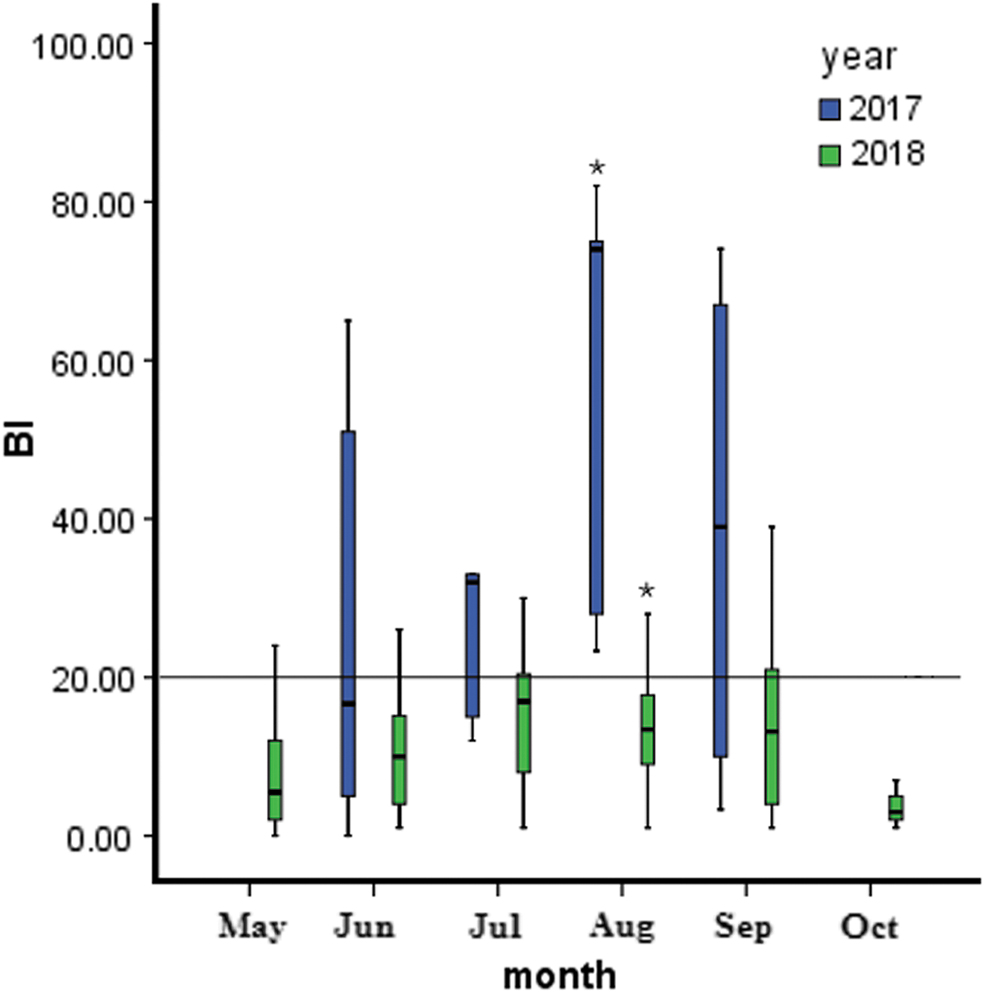
The BI fluctuation trend between 2017 and 2018. *p < 0.05. BI, Breteau index.
Discussion
In China, there is a trend of northward transmission of dengue fever, especially in Jining city, which is located in the northernmost area where the greatest number of local dengue cases has been reported so far. It is highly probable that the dengue outbreak in Jining 2017 was caused by Ae. albopictus. This research involves a comprehensive investigation conducted on Ae. albopictus in the city. The average biting rate was 0.67 f/m/h in 2018. The average BI was 38.67 and 11.17, respectively, in 2017 and 2018, thereby reaching dengue fever outbreak levels.
A number of previous studies have reported that the overall average density of Ae. albopictus was 0. 036 f/t/h when using the light traps at 41 national surveillance sites in China during 2006 to 2013 (Wu et al., 2015). The density in the tropical zone (0.091 f/t/h) was the highest, followed by the subtropical zone (0.051 f/t/h) and the warm temperature zone (0.029 f/t/h), respectively, and no Ae. albopictus were found in the mid-temperature zone. Jining lies in the warm temperature zone, and the average annual densities in 2017 and 2018 (0.0460 and 0.0660 f/t/h) were markedly higher than those in national media sites, the warm temperature zone, as well as the subtropical zone (Wu et al., 2015).
Although the light traps have been mainly used to catch night feeders, it can still represent the density of Aedes mosquitoes to a certain extent, especially when compared to the national density measured using the same method. It has been established that the provinces that belong to subtropical regions are all provinces with frequent dengue fever outbreaks or having experienced localized dengue fever in recent years.
In addition, the density of Ae. albopictus has been observed to be slowly growing. Therefore, it is necessary to strengthen the monitoring of the mosquito species and density in Shandong Province, China. It is important to highlight that the distribution of monitoring sites in the different habitats was not uniform, which could also impact the findings of this study. Hence, future studies should consider the potential effect of differences in the monitoring habitats on the mosquito monitoring data. In addition, the monitoring of adult mosquitoes should be conducted not only in night time but also in day time as the risk of dengue outbreak has been increasing in different regions.
To further monitor adult mosquito density, HDN method was applied in 2018. The average biting rates (0.67 f/m/h) were observed to be significantly below the recommended threshold (2 f/m/h). Moreover, the local dengue cases were also reported in Hangzhou in 2017 and the biting rate was significantly higher at that time (2.29–8.50 f/m/h) (Wei et al., 2019). This finding indicates that adult mosquito surveillance could provide valuable information for studying the seasonal fluctuations and estimating the risk of dengue transmission.
The average BI of Jining was found to be 38.67 in 2017, while the average BI decreased to 11.17 in 2018 after the administration of health education programs, mosquito control, and environmental optimization. However, in nine of the 14 counties, annual average of BI still exceeded 10 in 2018 and a similar study showed that BI values of Shandong Province were 13.39–31.80 in August 2015–2017 (Liu et al., 2018). Therefore, Shandong has always been a hot spot for dengue transmission, but except for 2017, there has been no widespread local dengue transmission. BI values of Taibaihu and Yutai were below 5.
The monitoring point of Taibaihu is an ecological protection area with the presence of many natural enemies of mosquitoes. Moreover, as a large water body, Taibai Lake is not a suitable breeding environment for Ae. albopictus, so its density has been observed to be relatively low. Yutai monitoring point is an important water storage area and urban drinking water protection area of the National South to North Water Transfer Project and Grand Canal flows through it. However, with stringent environmental governance, the area is not suitable for the breeding and reproduction of Aedes mosquitoes, and thus the density of Ae. albopictus remains relatively low.
BI is one of the important indicators used to determine the risk of dengue outbreaks (World Health Organization, 1995). In 2017, the BI value in Jiaxiang exceeded 100, thereby posing a risk of dengue fever spreading in the region. As the recommendation of the Technical Guidelines for Dengue Fever Prevention and Control, once the BI is greater than 20, different measures are implemented to inform the general public and various government agencies, enterprises, as well as institutions to carry out environmental sanitation improvement programs, turn over pots and tanks, and remove accumulated water in containers, especially in the settlement ponds at construction sites, thereby reducing the BI index to below 5 and preventing the transmission risk of dengue fever.
After Center for Disease Control and Prevention underwent a series of effective efforts, the BI decreased significantly from 107.27 to 4.95, with no more new cases reported. These results implicated that effectively reducing the mosquito breeding grounds and spraying chemical insecticides can serve as useful measures to control the transmission of dengue fever.
The guidelines for Aedes mosquito monitoring in China stated that a BI <5 is the threshold for controlling the disease, while 5–10, 10–20, and >20 represent the levels of transmission, outbreak, and regional prevalence, respectively (Liu et al., 2018). However, the exact threshold for the low-risk areas remains controversial. For instance, some studies have concluded that the value is supposed to <5 (Liu et al., 2018; Wijegunawardana et al., 2019), whereas others have indicated that it should be <4 (Luo et al., 2015) or <1 (Sanchez et al., 2006). The CCDC stipulates that BI <5 is perceived as the threshold for controlling the spread of dengue.
Interestingly, as no more cases were found when the BI dropped below 5, it turns out that BI <5 seems to be credible for indicating the incidence of dengue outbreaks. However, the BI values have reached the threshold for dengue transmission over the last few years; thus, one should strategize to strengthen the monitoring and further improve risk assessment. In addition, other studies have shown that class I (Guangdong, Yunnan, Guangxi, Hainan, Fujian, and Zhejiang) and class II (Shanghai, Chongqing, Jiangsu, Anhui, Jiangxi, Henan, Hubei, Hunan, Sichuan, and Guizhou) areas have higher densities of Aedes than class III areas, including Shandong (Liu et al., 2018; Luo et al., 2015; Yang et al., 2009).
However, in 2004 and 2017, BI values were all more than five, thus suggesting a risk of dengue fever, in Hainan, Zhejiang, and Fujian provinces from April to November, Guangxi province from April to September, and Yunnan province from June to October (Liu et al., 2018; Yang et al., 2009). In addition, BI values in Jiangxi, Henan, Hubei, and Sichuan from May to October were also all more than five, while the BI values in Henan and Hubei were more than 10, thus reaching the dengue fever outbreak levels (Liu et al., 2018).
A number of previous studies have also shown that the density of Aedes larvae was subjected to various factors, including the geographical situations, the breeding grounds, the meteorological elements, and different control measures conducted, as well as the health conditions (Guo et al., 2016; Liu et al., 2017; Thammapalo et al., 2008; Xiang et al., 2017). Thus, targeted measures should be adequately adopted so that the mosquito density and the spreading risk can be controlled effectively.
Conclusion
The BI can serve as useful larval index for monitoring mosquitoes and predicting the disease occurrence. Adult mosquito surveillance could supply valuable information for analyzing the seasonal fluctuations and estimating disease transmissions. The biting rate can also act as a potential indicator of future outbreaks. Thus, both larvae and adult densities are supposed to be surveyed in high-risk areas.
Footnotes
Author Disclosure Statement
The authors declare no competing interests.
Funding Information
This work was supported by grants from projects of Natural Science Foundation of Shandong Province (ZR2020KH001 and ZR2020MC048), Guangdong Provincial Key Laboratory of Insect Developmental Biology and Applied Technology, South China Normal University, Science Foundation of Shandong First Medical University (Shandong Academy of Medical Sciences) (202201-041), and the Innovation Project of Shandong Academy of Medical Sciences and Academic promotion programme of Shandong First Medical University (2019QL005).