




Abstract
Background:
La Crosse virus is an important endemic public health concern in the North Carolina Appalachian Mountains; however, human incidence is not commonly noted in this region on the South Carolina side of the mountain range border. No relevant studies have been performed in South Carolina evaluating mosquito vector populations for La Crosse virus (LACV) infection; thus, a pilot mosquito surveillance study was executed in summer 2020.
Material and Methods:
Vector surveillance occurred at five South Carolina state parks bordering neighboring state endemic counties from May to August 2020. Collections were approved by the state park authority, as noted in Permit No. N-8-20.
Results:
All three competent mosquito vectors were collected during the study duration; however, these vectors were collected in low abundance: Aedes triseriatus (4.5% of all collected mosquitos); Aedes albopictus (2.0%); Aedes japonicus (1.4%). Principal mosquito vector specimens, Ae. triseriatus, were sent to Centers for Disease Control and Prevention for testing of LACV by real-time reverse transcription PCR—all were negative.
Discussion:
While entomologic evidence suggests low transmission risk for this arbovirus in the South Carolina Appalachian Mountain region, further eco-epidemiologic investigations are warranted to understand this endemicity variance within a relatively small geographic area.
Introduction
La Crosse virus (LACV), a California serogroup bunyavirus, is the leading cause of pediatric arboviral neuroinvasive disease in the United States. LACV is found throughout the Midwestern and Southeastern regions of the United States; however, incidence is highest along the Appalachian Mountain range (Bewick et al., 2016; Byrd et al., 2018; Haddow and Odoi, 2009). LACV can quickly progress from acute, nonspecific febrile disease to neuroinvasive disease, with children disproportionately comprising the majority of severe LACV disease cases (Soto et al., 2022). According to the Centers for Disease Control and Prevention (CDC) website, “substantial under-diagnosis and under-reporting of less severe cases of LAC disease” exists (CDC, 2022). Consequently, these epidemiologic knowledge gaps damper the effectiveness of current public health prevention and vector control programs.
The eastern tree-hole mosquito, Aedes triseriatus (Say), the primary LACV mosquito vector, can be found in hardwood forests across the central and eastern United States. This zoophilic species completes the immature stages in water-holding deciduous tree holes and in manufactured containers holding fresh water. Moreover, these mosquitoes' host-seeking periods range between daylight and twilight and are involved with multiple animals serving as amplifying hosts for the virus, creating the opportunity for human transmission (Byrd et al., 2018; Darsie Jr. and Ward, 1981; Rust et al., 1999). Transovarial, transstadial, and venereal transmission among Ae. triseriatus populations has been described, allowing for sustained infectivity between mosquito generations (Thompson et al., 1965; Watts et al., 1973).
Other container-inhabiting mosquito species, Aedes albopictus (Skuse) and Aedes japonicus (Theobald), demonstrate vector competence for LACV and potentially contribute to viral activity maintenance in eastern Tennessee (Bara et al., 2016; Rowe et al., 2020; Westby et al., 2015). The sylvatic LACV cycle is maintained by primary viral amplifying hosts: the eastern chipmunk (Tamias striatus griseus), gray squirrel (Sciurus carolinensis), and fox squirrel (Sciurus niger) (Bewick et al., 2016; Borucki et al., 2002; Haddow and Odoi, 2009). These inter-related biological and ecological factors support pathogen transmission sustainability over decades without vector control intervention.
In the 1990s LACV emerged in Southern Appalachia and has become increasingly identified in western North Carolina as a local disease focus (Bewick et al., 2016; Byrd et al., 2018; Rowe et al., 2020). Estimates of annual incidence have been as high as 300,000 cases with an average of 30–180 severe disease cases annually (Bewick et al., 2016; Rust et al., 1999). In western North Carolina, geospatial and spatial-temporal clusters exist, resulting in coincidental infections within families and decades of continued transmission to local resident children (Byrd, 2016; Byrd et al., 2018)—highlighting the public health need to identify hotspots and mitigate transmission risk. Although disease clusters along the North Carolina and South Carolina border are evident, a grave human incidence disparity exists in the bordering counties.
South Carolina has reported five human cases in the past 15 years, compared to North Carolina, where 265 cases have been reported in the same timeframe (Devamani et al., 2020; NCPH, 2020). While bordering counties exhibit similar environmental conditions and sociodemographic population characteristics, it is unknown if this human case incidence disparity is due to low clinician knowledge/diagnosis or vector absence in the South Carolina bordering counties. Conversations with pediatricians at the local health care system (Prisma Health-Upstate) revealed moderate knowledge and self-reported clinical diagnostic test orders (M Nolan 2022, personal communication). Conversely, mosquito control programs in South Carolina border counties are either nonexistent or city-based, with the majority of these counties unsurveilled (Personal communication; Chris Evans, 2020). Therefore, the current study aimed to evaluate the mosquito population and pathogen prevalence in the primary vector among epidemiologically high-risk South Carolina counties along the Appalachian Mountain range during peak LACV transmission season.
Materials and Methods
This pilot study was conducted in four South Carolina counties bordering a North Carolina LACV endemic region (Bewick et al., 2016; Haddow and Odoi, 2009; Rowe et al., 2020). Five state parks (Caesar's Head, Jones Gap, King's Mountain, Oconee, and Table Rock) along the state border were selected for Ae. triseriatus mosquito collections. A state park permit was secured for collections (Permit No.: N-8-20). In total, these parks contain over 100 miles of hiking trails, 237 campgrounds, and over 23,000 acres of wilderness—the majority consisting of Appalachian Oak, Oak Pine, and Upland Forest type habitats dominated by various oak (Quercus spp.), hickory (Carya spp.), and pine (Pinus spp.) trees(South Carolina Department of Natural Resources, 2006).
From May to August 2020, ∼10 CDC miniature light traps (BioQuip Products, Rancho Dominguez, CA, USA) and 10 BG-Sentinel™ 2 (BioGents AG, Regensburg, Germany) traps were deployed weekly for adult mosquito collections. CDC miniature light traps were baited with an incandescent light bulb and CO2 from ∼1 kg of dry ice inside a 0.5 insulated gallon Igloo® cooler (Igloo Products Corp., Katy, TX, USA) with a hole drilled in the bottom (Wilke et al., 2019). BG Sentinel 2 traps were baited with an artificial human skin odor lure (the BG-lure) and CO2 from another identical Igloo cooler (Wilke et al., 2019). Igloo coolers with dry ice were hung from tree branches when available to ensure the sublimated CO2 was as close to the mouth of the trap as possible. A pair (one of each trap) was placed at least 50 meters from each other to prevent interference, totaling 10 traps per collection trip (Rochlin et al., 2015).
In each state park, trap site locations were chosen that were (1) within 50 meters from oak trees, (2) near where humans spend notable time in the park (i.e., campgrounds or near bathrooms), and (3) near visible tree holes in oak trees. Traps were set in the afternoon (15:00–16:00) and serviced the following morning (08:00–09:00); trap run time was ∼18 h every collection trip. Field technicians were instructed to search for tree holes containing water to siphon water for potential mosquito larvae or pupae on every collection trip within sight distance of the adult traps. Complete removal of water in tree holes was conducted using a turkey baster and placed into separate labeled Whirl-Pak® bags (NASCO Sampling, Madison, WI, USA) for each tree hole.
Following trap service, labeled adult mosquito collection bags were immediately taken to the University of South Carolina's Laboratory of Vector-Borne and Zoonotic Diseases in Columbia, SC for processing. Trap collection bags with live mosquitos were placed immediately into a −80°C freezer for 24 h to ensure mosquito mortality while maintaining viral cold chain. Only one tree hole from the entire pilot study contained water; this was emptied from the labeled Whirl-Pak bag and placed inside a labeled mosquito breeder (BioQuip Products). Following an incubation period of 1 week at ambient temperature, no larvae were observed. Thus, this portion of the study was removed from the analysis and results.
Weather information (minimum and maximum temperature, 24-h precipitation, and relative humidity) for all collection nights was noted from the National Oceanic and Atmospheric Administration (NOAA) National Weather Service, Observed Weather Datasets (NOAA, 2020). All adult mosquitoes were morphologically identified to species using a dichotomous key (Darsie Jr and Ward, 1981). Ae. triseriatus female mosquitoes were removed and sent to the CDC Division of Vector-Borne Diseases (DVBD), Arboviral Diseases Branch, in Fort Collins, CO and tested for LACV infection through real-time reverse transcription PCR (RT-qPCR) using previously described methods (Lambert et al., 2005).
Results
A total of 560 mosquitoes were collected from both the CDC miniature light and BG Sentinel™ 2 traps from the 5 parks over 13 trap nights. Of the 560 adult mosquitoes, 417 (74.5%) were successfully identified to species. Twenty-one mosquito species from eight different genera were identified (Table 1; Fig. 1). The species and trap locations are shown in Table 1 and Fig. 1, respectively. There were 111 (19.8%) male mosquitoes.
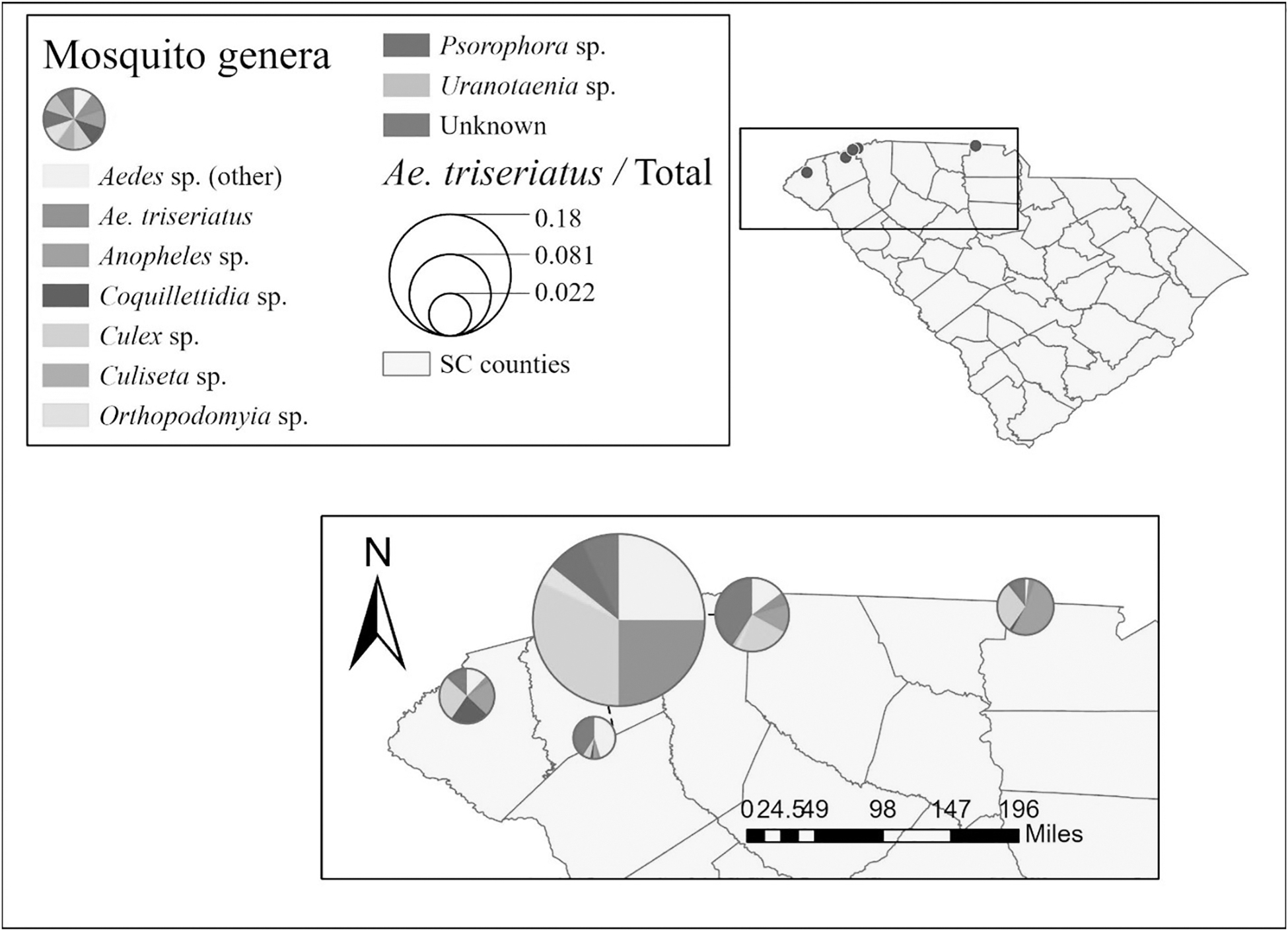
Map showing areas where Aedes triseriatus and the mosquito genera were captured at each of the State Parks between May and August 2020.
Summary of the Mosquito Species Captured in South Carolina State Parks Between May and August 2020
Traps located in Caesar's Head State Park (Greenville County) collected the highest number of Ae. triseriatus (n = 7) followed by Jones Gap State Park (n = 5) in the same county. Traps in Oconee State Park (Oconee County) collected the highest number of Ae. albopictus (n = 7) throughout the collection period, and Caesar's Head and Jones Gap Parks traps collected the highest number of Ae. japonicus (n = 3 from each site) (Table 2).
Average Minimum and Maximum Daily Temperature Ranges, Precipitation, and Relevant Mosquito Species Collected by State Park
During the trapping period, the daily temperature range (daily minimum and daily maximum) and 24 h average precipitation for each of the State Parks were: Table Rock between 57–84°F and 68–91°F, average precipitation between 0.29″ and 0.67″; Oconee between 69–89°F and 74–91°F, average precipitation between 0.01″ and 0.6″; King's Mountain between 61–86°F and 69–9°F, average precipitation between 0.13″ and 0.7″; Jones Gap between 70–90°F and 71–91°F, average precipitation between 0″ and 0.11″; Caesar's Head between 63–82°F and 73–90°F, average precipitation between 0.18″ and 0.38″ (Table 2).
Figure 2 shows the trends in temperature overtime along with the collection information from three Aedes species known as LACV main vectors: Ae. triseriatus, Ae. albopictus, and Ae. japonicus. Ae. triseriatus was collected throughout the trapping period, whereas Ae. albopictus and Ae. japonicus were not collected until the latter half of the study. Ae triseriatus numbers roughly followed the trends in average temperature, where higher temperatures coincided with more mosquitoes collected. This trend was not as evident with the other two Aedes species of interest.
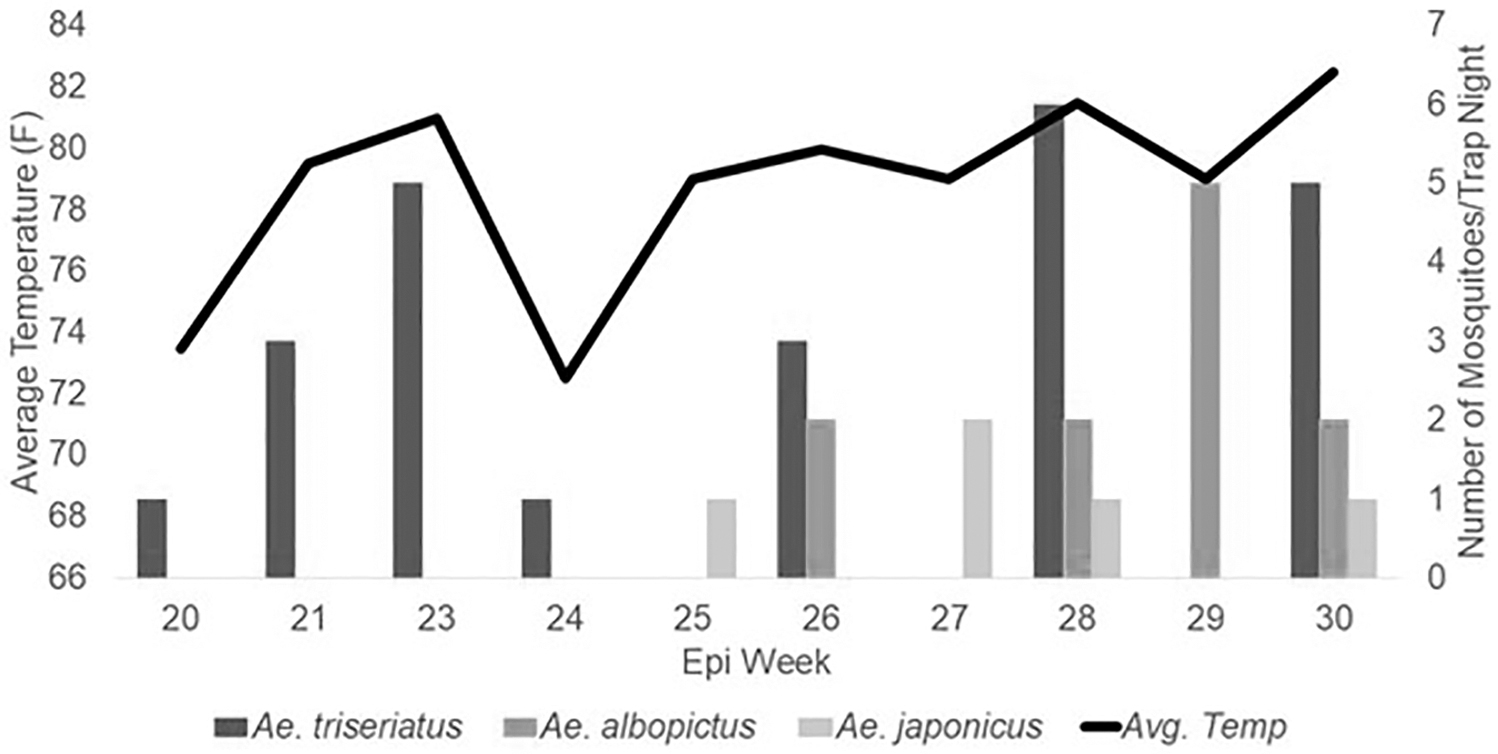
Trends in temperature over time and number of Aedes triseriatus, Aedes albopictus, and Aedes japonicus collected: May to August 2020.
All Ae. triseriatus (n = 25) sent for testing to the CDC were negative for LACV by RT-qPCR.
Discussion
This is the first attempt to analyze LACV pathogen and mosquito distribution in the Upstate region of South Carolina. Over summer 2020, we identified a small number of Ae. triseriatus mosquitoes without LACV infection among five state parks with mountainous terrain. Previous arboviral mosquito testing in South Carolina has identified a variety of other arboviral pathogens, but not LACV: Keystone, Cache Valley, Eastern equine encephalitis, St. Louis encephalitis, Flanders, Tensaw, and Jamestown Canyon viruses (Ortiz et al., 2005; Ortiz et al., 2003; Wozniak et al., 2001).
According to the South Carolina Department of Health and Environmental Control, state health department data, all the five LACV cases in South Carolina from the past 15 years were reported in counties directly adjacent to North Carolina: Cherokee, Greenville, and Oconee Counties. Despite these cases being suspected locally transmitted cases, positive correlated mosquito pools have not been reported. While LACV is reported annually in the Appalachian regions of West Virginia (Haddow et al., 2011), Tennessee (Cook et al., 2021; Morton, 2003), and North Carolina (Bewick et al., 2016; Byrd et al., 2018; Vahey et al., 2021), LACV remains either under-reported or in low prevalence among South Carolina Appalachian Mountain counties.
A few factors might have influenced our results. First, this pilot study was limited to May to August, reduced to a subset of the entire vector activity season of March to October. It is possible that South Carolinian mosquito populations exhibit earlier activity due to the milder winters compared to more Northern and Western endemic states. For example, a Virginia study demonstrated June as peak Ae. triseriatus abundance (Barker et al., 2003), yet Virginia has an annual winter temperature range of 34.8–44.7°F and average winter precipitation of 3.34 in (mostly snowfall) (2022). In comparison, South Carolina exhibits an annual winter temperature range of 44.6–53.9°F and average winter precipitation of 3.91 inches (rarely snowfall) (2022). The average ten degrees warmer climate and lack of snowpack could promote a shortened diapause in South Carolina mosquito populations that was missed in our sampling time frame.
In addition, one tree hole was observed with water throughout the summer yet produced no mosquito larvae. Sampling was not conducted strategically following rain events to target larvae, and this could be done in future studies to better understand the ecology of mosquitoes in tree holes in this region. Next, we might have missed mosquito populations due to usage of the incorrect trap type and/or lure. We used two host-seeking traps (CDC light trap and BG Sentinel trap), which have been shown useful for Ae. triseriatus in Tennessee and North Carolina (Szumlas et al., 1996; Urquhart et al., 2016). However, combinations of CDC miniature light traps with backpack aspirators and ovicups have been successful at collecting Ae. triseriatus in this same Appalachian area (Szumlas et al., 1996). Finally, our choice to perform surveillance at State Parks versus rural-residential settings might have inhibited mosquito detection. In a nearby LACV endemic area, Ae. triseriatus populations were highly abundant at peridomestic sites with high artificial container densities (Tamini et al., 2021). Despite these potential confounders, one could reasonably argue that Ae. triseriatus is not a predominant concern, and autochthonous LACV human transmission is likely uncommon.
This pilot study had some limitations worth noting. First, a small number of traps were deployed, leading to a small number of mosquitoes collected overall. Given the mountainous terrain and the heavy weight of the traps and their batteries, considerable physical exertion was required which limited the number of traps that could be set out on one evening. In addition, this pilot study was not extramurally funded, which limited the manpower resources available; however, three trained students volunteered their time to ensure that quality and consistent collections occurred. Another limitation is the lack of container surveillance to accompany adult traps. Although trained students searched for tree holes from the ground level within sight distance from adult traps, a larger effort was not made for this pilot study. Moreover, other potential LACV vectors, Ae. albopictus and Ae. japonicus, were not tested for pathogens, limiting additional entomological information to this report.
Although we did not find evidence of LACV in mosquitoes from South Carolina State Parks located in the Appalachian Mountains, the premise exists for rare human transmission given the proximity to prevalent endemic clusters from neighboring North Carolina counties. Future studies should utilize an expanded surveillance approach and pair collections around contemporary human case residences. Due to the unique epidemiology of this virus where case clusters are common in the same household (Byrd et al., 2018; Haddow and Odoi, 2009; Haddow et al., 2011), concentrated epidemiological investigations could be conducted when a case is reported in the state. Despite these null findings, mosquito and human case surveillance is warranted during summer months to detect unusually active seasons to mitigate severe outcomes among vulnerable pediatric populations, along with further understanding the eco-epidemiology of this virus in this specific region of the Appalachians.
Footnotes
Acknowledgments
The authors thank the South Carolina State Parks for their participation and cooperation for this project.
Authors' Contributions
L.G.-G.: formal analysis, data curation, writing—original draft. K.D.-B. and R.C.: conceptualization, methodology, writing—review and editing, supervision. A.W., T.B., and D.B.: investigation. K.B.: formal analysis, investigation. M.S.N.: project administration, methodology, writing—review and editing, supervision.
Disclaimer
The conclusions, findings, and opinions expressed by authors contributing to this journal do not necessarily reflect the official position of the U.S. Department of Health and Human Services, the Public Health Service, the Centers for Disease Control and Prevention, or the authors' affiliated institutions.
Author Disclosure Statement
No competing financial interests exist.
Funding Information
No funding was received for this article.