




Abstract
Background:
This study investigated the IgG-specific humoral immune responses against specific antigen-like whole-cell antigen (WCA), outer membrane protein (OMP), periplasmic protein (PP), and cytoplasmic protein (CP) during the acute and subacute stages of Brucella abortus biotype 1 infection in Sprague Dawley (SD) rats.
Materials and Methods:
The intraperitoneal method was used to experimentally infect forty-four 6- to 8-week-old SD rats with 1 × 10⁹ colony-forming units (CFUs) of B. abortus biotype 1. Following inoculation, the rat was serially sampled for serum at 0, 3, 7, 14, 21, 28, 35, 42, 60, 90, and 120 days. The IgG-specific immune responses and recognition of immunodominant antigens in WCA, OMP, PP, and CP of B. abortus were assessed by indirect enzyme-linked immunosorbent assay (IELISA) and western blot (WB) assay using infected rat sera.
Results:
The IgG antibody response was detectable at 3 days after infection. The peak serum IgG antibody titers were recorded against CP and PP at 28 days after infection. The highest serum IgG antibody titers were recorded at 42 days after infection against WCA and 90 days after infection only against OMP. WB assay revealed a wide array of protein bands between molecular weight of 13 and 95 kDa for WCA, 13 and 95 kDa for OMP, 15 and 65 kDa for PP, and 12 and 85 kDa for CP. Proteins bands of 10, 13, 20, 24, 46, and 76 kDa for WCA; 28, 35, 39, 85, and 95 for OMP; 20, 30, 40, 43, 46, and 65 kDa for PP, and 12, 23, 68, and 85 for CP were intensely recognized.
Conclusion:
Data of this study indicated that WCA, CP, and PP of B. abortus could be useful for diagnosis of acute and subacute brucellosis in SD rat model. OMP of B. abortus could be useful for differential diagnosis of subacute brucellosis.
Introduction
Brucella spp. are gram-negative, facultative intracellular bacteria that infect people, domestic animals, and wild mammals with illness. (Nicoletti, 1980; Young, 1983). Clinical symptoms of human brucellosis include a persistent fever, chills, sweating, anorexia, exhaustion, weight loss, depression, arthralgia, and myalgia. It results in animal abortion, infertility, stillbirth, and placenta retention, all of which have a significant negative economic impact (Radostits et al., 2007). In general, humans become infected through coming into contact with infected animals or by eating contaminated food, particularly unpasteurized milk and milk products (Nicoletti, 1992; Pappas et al., 2006). Using infected bulls or semen during natural breeding or artificial inseminations, as well as contaminated materials used in abortions, are the main ways that brucellosis is transmitted from one animal to another (Lim et al., 2005). Free-ranging wildlife is the second most frequent cause of brucellosis introduction in farmed animals (Davis and Elzer, 2002).
Many poor nations still have endemic brucellosis, which has negative effects on animal health and productivity (Trujillo et al., 1994). Despite animal brucellosis control programs, brucellosis is currently a growing public and animal health issue in many nations, including South Korea. In accordance with Oliakova and Antoniuk (1989), rats are known to carry Brucella in a number of geographical locations around the world and can contract Brucella abortus on farms where sick cattle are kept (Moore and Schnurrenberger, 1981). It would be hard to manage brucellosis in both animals and humans without eradicating the disease in primary reservoir hosts as well as in free-ranging wildlife (Davis and Elzer, 2002; Godfroid, 2002).
According to the severity of the illness, brucellosis has three clinical stages: acute, subacute, and chronic. Acute brucellosis lasts no longer than 8 weeks, subacute brucellosis lasts between 8 and 52 weeks, and chronic brucellosis lasts more than 52 weeks (Young, 1989). Both recovery and a chronic form of brucellosis are possible after an acute stage (Gotuzzo and Cellillo, 1998). The usual serological assays used to diagnose brucellosis in domesticated animals look for antibodies against the O-polysaccharide of smooth Brucella spp. in the serum. Smooth Brucella O-polysaccharide antibodies are known to react with closely related bacteria, which make it difficult to diagnose Brucella accurately (Kittelberger et al., 1998). This and other drawbacks of anti-LPS antibodies have fueled an increasing interest in the detection of antibodies to alternative antigens, mainly outer membrane proteins (OMPs) and cytoplasmic proteins (CPs).
It is known that antibodies produced in reaction to Brucella proteins are unique to the Brucella genus (Diaz and Moriyon, 1989). In animals and humans, Brucella proteins induce immunological responses that are mediated by cells and antibodies and have been studied for diagnostic purposes. In Sprague Dawley (SD) rats, we previously examined the humoral immune reactions and the kinetics of B. abortus biotype 1 infection (Khatun et al., 2015). In addition, using an enzyme-linked immunosorbent assay (ELISA), we measured the responses of IgG and its subclasses (IgG1 and IgG2a) to lipopolysaccharide, whole-cell antigen (WCA), OMP, periplasmic protein (PP), CP, and crude Brucella protein of B. abortus biotype 1 (Khatun et al., 2020; Khatun et al., 2009a; Khatun et al., 2009b).
We also assessed IFN- and IL-10 in vitro and in vivo using crude Brucella protein (CBP) during the acute and subacute stages of B. abortus biotype 1 infection in SD rats (Khatun et al., 2021). However, there is no study concerning comparative analysis of humoral immune response and cognate antigen detection using different proteins of B. abortus biotype 1 in free-ranging wildlife such as rats. In the present study, the humoral immune responses to WCA, OMP, PP, and CP of B. abortus biotype 1 have been measured during the acute and subacute stage of Brucella infection in SD rats, and also, specific antigens have been detected.
Materials and Methods
Ethical approval
The experimental protocol was approved by the Animal Ethics Committee of the Chonbuk National University (Jeonju, South Korea).
Rats
A commercial laboratory animal company (Koatech) sold adult, female SD rats (n = 44) that were 8 weeks old. The rats had unrestricted access to food and water while being housed in cages. Rats were handled humanely during the experiment according to guidelines set by Chonbuk National University.
Bacterial strain
An isolated B. abortus biotype 1 from Korean cattle was used to conduct the experiment. A lyophilized stock culture of B. abortus biotype 1 was collected from the laboratory repository. Incubation of the Brucella bacteria took place at 37°C for 5–7 days with 5% CO2 after Brucella was introduced into the brucella agar media (Difco, Kansas City, MO). A normal saline solution was used to extract the growing bacteria.
Animal experimental design
Forty rats were injected intraperitoneally with 0.1 mL sterile pyrogen-free solution containing 1 × 10¹⁰ colony-forming unit (CFU)/mL of B. abortus biotype 1. Four uninfected control rats were injected intraperitoneally with 0.1 mL sterile pyrogen-free solution. All infected and control rats had their rectal temperatures, food and water intake, as well as other aberrant clinical symptoms, documented every day for 2 weeks. Sera samples were taken from SD rats at 0, 3, 7, 14, 21, 28, 35, 42, 60, 90, and 120 days after infection.
Preparation of Brucella WCA
WCAs from B. abortus were made in the manner previously described (Colby, 1997). B. abortus biotype 1 was grown on Brucella agar medium for 7 days at 37°C with 5% CO2, and the cells were then collected in 10 mM Tris at pH 8.0. The bacteria were acetone-killed by adding an equal volume of acetone and stirring for 3 min. The bacteria were resuspended in 10 mM Tris to 10% transmittance at 525 nm after being washed twice in 10 mM Tris. The pellets from this suspension were centrifuged and then resuspended in 100 μL of 10 mM Tris after being separated into 1 mL aliquots. At −20°C, this preparation was kept.
Preparation of periplasmic, cytoplasmic and OMPs of B. abortus biotype 1
A modified version of the lysozyme-osmotic shock method (Witholt et al., 1976) was used to prepare the PP, CP, and OMPs. Brucella agar was inoculated with B. abortus biotype 1 and then left to grow for 5–7 days at 37°C with 5% CO2. After 5–7 days of incubation, the culture was harvested in phosphate-buffered saline (PBS), centrifuged at 7000 rpm for 10 min, and the supernatant fluid was preserved for the identification of secreted proteins. The cell pellets were resuspended in 800 μL of 100 mM Tris-HCl buffer (pH 8.6) containing 500 mM sucrose and 0.5 mM EDTA. Hen egg white lysozyme (40 μL of a 4 mg/mL stock solution) was added, followed immediately by the addition of 3.2 mL of 50 mM Tris-HCl buffer (pH 8.6) containing 250 mM sucrose, 0.25 mM EDTA, and 2.5 mM MgCl2.
The suspension was incubated for 15 min in an ice bath, following gentle agitation. The supernatant was filtered through a 0.45 meters-pore size filter after being centrifuged at 7000 g for 6 min to remove the cells. The PP was made of the fluid from the filtered supernatant. Two passes through a French pressure cell (American Instrument Company, Silver Spring, MD) were used to disrupt cells that had been resuspended in 4 mL of 20 mM Tris-HCl (pH 8.6). Unbroken cells were removed from cell lysates by centrifuging them at 7000 g for 6 min at 4°C. To separate the soluble fraction and insoluble cell envelopes, the supernatant fluid was centrifuged at 132,000 g for 1 h at 4°C. The CP was present in the soluble fraction. Total envelope pellets were resuspended in 4 mL of 1% sarkosyl-containing 20 mM Tris-HCl (pH 8.6) to separate the OMP.
Rose Bengal plate test
Sera samples collected from SD rats at 0, 3, 7, 14, 21, 28, 35, 42, 60, 90, and 120 days after infection was tested by Rose Bengal Plate Test (RBPT) according to the previously described method (Alton et al., 1988).
Enzyme-linked immunosorbent assay
The presence of Brucella-specific IgG in the sera of the infected rats during acute and subacute infections were determined against WCA, OMP, PP, and CP of B. abortus biotype 1 by an indirect ELISA. All antigens were separately diluted to 10 μg/mL in 0.05 mM sodium bicarbonate buffer (pH 9.6) and used to coat the wells (100 μL/well) of a flat-bottomed 96-well microtiter plate (Nunc). For the development of the standard curve, 96-well plates coated with affinity-purified Rat IgG (Bethyl Laboratories, Inc.) ranged in concentration from 500 to 7.8 ng/well. Plates were rinsed three times with wash solution (PBST: PBS [pH 7.4] with 0.05% [v/v] Tween 20) following an overnight incubation at 4°C. They were then blocked with 1% bovine serum albumin (BSA; Sigma Aldrich, Inc., St. Louis, MO) in PBS for 30 min at 37°C.
One hundred microliters of control and test sera samples, diluted 1:500 in sample diluent (50 mM Tris, 0.14 M NaCl, 1% BSA, 0.05% Tween 20, pH 8.0), were added to each well in duplicate after three PBST washes. The plates were covered and incubated for 1 h at 37°C. Each well was incubated with 100 μL of a 1:100,000 dilution of goat anti-rat IgG antibodies conjugated to horseradish peroxidase (Bethyl Laboratories, Inc.) diluted in conjugate diluent (50 mM tris, 0.14 M NaCl, 1% BSA, 0.05% Tween 20, pH 8.0). This was done after five cycles of washing with PBST. The color reaction was created by adding 200 μL/well of a solution containing 1.0 mg/mL of O-phenylenediamine dihydrochloride (OPD; Sigma Aldrich, Inc.) in 0.05 M citrate buffer (pH 4.0) with 0.04% H2O2 after 1 h of incubation at 37°C, plates were washed five times as stated above.
The enzyme reaction was halted by adding 50 μL of 3 M sulfuric acid to each well after 30 min of room temperature incubation, and the absorbance of the generated color was measured at 492 nm using an automatic ELISA plate reader (Tecan). The antibody concentration for each sample was expressed as ng/mL, and a standard curve was created to show the relationship between standard concentration and absorbance value.
Sodium dodecyl sulfate-polyacrylamide gel electrophoresis and western blot analysis
Sodium dodecyl sulfate-polyacrylamide gel electrophoresis (SDS-PAGE) analysis of B. abortus biotype 1 antigen was performed in a mini-gel system (Bio-Rad) under reducing conditions as described by Laemmli (1970). In brief, the WCA, OMP, CP, and PP antigen was solubilized in sample buffer and subjected to SDS-PAGE using 12% polyacrylamide gels and analyzed with Coomassie blue (2.5% brilliant blue in 50% methanol, 10% acetic acid) staining. Western blotting was performed using electrophoresed antigen applied to nitrocellulose membranes (0.45 meters pore size; Bio-Rad) at 100 volt for 1 h under substantially the same circumstances as those mentioned by Towbin et al. (1979). PBS containing 0.2% Tween 20 was applied to the membrane to block unbound sites overnight at 4°C.
The membrane was washed three times with PBST (0.1% Tween 20 in PBS) after the blocking solution was drained off. The membrane was then subjected to a reaction for 1 h at room temperature with sample serum diluted in PBS containing 0.05% Tween 20. Phosphatase-labeled affinity purified rat IgG (KPL) antibodies were reacted for 1 h at room temperature following three rinses with PBS containing 0.1% Tween 20 for 30 min. After three rounds of rinsing as previously mentioned, the membrane was submerged in BCIP/NBT substrate (KPL), and the reaction was carried out at room temperature for 10–15 min in complete darkness, or until the required color was obtained. With distilled water, one final washing phase was completed. The membrane was allowed to air dry. The membrane was scanned to capture the image after being completely dried.
Statistical analysis
Using the Student's t-test, the data were examined for statistical significance (Microsoft Excel Package 2000). Significant results were defined as a p value 0.05.
Results
Clinical observations
All of the rats experienced sluggish, anorexic, and febrile symptoms within 24 h of receiving the B. abortus biotype 1 infection. None of the aberrant clinical symptoms was present in the healthy control rats. The inoculated group's greatest rectal temperature was 38.30°C ± 0.152°C, while the uninfected control group's was 36.5°C ± 0.05°C.
RBPT screening
The RBPT detected B. abortus in sera collected 7, 14, 21, 28, 35, 42, 60, 90, and 120 days after infection. However, for sera taken at 0 and 3 days following infection, RBPT was negative.
ELISA antibody titers against B. abortus WCA
Three days after being experimentally infected with B. abortus, rats generated an IgG antibody response (173.74 ± 1.47 ng/mL). When compared to IgG antibody responses at 3 days after infection, a substantial IgG response was observed at 7 days following infection (282.51 ± 2.40 ng/mL; p = 0.001). At 42 days after infection, the IgG antibody titers peaked (777.75 ± 12.81 ng/mL; p = 0.001). The IgG antibody titers were then determined to be 639.13 ± 18.11, 523.59 ± 3.40, and 591.41 ± 15.41 ng/mL, respectively, at 60, 90, and 120 days following infection. The findings of the IgG responses in the serum of infected rats against B. abortus WCA are shown in Fig. 1.
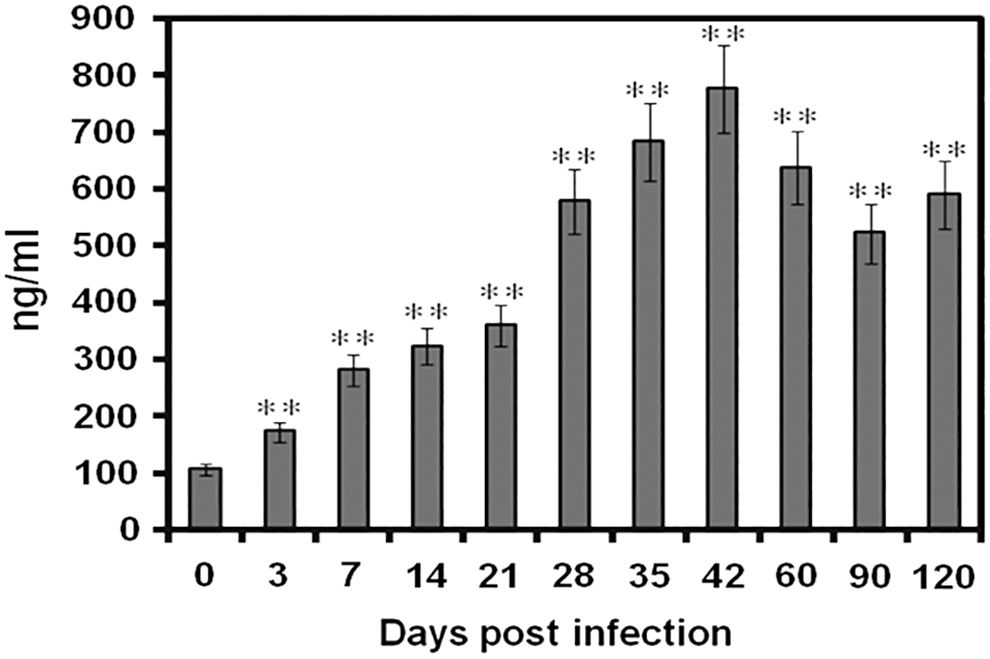
IgG serum antibody titers in Brucella abortus biotype 1-infected rats measured by IELISA against WCA of B. abortus at 0, 3, 7, 14, 21, 28, 35, 42, 60, 90, and 120 days after infection. Results are expressed as mean value of four rats ± standard deviation. Statistically significant differences of antibody titers between control and infected rats at different time points of infection are indicated by asterisks (**p < 0.001). IELISA, indirect enzyme-linked immunosorbent assay; WCA, whole-cell antigen.
ELISA antibody titers against Brucella OMP
Rats used in experiments with B. abortus developed a 3 day postinfection IgG antibody response that peaked at 71.29 ± 4.73 ng/mL. Infected rats had IgG antibody titers of 136.83 ± 1.59 ng/mL at 7 days postinfection. The IgG antibody titers then gradually rose till 90 days following infection. The highest serum IgG antibody titers were discovered 90 days following infection (1213.27 ± 9.06 ng/mL; p = 0.001). The findings of IgG antibody responses in the serum of infected rats against OMP of B. abortus biotype 1 are shown in Fig. 2.

IgG serum antibody titers in Brucella abortus biotype 1-infected rats measured by IELISA against OMP of B. abortus at 0, 3, 7, 14, 21, 28, 35, 42, 60, 90, and 120 days after infection. Results are expressed as mean value of four rats ± standard deviation. Statistically significant differences of antibody titers between control and infected rats at different time points of infection are indicated by asterisks (**p < 0.001). OMP, outer membrane protein.
ELISA antibody titers against Brucella PP
The B. abortus-specific IgG antibody response in the infected rats peaked 3 days after infection (85.98 ± 3.67 ng/mL). IgG antibody titer measurements were made beginning 14 days after infection (284.21 ± 1.6 ng/mL; p = 0.001). At 28 days following infection, the highest serum IgG antibody titers were found (930.97 ± 20.17 ng/mL; p = 0.001). The antibody titers then gradually declined until 60 days following infection. At 90 and 120 days following infection (781.24 ± 17.19 and 785.47 ± 14.44 ng/mL, respectively), the IgG antibody titers increased once more. In Fig. 3, the results of IgG antibody responses in the sera of infected rats against PP of B. abortus biotype 1 are displayed.
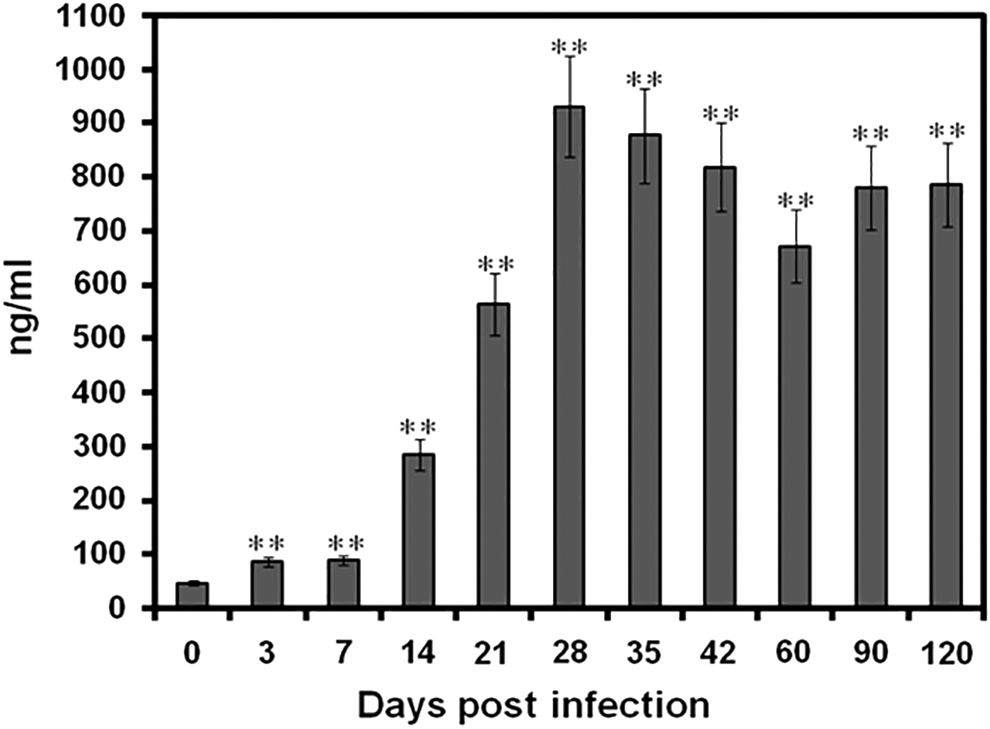
IgG serum antibody titers in Brucella abortus biotype 1-infected rats measured by IELISA against PP of B. abortus at 0, 3, 7, 14, 21, 28, 35, 42, 60, 90, and 120 days after infection. Results are expressed as mean value of four rats ± standard deviation. Statistically significant differences of antibody titers between control and infected rats at different time points of infection are indicated by asterisks (**p < 0.001). PP, periplasmic protein.
ELISA antibody titers against Brucella CP
After 3 days of infection with B. abortus in experimental rats, the IgG-specific antibody responses rose. At 7 days following infection, infected rats showed a substantial immunological response (455.12 ± 3.71 ng/mL; p = 0.001). The greatest serum IgG antibody titers were discovered at 28 days following experimental infection (p = 0.001). The IgG antibody titers thereafter stayed nearly constant till the completion of this trial. The findings of IgG antibody responses in the serum of infected rats against the CP of B. abortus biotype 1 are shown in Fig. 4.
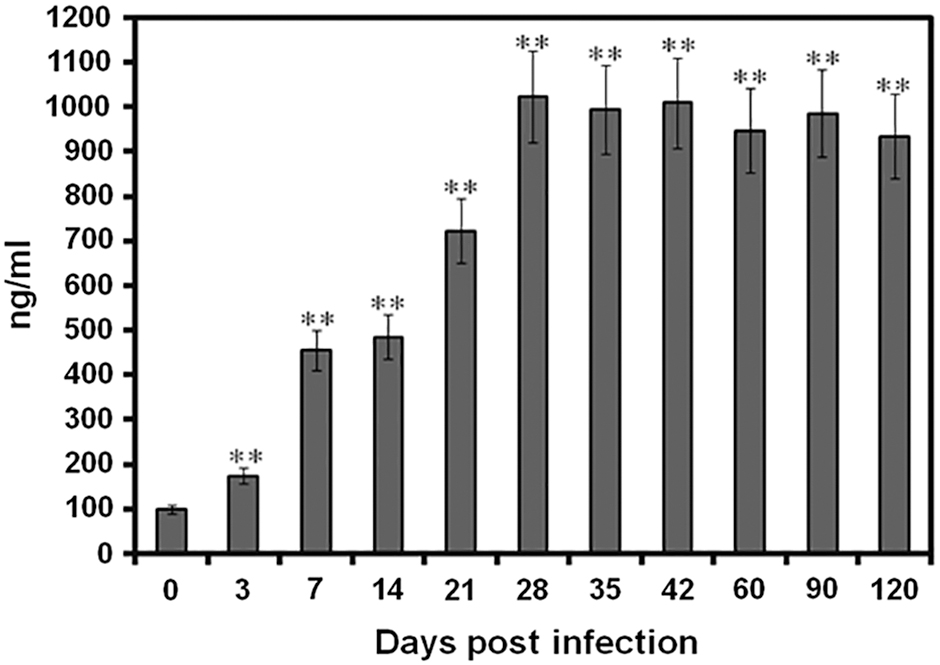
IgG serum antibody titers in Brucella abortus biotype 1-infected rats measured by IELISA against CP of B. abortus at 0, 3, 7, 14, 21, 28, 35, 42, 60, 90, and 120 days after infection. Results are expressed as mean value of four rats ± standard deviation. Statistically significant differences of antibody titers between control and infected rats at different time points of infection are indicated by asterisks (**p < 0.001). CP, cytoplasmic protein.
SDS-PAGE analysis of B. abortus biotype 1 antigens
The WCA, OMP, CP, and PP antigens from B. abortus stained with commassie blue on SDS-PAGE revealed many bands with molecular weights ranging from 10 to 250 kDa. Figure 5 shows the SDS-PAGE analysis of all B. abortus antigens.
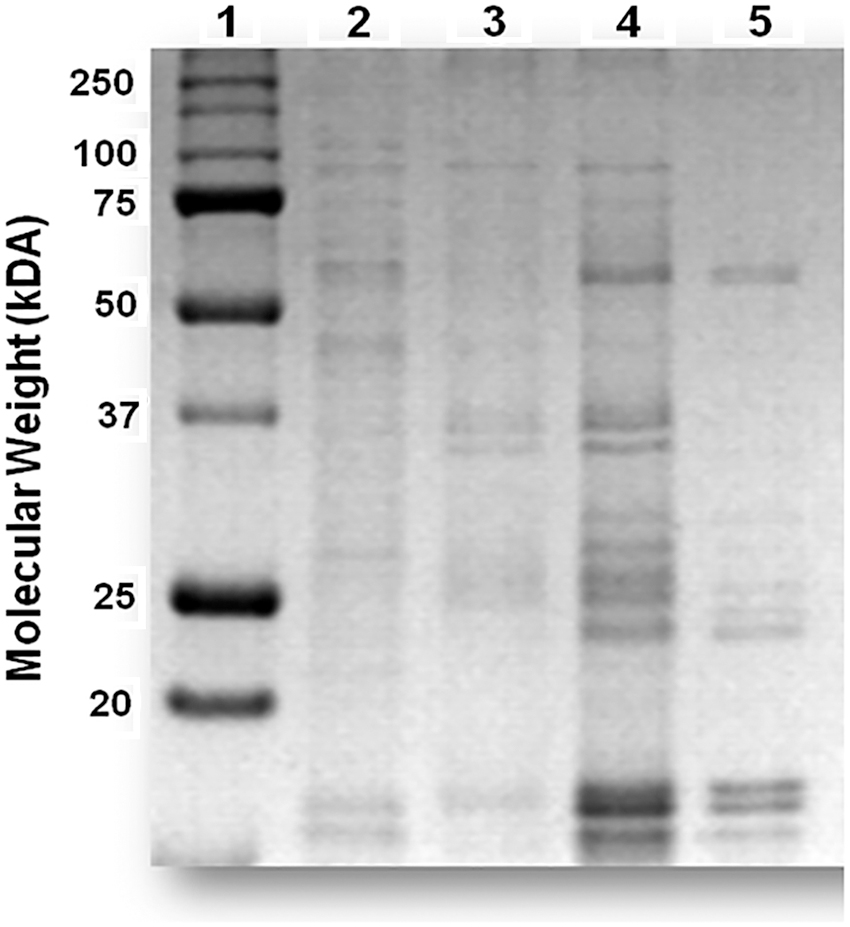
SDS-PAGE analysis of different antigens of Brucella abortus biotype 1. Lane 1: Molecular marker; Lane 2: WCA; Lane 3: OMP; Lane 4: CP; Lane 5: PP. SDS-PAGE, sodium dodecyl sulfate-polyacrylamide gel electrophoresis.
Western blot analysis of sera of rats infected with B. abortus using WCA of B. abortus
B. abortus antigens electrophoretically separated were transferred onto a nitrocellulose membrane, which displayed a wide variety of protein bands with apparent molecular weights between 10 and 98 kDa. The 24, 32, and 76 kDa proteins elicited a modest response from preinfection serum. The sera detected the 76, 32, 24, and 20 kDa proteins 3 days after infection. The 46, 24, and 10 kDa proteins were detected by the infected rats' serum 7 days after infection. Fourteen days after infection, 46, 24, and 20 kDa protein bands were seen in the serum. Twenty-one days after infection, 76, 46, 24, 20, 13, and 10 kDa proteins were reactive with sera. Sera obtained 28 days after infection responded with protein bands of 76, 53, 46, 24, 20, and 10 kDa.
Thirty-five days after infection, 98, 32, 46, 24, and 20 kDa proteins responded with sera. With sera taken at 42 days after infection, six protein bands with molecular weights of 76, 46, 40, 20, 13, and 10 kDa responded. Sixty days after infection, 76, 46, 20, 13, and 10 kDa proteins were detected in the sera. Serum samples taken 90 days after infection revealed protein bands with molecular weights of 76, 46, 22, 20, 18, 13, and 10. One hundred twenty days after infection, sera were obtained, and 76, 46, 32, 20, 18, 13, and 10 kDa proteins were reactive. The results of western blot (WB) assay are shown in Fig. 6.
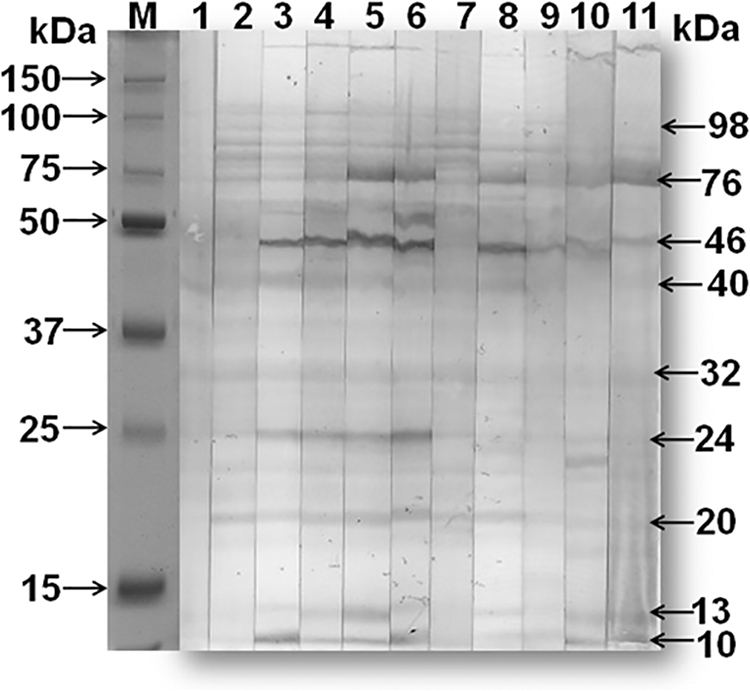
WB analysis of the rat sera using IgG against Brucella abortus WCA. M, molecular marker (kDa), Lanes 1–11, sera collected at 0, 3, 7, 14, 21, 28, 35, 42, 60, 90, and 120 days after infection with B. abortus biotype 1, respectively. WB, western blot.
WB analysis of sera of rats infected with B. abortus using OMP of B. abortus
B. abortus antigens electrophoretically separated were transferred onto a nitrocellulose membrane, which produced a wide variety of protein bands with apparent molecular weight between 13 and 95 kDa. The proteins at 95, 85, and 45 kDa only moderately interacted with preinfection sera. The sera recognized 95, 85, 63, and 35 kDa proteins 3 days after infection. At 7 days after infection, sera of the infected rats recognized 95, 85, 75, 63, 45, 39, 28, and 13 kDa proteins. Protein bands with sizes of 95, 85, 75, 63, 45, 39, 35, 28, and 13 kDa protein were found in the sera 14 days after infection. Proteins with molecular weights of 95, 85, 75, 63, 45, 39, 35, 28, 17, and 13 kDa interacted with sera collected 21 days after infection.
Sera obtained 28 days after infection reacted with protein bands of the 95, 85, 75, 63, 37, 35, 28, 17, and 13 kDa. Sera collected at 35 days after infection reacted with 95, 85, 39, 35, and 28 kDa proteins. Protein bands with molecular weight of 95, 85, 75, 63, 45, 39, 35, 28, and 13 kDa reacted with sera taken 42 days after infection. At 60 days postinfection, sera interacted with proteins of 95, 85, 75, 63, 45, 39, 35, 28, 23, 21, 17, and 13 kDa. Serum samples taken 90 days after infection showed the presence of protein bands with molecular weights of 95, 85, 75, 63, 45, 39, 35, 28, 17, and 13 kDa. Sera gathered 120 days after infection interacted with proteins of 95, 45, 39, 35, 17, and 13 kDa. The findings of WB assay are displayed in Fig. 7.

WB analysis of the rat sera using IgG against Brucella abortus OMP. M, molecular marker (kDa), Lanes 1–11, sera collected at 0, 3, 7, 14, 21, 28, 35, 42, 60, 90, and 120 days after infection with B. abortus biotype 1, respectively.
WB analysis of sera of rats infected with B. abortus using PP of B. abortus
A wide variety of protein bands with apparent molecular weight between 20 and 65 kDa were visible when B. abortus antigens electrophoretically separated onto a nitrocellulose membrane. None of the PP caused any reactions in preinfection sera. The sera recognized 30 and 20 kDa proteins 3 days after infection. At 7 days after infection, sera of the infected rats recognized 30 and 20 kDa proteins. Protein bands of 65, 30, and 20 kDa were seen in the sera 14 days after infection. Sera collected 21 days after infection reacted with 65, 30, and 20 kDa proteins. Protein bands of the 65, 30, and 20 kDa reacted with sera collected at 28 days after infection.
Sera collected 35 days after infection reacted with 65, 46, 43, 40, 32, 30, and 20 kDa proteins. Serum collected 42 days after infection reacted with seven proteins having molecular weights of 65, 46, 43, 40, 35, 32, and 30 kDa. Sixty days after infection, 65, 50, 46, 43, 40, 35, 32, 24, and 20 kDa proteins interacted with sera. In sera taken 90 days after infection, protein bands with molecular weights of 65, 50, 46, 43, 40, 35, 32, 30, 24, 20, and 15 kDa were seen. Forty-six, 30 and 20 kDa proteins reacted with sera taken 120 days after infection. The results of WB assay are shown in Fig. 8.
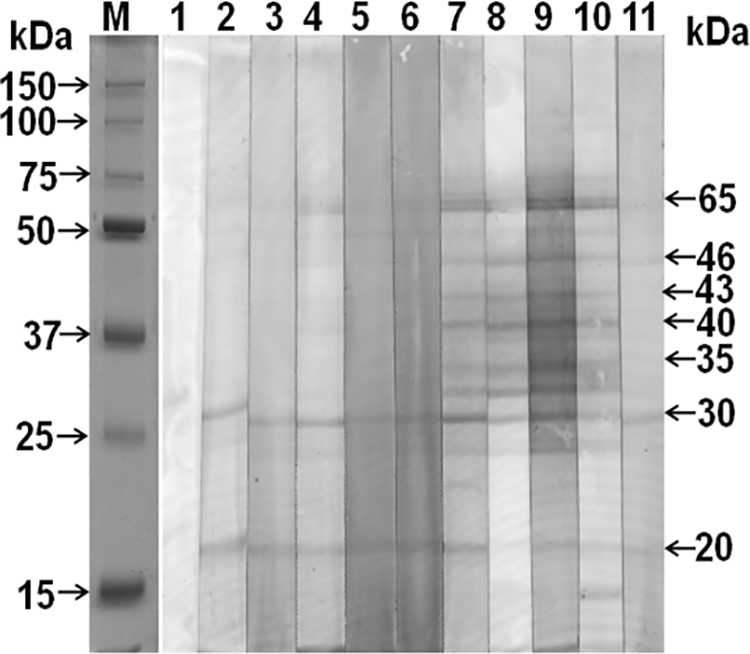
WB analysis of the rat sera using IgG against PP of Brucella abortus. M, molecular marker (kDa), Lanes 1–11, sera collected at 0, 3, 7, 14, 21, 28, 35, 42, 60, 90, and 120 days after infection with B. abortus biotype 1, respectively.
WB analysis of sera of rats infected with B. abortus using CP of B. abortus
The transfer of B. abortus antigens separated by electrophoresis onto a nitrocellulose membrane revealed a wide variety of protein bands with apparent molecular weight between 12 and 85 kDa. Preinfection sera did not react with any of the CP. Three days after infection, the 85, 68, 23, and 15 kDa proteins produced a mild reaction in the sera. At 7 days after infection, sera of the infected rats recognized 85, 68 and 12 kDa proteins. Protein bands of 85, 68, 23, 15, and 12 kDa were seen in the sera 14 days after infection. 85, 68, 23, and 12 kDa proteins were reactive with sera collected 21 days after infection. Protein bands of the 85, 68, 33, 23 and 12 kDa reacted with sera collected at 28 days after infection. The proteins 85, 68, 23, and 12 kDa reacted with sera taken 35 days after infection.
Serum samples taken 42 days after infection responded with three proteins, whose molecular weights were 85, 68, and 33 kDa. Sera at 60 days after infection reacted with 85, 23, and 12 kDa proteins. Protein bands around 60, 23, and 12 kDa molecular weight were observed in sera collected at 90 days after infection. The proteins that responded with sera obtained 120 days after infection were 85, 68, 33, 23, and 12 kDa. The results of WB assay are shown in Fig. 9.

WB analysis of the rat sera using IgG against Brucella abortus CP. M, molecular marker (kDa), Lanes 1–11, sera collected at 0, 3, 7, 14, 21, 28, 35, 42, 60, 90, and 120 days after infection with B. abortus biotype 1, respectively.
Discussion
Characterization of Brucella protein antigen using hyper immune antisera of Brucella is important for development of subunit vaccine as well as diagnostic methods of brucellosis using the protein antigens. The use of one or a mixture of physicochemically characterized protein antigens in humoral test can improve the diagnosis by preventing cross-reaction. The current understanding of immune response and antigen recognition of B. abortus has been arisen from the studies in the human, cattle and mouse model of experiments. There is almost no information about humoral immune responses and cognate antigen detection during the acute and subacute course of infection of SD rats with B. abortus biotype 1. Therefore, the present study was undertaken to measure the IgG-specific humoral immune responses and cognate antigen detection against WCA, OMP, PP, and CP of B. abortus biotype 1 in acute and subacute stages of infection in SD rats.
The cellular and humoral immunity in Brucella infection has always been a matter of interest for the researchers. Brucellosis research is currently focused on the identification of non-LPS antigens that could potentially be useful for the specific serologic diagnosis of brucellosis (Letesson et al., 1997). ELISA targeting CP (Hemmen et al., 1995), PP (Cloeckaert et al.,1992; Rossetti et al., 1996), or OMP (Cloeckaert et al., 1990; Zygmunt et al., 1994) and CBP (Onate et al., 2003) has been described as a means to improve the diagnosis of bovine brucellosis. However, usefulness of antigens other than LPS for the differential diagnosis of brucellosis has not been investigated in free-ranging wildlife such as rat.
Little is known about the relevance of Brucella proteins in the immune response. To the best of our knowledge this the first report of homoral immune response and cognate antigen recognition of non–LPS antigens such as WCA, OMP, CP, and PP of B. abortus biotype 1 in the SD rat model.
B. abortus is a gram-negative, intracellular parasite, thus immune responses may be directed to surface and internal proteins, depending on the processing of the bacteria by macrophages (Rossetti et al., 1996). This study evaluated IgG-specific humoral immune responses against these proteins by using sera from B. abortus-infected rats. Several Brucella proteins have been described as targets of the humoral immune response (Baldi et al., 1996; Goldbaum et al., 1992; Gomez-Miguel et al., 1988; Limet et al., 1993; Zygmunt et al., 1992). Four proteins such as WCA, OMP, PP, and CP were selected and evaluated their potential use for the serologic diagnosis of brucellosis in rats.
In this investigation, maximal IgG antibody titers were observed 42 days after infection. Serum IgG antibody against the WCA of B. abortus was evaluated by ELISA and shown a substantial response at 3 days after infection. In addition, it was discovered that the IgG antibody titers were much greater in the sera obtained after subacute infection, suggesting that WCA could be helpful for diagnosing both acute and subacute brucellosis in the SD rat model. The present study demonstrated a delayed serum IgG antibody response against OMP of B. abortus. The highest anti-OMP IgG antibody titers were recorded in sera at 90 days after infection. The serological data of this experiment indicated that OMP antigens could be useful for diagnosis of subacute brucellosis. These results are in agreement with Letesson et al. (1997) who also recorded delayed antibody response against OMP when compared to the antismooth LPS (S-LPS) response.
Animal and human brucellosis were both diagnosed by Rossetti et al. (1996) using PP of B. abortus. In the present study, the total serum IgG antibody titers of B. abortus-infected rats when measured against PP of B. abortus, the highest IgG antibody titers were noted at 28 days after infection. Although anti-PP IgG antibody titers gradually decreased after 28 postinfection, the titers were found to be significantly higher during subacute stages of infection. The pattern of anti-PP IgG antibody responses recorded in this study suggested that this antigen could be useful for diagnosis of both acute and subacute brucellosis.
The CP used as an antigen for serologic tests have been shown to allow discrimination between active and inactive human brucellosis (Goldbaum et al., 1992). In this experiment, ELISA detecting serum IgG antibody response in B. abortus-infected rat sera against CP of B. abortus noted gradual rising of IgG antibody titers from 3 days after infection. The peak IgG antibody titers reached at 28 days after infection. The IgG antibody titers were found to be almost same level during subacute brucellosis when compared to antibody titer in acute brucellosis at 28 days after infection.
Baldi et al. (1996) investigated the humoral immune responses to total CP of Brucella and to the 18-kDa protein have been measured during the course of infection in cattle and found this antigen useful for differential diagnosis of bovine brucellosis. The IgG antibody responses in this study indicated that the CP of B. abortus in the ELISA might be useful for the specific detection of Brucella-infected animals during acute and subacute stages of brucellosis.
We investigated total serum IgG antibody response by ELISA against B. abortus biotype 1 using CBP during the course of infection. IgG antibody response was detected at 3 days after infection (Khatun et al., 2009b). Beh (1973) observed IgG antibody responses in cattle 7 days after B. abortus infection. When brucellosis is acute, the serum IgG response is initially low, but as the infection worsens, the IgG antibody titers rise. In this study, the serum IgG antibody response measured by ELISA showed maximal antibody titers at 42 days after infection. Although IgG antibody titers gradually decreased from 42 days after infection until the end of the experiment but remained at significantly higher level during subacute brucellosis.
Similar pattern of IgG antibody responses to B. abortus under experimental conditions have previously been documented in BALB/c mice by High et al. (2007). Contrarily, the IgG antibody responses to B. abortus in cattle peaked 28–42 days after infection and then began to drop (MacMillan, 1990).
In this experiment, protein fractions of B. abortus were used in ELISA to investigate the reactivity of the sera collected from B. abortus-infected rats during acute and subacute brucellosis. The application of molecular biology techniques will be crucial in resolving this issue because fractionated proteins from B. abortus are constantly contaminated with the bacterial LPS (Lindler et al., 1996), making it challenging to understand their significance in the host-parasite connection. The Brucella cell envelope is a three-layered structure, in which an inner or cytoplasmic membrane, a periplasmic space, and an outer membrane can be differentiated (Cloeckaert et al., 1990). The immunoreactive proteins of Brucella spp. that may serve as diagnostic antigens for human or animal brucellosis have been identified using the WB assay (Letesson et al., 1997).
Among the immunodominant Brucella antigens identified by WB, some belong to the cell envelope and correspond to both major OMPs (25–27 and 36–38 kDa) and minor OMPs (10, 16.5, 19, and 89 kDa) (Letesson et al., 1997). Several immunoreactive bands (39, 50 and 20 kDa) were identified in cytoplasmic extracts by WB analysis (Zygmunt et al., 1990).
In the current study, WB analysis was performed with sera from rats with acute, subacute brucellosis and negative controls using WCA, OMP, PP, and CP of B. abortus biotype 1 to identify the immunoreactive antigens. In the WB experiment, a variety of immunodominant proteins from the whole cell of B. abortus responded with the IgG antibody present in the serum of rats during acute and subacute brucellosis. Based on the frequency and intensity of recognition, immunoreactive protein bands of WCA with molecular weight of 76, 46, 20, 13, and 10 kDa could be useful for diagnosis of both acute and subacute brucellosis in rats. The analysis of the sera of rats by WB assay using OMP of B. abortus revealed multiple immunoreactive protein bands. Sera of rats during acute infection commonly reacted with protein bands with molecular weight of 95, 85, 75, 63, 45, 28, and 13 kDa.
On the contrary, protein bands with molecular weights of 95, 85, 45, 39, 35, 17, and 13 kDa were commonly recognized by rat sera during subacute infection. WB analysis of sera sample against PP commonly recognized protein bands of molecular weights of 65, 46, 43, 40, 32, 30, and 20 kDa during acute infection. In contrast, 46, 30, and 20 kDa protein bands were commonly seen in PP during subacute brucellosis in rats by WB analysis. The sera of B. abortus-infected rats during acute infection commonly reacted with the protein bands at the molecular weight of 85, 68, 33, 23, and 12 kDa by WB assay using CP of B. abortus.
In this study, a few bands were weakly recognized by preinfection sera collected at 0 day after infection. Cross-reactivity and background binding were documented especially when soluble antigens were utilized (Dubey et al., 1996; Harkins et al., 1998; Nishikawa et al., 2002; O'Handley et al., 2002). Data of this study suggest that the antiprotein antibody responses were heterogeneous among infected animals and that only specific Brucella proteins could lead to a satisfactory diagnostic test (Hemmen et al., 1995; Limet et al., 1993; Tabatabai and Hennager, 1994).
Conclusion
The results of this investigation led to the conclusion that immunodominant proteins found in WCA, OMP, PP, and CP could be helpful for ELISA and WB assay-based B. abortus infection diagnosis in free-ranging wildlife, such as rats.
Footnotes
Acknowledgments
This study was a component of the PhD research work at the Chonbuk National University. The authors expressed gratitude to the Islamic Development Bank (IDB), Saudi Arabia for providing the funding necessary to complete the study.
Authors' Contributions
M.M.K. and M.A.I. carried out animal experiment, collected and processed the samples, and conducted ELISA and western blotting; M.M.K. and M.A.I. wrote the article; B.K.B. evaluated the article. All authors have reviewed and approved the article.
Author Disclosure Statement
The authors have no conflict of interest to declare.
Funding Information
This work was supported by the IDB, Saudia Arabia (Grant No. 4/BD/P27).