




Abstract
Background:
Although Brucella abortus, Brucella suis, and Brucella canis may infect humans and dogs worldwide, no study to date has assessed and compared owners and their dogs between island and mainland seashore areas.
Materials and Methods:
Accordingly, the study herein has applied serological tests, including Microplate Agglutination Test with 2-Mercaptoethanol, immunochromatographic assay, and Rose Bengal Test, and a Brucella genus-specific PCR assay to 195 owners and their 148 dogs living on 1 mainland seashore area and three nearby oceanic islands of southern Brazil.
Results:
No seropositivity to B. abortus and B. suis was detected in owner or dog sera. Anti-B. canis seropositivity was observed in 3/148 (2.0%) dogs, but no owner sample was seropositive to B. canis. In addition, all blood samples from both owners and dogs were negative on Brucella genus-specific PCR assay.
Conclusions:
The seropositive dogs were not related and lived on the seashore mainland area of Guaraqueçaba city. The absence of seropositivity on the islands and the low seropositivity on the seashore mainland could be attributed to geographic isolation, and suggest the low impact of the disease in the region. Despite being a zoonotic disease, brucellosis by B. canis is not included in the National Program for Control and Eradication of Brucellosis, and its diagnosis and notification are not mandatory. The presence of seropositive dogs highlights the risk to human health and the importance of epidemiological surveillance actions in the region, as well as the need for the implantation of preventive measures to avoid the transmission of the pathogen.
Introduction
Dogs were probably the first animal species to be domesticated, approaching early human owners in search of food and shelter, but since then playing a growing role in human life due to labor and emotional reasons (De Souza Cabral and Savalli, 2020; Wallach, 2022). Although the establishment of human–animal bond has provided mutual benefits throughout time, interaction has also increased the risk of zoonotic disease transmission (Lima et al., 2022), particularly brucellosis (Hull and Schumaker, 2018).
Brucellosis has been caused by gram-negative bacteria of the Brucella genus and several species, causing a variety of clinical signs in humans and reproductive disorders in animals, with still undetermined importance of certain species on human and animal health (El-Sayed and Awad, 2018; Hördt et al., 2020). Although having a preferred host, Brucella species have been considered as nonspecies specific, and infect other host species through direct or indirect contact with infected animals (Hull and Schumaker, 2018).
Domestic animals have been reportedly indicated as preferential hosts of Brucella melitensis (goats and sheep), Brucella suis biovar 1 and 3 (pigs), Brucella abortus (cattle and buffaloes), Brucella ovis (sheep), and Brucella canis (dogs) (El-Sayed and Awad, 2018; Hull and Schumaker, 2018; Sousa et al., 2017). Considering classical Brucella species, humans and dogs can be infected by B. melitensis, B. suis, B. abortus, and B. canis (Greene and Carmichael, 2015; Lawinsky et al., 2010), with B. melitensis never been reported in Brazil (Megid and Mathias, 2016).
Human brucellosis has been mostly caused by B. suis and B. abortus and considered primarily an occupational disease, affecting workers in contact with infected livestock and their contaminated tissues (Lytras et al., 2016; Pereira et al., 2020). Besides work exposure, foodborne infection by consumption of contaminated products of animal origin has been another important route of transmission (Lytras et al., 2016). Dogs may also be infected with B. abortus or B. suis through contact with infected livestock, and their products or secretions (Mor et al., 2016; Xavier et al., 2009). Nevertheless, the disease has been considered underdiagnosed, under-reported, and neglected, according to international health organizations (Corbel et al., 2006; Lawinsky et al., 2010).
Although B. canis has been well known as the agent of canine brucellosis, bacteria can also infect humans during human–animal interaction (Santos et al., 2021). The pathogen transmission between dogs has been usually associated with reproduction, mostly by breeding and contact with aborted fetuses and vaginal discharge, but also with biological fluids including blood, semen, and urine (Hensel et al., 2018; Santos et al., 2021). Despite the zoonotic potential being often neglected and under-recognized, humans have been also susceptible to B. canis infection through direct or indirect contact with infected dogs and their contaminated secretions (Hensel et al., 2018; Santos et al., 2021).
Underdiagnosis of human brucellosis may also be attributed to nonspecific symptomatology and the lack of serological crossreactivity between smooth (e.g., B. abortus) and rough (e.g., B. canis) strains (Hensel et al., 2018; Hull and Schumaker, 2018). Accordingly, this study has aimed to investigate Brucella species, including B. suis, B. abortus, and B. canis in seashore mainland and oceanic islands of southern Brazil, using serological testing and a Brucella genus-specific PCR.
Materials and Methods
Ethics
This study was approved by the Ethics Committee in Human Health at the Brazilian Ministry of Health (protocol 46994521.0.0000.0102) and the Ethics Committee of Animal Use of the Federal University of Parana (protocol No. 036/2021).
Study design
The study herein was a cross-sectional, serological, and molecular study aiming to investigate the occurrence of B. abortus, B. suis, and B. canis in owners and their dogs living on oceanic islands and seashore mainland city of Paraná State, southern Brazil, conducted from December 2019 through February 2020.
Local of study
This study was conducted on three oceanic islands, named Ilha do Mel, Superagui, and Peças, considered as environmentally protected conservation units and the seashore mainland area of the Guaraqueçaba city, all of them located in the Paraná State, southern Brazil (Table 1 and Fig. 1). The main sources of income were tourism (Ilha do Mel Island), fishing, and craft activity (Superagui Island and Peças Island), although ecological tourism has increased in the last few years, neither island has adequate infrastructure for health, education, basic sanitation, difficult accessibility, or other services. In addition, most supplies were shipped from the mainland at the time (Delai et al., 2021; Freitas et al., 2022).
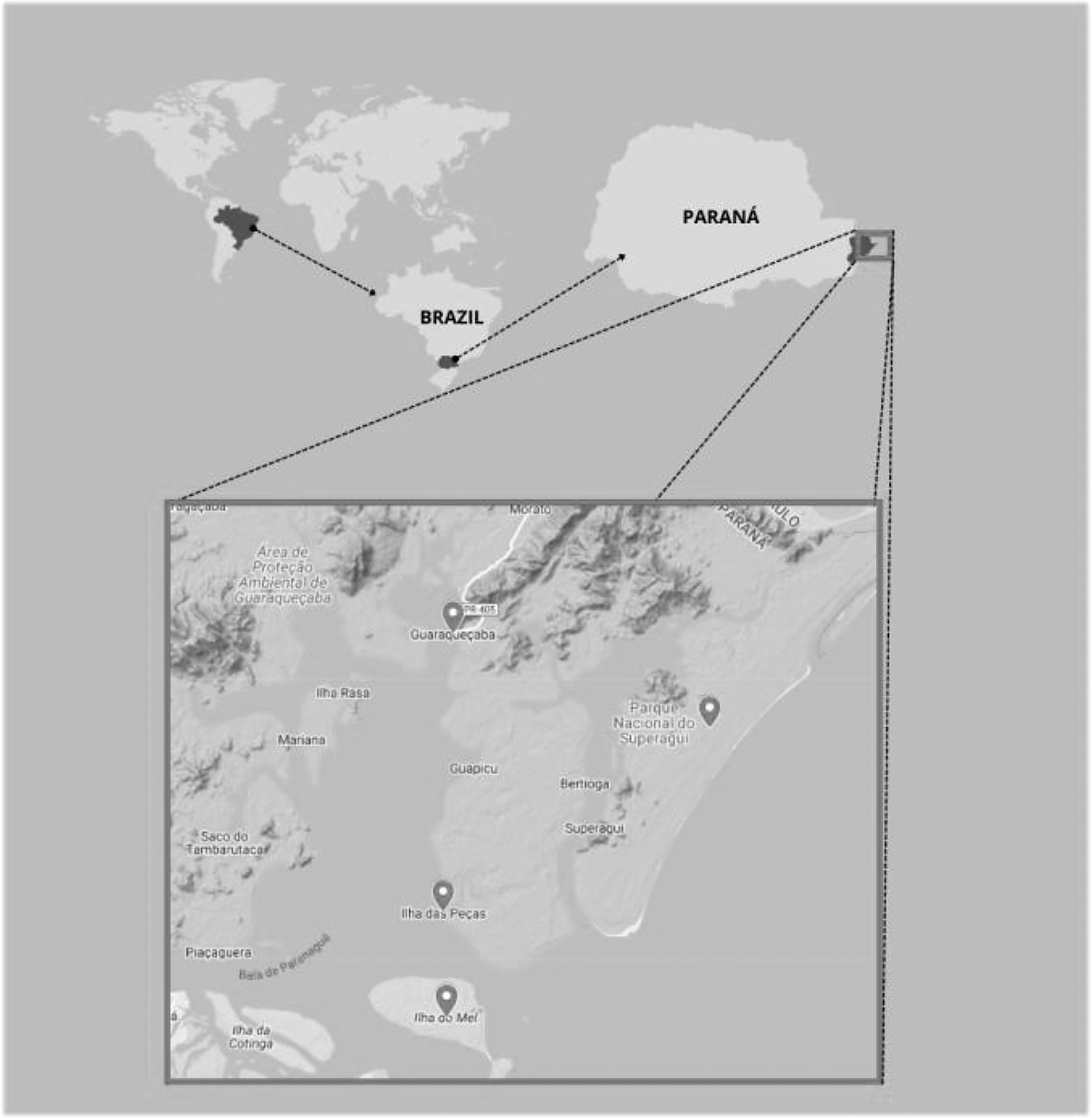
The study area location. The maps were created with
Coordinates, Total of Human Population, and Number of Samples of Dogs and Humans, Collected in Each Locality
Considered only inhabitants of the mainland port area, as Guaraqueçaba city had an overall estimated 7594 inhabitants at the time.
The seashore area of the Guaraqueçaba city, also an area of environmental preservation and semi-isolated, due to difficult land and sea access, was sampled for mainland comparison (Delai et al., 2021; Freitas et al., 2022). All sampled sites were located within the largest continuous remnant of Atlantic Forest in Brazil.
Blood sample collection
Owners and dogs were selected for convenience, during actions of population management of domestic animals developed by the “One health boat” volunteer project in the above-cited areas. Dog owners were informed about the research when brought their dogs to be cared for in the project, and blood samples were collected from owners and their dogs, after agreeing to participate in the study. People who have contact with dogs, but do not own them, were also sampled. Blood samples were collected aseptically using alcohol (70%) by cephalic venipuncture in owners and by external jugular venipuncture in dogs. Each blood sample was placed in two sterile vacuum tubes, one containing ethylenediaminetetraacetic acid (EDTA) and another containing a serum separator gel.
EDTA blood samples were frozen at −80°C. Whole blood samples in tubes containing separator gel were kept at room temperature (25°C) until clot retraction, centrifuged at 800 g for 5 min to separate serum, and then, only the serum was kept at −20°C until processing. All sera collected from owners (n = 195) and their dogs (n = 148) were submitted to serological tests (RBT—Rose Bengal Test and 2ME-MAT—Microplate Agglutination Test with 2-Mercaptoethanol). Sera with a titer equal to 20 (n = 49) or higher, in the 2ME-MAT test, were submitted to a standardized immunochromatographic assay and a molecular test (Brucella genus-specific PCR).
Serological tests
Serological tests that use cell wall antigens do not show crossreaction between smooth and rough Brucella species, demanding specific tests for each strain type (Hensel et al., 2018). This was taken into consideration in the methodology of this study.
To detect anti-B. abortus and anti-B. suis antibodies, the qualitative RBT was performed following the recommendations of the World Organization for Animal Health (WOAH) (WOAH, 2022). The antigen used consisted of an inactivated suspension of B. abortus strain 1119-3, stained by Rose Bengal, and diluted 8.0% in buffer solution (pH 3.65) (Brasil, 2006).
To detect anti-B. canis antibodies, an association of the 2ME-MAT and the immunochromatographic assay was used (Barbuddhe et al., 2020; De Massis et al., 2021).
The 2ME-MAT was performed according to the protocol of the Agence Nationale de Securité Sanitaire de L'Alimentation, de L'Eenvironnement et du Travail (ANSES, Maisons-Alfort, France), which is the National/European Union/WOAH reference laboratory for brucellosis. The assay used B. canis antigen and was conducted in six dilutions from 1:20 to 1:640. Sera with an agglutination titer ≥20 were considered reagents, conforming to a previous study (De Massis et al., 2021).
The immunochromatographic assay was performed according to the manufacturer (Anigen Rapid C.Brucella Ab Test Kit; Bionote, Inc.), and B. canis antigens were used as a capture and detector in the assay (BIONOTE, 2023.). A tested sample was considered positive for B. canis in the present study when reagent in both 2ME-MAT and immunochromatographic assay.
Molecular tests
Conventional PCR was chosen for detection of the genus Brucella. A pool of two samples of the same species (human or canine) and the same location was used to reduce expenses. When grouping in pairs was not possible, because the total sampled was not an even number, the samples were tested individually. Whole blood samples were used for genomic DNA extraction according to the manufacturer's protocol (Wizard Genomic DNA Purification Kit—Promega Corporation®).
DNA amplification was performed using a specific set of primers designed to detect Brucella spp. (ITS66: ACA TAG ATC GCA GGC CAG TCA and ITS279: AGA TAC CGA CGC AAA CGC TAC), according to previously described methodology (Keid et al., 2007). The samples were analyzed by electrophoresis in a 1.5% agarose gel, and then stained with SYBR® Safe DNA gel stain (S33102).
Data collection
A questionnaire was applied to people who agreed to participate in the study (n = 195). Owners were asked to answer about their own gender, age, education level, dog ownership, household income, and address, along with the gender, age, breed, and origin of their dogs. Inconsistencies in the information provided by the owners were disregarded in the analysis. Data were correlated to positive serological results.
Results
A total of 195 human samples were collected, with 101/195 (51.8%) from islands and 94/195 (48.2%) from seashore mainland. All samples were seronegative or negative to B. abortus, B. suis, or B. canis.
Most of the people who participated in the study were women, with secondary education or higher, earned more than one minimum wage per month, were dog owners, and did not eat raw or undercooked meat. Although a minority, those who consumed raw or undercooked meat ate, among other meats, beef, pork, and game meat (Table 2).
Characteristics of the Human Sampling Population
Eat raw or undercooked meat of beef (n = 61), pork (n = 15), poultry (n = 15), fish (n = 36), or game meat (n = 3).
A total of 148 dog samples were collected, with 58/148 (39.2%) from islands and 90/148 (60.8%) from seashore mainland. For serological tests, 3/148 (2.0%) dogs from mainland area were seropositive to B. canis, and all were seronegative for B. abortus or B. suis. All samples were negative for Brucella genus-specific PCR assay. The sampled owners of B. canis seropositive dogs were seronegative, but there are uninvestigated contacts whose serological status is unknown (Table 3).
Characteristics of Seropositive Dogs
Most of the sampled dogs were mixed breed, female adults, adopted, rescued, or gifted to their owners. Few had access to the street or the forest, and consumed raw or undercooked meat, including beef, pork, and game meat. In contrast, the majority hunted animals, including wild swine (Table 4).
Characteristics of the Dog Sampling Population
Eat raw or undercooked meat of beef (n = 32), pork (n = 8), poultry (n = 16), fish (n = 11), or game meat (n = 1).
The animals hunted are rodents, birds, lizards, possums, insects, wild pigs (Pecari tajacu), cats, snails, geese, bats, hedgehogs, snakes, anteaters, and wild birds (Penelope spp.).
Discussion
To our knowledge, the study herein compares for the first time Brucella spp. exposure and infection in humans and their dogs from islands and seashore mainland.
In this study, all human sampled were seronegative and negative for Brucella spp., diverging from the estimated prevalence of 15.53% in the general population worldwide (Khoshnood et al., 2022). Cattle have been the predominant hosts of B. abortus, while pigs for B. suis (biovar 1 and 3) (El-Sayed and Awad, 2018; Hull and Schumaker, 2018; Sousa et al., 2017). The bacteria can be transmitted from infected animals to humans by direct or indirect contact with those animals or their products (Tuon et al., 2017).
Human brucellosis caused by this species was primarily an occupational disease of those working with infected animals, their contaminated biological material, or attenuated anti-Brucella vaccines (Pereira et al., 2020). Another form of transmission, more important for people without the occupational risk of the disease, has been through the consumption of contaminated animal products, especially unpasteurized milk and dairy products (Lytras et al., 2016). The owners sampled herein were not part of the risk group for occupational brucellosis, as they work primarily with handcrafts, fishing, and tourism (Delai et al., 2021; Freitas et al., 2022).
Moreover, the authors speculate that geographic isolation makes the informal trade of milk and dairy products difficult. They believe that the inhabitants of these locations consume milk and derivatives processed by the industry, such as (ultra-high-temperature) UHT or pasteurized milk and commercialized in local markets. This dynamic was even more pronounced on the Islands, as it requires transport by sea, which makes the logistics of transporting perishable products even more complex.
In addition, although some owners eat raw or undercooked meat from cattle (61/193) and pigs (15/193), none of them tested positive to B. abortus or B. suis, indicating the low impact of the disease in owners living in the region. Thus, despite the presence of backyard livestock, human reports of close contact with their dogs, and hunting habits, the negative results herein suggest the low circulation of Brucella spp. in such areas.
The dog seropositivity (3/148; 2.0%) was within the worldwide seroprevalence range for B. canis from 1% to 28% (Hensel et al., 2018). B. canis has been recognized as the most common species, which infects dogs and represents human relevance due to their close contact with owners (Santos et al., 2021). Dog-to-dog transmission occurs predominantly through breeding and contact with the reproductive secretions (placenta, fetal tissues, and vaginal discharges resulting from abortion) of an infected animal because of the great number of bacteria eliminated on those (Greene and Carmichael, 2015).
Dogs can also shed bacteria in their blood, milk, nasal secretions, and urine, but infections through contact with those biological materials have been less common (Cosford, 2018; Greene and Carmichael, 2015; Hensel et al., 2018; Megid and Mathias, 2016). In addition, stray and non-neutered dogs may be more likely to be seropositive than owned dogs (Hensel et al., 2018). Although a relatively low seroprevalence was found herein for dogs, results highlighted a potential spillover that could lead to human infection, as canine brucellosis may present higher burden and intermittent pattern in stray or roaming dog populations, as previously reported (Hensel et al., 2018).
Dog-to-human transmission may occur through direct contact with infected dogs or their contaminated secretions, and has been estimated that only 1% of diagnosed human brucellosis has been due to B. canis (Angel et al., 2012; Santos et al., 2021). Although underestimated, transmission to humans has been considered occasional and usually associated with close contact with dogs, affecting especially kennel keepers and owners of sick or asymptomatic carrier dogs (Rodrigues et al., 2017; Suzuki et al., 2008). However, dog-to-human transmission may not occur because humans have been relatively resistant to B. canis infection (Greene and Carmichael, 2015).
Dogs closely associated with infected livestock or wildlife occasionally can be infected with B. abortus or B. suis (Mor et al., 2016; Mortola, 2019). Foodborne infection can also occur, especially through the consumption of raw milk and uncooked meat (Mor et al., 2016; Wareth et al., 2017). Although hunting habits and intake of raw or undercooked meat were respectively recorded in 61.3% (84/137) and 26.5% (39/147) dogs herein, no seropositivity or positivity for B. abortus or B. suis were reported.
The results herein corroborate with another study conducted on Fernando de Noronha Island, Pernambuco State, northeast Brazil (de Almeida et al., 2022). Apparently, the sampled dogs, just like their owners, were not related to infected livestock, and probably have not ingested contaminated animal products or derivates. Therefore, infection with those Brucella species was unlikely.
Laboratory tests have been essential for the definitive diagnosis of brucellosis, due to the nonspecific symptomatology of this disease (Hull and Schumaker, 2018; Santos et al., 2021). In case of infection with Brucella spp., the isolation and identification of the agent considered the gold standards for diagnosis. However, this may be a risky procedure considering its zoonotic potential for laboratory personnel, and false negative results were common due to the difficulties in this test that lead to low sensitivity (Cosford, 2018; De Massis et al., 2022; Santos et al., 2021). For those reasons, serological tests were usually used in the surveillance of human and animal brucellosis (Hensel et al., 2018; Hull and Schumaker, 2018).
The PCR test did not detect Brucella spp. DNA in the blood of seropositive individuals. The nonagreement between serological and molecular test results can be explained by the absence of bacteremia during blood collection. Bacteremia in B. canis infection is prolonged, but intermittent, and usually disappears in chronic infections, so the agent may not be recovered from the blood (Fernandes et al., 2013). Seroconversion, without detection of bacterial DNA, could be explained by a competent immune response to a pathogenic challenge, usually mediated by T helper 1 lymphocytes (Cosford, 2018).
Another possibility was that the results were false positives, due to nonspecific and specific crossreactions with shared surface antigens on other microorganisms, particularly gram-negative bacteria (Cosford, 2018; De Massis et al., 2022; Kauffman and Petersen, 2019; Mol et al., 2020). Due to the possibility of false positive results (Santos et al., 2021), the association of serological tests, as suggested in another study (De Massis et al., 2021), was used here with the aim of the greater reliability of the results. In view of the potential of zoonotic transmission and the risk of disease spreading in the dog population, the positive results cannot be ignored. Ideally, a follow-up investigation in the family of the seropositive dogs should be conducted.
Study Limitations
At the time of sample collection and application of the questionnaire, a different set of zoonotic pathogens were aimed, and only after it was decided to expand the number of infectious agents investigated, which were also relevant in public health, as Brucella. For this reason, the questionnaire did not include essential questions about the risk factors for brucellosis that could elucidate the present result. Besides that, the return to the areas where samples were collected was not feasible at the time due to logistics and a lack of financial resources. Other limitations of this study were using a convenience sample, which could result in biased results, and using a pool of two samples in the PCR assay, as it could reduce the test sensibility.
Conclusions
This study showed the absence of seropositivity to B. abortus and B. suis in owners and dogs, besides the absence of seropositivity to B. canis in owners, and low seropositivity in their dogs. Nevertheless, no active infection was confirmed by PCR test. All the seropositive dogs lived on the seashore mainland area (Guaraqueçaba city), although they were not related. The absence of seropositivity on the islands and the low seropositivity on the seashore mainland could be attributed to geographic isolation, and suggest the low impact of the disease in the region. Despite the absence of seropositive owners, the presence of seropositive dogs highlights the importance of epidemiological surveillance actions in the region and the need for the implantation of preventive measures to avoid the transmission of the pathogen.
Footnotes
Acknowledgment
This research was part of a master's thesis of N.L.C.B. (Master of Preventive Veterinary Medicine, São Paulo State University [UNESP] on April 26, 2023;
Authors' Contributions
A.W.B., C.M.A., J.M., R.R.D., A.R.F., N.L.C.B., and A.F.V. contributed to conception and design of the study. N.L.C.B. organized the database. N.L.C.B. wrote the first draft of the article. A.W.B., C.M.A., J.M., R.R.D., A.R.F., N.L.C.B., L.B.K., C.T.P., M.L.R., W.S.R.T., C.P., and A.F.V. wrote sections of the article. All authors contributed to article revision, read, and approved the submitted version.
Author Disclosure Statement
The authors declare that the research was conducted in the absence of any commercial or financial relationships that could be construed as a potential conflict of interest.
Funding Information
This study was financed in part by the Coordenação de Aperfeiçoamento de Pessoal de Nível Superior—Brasil (CAPES)—Finance Code 001.