




Abstract
Background:
Leishmaniasis is a zoonotic protozoan infection which is endemic in parts of Europe. Dogs are commonly affected by Leishmania infantum and are regarded as the main reservoir for humans' infection. Sporadic human cases are reported annually, mainly from the endemic south part of Bulgaria. However, no recent data on canine leishmaniasis geographical distribution in Bulgaria have been published. The aim of this study was to investigate the current seroprevalence rate of L. infantum in stray dogs from areas where this infection was not previously reported.
Results:
The estimated overall seroprevalence rate was 8.3% (95% confidence interval [CI]: 2.6–14.0) with no significant difference between the two examined districts [χ 2 (1, N = 90) = 0.32, p = 0.69]. In Sofia, the seropositivity was 7.2% (95% CI: 0.9–13.5) and in Sofia (stolitsa) 11.0% (95% CI: 0–23.0). No association between sex and serological status [χ 2 (1, N = 90) = 1.83, p = 0.27] and age and seropositivity [χ 2 (2, N = 90) = 1.98, p = 0.52] was detected. High levels of antibodies (fourfold increase from the assay's cut-off) were observed in half of the positive dogs.
Introduction
Leishmaniasis is a protozoan infection caused by Leishmania species parasites, transmitted by infected female Phlebotominae (Diptera, Psychodidae) sandflies (Akhoundi et al., 2016). The range of susceptible species is broad and includes humans, dogs, and rodents. Although the infection is endemic in more than 98 countries (Gradoni et al., 2017), and at least 1,500,000 new human cases occur every year (Torres-Guerrero et al., 2017), leishmaniasis is classified as a neglected tropical disease by the World Health Organization (WHO). In the European region, three entities of Leishmania species are identified in human cases, namely Leishmania infantum, Leishmania major, and Leishmania tropica with L. infantum infection the most prevalent one. Dogs are commonly affected by L. infantum and are regarded as the main reservoir for humans' infection (Morales-Yuste et al., 2022). Canine leishmaniasis' (CanL) clinical symptoms range from asymptomatic infection to multisystemic severe disease.
Despite the increasing trend in the number of human visceral (VL) and cutaneous leishmaniasis (CL) observed globally at the end of the 20th century, the spread of the infection among the canine population remains unknown and the majority of the affected dogs are detected when clinical symptoms are present (Ruiz-Postigo et al., 2022).
Sporadic cases of human VL are reported annually, mainly from the endemic south part of Bulgaria, where CanL is also present (Harizanov et al., 2013; Tsachev et al., 2010). However, no recent data on CanL geographical distribution in Bulgaria have been published.
The aim of this study was to investigate the current seroprevalence rate of L. infantum in stray dogs from areas where CanL was not previously reported.
Materials and Methods
Ninety (n = 90) dogs from two nonendemic districts (Sofia = 64 and Sofia [stolitsa] = 26) were sampled during neutering campaign. All animals were clinically healthy at the time of the sampling (from May to June 2022). Date of sampling, location, sex, breed, age, and health status were recorded for each dog. The age of the animals was determined by dental examination performed by the surgeons who participate in the campaign. Serum was obtained following centrifugation at 1500 g for 15 min and stored at −20°C until analysis.
Serum samples were tested for presence of L. infantum antibodies with commercial enzyme-linked immunosorbent assay (ELISA) following manufacturer's protocol (ID Screen® Leishmaniasis Indirect; IDvet, France). Briefly, diluted serum samples were distributed in 96-well plates, precoated with purified L. infantum antigen. After incubation for 45 min at 37°C, plates were washed and anti-dog immunoglobulin G horseradish peroxidase (HRP) conjugate was added to each well. Plates were incubated for 30 min at 37°C and washed before adding 3,3′,5,5′- Tetramethylbenzidine (TMB) substrate solution. The colorimetric reaction was terminated by stop solution, and plates were read at 450 nm. According to manufacturer's instruction, samples were classified as negative (S/P%≤40%), doubtful (40%<S/P%<50%), and positive (S/P%≥50%). All procedures involving the collection of samples were approved by the Institutional Animal Care and Use Committees of the University of Forestry (076183).
Data analysis was performed with STATA 12.0 and GraphPad Prism 6.0. Association between parameters was examined through Fisher's χ 2 test. For the statistical analysis, samples with doubtful results were considered as negative and animals' age was categorized in three groups: young dogs (0.5–2 years), adults (3–7 years), and old animals (8–11 years). For all statistical tests, p value <0.05 was considered as significant.
Prevalence was calculated from the ratio of the positive samples to the total number of tested samples and the following diagnostic characteristics of the ELISA test: 98.5% sensitivity (SE) and 99.2% specificity (SP) (Pourquier et al., 2007).
Results
Out of the 90 dogs sampled, 52.2% (n = 47) were females and 47.8% (n = 43) were males. No notable difference in the sex distribution was observed between the two districts. A majority of the dogs were young adults with negligible higher mean age in Sofia (stolitsa), attributed to the smaller sample size from this district and the larger standard error (Table 1).
Characteristics of Dogs Tested for Antibodies Against Leishmania infantum
SD, standard deviation; SE, standard error.
According to the manufacturer's instruction for result interpretation (S/P% ≤ 40%: negative; 40% <S/P% < 50%: doubtful; S/P% ≥50%: positive), eight animals were found positive, five samples were classified as doubtful, and 77 were negative. Mean S/P% per group was 19.0% for the negative samples, 46.5% for the samples with doubtful results, and 238.5% for the positive group. Within group, the range of the S/P% was wide for the negative and the positive samples. A notably high S/P% was observed for the positive samples: S/P% in half of the samples were four times higher than the ELISA cut-off (Fig. 1).
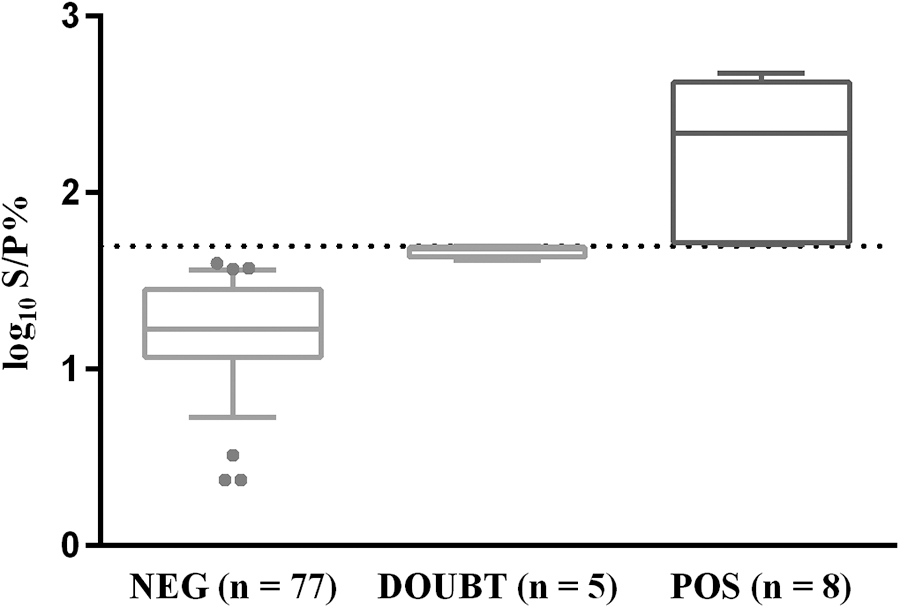
Positivity percentages detected in samples with negative, doubtful, and positive result. Solid line in the box: median; whiskers: 5–95 percentiles; points—outliers. Dotted line represents ELISA cut-off (≥50%). ELISA, enzyme-linked immunosorbent assay.
The estimated overall seroprevalence rate was 8.3% (95% CI: 2.6–14.0) with no significant difference between the two districts [χ 2 (1, N = 90) = 0.32, p = 0.69]. In Sofia, the seropositivity was 7.2% (95% CI: 0.9–13.5), and in Sofia (stolitsa), 11.0% (95% CI: 0–23.0). No association between sex and serological status [χ 2 (1, N = 90) = 1.83, p = 0.27] and age and seropositivity [χ 2 (2, N = 90) = 1.98, p = 0.52] was detected. Furthermore, on a district level, these characteristics were not identified as risk factors for CanL infection. In Sofia, the estimates were as follows: for sex [χ 2 (1, N = 64) = 0.15, p = 1.00] and for age [χ 2 (2, N = 64) = 2.41, p = 0.31]. Similar results were obtained for Sofia (stolitsa): for sex [χ 2 (1, N = 26) = 2.90, p = 0.23]; for age [χ 2 (2, N = 26) = 0.81, p = 1.00]. Since all animals were from mixed breed and all were clinically healthy during the sampling, the effect of these parameters on the seropositivity rate was not examined.
Discussion
In this study, L. infantum antibodies were detected in stray dogs from areas where CanL was not previously reported. The overall seroprevalence rate was 8.3% (95% CI: 2.6–14.0) with no significant difference between the two districts [χ 2 (1, N = 90) = 0.32, p = 0.69]. Over the past 20 years, several studies focusing on CanL have been performed in Bulgaria. In 2004, a serological screening of 202 dogs from 11 endemic and nonendemic districts was conducted, and none of the animals was found seropositive (Tsachev et al., 2007). Subsequently, a second field study performed in 2007 in two endemic districts (Blagoevgrad and Haskovo) detected antibodies in 11.3% of the tested samples with immunofluorescence test (IFAT): 4.7% in animals with clinical manifestation of the infection and 6.6% in asymptomatic dogs (Tsachev, 2009). While the current distribution of CanL in Sofia and Sofia (stolitsa) districts could be classified as low (<15%), the observed seropositivity rates are unexpectedly similar to the seroprevalence measured during 2007 in the endemic areas.
Since information relating to animal movement or their exposure to sandflies was not available, the interpretation of the geographical distribution data should be done with caution. Recently, an entomological survey was conducted in Bulgaria and competent vectors were collected in the Southwest part of the country (Dvorak et al., 2020). Despite the lack of data for sandflies presence in Sofia and Sofia (stolitsa) districts, an expansion in the distribution of the competent vectors to new areas could not be excluded. In Europe, sandflies spread to areas where the vector was not previously detected has been already reported (Ballart et al., 2012; Morosetti et al., 2009). Moreover, the extensive movement of reservoir hosts into new areas may facilitate the expansion in the geographical distribution of the infection. Since parasites are present in the skin of symptomatic and asymptomatic dogs, all dogs, regardless of the clinical manifestation could be considered as a source of infection for the vector population (Reis et al., 2006).
In this study, we were not able to observe association between sex and serological status [χ 2 (1, N = 90) = 1.83, p = 0.27] and age and seropositivity [χ 2 (2, N = 90) = 1.98, p = 0.52]. Currently, published data on the influence of the age on CanL are controversial. Some authors reported that dogs younger than 3 years or older than 8 years are at higher risk of being infected, while others described an increase in the number of affected animals with age (Alvar et al., 2004; Tamponi et al., 2021). In humans, age has been recognized as an important risk factor for L. infantum infection (WHO Expert Committee on the Control of the Leishmaniases and World Health Organization, 2010). Depending on the parasite species and the history of population exposure, different age groups have been reported to be affected. For example, in the Mediterranean region, mostly young children (<5 years) have been affected; however, in recent years, a large number of adult cases have been detected in various European countries (Gradoni et al., 2017; Harizanov et al., 2013).
To identify correctly the risk factors for L. infantum infection, a higher number of animals should be additionally tested and local results should be extrapolated to other areas with caution, after sufficient amount of data has been generated in different canine populations over a longer period of time.
A notably high percentage of positivity was observed among dogs with positive result. S/P% in half of the samples were four times higher than the ELISA cut-off. Although the most successful approach to identify Leishmania-infected dogs is the combination of serology and molecular methods (Miró et al., 2008), serological tests have been employed extensively in epidemiological surveys of L. infantum infections. Among the existing immunological techniques, the most frequently used are the IFAT and the ELISA, both of which are recommended for leishmaniasis surveillance by the World Organization for Animal Health (WOAH, 2021). In addition, the detection of high levels of antibodies (threefold to fourfold increase from the test cut-off) is considered from some experts as conclusive for CanL infection (Solano-Gallego et al., 2011).
Conclusions
CanL is a neglected parasitic disease which is characterized by heterogeneous geographical and temporal distribution. The increased movement of animals and the expansion of vector distribution necessitate timely disease detection in both endemic and nonendemic areas. Detailed, large-scale field studies are imperative for understanding the epidemiology of the CanL and successfully controlling this infection.
Footnotes
Acknowledgments
The authors are grateful to veterinarians collecting samples and animal data.
Authors' Contributions
Conceptualization, writing—original draft, writing—review and editing by G.M.S. Formal analysis, writing—review and editing by S.T.
Ethics Statement
This study was carried out in accordance with the regulation for the implementation of the national program for controlling the population of stray dogs on the territory of the Republic of Bulgaria and for the procedures for its implementation, the mechanism of financing and accountability (April 2021) and the National program for prevention, surveillance, control, and eradication of animal diseases, including zoonoses in the Republic of Bulgaria 2022–2024.
Authors Disclosure Statement
No conflicting financial interests exist.
Funding Information
No funding was received for this article.