




Abstract
Background:
Tuberculosis (TB) is a chronic, zoonotic infectious disease caused by Mycobacterium tuberculosis that infects not only humans but also animals such as pigs, cows, buffaloes, sheep, and goats. Among them, pigs are one of the main food animals in the world. If pigs are infected with M. tuberculosis, meat products will be negatively affected, causing economic losses to the livestock industry. There is currently no systematic epidemiological assessment of swine TB in the world, so it is important to know the prevalence of swine, and these data are currently lacking, so we performed a statistical analysis.
Results:
We searched 6791 articles and finally included data from 35,303 pigs from 15 countries or territories, showing a combined prevalence of TB in pigs of 12.1% (95% confidence interval [CI]: 9.2 to 15.9). Among them, the prevalence rate of swine TB in Europe was 15.2% (95% CI: 11.1 to 20.7, 2491/25,050), which was higher compared with other continents, and the difference was significant; the positive rate of PCR method was higher in the detection method subgroup, which was 15.7% (95% CI: 8.0 to 31.0, 376/2261); Mycobacterium bovis was detected in pigs in the M. tuberculosis typing group (9.5%, 95% CI: 6.7 to 13.5, 1364/21,430). The positive rate is higher compared with Mycobacterium capris.
Conclusion:
This systematic review and meta-analysis is the first to determine the global prevalence of TB in swine herds. Although the seroprevalence of swine TB in this article is very low, the harm of TB cannot be ignored. It is important to take effective control and preventive measures to stop the spread of TB to reduce the impact of diseased pigs on animal husbandry and human health.
Introduction
Tuberculosis (TB) is a chronic, zoonotic bacterial disease mainly caused by Mycobacterium tuberculosis (Ma et al., 2020). TB is transmitted through aerosols, and the route of infection in cattle is usually through inhalation of infected aerosols, which are expelled from the lungs through coughing. Calves can become infected by ingesting colostrum or milk from infected cows. In addition, pigs, sheep, goats, and others can also get sick through this pathway. (Infantes-Lorenzo et al., 2019; Turner and Bothamley, 2015). Animals are generally infected with TB through the digestive tract, and M. tuberculosis and Mycobacterium bovis can cause TB in animals (Barandiaran et al., 2019; Díez-Delgado et al., 2019; Garrido et al., 2010; Ghielmetti et al., 2021). People may become infected by ingesting dairy products from infected cows, or by coming into contact with infected tissues in slaughterhouses or meat shops.
The pathogenic bacteria of TB mainly invade the human lungs to form pulmonary TB. The main symptoms of the disease are cough, sputum, hemoptysis, chest pain, and even life-threatening. The characteristics of M. bovis are transmitted to humans through ingestion of infected milk. Therefore, historically, the lesions of M. bovis in humans have mainly been extrapulmonary or intestinal. In contrast, cattle infected with M. bovis typically have lung infections, and M. bovis may shed through respiratory secretions (Orcau et al., 2011). In 2014, the 67th World Health Assembly endorsed the World Health Organization (WHO) Strategy to Eliminate Tuberculosis (TB): Assembling a broader approach to ending the TB epidemic as a major public health challenge, 2016–2035.
According to the WHO, about 1.4 million people died of this disease in 2019, which is one of the top 10 causes of death worldwide, and now ranks first among bacterial infections (Huang et al., 2019; Khan et al., 2019). Pigs are the spillover host of TB in animals. Once the disease occurs, it is difficult to distinguish whether they have the disease only from clinical symptoms (Barandiaran et al., 2015b). Pulmonary TB is found at necropsy of dead pigs, and most organs of sick pigs are destroyed by bacteria, especially the lungs and lymph nodes, showing typical granulomatous inflammation and caseous tuberculous nodular lesions (Parra et al., 2003).
Sick pigs can be transmitted to their keepers through sputum, mucus, feces, genital secretions, or abortion, which indicates that close contact between humans and pigs may promote the transmission of TB between humans and animals (Arega et al., 2013; Brown et al., 2018; Pesciaroli et al., 2014). Pig TB can appear together with pig viral diseases, but it is generally difficult to find TB together with other viral diseases because of the improved immune procedures in pig farms. African warthog (a kind of wild boar) and wild or domestic cloven-hoofed animals use the same water source or eat the same grassland, which will greatly increase the possibility of animals suffering from various diseases (Kock et al., 2021).
Wild boar serum samples were collected in a park belonging to the control area of African swine fever virus (ASFV). It was found that not only was ASFV reactive antibody detected in most samples but also M. bovis-positive reaction was found (Neiffer et al., 2021). In 1960, United Kingdom killed a large number of farm animals (pigs, cattle, and sheep) due to infection with classical swine fever virus (CSF), Newcastle disease virus NDV, foot and mouth disease (FMD), and bovine tuberculosis (bTB), reducing the impact of mutual transmission (Peiso et al., 2011).
In the DNA vaccine inoculation against FMD, Aujeszky's disease (AjD), and CSF diseases, BCG-DNA was used as an adjuvant for injection. The results showed that the co-delivery of BCG-DNA enhanced the induction of antigen-specific humoral immunity and cell-mediated immunity. Therefore, the DNA vaccine with BCG-DNA as an adjuvant enhanced the immune response to the three pig diseases, and inhibited the phenomenon that TB occurred together with other diseases in the pig population (Zhang et al., 2005). Pigs are the main farmed species in the livestock industry, accounting for 37% of global meat production in 2016, according to the Food and Agriculture Organization of the United Nations (FAO). The EU pig industry produced an average of 23.1 billion kilograms of pork annually between 2014 and 2017 (Niemi et al., 2020).
Pigs are not only a delicacy on the table, biologically, the genetic diversity of pig breeds can also be increased through crossbreeding. When sick pigs are found on the farm, they must be isolated separately for harmless treatment. If harmless treatment is not carried out in time, it will increase the risk of TB in pig farms. Therefore, we need to study the risk factors affecting swine TB for better control. To the best of our knowledge, the overall seroprevalence of swine TB and factors associated with infection have not previously been analyzed worldwide. Therefore, a systematic review and meta-analysis was performed to analyze the overall seroprevalence of swine TB and to assess its association with swine TB. Potential risk factors related to prevention.
Materials and Methods
Search strategy
We searched all swine TB studies from inception to May 24, 2021, through six databases, PubMed, Web of Science, Science Direct, Wanfang, VIP, and CNKI. This study uses the corresponding English keywords or titles for retrieval.
First, connect the “Swine” and free words in the PubMed database through the Boolean operator “OR” to construct a search A: ((((((“Swine”[Mesh]) OR (Suidae)) OR (Pigs)) OR (Warthogs)) OR (Wart Hogs)) OR (Hog, Wart)) OR (Pig, Wart)) OR (Wart Hogs)) OR (Phacochoerus).
Then use the Boolean operator “OR” to connect “Tuberculosis” and free words to create search B: ((((((((“Tuberculosis” [Mesh]) OR (Tuberculoses)) OR (Kochs disease)) OR (Koch's disease)) OR (Koch disease)) OR (Mycobacterium tuberculosis infection)) or (infection, Mycobacterium tuberculosis)) OR (infection, Mycobacterium tuberculosis)) OR (Mycobacterium tuberculosis infection).
Finally, use the Boolean operator “AND” to search for research that satisfies both search formula A and search formula B: (((((((((“Swine”[Mesh]) OR (Suidae)) OR (Pigs)) OR (Warthogs)) OR (Wart Hogs)) OR (Hog, Wart)) OR (Hogs, Wart)) OR (Wart Hog)) OR (Phacochoerus)) AND (((((((((“Tuberculosis”[Mesh]) OR (Tuberculoses)) OR (Kochs Disease)) OR (Koch's Disease)) OR (Koch Disease)) OR (Mycobacterium tuberculosis Infection)) OR (Infection, Mycobacterium tuberculosis)) OR (Infections, Mycobacterium tuberculosis)) OR (Mycobacterium tuberculosis Infections)).
In the Science Direct database, we searched for relevant articles using the keywords “Pig,” “Mycobacterium tuberculosis,” and “Prevalence.” The Web of Science database was also searched using the same subject terms as the Science Direct database. In CNKI, Wanfang, and VIP databases, we all searched using the subject headings “Pig” (Chinese) and “Tuberculosis” (Chinese), and the three Chinese databases used subject headings or synonyms to expand retrieval articles, and we also stated our search policy and search restrictions.
Articles searched in the six databases meeting the following criteria will be included: The research object is pigs; The purpose of the study is to investigate the seroprevalence of swine TB; The data must include the number of pigs examined and the number of TB-positive pigs; The research reports are articles published in Chinese or English.
Articles that met the following criteria in the six databases were excluded:
Non-TB infection;
Data error;
The article information is incomplete;
The species is not a pig;
Animals that have been infected;
The article is repeated;
Overview.
Data extraction and quality assessment
We extracted key information and risk factors from studies that met our inclusion criteria and used Microsoft® Excel® 2019 to collect and organize data (Ni et al., 2020) (Supplementary Table S2). The data were recorded as follows: country, region, sampling year, detection method, TB type, age, sex, sample, geographical factors, and species. Among them, we classified pigs less than or equal to 1 year old as piglets, pigs between 1 and 2 years old as juveniles, and pigs older than 2 years as adult pigs. The articles were grouped according to region, sample, detection method, M. tuberculosis typing, sex, and age of pigs.
We evaluated the quality of the included studies on a scale of 0–5 points. If the corresponding conditions are met, 1 point will be added. The following items are all 1 point: random sampling, whether the detection method is clear, whether the adopted method is clear, sampling time, four or more factors.
Statistical analysis
We performed a statistical analysis of data with R software, using five methods (PRAW, PLN, PLOGIT, PAS, and PFT) to transform the data to be more normally distributed (Table 1) (Barendregt et al., 2013; Kock et al., 2021). To investigate whether the included search articles were significantly heterogeneous, we used the degree of heterogeneity between included studies assessed by the χ Qtest and I 2 as the basis for the effect model. We used Egger's test, sensitivity analysis, funnel plot, and trim fill analysis to analyze the stability and bias of included articles. Forest plots provide a simple and intuitive visual description of results by depicting combined effect sizes and confidence intervals (CIs) for multiple studies (Li et al., 2020). The funnel plot can visually see the degree of conversion, and the symmetry of the funnel plot can be used to judge publication bias and heterogeneity.
Normal Distribution Test for the Normal Rate and the Different Conversion of the Normal Rate
“PRAW”: original rate; “PLN”: logarithmic conversion; “PLOGIT”: logit transformation; “PAS”: arcsine transformation; “PFT”: double-arcsine transformation; “NaN”: meaningless number; “NA”: missing data.
When the funnel plot is asymmetrical, it indicates poor stability and high heterogeneity. Egger's test evaluation is denoted by the letter “p,” when p ≤ 0.05, there is significant publication bias, and when p ≤ 0.05, there is no publication bias (Assefa and Bihon, 2019). Complementary method is used to evaluate the impact of publication bias on the results. If the impact on the results is small, it means that the authenticity is good, and if the impact is large, the data are not statistically significant. The cut and fill method uses an iterative algorithm to make the funnel plot symmetrical to the left and right, to further determine the stability of results. Finally, we used sensitivity analysis and repeated meta-analysis to analyze the impact of each included article on the results, and finally deleted the articles that did not meet the criteria (Supplementary Table S3).
The test of heterogeneity was carried out by subgroup analysis and regression analysis, and the factors investigated included region (Europe vs. six other continents); year of sampling (sampling year <2000, 2001–2014, >2015); detection method (enzyme-linked immunosorbent assay [ELISA], PCR, Tuberculin test, and Bacteriological test); source of collected samples (serum vs. tissue); gender (female vs. male); age (piglet vs. juveniles vs. adult); and M. tuberculosis typing (M. bovis vs. Mycobacterium capris) (Supplementary Figs. S1–S11).
Results
We retrieved a total of 7025 articles from 6 databases, deleted 234 duplicate articles, and screened the remaining 6791 articles according to the inclusion and exclusion criteria, and finally performed data extraction on 46 articles that met the criteria (Fig. 1). These articles were found from 15 countries, including 3 countries in Africa; 2 countries in Asia; 7 countries in Europe; 1 country in North America; 1 country in Oceania; and 1 country in South America (Tables 2 and 3).
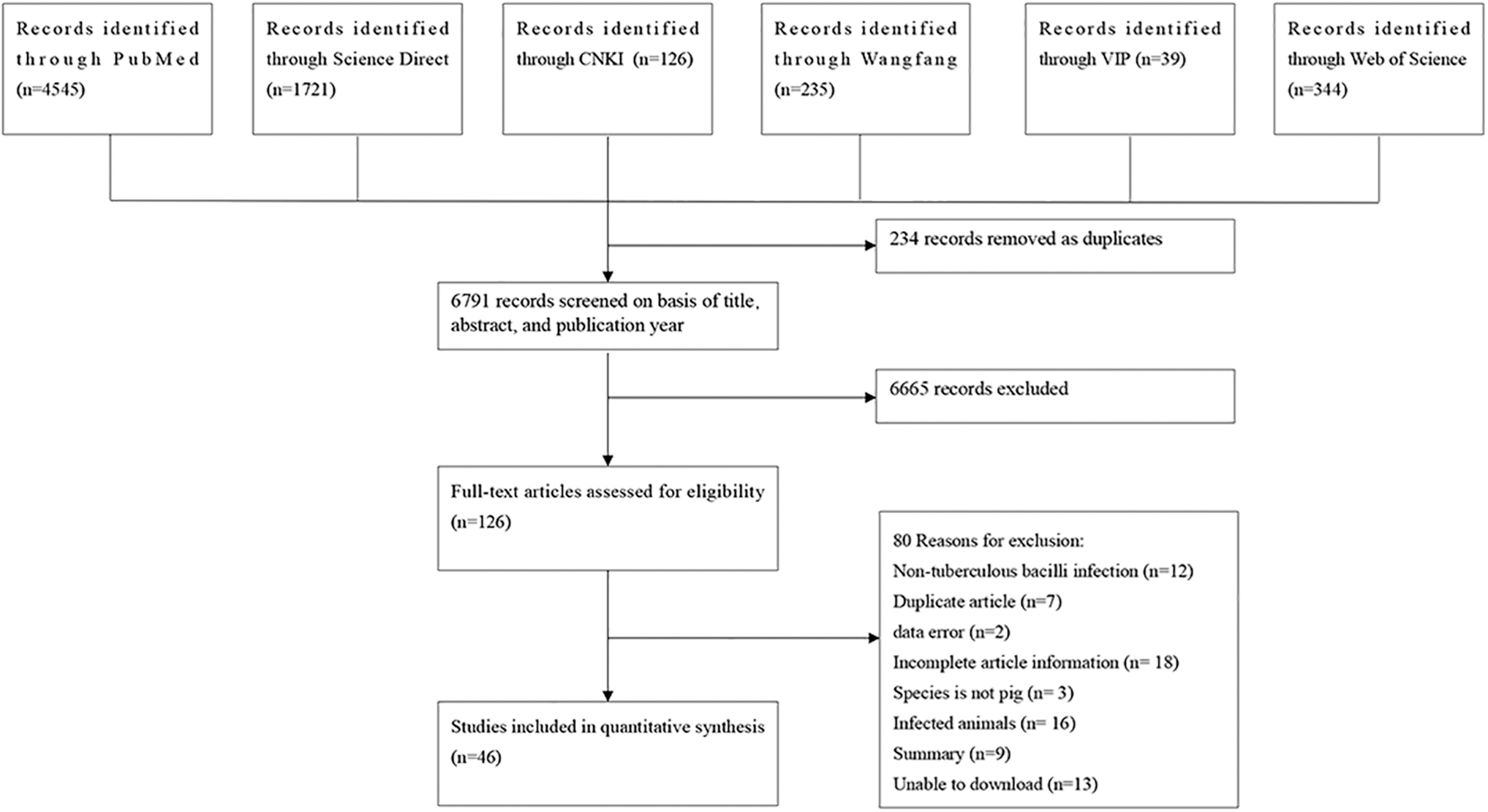
The selection process showing inclusion and exclusion of studies.
World Swine Tuberculosis Infection Included in Studies
ELISA, enzyme-linked immunosorbent assay; UN, unclear.
Estimates of the Combined Seroprevalence of Swine Tuberculosis in the World
Publication bias assessment
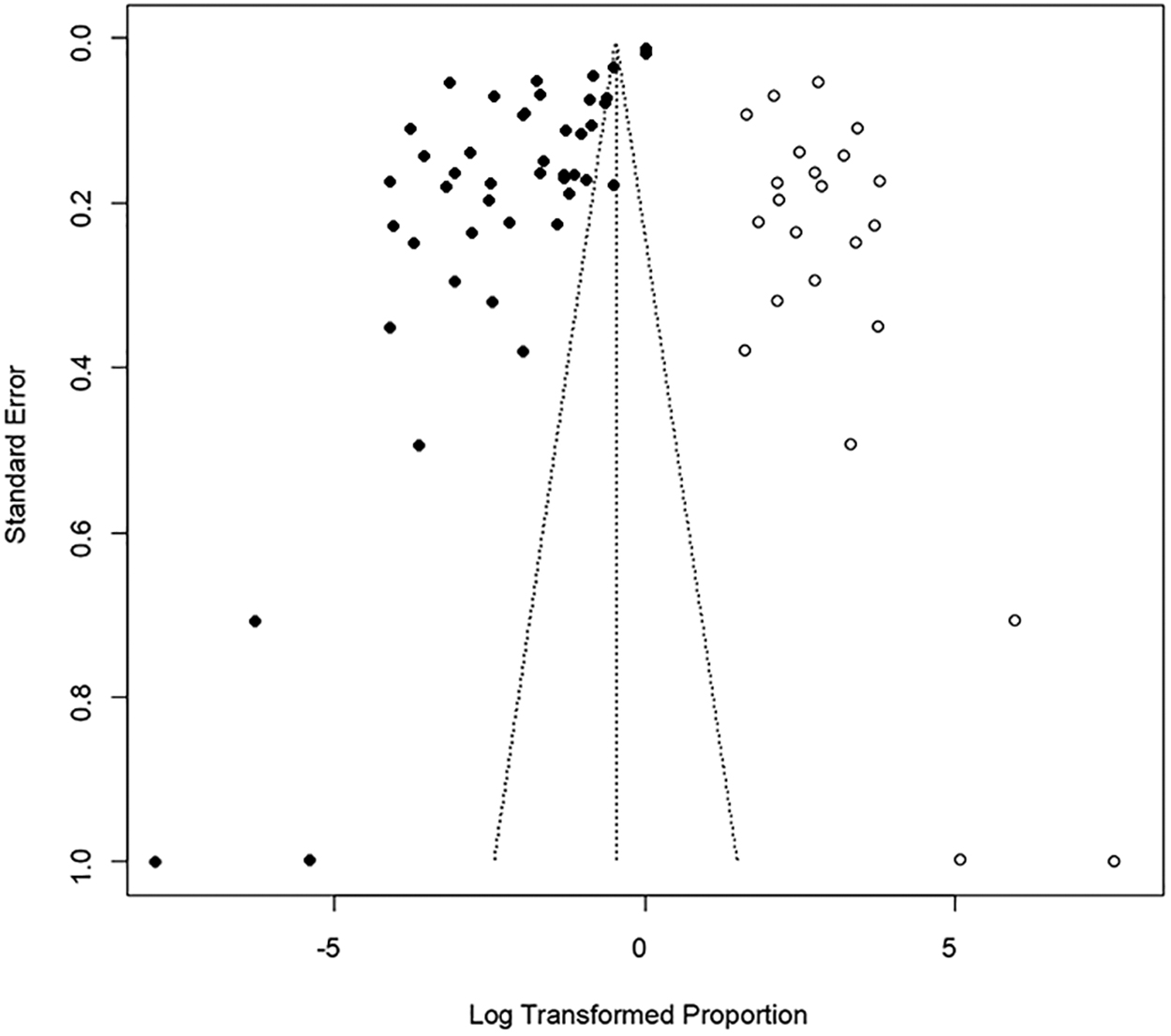
By sinusoidally transforming the data, the results of the PFT transform were found to be close to a normal distribution, so the combined results of the PFT transform were used for meta-analysis (Table 1). Publication bias of selected articles was assessed using a funnel plot (Fig. 2) and visualized by a forest plot (Fig. 3), and finally confirmed with Egger's test results (p = 1.751e-09, t = −7.559) (Fig. 4 and Supplementary Table S1). In our own study, cut and fill analysis showed no publication bias (Fig. 5). Removing the results of one study from the sensitivity analysis had little effect on the others, suggesting that our meta-analysis was trustworthy (Fig. 6).
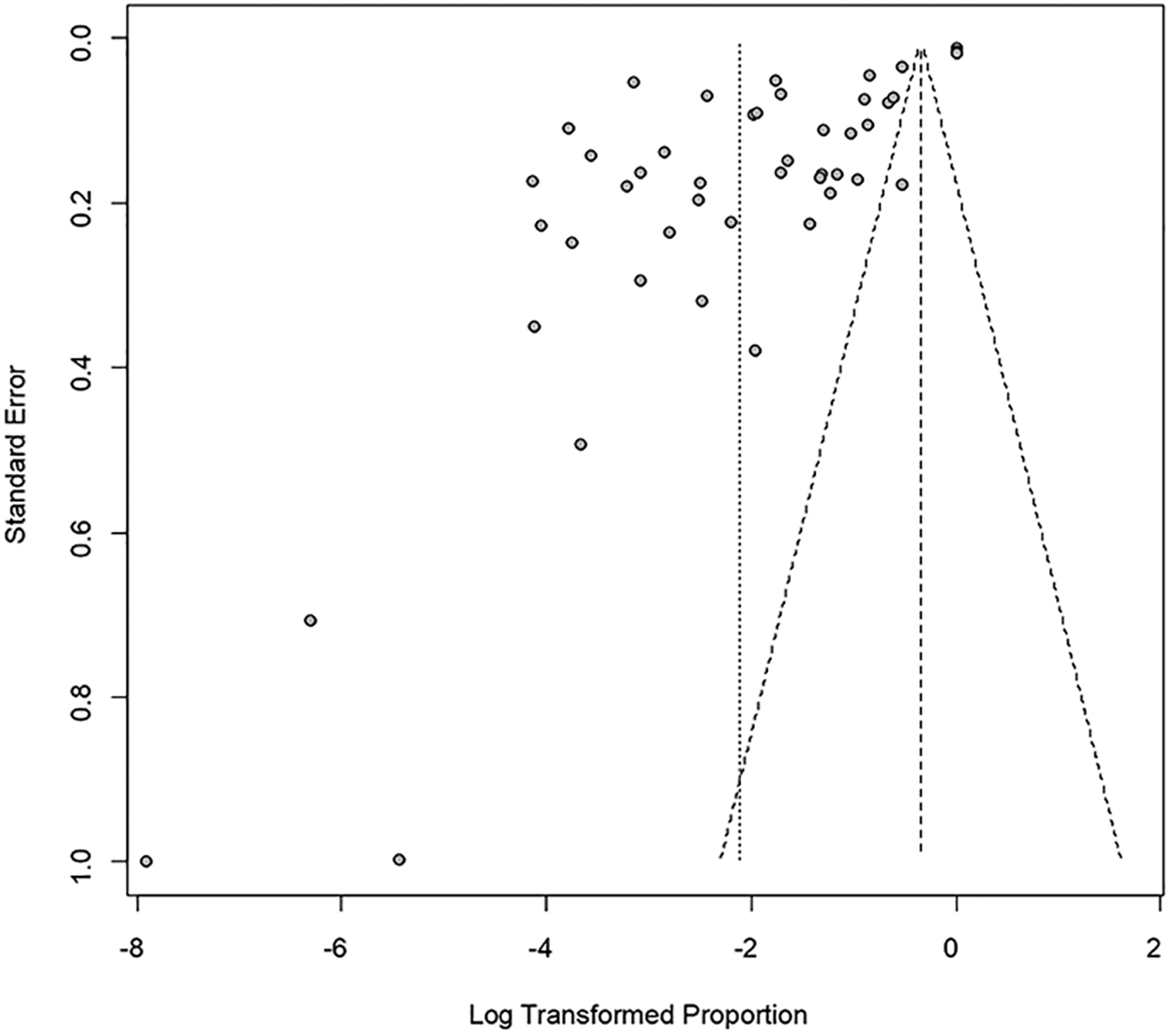
Publication bias of studies by funnel plot.
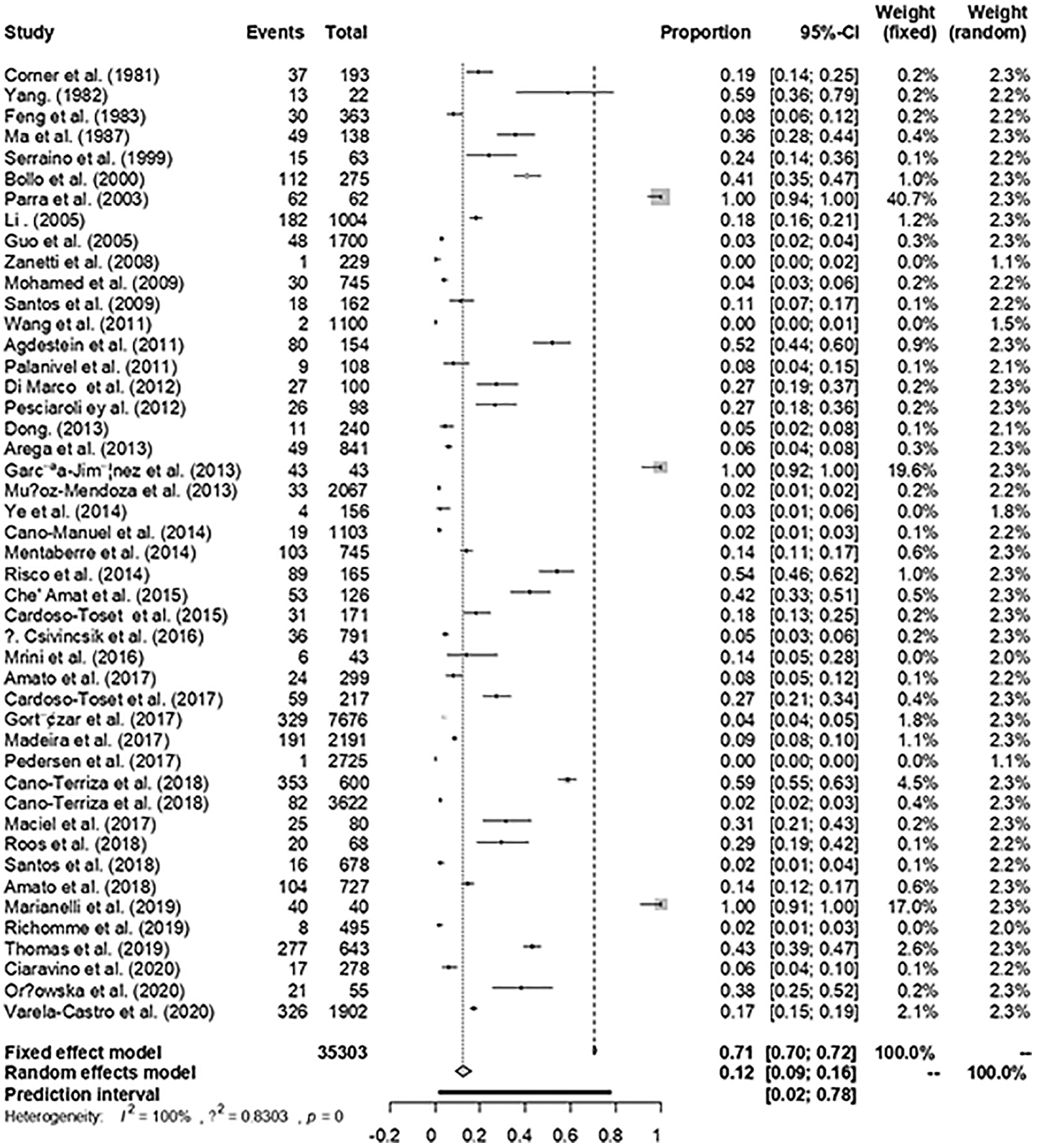
Forest map showing publication bias.
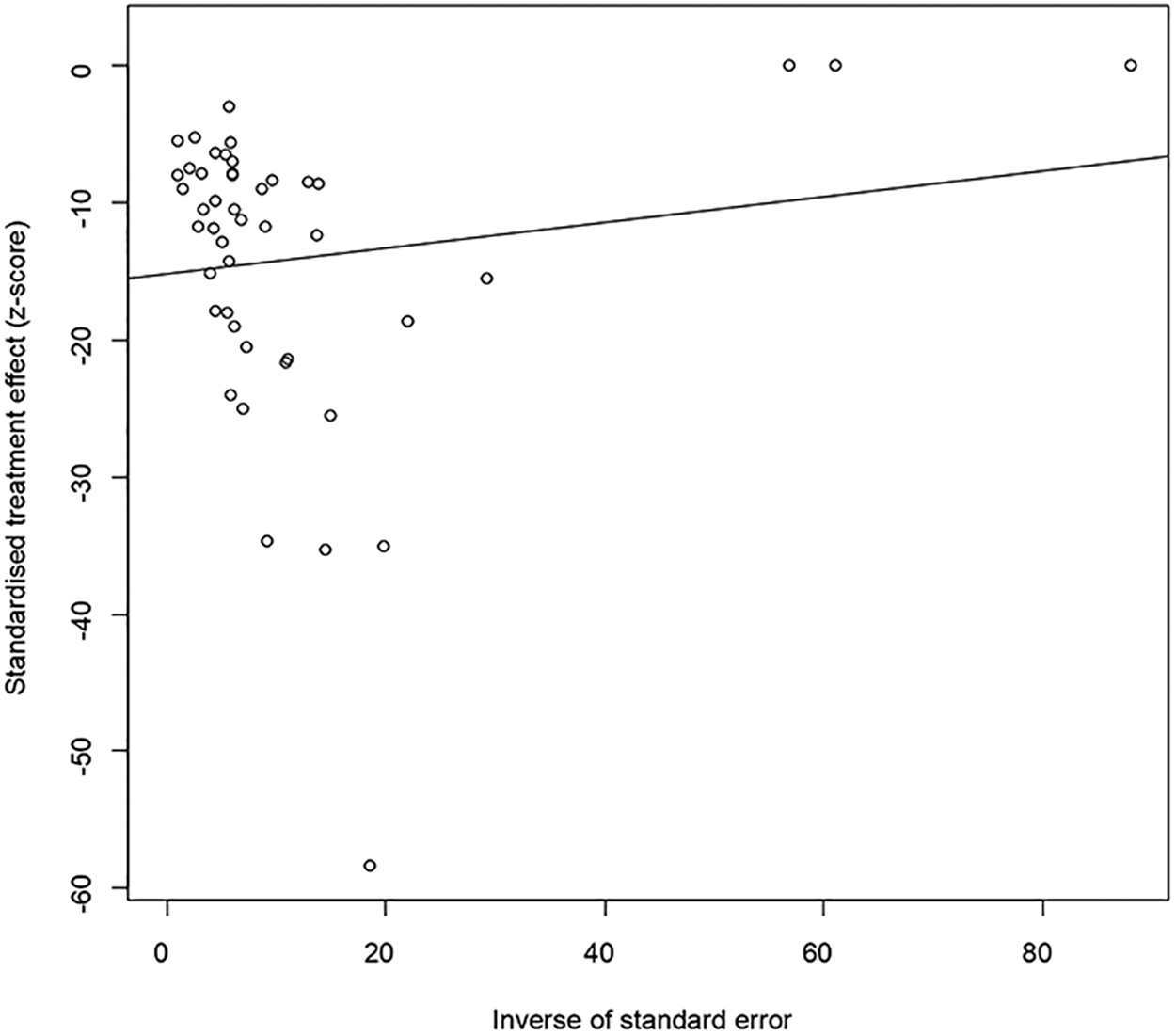
Egger's plot showing publication bias.
Publication bias of studies by cut and fill analysis.

Sensitivity analysis.
Meta-analysis
We screened 6791 articles from our database search, and ultimately 46 articles were eligible for inclusion. Of these 35,303 pigs tested for TB, 3,111 were positive, a positivity rate of 12.1% (95% CI: 9.2 to 15.9) (Fig. 1 and Table 4). In the regional subgroup analysis, the prevalence of swine TB in Europe was 15.2% (95% CI: 11.1 to 20.7, 2491/25,050), which was relatively higher than the other five continents; the prevalence of TB was higher at 52.0% (95% CI: 44.6 to 60.5, 80/154) (Table 4).
Summary of Swine Tuberculosis Prevalence in the World
Area: Africa: Egypt, Ethiopia, Morocco; Asia: China, India; Europe: Italy, Spain, Portugal, France, Poland; North America: United States; Oceania: Australia; South America: Brazil.
CI, confidence interval.
As can be seen from Table 4, the prevalence of swine TB after 2015 in the sampling years (15.9%, 95% CI: 4.8 to 53.2, 416/4583) was higher than that before 2000 (26.4%, 95% CI: 12.1 to 57.6, 170/723) and the 2001–2014 group (8.1%, 95% CI: 4.4 to 15.0, 1079/15,230). The prevalence of TB in boars by sex (10.9%, 95% CI: 7.4 to 16.0, 248/1971) was almost the same as in sows (10.4%, 95% CI: 6.2 to 17.4, 367/3599) (Table 4). Among age groups, the highest prevalence of TB was 25.8% (95% CI: 9.6 to 69.5, 138/688) in pigs older than 2 years of age (Table 4).
In pig breed subgroup analysis, breeding pigs (18.6%, 95% CI: 9.7 to 35.7, 721/7903) had the highest prevalence of TB, and wild boars had the lowest (14.3%, 95% CI: 9.8 to 21.0, 2155/20,539) (Table 4). In terms of sampling method, PCR (15.7%, 95% CI: 8.0 to 31.0, 376/2261) was more commonly used to detect swine TB (Table 4). In the sampling method grouping, the prevalence of pig tissue was 14.3% (95% CI: 10.4 to 19.7, 1442/17,433) higher compared with serum 9.9% (95% CI: 5.3 to 18.5, 1212/11,714) (Table 4).
From Table 4, it can be found that among the M. tuberculosis subgroups, M. bovis has the highest positive rate in pigs (9.5%, 95% CI: 6.7 to 13.5, 1364/21,430), while the positive rate of Mycobacterium capris was lowest at 4.2% (95% CI: 1.1 to 15.3, 118/4278). In the quality score grouping, articles with scores 2–3 (12.2%, 95% CI: 8.6 to 17.3, 2368/26,191) had a higher prevalence of swine TB than those with scores 4–5 (11.0%, 95% CI: 5.5 to 21.8, 743/9112) (Table 4).
Discussion
TB, confirmed by bacteriologist Robert Koch in 1882, was incurable in the 17th and 18th centuries and caused massive deaths in humans and animals (Orgeur and Brosch, 2018). As a serious zoonotic disease, it seriously threatens the world public health problem. TB is an important emerging disease in animals in many parts of the world (Bollo et al., 2000). Swine TB was first discovered in the 1930s. Pigs are usually infected with TB through the digestive tract (Fredriksson-Ahomaa et al., 2020).
When pigs get TB, the sick pigs show symptoms such as increased body temperature, loss of appetite, difficulty breathing, and frequent coughing (Di Marco et al., 2012). Today, pork accounts for a high proportion of the world's meat products. If pigs suffer from TB, it may affect global meat production and bring serious losses to the world economy. Therefore, it is necessary to master the epidemiology of swine TB and lay the foundation for the prevention and treatment of swine TB.
We searched all articles on the swine TB epidemic from 1966 to 2020, covering 34,508 pigs in 15 countries on 6 continents. Among the regional subgroups, the prevalence of swine TB was highest in South America and lowest in North America, with significant differences between groups (p < 0.05). Cattle are the main reservoir for M. bovis infection, but in European countries, mixed breeding of cattle and pigs is common, where pigs are infected from the cow's milk, dairy products, or offal when living with domestic pigs, so the incidence in pig herds may be related to cattle (Pesciaroli et al., 2014).
In addition, studies have shown that historical dynamics of wild boar populations are closely related to interspecies contact rates and incidence of bTB (Naranjo et al., 2008; Nugent et al., 2002). Killing diseased wild boars for harmless treatment not only reduces the incidence of TB in wild boars but also reduces the prevalence of the disease in the region and its regional species. In Spain, when the number of wild boars in a region is reduced by half, the prevalence of TB in that region is reduced by 21–48% (Delahay et al., 2002). In Portugal, pigs have been shown to be the sustaining host of bTB, and pigs may be widely exposed to their susceptible M. bovis and Mycobacterium capris by eating the carcasses of other animals, resulting in the epidemic of TB in a certain area (Gortazar et al., 2011; Yockney et al., 2013).
The study found that in hunting areas, hunters who regularly hunt wild boar will be more susceptible to TB than the average person. Ordinary people have close contact with infected pigs or eat infected pork products through factors such as dietary habits and economic changes, which may increase the probability of zoonotic transmission to humans (Coburn et al., 2005). To sum up, to reduce the regional TB prevalence, cattle and pigs should be kept separately, and the monitoring of pig TB should be strengthened at the same time.
Statistics show that the global swine TB infection rate before 2000 was higher than that from 2001 to 2014, and after 2015, and there was no significant difference. The possible reason is that in 2000, the League of Nations organized the tuberculosis Alliance to strengthen the prevention and control of tuberculosis, reduce the risk of human tuberculosis, and reduce the risk of animal to human transmission when breeders feed animals. In 2014, the 67th World Health Assembly approved the WHO Strategy to eliminate TB (Dirlikov et al., 2015; Zumla et al., 2015). To strengthen the prevention and control of TB in the world, block the mutual transmission between people and susceptible animals, inhibit the susceptibility of people to TB, reduce the prevalence of TB in animals, and finally bring TB under better control after 2000.
The assays included in the included articles were PCR, ELISA, tuberculin test, and bacteriology. Among them, the positive rate of PCR method was the highest, and the positive rate of ELISA method was the lowest. Possibly because the PCR method can detect a small number of mycobacterial cells directly on the specimen within 5–10 h, PCR is more suitable for the detection of mycobacteria in the laboratory and is considered to be an efficient, highly sensitive, and specific diagnosis tool (Agdestein et al., 2011; Bollo et al., 2000). And ELISA test must meet the requirements of biosafety level 3 laboratory or above, which is difficult to achieve in many countries in the world.
However, no significant difference was found between the various detection methods in our study, among which the positive rate of tuberculin test and bacteriology test is about the same. Tuberculin test is susceptible to injection technique and measurement error factors and may be different from other non-tuberculous mycobacteria cross-reactivity (Thomas et al., 2019). Although the bacteriology method can be used as an important means for epidemiological and veterinary public health research, and it can more accurately assess the prevalence of swine TB than pathological testing, this method lacks sensitivity. Therefore, bacterial culture in clinical samples cannot be considered the gold standard for the diagnosis of mycobacterial infection (Mohamed et al., 2009; Pesciaroli et al., 2012). To improve the sensitivity and accuracy of the detection, we recommend a combination of PCR and ELISA for TB detection.
Among age subgroups, the prevalence of TB in pigs older than 2 years was higher than that in pigs younger than 1 year and between 1 and 2 years of age. This is in line with the trend in the world that adult animals are more susceptible to disease than juveniles (Sipos, 2019). Changes in the living environment have led to further contact with potentially diseased animals during long-distance foraging of adult wild boars (Chambers, 2013; Garrido et al., 2011; Varela-Castro et al., 2020).
Studies have reported that adult boars can move up to 120–150 km2, and sows can move 40–60 km2 (Santos et al., 2009); because of its extensive range of activities and the decline of autoimmune function (Poonsuk and Zimmerman, 2018), it cannot resist large-scale pathogen invasion, providing opportunities for M. tuberculosis to invade body organs, and may eventually develop into diseased pigs (Lekko et al., 2021). Therefore, we should reduce the migration between animals, and timely prevention, monitoring, and disinfection within a limited range can not only detect and block the spread of TB in time but also save unnecessary economic losses.
In sex subgroups, we found no significant difference in TB prevalence in boars and sows. When boars and sows are in the same rearing environment, such as mixed breeding pig herds with underdeveloped agriculture in Ethiopian, feeding unhygienic feeds may cause pigs to carry pathogenic bacteria during the transfer process (Abdu and Gashaw, 2011).
The ingestion of water or food contaminated with Mycobacteria by boars can be transmitted to sows through aerosols, resulting in the infection of sows with M. tuberculosis, which may lead to clustered outbreaks of TB (Hambolu et al., 2013; Müller et al., 2013). During the transmission of TB, sick sows can infect piglets through vertical transmission. Conversely, when immune-compromised piglets have TB, sucking the milk of the lactating sow increases the risk of the sow (Che’ Amat et al., 2015). To reduce the prevalence of swine TB, pigs of different genders should be reared in different zones, the density of the pens should be adjusted reasonably, and the food should be fed with safety standards.
In the sample subgroup, although prevalence by histopathology was higher than serum prevalence, there was no significant difference between them. The higher prevalence of histopathological examination may be due to the fact that swine histopathological examination can observe the etiology of lesions and can characterize the epidemiology of infection (Bollo et al., 2000), However, it cannot be ignored that there is a large human error in the inspection of diseased tissue by tissue samples, which may greatly underestimate the prevalence of TB (Santos et al., 2009). This method can only initially determine whether there is M. tuberculosis infection, and tissue samples can lay the foundation for subsequent bacteriological culture, and further type the identified M. tuberculosis. It has been reported that serological testing has been proposed as a screening tool for the detection of infected pig herds (Che’ Amat et al., 2015).
Compared with pathological tissue testing, serological testing can sample live animals, and its cheapness and ease of operation are one of its advantages, and it is conducive to large-scale testing (Beerli et al., 2015). Based on the limitations of the included articles, it can only be seen from the side that pathological tissue detection is more widely used than serological detection, but this does not represent a trend of future sample collection.
In the M. tuberculosis typing subgroup, we found that the included articles mainly involved two species of M. tuberculosis, Mycobacterium capris and M. bovis. In general, genotyping of M. tuberculosis provides a clearer understanding of the epidemiology of swine TB and a faster and more timely surveillance assessment of swine TB. Mycobacterium capris was first discovered in 2003 (Aranaz et al., 2003). In 2004, Erler pointed out that there were reports of wild boar infection with Mycobacterium capris in Central European countries, and the pathogen of Mycobacterium capris could make the effluent of sick pigs more infectious (Erler et al., 2004).
Studies have shown that wild boar is more susceptible to Mycobacterium capris than M. bovis in Central European countries, and the pathogen of Mycobacterium capris could make the effluent of sick pigs more infectious (Erler et al., 2004). Studies have shown that wild boar is more susceptible to Mycobacterium capris than M. bovis (García-Jiménez et al., 2013a). M. bovis can spread among animals and humans, and cross-infection between humans and animals to cause human TB. Although M. bovis mainly causes bTB, pigs are a common reservoir for M. bovis TB in most regions and have important public health implications (Clausi et al., 2021; Gortazar and Cowan, 2013; Richomme et al., 2019). Cattle are the main reservoir of TB, and M. bovis has been detected in diseased pigs, most likely in cases where cattle are co-housed with pigs (Barandiaran et al., 2015a; Hardstaff et al., 2014).
In our article, it was found that M. bovis was 9.5% more common in sick pigs. When there is a potential risk of disease in cattle, pigs as a maintenance host and the same water source as the herd or living in the same environment will cause TB (García-Jiménez et al., 2013b; García-Jiménez et al., 2013c; Mentaberre et al., 2014). Studies in Argentina have shown that the chance of bTB being diagnosed is inversely proportional to the number of sows, and that this trend is related to the density of cattle populations. That is, for each additional sow on the farm, the odds of bTB are reduced by 0.6%, but the odds of bTB on cattle farms are tripled (Barandiaran et al., 2021). Therefore, contact between different animal species can be minimized when necessary to further reduce the prevalence of TB.
In pig breed taxonomic subgroups, the prevalence of TB in finishing pigs is higher than in wild boars and they are not significantly different. Possible reasons are that fattening pigs often share pasture with cattle and sheep, and seasonal migrations in summer and winter increase the likelihood of TB within and between species (Di Marco et al., 2012; Marianelli et al., 2019). Compared with finishing pigs, the living environment of wild boars is more free and broad.
When finishing pigs living in a closed environment have potential risks of disease, the closed environment may cause the finishing pigs to present a higher probability of disease through factors such as aerosols (Thomas et al., 2019). However, studies have shown that there are multiple and continuous contacts between species, and both bred pigs and wild boars will likely become the maintenance host of TB (Amato et al., 2017). Feeding of finishing pigs should reduce its contact with other species and reduce the use of antibiotics according to local conditions (Zhong et al., 2017).
Intensive farming and free-range farming are two breeding modes of pigs. The prevalence of free-range farming in the subgroup of farming modes is higher compared with intensive farming, but there is no significant difference between the two. Possibly intensive farming is more common in middle and higher developed countries, where 92% of pork in United Kingdom comes from around 1600 farms with guaranteed intensive farming (Niemi et al., 2020). The establishment of a health classification system for the Finnish pig industry can cover about 90% of intensive farming. In the farm, daily inspection of pigs and reporting of the health status of cattle on the same farm can be carried out to monitor the health status of pigs in time.
Free-range pigs without overcrowding, pens, and supplementary feeding have a lower density of pigs, but free-range pigs have access to more animals than in intensive farming, and because TB is mainly transmitted through the respiratory tract, when there is a certain imbalance between animals and animals or between animals and the environment, sanitation or poor supervision of animals leads to outbreaks of TB in groups that will affect animal health and animal meat product supply and marketing problems (Acevedo et al., 2014; Vicente et al., 2007). In the future farming model, we recommend intensive farming, as it is easy to manage, can control the dynamics of pig health in time, and reduce the incidence of TB, and also should implement an active epidemiological surveillance program in the slaughterhouse.
Our systematic review and meta-analysis may have some limitations. First, we collected several different terms on swine TB in our chosen database, but many of these articles were not eligible for admission. Second, we have found almost no research on swine TB in countries around the world, and some countries and regions have few reports or small sample sizes, so it is difficult to objectively and accurately determine the true incidence of the disease. Third, only articles in English and Chinese were included in the articles, which may cause articles in other languages to be ignored, thus affecting the results.
Fourth, the quality of included articles was mixed, and the prevalence of swine TB in all regions could not be fully reflected, and more testing was needed. Finally, some of the included articles were not informative and the data were incomplete for a full analysis. For example, our systematic reviews and meta-analyses did not analyze seasons. The novelty of this article is that before collecting data, our article has searched six databases in materials and methods for epidemiological analysis of pig TB, and found that no one has written it, so we will write epidemiological analysis of pig TB.
Conclusion
Our meta-analysis shows that TB can cause a serious epidemic of pigs in the world. To improve public health, appropriate management and monitoring measures must be taken for swine TB infection. TB infection is affected by the type and feeding mode of pigs. At the same time, it is necessary to maintain proper feeding density and improve intensive farming on farms. Since the research we included only involves data of the single infection rate of pig TB, and does not involve the co-infection rate with other pig diseases, we suggest that no matter what kind of species, when detecting TB, we can also detect whether there are other related diseases, or we can take the co-infection of TB and a disease as the inclusion condition for epidemiological meta-analysis. The meta-analysis provides epidemiological data and theoretical basis for the formulation of TB prevention and control plan.
Ethical Statement
Not applicable.
Data Availability
We confirm that we have included citations of available data in the References section, unless the article type is exempt. The data can be made available upon reasonable request from the Corresponding author.
Consent to Publication (Not Applicable)
W.Z., N.-C.D., Q.W., C.-Y.W., N.S., J.-Y.Y., T.T., K.S., and R.D., all the above authors agree to publish “Worldwide swine tuberculosis seroprevalence and associated risk factors, 1966–2020: a systematic review and meta-analysis” on BMC.
Footnotes
Acknowledgments
We thank the scientists and personnel of the College of Chinese Medicine Materials and the College of Animal Science and Technology, Jilin Agricultural University, for their collaboration.
Authors' Contributions
R.D. and K.S. contributed to the conception and design of this analysis. T.T., J.-Y.Y., and N.S. independently extracted and recorded data from each selected study. Q.W. conducted the statistical analysis. W.Z. prepared the article. C.-Y.W. and N.-C.D. revised the article. All the authors reviewed and approved the final article.
Author Disclosure Statement
The authors declare that the research was conducted in the absence of any commercial or financial relationship that could be construed as a potential conflict of interest.
Funding Information
This work was funded by the National Key R&D Plan (2018YFD0500900).
Supplementary Material
Supplementary Figure S1
Supplementary Figure S2
Supplementary Figure S3
Supplementary Figure S4
Supplementary Figure S5
Supplementary Figure S6
Supplementary Figure S7
Supplementary Figure S8
Supplementary Figure S9
Supplementary Figure S10
Supplementary Figure S11
Supplementary Table S1
Supplementary Table S2
Supplementary Table S3
References
Supplementary Material
Please find the following supplemental material available below.
For Open Access articles published under a Creative Commons License, all supplemental material carries the same license as the article it is associated with.
For non-Open Access articles published, all supplemental material carries a non-exclusive license, and permission requests for re-use of supplemental material or any part of supplemental material shall be sent directly to the copyright owner as specified in the copyright notice associated with the article.
