




Abstract
Background:
The potential molluscicidal extracts, obtained from indigenous plants Cannabis sativa, Acacia nilotica, and Tinospora cordifolia, were tested for toxicity against freshwater pulmonate snail Lymnaea acuminata, an intermediate host of Fasciola hepatica. The organic extracts had a significant effect on young snails.
Materials and Methods:
All organic extracts and column-purified fractions gave median lethal concentrations (19–100.05 mg/L; 24 h) that fell well within the threshold level of 100 mg/L, set for a potential molluscicide by the World Health Organization.
Results:
The toxicity of T. cordifolia stem acetone extract (96 h LC50: 16.08 mg/L) was more pronounced compared with C. sativa leaf ethanol extract (96 h LC50: 16.32 mg/L) and A. nilotica leaf ethanol extract (96 h LC50: 24.78 mg/L). β-caryophyllene, gallic acid, and berberine were characterized and identified as active molluscicidal components. Co-migration of β-caryophyllene (retardation factor [Rf] 0.95), gallic acid (Rf 0.30), and berberine (Rf 0.23) with column-purified parts of Cannabis sativa, Acacia nilotica, and Tinospora cordifolia on thin-layer chromatography demonstrates same Rf value, that is, 0.95, 0.30, and 0.23, respectively.
Conclusion:
This study indicates that these extracts thus represent potential plant-derived molluscicides that are worthy of further investigations.
Introduction
Fascioliasis, a parasitic disease of animals as well as human beings, is widespread in tropical and subtropical countries and caused by trematodes Fasciola hepatica and Fasciola gigantica (Singh et al., 2012). Pulmonate snail Lymnaea acuminata serves as intermediate hosts for Fasciola spp. (Mas-Coma et al., 2005). Fascioliasis causes great economic losses to cattle, water buffalo, sheep, and goat farmers across the world (Portugaliza et al., 2019; Singh et al., 2012). The disease affects animal conditions and production is reduced (Mazeri et al., 2017). Human fascioliasis is reported worldwide and characterized by abdominal pain, hypereosinophilia, and exceptionally acute pancreatitis (Echenique-Elizondo et al., 2005; Fürst et al., 2012; Yattoo et al., 2021).
One of the possible solutions to control fasciolosis is to disrupt the life cycle of Fasciola by killing the intermediate host snails below the threshold level (Singh et al., 2012). Out of several methods to eliminate the snail population, one method of choice is the application of commercially available synthetic molluscicides. However, the high cost of synthetic molluscicides and their negative impacts on the environment, including their toxicity to nontarget organisms like fish, as well as the development of snail resistance to these compounds have given a new impetus to the study of eco-friendly and cost-effective molluscicides of plant origin (Adetunji and Salawu, 2010).
A previous study by the authors demonstrated the lethal action of aqueous extracts of indigenous plants Cannabis sativa, Acacia nilotica, and Tinospora cordifolia against the snail Lymnaea acuminata (Singh and Singh, 2023) (Tables 1 –4). This study has the objectives to evaluate the potential molluscicidal activities of organic extracts of these plant parts and identification of active phytoconstituents responsible for toxicity.
Concentration of Different Plant Products and Their Active Components Used for Toxicity Determination Against Lymnaea acuminata
Toxicity of Cannabis sativa Leaf, Organic Solvent Extracts, Column-Purified Fraction, and β-Caryophyllene (Active Component) Against Snail Lymnaea acuminata at Different Exposure Periods
Mortality was determined every 24 h up to 96 h. Each set of experiment was replicated six times.
Significant negative regression (p < 0.05) was observed between exposure time and LC50 of treatments.
aq., aqueous; LCL, lower confidence limit; UCL, upper confidence limit.
Toxicity of Acacia nilotica Leaf, Organic Solvent Extracts, Column-Purified Fraction, and Gallic Acid (Active Component) Against Snail Lymnaea acuminata at Different Exposure Periods
Mortality was determined every 24 h up to 96 h. Each set of experiment was replicate six times.
Significant negative regression (p < 0.05) was observed between exposure time and LC50 of treatments.
Toxicity of Tinospora cordifolia Stem, Organic Solvent Extracts, Column-Purified Fraction, and Berberine (Active Component) Against Snail Lymnaea acuminata at Different Exposure Periods
Mortality was determined every 24 h up to 96 h. Each set of experiment was replicate six times.
Significant negative regression (p < 0.05) was observed between exposure time and LC50 of treatments.
Materials and Methods
The experiment was carried out in the Malacology laboratory, Department of Zoology, D.D.U. Gorakhpur University, Gorakhpur.
Plants used
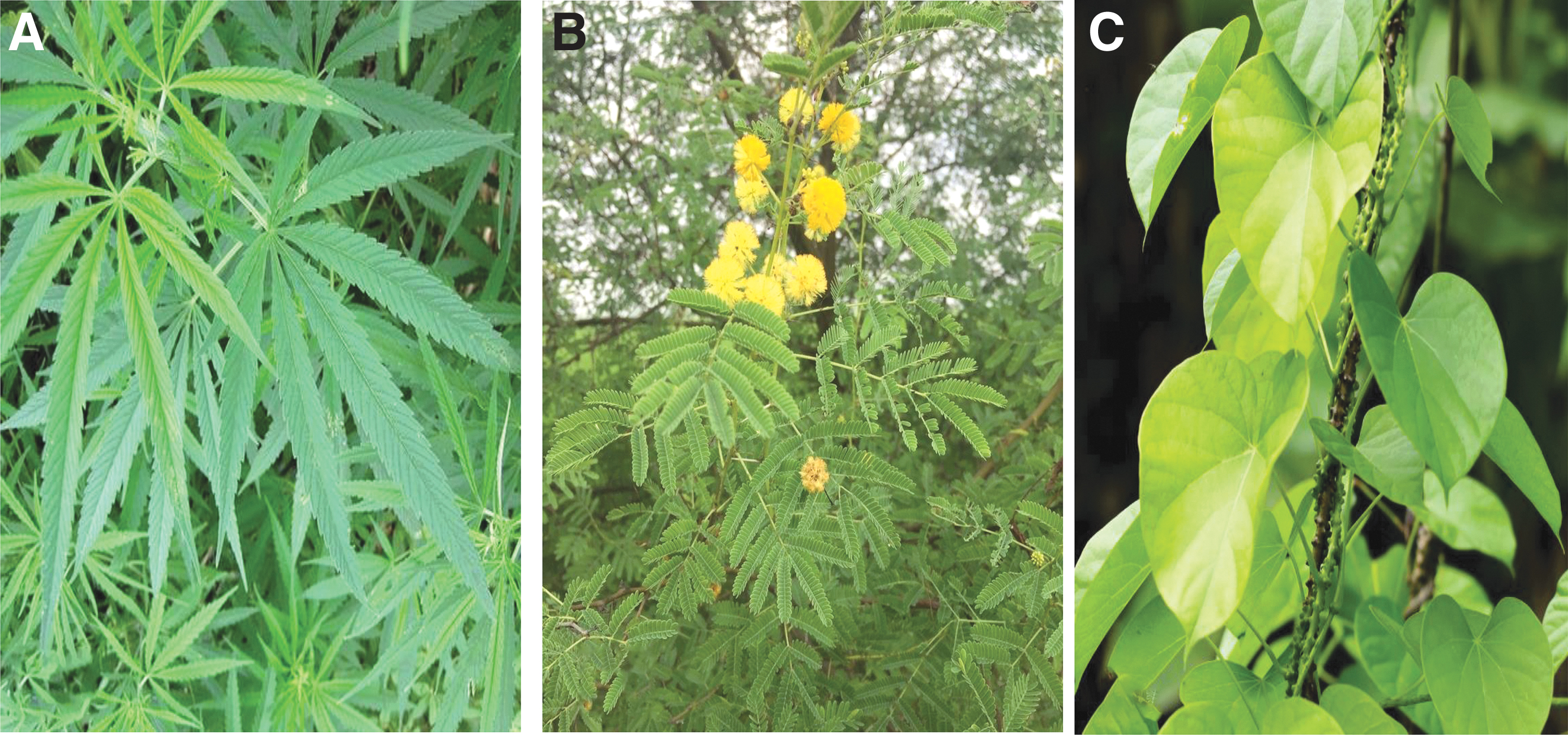
Fresh aerial parts of Cannabis sativa (leaf), Acacia nilotica (leaf), and Tinospora cordifolia (stem) (Fig. 1) were collected from local areas and identified by the Department of Botany, DDU Gorakhpur University, Gorakhpur, India. Plant parts were washed thoroughly, shade dried, and pulverized separately in the electric grinder, and the crude powders obtained were then sieved with the help of fine mesh cloth. These fine powders were used separately for toxicity experiments.
Solvent extraction
Fifty grams of C. sativa (leaf), A. nilotica (leaf), and T. cordifolia (stem) was extracted separately with 100 mL of each solvent viz. chloroform (99%), acetone (99%), and ethanol (95%) at room temperature for 24 h. Each preparation was filtered through Whatman No.1 filter paper and the filtrates were subsequently evaporated under a vacuum (Jaiswal and Singh, 2008). The residues, thus obtained, were used for the determination of molluscicidal activity.
Column purification
One hundred milliliters of Cannabis sativa leaf ethanol extract, Acacia nilotica leaf ethanol extract, and Tinospora cordifolia stem ethanol extract was subjected to silica gel (60–120 mesh, Qualigens glass, Precious Electro Chemindus Private Limited, Mumbai, India) chromatography through 95 × 45 cm column. Fifty-five fractions of C. sativa were eluted with methanol (95%) and 55 fractions of A. nilotica and Tinospora cordifolia were eluted with ethanol (95%). Solvents were evaporated under a vacuum and the remaining solids thus obtained were used for determination of molluscicidal activity of each fraction.
Thin-layer chromatography
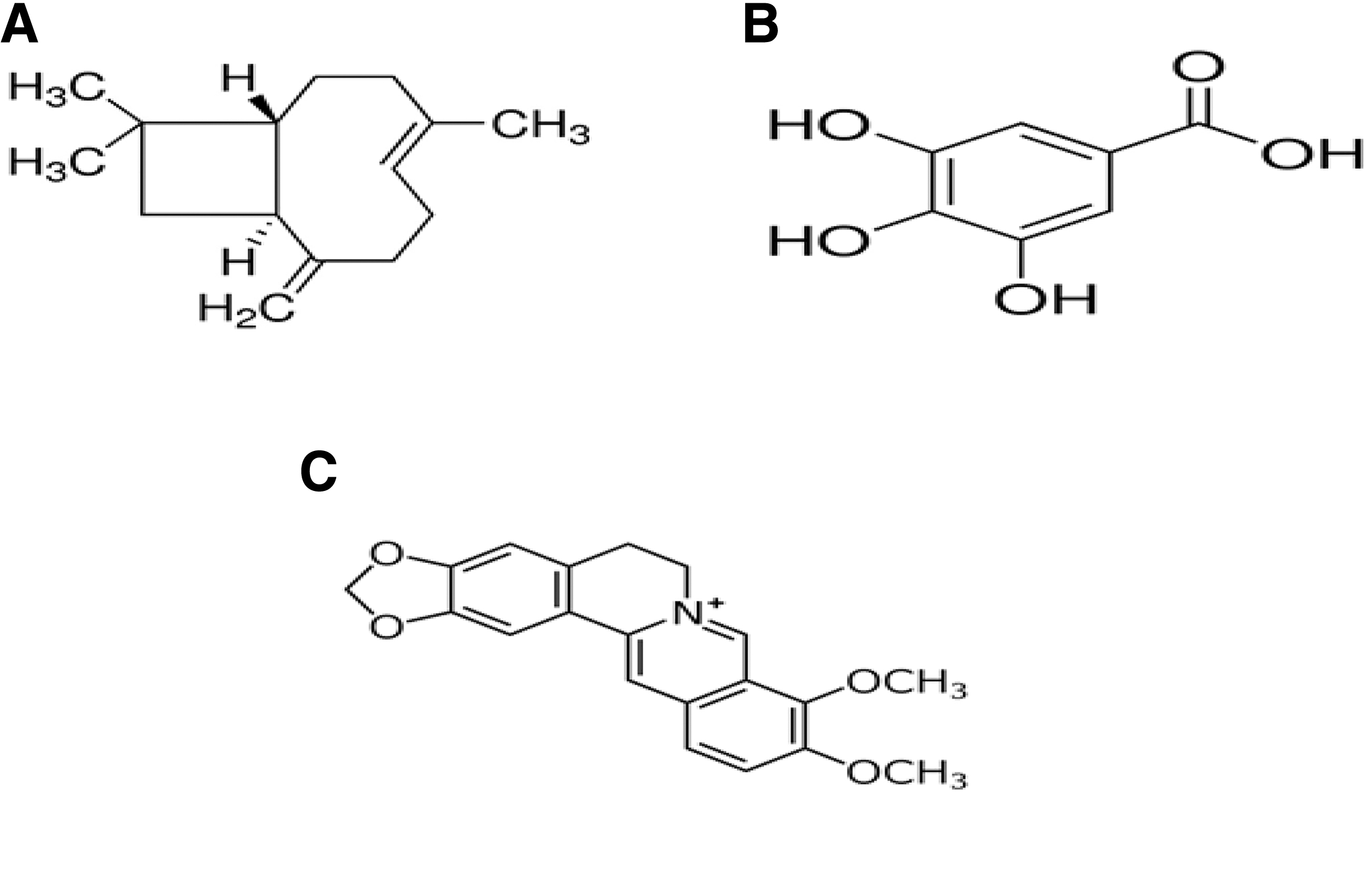
Thin-layer chromatography (TLC) was performed by the method of Singh and Singh (1995) with some modifications to identify the active component present in C. sativa leaf, A. nilotica leaf, and T. cordifolia stem extracts. TLC was done on 20 × 20 cm of precoated silica gel (Precious Electrochemical Industry Pvt. Ltd., Mumbai, India). For C. sativa, the solvent n-hexane/ethyl acetate (3:1 v:v) was used as the mobile phase, and the solvent benzene/ethyl acetate (9:1 v:v) was used as the mobile phase for A. nilotica and T. cordifolia. Spots of column-purified fractions of C. sativa leaf, A. nilotica leaf, and T. cordifolia stem extracts, along with their respective active components β-caryophyllene, gallic acid, and berberine (Fig. 2), were applied on TLC plates with the help of a micropipette. Furthermore, the TLC plates were developed by spraying fast blue reagent for C. sativa and iodine vapor for A. nilotica and T. cordifolia. The plates were immediately traced to create copies of the chromatogram, after which the retardation factor (Rf) was determined.
Pure compound
β-caryophyllene (1R,4E,9S)-4,11,11-trimethyl-8-methylidenebicyclo[7.2.0]undec-4-ene), gallic acid (3,4,5-Trihydroxybenzoic acid), and berberine (9,10-Dimethoxy-7,8,13,13a-tetradehydro-2′H-[1,3]dioxolo[4′,5′:2,3]berbin-7-ium) were procured from Sigma Aldrich Chemicals Private Limited, Maharashtra, India.
Animal collection
Adult and healthy Lymnaea acuminata (1.35 ± 0.2 cm in length) were collected from freshwater ponds of Gorakhpur District, Uttar Pradesh, India, and were acclimatized for 72 h in the laboratory conditions. Ten snails were then allocated to each experimental group and immersed in 3 L dechlorinated tap water (23 ± 1°C). The pH, free carbon dioxide, dissolved oxygen, and bicarbonate alkalinity were 7.1–7.3, 5.2–6.3, 6.6–7.3, and 102–104 mg/L, respectively. The dead snails were removed from the aquariums to avoid any contamination.
Toxicity experiment
Concentration–response relationship
The toxicity experiments were performed by the method of Singh and Singh (2023). Ten snails were kept in a glass aquarium containing 3 L of dechlorinated tap water and were exposed continuously for 96 h to different concentrations of C. sativa leaf, A. nilotica leaf, and T. cordifolia stem extracts (Table 1). The experiment was set up in six replicates. Negative control was set up under similar conditions without any treatment. Mortality of snails was recorded at intervals of 24 h up to 96 h and death of the snails was determined and confirmed by lack of any movement and lack of reaction to irritation of foot with needle probe to elicit typical withdrawal movements and contraction of their body in the shell.
Statistical analysis (p < 0.05)
The LC50 values, lower confidence limits, upper confidence limits, slope values, and heterogeneity factor, were calculated by polo software program (PoLo Plus LeOra software version 2.0).
Results
The toxicity of different organic solvent extracts of C. sativa leaf, A. nilotica leaf, and T. cordifolia stem was time and concentration dependent. The number of deaths among L. acuminata snails treated with organic solvent extracts, column-purified fractions, and pure compounds increased with increased treatment concentrations (Figs. 3 –5). The calculated values of LC50 of organic extracts and column-purified fractions of all three plant species against adult Lymnaea acuminata are given in Tables 2–4. T. cordifolia stem acetone extract was found to be most promising after 96 h of exposure (LC50 16.08 mg/L). The values indicate that the C. sativa leaf ethanol extract (24 h LC50: 30.43 mg/L), A. nilotica leaf ethanol extract (24 h LC50: 53.59 mg/L), and T. cordifolia stem acetone extract (24 h LC50: 29.67 mg/L) were more toxic in comparison to other organic extracts (Tables 2–4). The column-purified fractions of these plants were highly toxic. The 96-h LC50 of the column-purified fraction of T. cordifolia (9.49 mg/L) was higher compared with C. sativa (9.80 mg/L) and A. nilotica (12.39 mg/L) (Tables 2–4). The 96-h LC50 of β-caryophyllene, gallic acid, and berberine was 3.47, 6.10, and 7.42 mg/L, respectively. TLC analysis demonstrated that the Rf values of β-caryophyllene (0.95) were equivalent to the Rf value of the column-purified fraction of C. sativa (0.95), gallic acid (0.30) was equivalent to the Rf value of the column-purified fraction of A. nilotica (0.30), and berberine (0.23) was equivalent to the Rf value of the column-purified fraction of T. cordifolia (0.23). Mortality rates in snail L. acuminata were over 40% for each treatment and highest mortality rate recorded for T. cordifolia leaf acetone extract (98.3%) (Table 5).

Average mortality of snail Lymnaea acuminata on exposure of different solvent extracts, column-purified fraction of C. sativa leaf and active component β-caryophyllene.
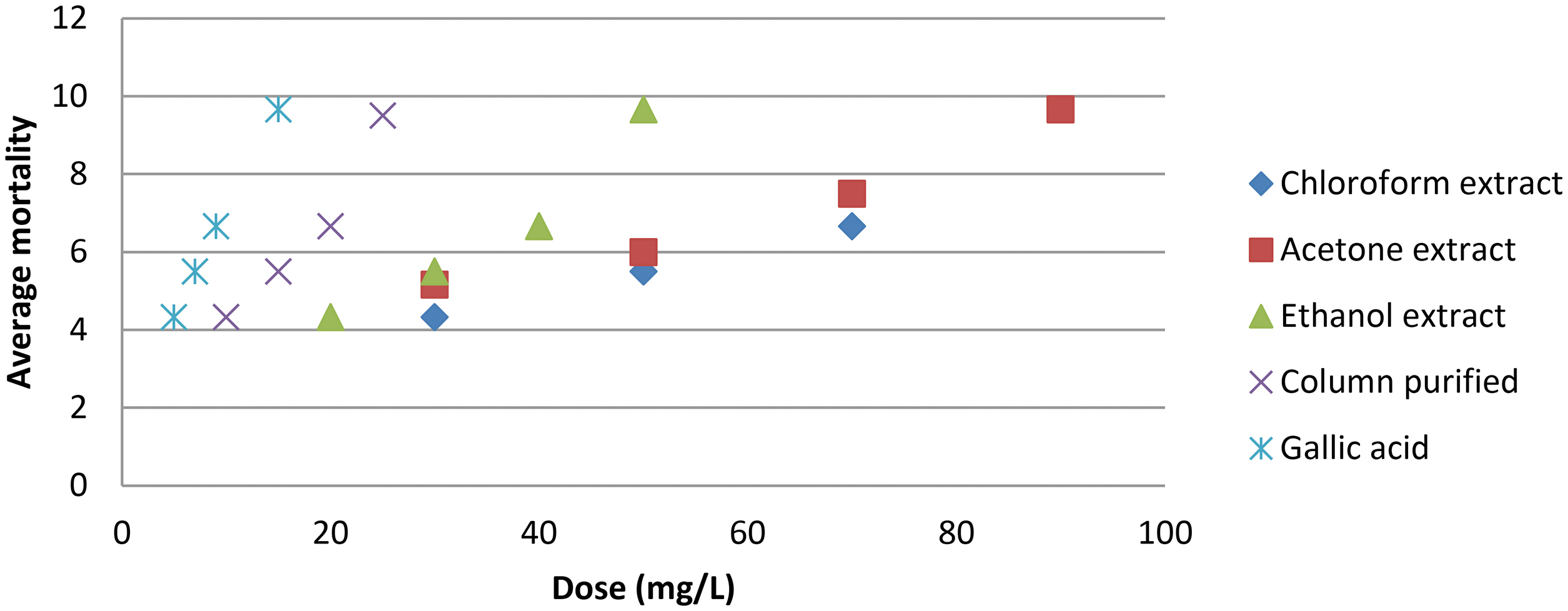
Average mortality of snail L. acuminata on exposure of different solvent extracts, column-purified fraction of A. nilotica leaf and active component gallic acid.

Average mortality of snail L. acuminata on exposure of different solvent extracts, column-purified fraction of T. cordifolia stem, and active component berberine.
Molluscicidal Activity of Indigenous Plant Extracts and Their Active Components on Lymnaea acuminata After 96 h Exposure
All data in the table are mean of six replicates (n = 10). Values in parentheses are treatment dose in mg/L.
The slope values given in Tables 2–4 were steep. Based on each of the six replicates, the separate estimates of LC values were found to be within the 95% confidence limit of LC50. The heterogeneity factor was less than 1.0, the t-ratio was higher than 1.96, and the g-value was <0.5 at all probability levels (90, 95, and 99). There was a significant negative regression (p < 0.05) between exposure time and the LC50 of exposures (Table 2–4).
Discussion
Sustainable control of fascioliasis requires that the life cycle of Fasciola hepatica should be interrupted by killing the intermediate host snails. Niclosamide, trifenmorph, bayluscide, and the other synthetic molluscicides currently in use to control the aquatic host snails and larvae of Fasciola spp. are toxic to nontarget organisms like fish and very expensive, and resistance to snails is highly probable (Marston and Hostettmann, 1985). Plant molluscicides may serve as cheap and biodegradable, effective alternatives to synthetic molluscicides and may be obtained as crude extracts.
This study clearly demonstrates that C. sativa leaf extracts, A. nilotica leaf extracts, and T. cordifolia stem extracts are potent molluscicides, and mortality caused by all the plant preparations was time and concentration dependent. There was a negative regression between LC values and exposure time. The toxicity of purified preparations of all three plants against L. acuminata is in the range of a potent molluscicide that is less than the threshold of 100 mg/L, set for a potential molluscicide by the World Health Organization (WHO) (Wei et al., 2002). Among all the organic solvent extracts, the higher toxicity of ethanol extracts of C. sativa leaf and A. nilotica leaf and acetone extracts of T. cordifolia stem indicate that the active molluscicidal components are soluble in ethanol and acetone, respectively, than other organic solvents.
Molluscicidal activity of C. sativa, A. nilotica, and T. cordifolia is due to the presence of β-caryophyllene, gallic acid, and berberine, as evident from individual toxicity and identification by TLC. Earlier, it was reported that β-caryophyllene is a potent molluscicide (Bedini et al., 2016). The pharmacological and biological effects of β-caryophyllene as an antiviral against Zika virus (Sobrinho et al., 2021); (Astani et al., 2011)
Anti-inflammatory, antioxidant, antibacterial, anticancer, and antifungal activities of A. nilotica have been reported (Banso, 2009; Rather and Mohammad, 2015; Sadiq et al., 2017). Most of the biological activities of A. nilotica extracts are due to tannis (Sadiq et al., 2015). Different biological activities of T. cordifolia, such as antiviral infections, anticancer, antidiabetes, inflammation, neurological, and immunomodulatory effects in human beings, have been reported (Gupta and Sharma, 2011; Jagetia and Rao, 2006; Patel et al., 2009).
A comparison of the molluscicidal activity of β-caryophyllene, gallic acid, and berberine active components present in C. sativa, A. nilotica, and T. cordifolia, respectively, with synthetic molluscicides clearly demonstrates that these components are more potent against L. acuminata. Ninety-six-hour LC50 of β-caryophyllene (3.47 mg/L), gallic acid (6.10 mg/L), and berberine (7.42 mg/L) are lower than those of synthetic molluscicides niclosamide (11.8 mg/L), carbaryl (14.40 mg/L), formothion (8.56 mg/L), and phorate (15.0 mg/L) (Singh et al., 2012).
Conclusion
The study findings suggest that the crude extracts, organic solvent extracts, and bioactive fractions of indigenous plants C. sativa, A. nilotica, and T. cordifolia have the potential to be used as molluscicides against the snail Lymnaea acuminata. This study discovered the potentiality of indigenous plants as cost-effective and eco-friendly molluscicides, and the results revealed that the molluscicides from plants are a better substitute for costly and harmful synthetic molluscicides. Further investigations are required to reveal the mode of action of these phytoconstituents responsible for the toxicity.
Footnotes
Authors' Contributions
V.K.S.: Supervision, conceptualization, methodology, software, reviewing, and editing. N.V.S.: Data curation, writing- original draft preparation, visualization, and investigation.
Author Disclosure Statement
No conflicting financial interests exist.
Funding Information
No funding was received for this article.